

Green Card for E-2 Visa Holders: Strategic Pathways to Permanent Residency in 2026
- Gianni Mendes Toniutti, Esq.

- 1 day ago
- 12 min read
What if the treaty-based investment that built your American dream is actually the barrier preventing you from making it permanent? For many entrepreneurs, the E-2 visa feels like a precarious bridge where the requirement to maintain non-immigrant intent often conflicts with the natural desire for a lasting legacy. Securing a Green Card for E-2 visa holders is not a simple conversion; it's a strategic pivot that demands a sophisticated understanding of cross-border legal frameworks and meticulous timing.
You likely recognize the complexity of transitioning a boutique investment into a high-threshold category like the EB-5, or the growing anxiety surrounding 2026 English proficiency standards for specific operational roles. We'll show you how to navigate these hurdles with precision. This article reveals the precise legal pathways and timing strategies required to move from temporary status to permanent residency. We'll explore four viable categories, the implications of the 90-day rule for adjustment of status, and the expert legal coordination needed to protect your international interests while building a permanent home in the United States.
Table of Contents
The E-2 Visa and the Permanent Residency Paradox
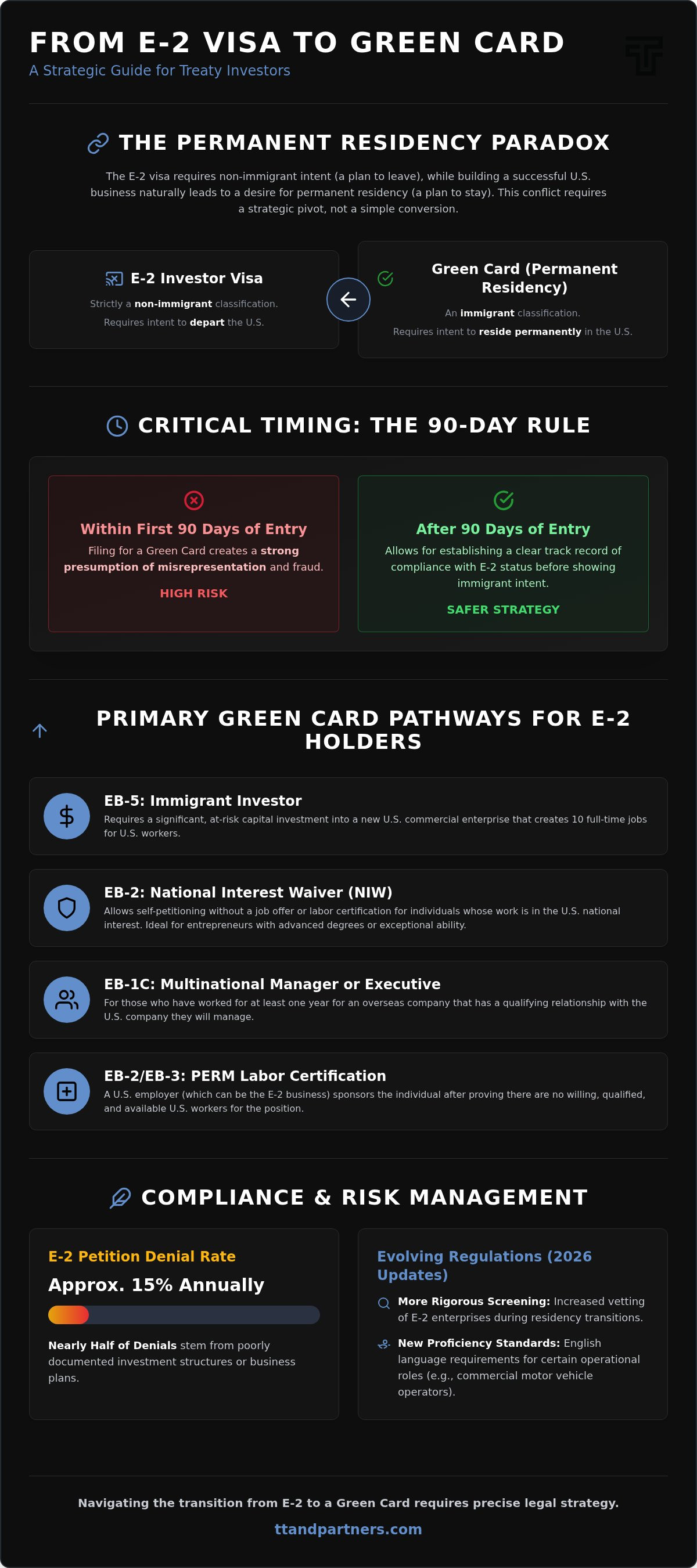
Success in the American market often begins with the E-2 Investor Visa, a category that grants entry based on substantial capital investment from treaty nations. While this status provides a robust foundation for building a business, it carries a fundamental legal constraint: it's strictly a non-immigrant classification. This creates what we call the permanent residency paradox. The law requires you to maintain an intent to depart the United States upon the expiration of your status, yet the natural progression of a successful enterprise often leads toward a desire for permanent residency.
Transitioning to a Green Card for E-2 visa holders isn't a matter of simple conversion. There's no automated process to upgrade your status. Instead, it's a strategic pivot to an entirely different legal framework, such as the EB-5 or EB-2 categories. The primary challenge lies in managing your intent during this transition. If USCIS believes you entered on an E-2 with a pre-existing plan to file for residency, you risk a denial based on misrepresentation. This is why a strategic legal partner is essential when moving from temporary to permanent status.
The Non-Immigrant Intent Requirement
Under Section 214(b) of the Immigration and Nationality Act, every applicant is presumed to have immigrant intent until they prove otherwise. For E-2 holders, this means demonstrating ties to their home country. While an O-1 visa doesn't require maintaining a foreign residence, the E-2 is less flexible. Filing for a Green Card too early in your E-2 lifecycle; specifically within the first 90 days of entry; can trigger a presumption of fraud. This guideline, known as the 90-day rule, remains a critical hurdle for investors who don't time their status adjustments with professional precision.
The Evolution of E-2 Regulations in 2026
The regulatory landscape has tightened significantly as of mid-2026. USCIS alerts issued earlier this year introduced more rigorous screening and vetting processes for treaty investors. One notable shift involves new English proficiency standards for certain operational roles, specifically those involving commercial motor vehicle operators. Maintaining strict compliance isn't just about keeping your current visa; it's about preserving your eligibility for future residency. Current data from USCIS indicates that approximately 15% of E-2 petitions are denied annually. Nearly half of these denials stem from poorly documented investment structures. A flawed foundation today can permanently block your pathway to a Green Card for E-2 visa holders tomorrow.
Navigating Dual Intent and Status Adjustments
The legal reality of dual intent for treaty investors is often misunderstood. While H-1B and L-1 visas are explicitly designed for dual intent, the E-2 is technically a single-intent category. However, the law doesn't forbid you from having an ultimate desire to stay; it only requires that your current intent is to depart when your status ends. USCIS views the transition to a Green Card for E-2 visa holders as a pivot that must be documented with extreme care to avoid allegations of fraud. This nuance is where many self-filed applications fail, as they don't adequately distinguish between long-term goals and immediate compliance.
The 90-Day Rule and Timing Strategy
The 90-day rule is a guideline used by the Department of State to assess whether a non-immigrant misrepresented their intent upon entry. Filing an I-140 petition or an I-485 application within three months of arriving on an E-2 visa creates a strong presumption of misrepresentation. It's safer to wait until you've established a clear track record of business operations in your current status before initiating the permanent residency process. If you're unsure about the timing of your filing, seeking specialized legal counsel can prevent costly missteps that jeopardize your future.
This strategic timing is even more critical in light of the 2026 USCIS alerts. New screening processes now focus on the operational viability of the E-2 enterprise during the residency transition. For instance, the updated English proficiency standards for commercial motor vehicle operators represent a new layer of vetting. If your business relies on these roles, any staffing changes made while pursuing a Green Card for E-2 visa holders must align perfectly with your original treaty investment goals. Any perceived deviation from your business plan during a status adjustment can trigger an intensive audit of your original investment's legitimacy.
Consular Processing vs. Adjustment of Status
Adjustment of Status (AOS) is generally the preferred route for entrepreneurs who need to maintain daily control over their investment. However, it requires a temporary sacrifice of international mobility. Filing Form I-485 triggers a period where you cannot leave the U.S. until you obtain Advance Parole, which can take several months. If you leave the country without this document, USCIS will consider your application abandoned. Most investors prefer AOS because it allows them to oversee their U.S. operations without the uncertainty of a consular interview abroad, where local officers might apply different standards of scrutiny than domestic USCIS officials. Balancing these risks requires a clear roadmap tailored to your specific business architecture and travel requirements.
Primary Green Card Pathways for E-2 Holders
Selecting the right architecture for your permanent residency requires aligning your current business trajectory with specific USCIS thresholds. While the E-2 visa provides the immediate ability to operate, a Green Card for E-2 visa holders demands a more permanent contribution to the American economy. Determining the path with the highest probability of success depends on your capital liquidity, the number of U.S. workers you employ; and your professional standing within your industry. Matching your business growth to these requirements is a delicate balancing act that requires foresight and legal precision.
The EB-5 Immigrant Investor Route
The EB-5 category is often the most direct bridge for investors whose E-2 enterprises have scaled significantly. To qualify in 2026, you must meet the standard investment threshold of $1,050,000, or $800,000 if the business is located in a Targeted Employment Area (TEA). Unlike the "substantial" requirement of the E-2, these figures are rigid. You can use accumulated E-2 business profits to fund this investment, provided the source of funds is meticulously documented. The critical differentiator is the requirement to create or preserve at least 10 full-time roles for qualified U.S. workers, a metric that often dictates the timing of the transition.
EB-1 and EB-2 National Interest Waivers (NIW)
For entrepreneurs whose value lies in their intellectual or professional impact rather than just capital, the EB-1A and EB-2 NIW paths offer significant advantages. The EB-1A "Extraordinary Ability" category is reserved for those at the top of their field, while the EB-2 NIW allows you to bypass the employer sponsorship requirement if your venture has "substantial merit and national importance." These are self-petitioning routes, meaning you don't need a separate sponsor. They're particularly attractive for E-2 holders who want to maintain full autonomy over their status without the complexities of the PERM labor certification process.
Employer-Sponsored Paths (EB-1C and EB-3)
If your U.S. company is part of a multinational structure, the EB-1C route for managers and executives is an efficient option. It doesn't require the PERM process, which involves proving that no qualified U.S. workers are available for your role. While it's possible for your own E-2 company to sponsor you, USCIS applies high scrutiny to "self-sponsorship" in the EB-3 category. This path usually requires a PERM certification, where the Department of Labor vets the necessity of your specific role. Family sponsorship remains another viable alternative if you have immediate relatives who are U.S. citizens, though this often follows a different timeline than employment-based routes.
Compliance and Risk Management in 2026
Managing the transition to a Green Card for E-2 visa holders requires more than just meeting investment thresholds; it demands a continuous demonstration of operational integrity. One of the most significant risks in 2026 is "Circular Filing," a situation where an investor attempts to renew their E-2 status while a permanent residency petition is already pending. Because the E-2 is a non-immigrant category, a renewal application at a consulate requires you to re-attest to your intent to depart. If USCIS records show a concurrent immigrant petition, this contradiction can lead to a visa denial or a finding of misrepresentation that jeopardizes both your current and future status.
The 2026 vetting procedures have become increasingly sophisticated, with a particular focus on international business travel and the consistency of corporate records. If you travel outside the U.S. while your residency application is in process, you must ensure your E-2 visa remains valid and your underlying business remains "active." A business that becomes passive or merely serves as a vehicle for residency will not satisfy the requirements of either status. Maintaining the active, job-creating nature of your enterprise is the only way to ensure your legal bridge remains stable during this transition.
Source of Funds and Wealth Documentation
Tracing the original capital used for your E-2 investment is a prerequisite for any investment-based residency application. USCIS now requires an unbroken chain of custody for all funds, often looking back several years to verify the initial source. Common pitfalls in cross-border transfers include commingling personal and business assets or failing to document the tax filings associated with the original capital. Lawful source of funds in 2026 means a transparent, documented history of capital acquisition that complies with both U.S. and international financial reporting standards; ensuring every dollar is accounted for from its origin to its deployment in the American enterprise.
Managing E-2 Renewals during the Green Card Process
Timing your E-2 renewal is critical if your I-485 application is still pending. If your E-2 status expires before your residency is approved, you rely entirely on your "pending" status, which may limit your ability to work or travel if your Advance Parole or Employment Authorization Document (EAD) hasn't arrived yet. We recommend using our E-2 Visa Guide 2026 to ensure your business architecture supports these overlapping timelines. Strategic legal planning allows you to maintain your non-immigrant status as a safety net while the permanent residency process unfolds. If you're facing a renewal deadline while your Green Card for E-2 visa holders is in the queue, consult with our legal team to synchronize these filings and protect your operational continuity.
Strategic Legal Counsel for US-Italy Transitions
Italian treaty nationals occupy a unique position within the American immigration system. While the E-2 visa offers a flexible entry point for entrepreneurs, the transition to permanent residency demands a specialized understanding of the bilateral relationship between Rome and Washington. Securing a Green Card for E-2 visa holders is a multi-layered process where Italian legal requirements often intersect with US federal regulations. Navigating this successfully requires more than just domestic legal knowledge; it requires a bridge between two distinct legal cultures that respect both European origins and American aspirations.
Your corporate foundation must be designed for longevity from the moment of inception. A strategic LLC Incorporation serves as the primary vehicle for your investment, but its structure must be resilient enough to support a transition to an immigrant category. We analyze your business architecture to ensure it meets the job creation metrics of the EB-5 or the managerial definitions required for the EB-1C category. This foresight prevents the need for costly corporate restructuring when you're ready to pivot toward residency, ensuring your business remains a stable platform for your family's future.
The Advantage of Cross-Border Expertise
Cross-border expertise is vital for managing the fiscal and legal implications of your status change. The US-Italy Tax Treaty provides essential protections against double taxation, but your global tax liability changes significantly once you transition from a non-immigrant to a Lawful Permanent Resident. We coordinate your US immigration strategy with your existing Italian professional profile, ensuring that your business expansion remains compliant in both jurisdictions. This holistic approach protects your assets and your standing in Italy while you build your permanent home in the United States.
Securing Your Future with Tosolini, Toniutti & Partners
Tosolini, Toniutti & Partners specializes in these complex transitions for high-net-worth investors and visionary entrepreneurs. We don't just file applications; we architect comprehensive roadmaps that integrate business growth with residency goals. Our team provides integrated support that extends to International Litigation if disputes arise during your cross-border operations. Securing a Green Card for E-2 visa holders is the culmination of a well-planned professional journey that demands precision at every stage. Schedule a strategic consultation to plan your Green Card transition and ensure your American legacy is built on a secure, sophisticated legal foundation.
Architecting Your Permanent American Legacy
The journey from a treaty investor status to permanent residency is a sophisticated evolution that requires more than just business success. It demands a meticulous alignment of your commercial achievements with complex federal requirements. We've explored how managing the paradox of non-immigrant intent and selecting the optimal pathway, whether through EB-5 capital thresholds or the intellectual merit of a National Interest Waiver, defines the future of your enterprise. Securing a Green Card for E-2 visa holders in 2026 is a high-stakes endeavor where timing and documentation leave no room for error.
Our firm serves as the specialized legal bridge for Italian entrepreneurs, offering expertise in E-2 to Green Card pivots and comprehensive cross-border support. By integrating your business expansion with a customized residency roadmap, you can protect your international interests while establishing roots in the United States. Don't leave your status to chance when you can build it on a foundation of professional precision. Secure your permanent residency strategy with Tosolini, Toniutti & Partners. Your vision for a permanent American future is within reach with the right strategic partner.
Frequently Asked Questions
Can I apply for a Green Card while on an E-2 visa?
Yes, you can apply for a Green Card while holding E-2 status, provided you navigate the transition with strategic timing. The E-2 is a non-immigrant category, so you must demonstrate that your intent wasn't to seek residency at the time of your last entry. Filing for a Green Card for E-2 visa holders typically requires waiting at least 90 days after your most recent arrival to avoid allegations of preconceived intent.
How long does it take to get a Green Card from an E-2 visa?
The timeline varies significantly based on the chosen pathway. For an EB-5 investor Green Card, the total duration from the initial petition to receiving a conditional card generally spans 2 to 4 years. If you're filing an employment-based adjustment of status (Form I-485), the processing time typically ranges between 8 and 18 months once your priority date becomes current. These periods depend on USCIS caseloads and the specific category's priority.
Does the E-2 visa count toward the 5-year residency for citizenship?
No, time spent in the United States on an E-2 visa doesn't count toward the residency requirement for naturalization. The five-year clock for citizenship only begins once you've officially become a Lawful Permanent Resident (LPR). While your years as a treaty investor demonstrate your commitment to the American economy, they don't shorten the statutory period required to apply for US citizenship after your Green Card is approved.
Can my spouse get a Green Card if I am an E-2 holder?
Yes, your spouse and unmarried children under 21 are eligible to receive Green Cards as derivative beneficiaries of your petition. When you apply for permanent residency, your immediate family members can file their own adjustment of status applications concurrently. This allows the entire family to transition from dependent E-2 status to permanent residency together, ensuring that your children don't age out of their legal status before the process is complete.
What happens to my E-2 business if my Green Card is denied?
If your residency application is denied, your E-2 status remains valid until its expiration date, provided the denial wasn't based on a violation of your current visa terms. You can continue operating your business as a treaty investor. However, a denial based on fraud or misrepresentation of intent could jeopardize your ability to renew your E-2 visa in the future. Maintaining the active nature of your investment is essential for either outcome.
Is the EB-5 visa the only way for an E-2 holder to get a Green Card?
No, the EB-5 isn't the only route available to treaty investors. Many entrepreneurs successfully transition through the EB-2 National Interest Waiver (NIW) or the EB-1C category for multinational managers. These alternatives are often more efficient for those who don't meet the high capital thresholds of the EB-5 but possess substantial merit or specialized managerial expertise. The right choice depends on your professional profile and the specific structure of your American enterprise.
Do I need to leave the US to apply for a Green Card from E-2 status?
No, you don't necessarily need to leave the country. Most treaty investors choose the Adjustment of Status (AOS) process, which allows you to remain in the US while USCIS reviews your application. This path is preferred because it avoids the uncertainty of a consular interview abroad. You'll need to obtain Advance Parole to travel internationally while your application is pending; otherwise, USCIS will consider your request for a Green Card abandoned.
How much does it cost to transition from an E-2 to a Green Card in 2026?
Transitioning in 2026 involves several government filing fees. For an adjustment of status, the Form I-485 fee is $1,440. If you pursue an EB-5 petition, the Form I-526 filing fee is $11,160. Other costs may include the I-129 fee of $1,015 for standard employers or $810 for small firms. Because these figures represent only the administrative portion of a Green Card for E-2 visa holders, you should also budget for medical examinations and required documentation.


Comments