

E-2 Visa vs. Green Card for Investors: A Strategic 2026 Comparison
- Gianni Mendes Toniutti, Esq.

- 12 hours ago
- 12 min read
The most direct path to American residency isn't always the most strategic one for a growing enterprise. While the permanent security of a Green Card appears definitive, the agility of the E-2 treaty status often provides a more harmonious alignment with the immediate needs of international expansion. Deciding between the E-2 visa vs Green Card for investors requires a sophisticated understanding of how capital risk and family stability intersect in the 2026 regulatory environment. It's a choice that demands both engineering-level precision and a visionary's perspective on long-term growth.
We understand that the complexity of cross-border legal systems can create a sense of profound uncertainty, especially when your family's future and your capital are at stake. This comparison offers a clear, predictable legal roadmap for your U.S. expansion. We'll explore the specific requirements and costs associated with each path, including the updated 2026 USCIS fee structures and the latest Department of State adjudication standards. By the end of this analysis, you'll have a transparent view of work authorization pathways for yourself and your spouse, alongside a definitive strategy for transitioning to permanent residency if your vision calls for it.
Table of Contents
Investor Visas vs. Green Cards: Defining the Fundamental Divide
The E-2 Treaty Investor Framework: Strategic Flexibility for 2026
The Green Card Pathways: EB-5 and EB-1C for High-Net-Worth Investors
Comparative Analysis: Operational Agility vs. Residency Certainty
Executing Your Vision: Corporate Structuring and Legal Roadmap
Investor Visas vs. Green Cards: Defining the Fundamental Divide
The decision to expand into the United States is rarely just about capital. It's about the architecture of your life and business. In 2026, the E-2 visa vs Green Card for investors debate centers on whether you seek immediate operational agility or a permanent seat at the table. Your choice depends on how your global corporate structure interacts with U.S. law. For many entrepreneurs, the E-2 provides a bridge. For others, the Green Card is the ultimate destination.
Nationality acts as the first filter in this strategic process. The E-2 is reserved for citizens of countries that maintain a qualifying treaty of commerce and navigation with the United States. This prerequisite makes the E-2 a primary path for Italian citizens, yet it effectively closes the door to those from non-treaty nations. It's a foundational constraint that must be verified before any capital is committed to a U.S. enterprise.
The E-2 Investor Visa: Operational Control
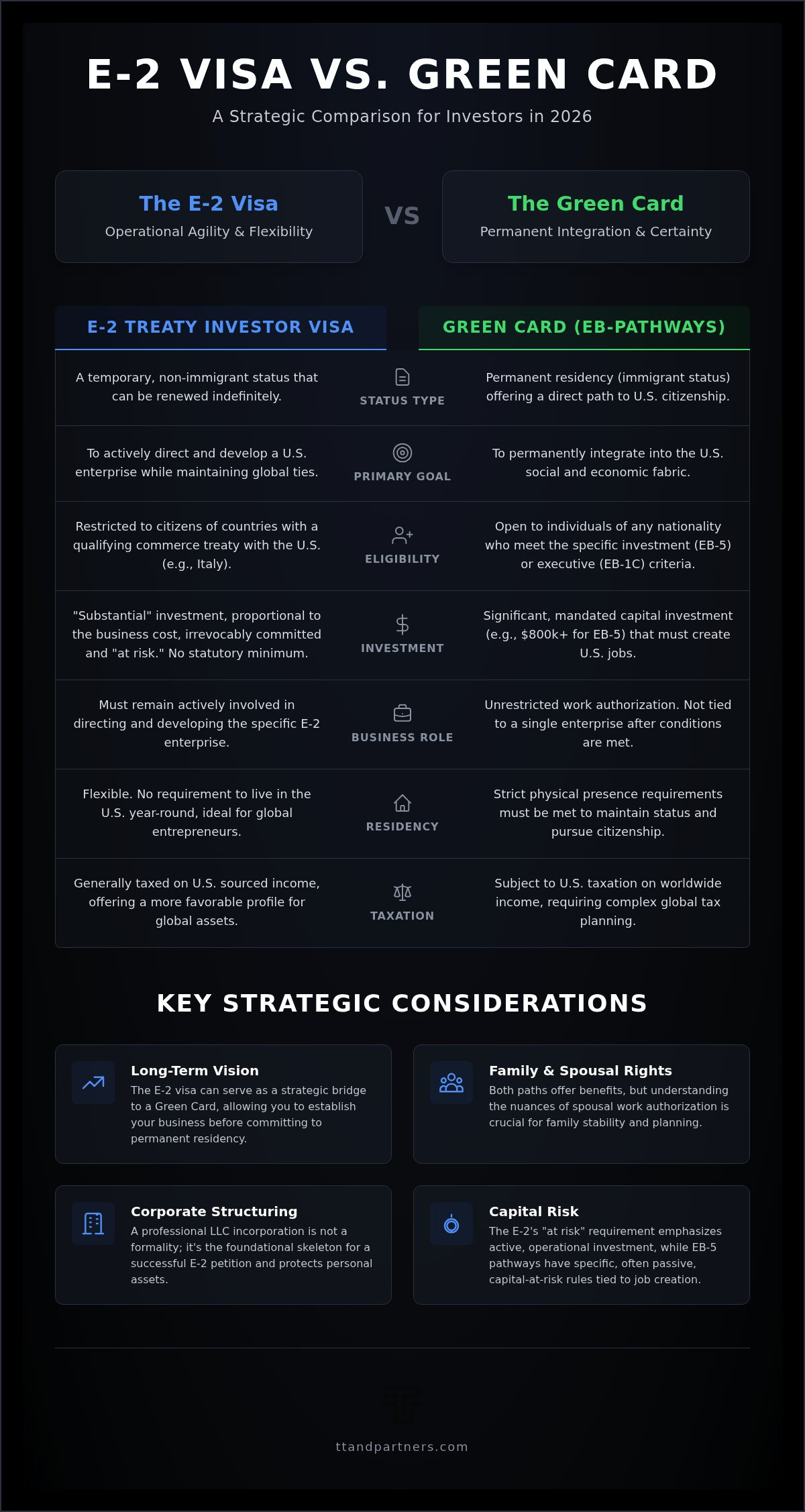
The E-2 classification operates within the E-2 Treaty Investor Framework, providing a flexible, non-immigrant solution for those who wish to direct and develop their U.S. enterprise. Unlike permanent residency, it doesn't require a commitment to live in the U.S. year-round. This makes it ideal for entrepreneurs who maintain significant interests abroad. A substantial investment is defined as a proportional test where the amount invested must be significant in relation to the total cost of either purchasing an existing business or establishing a new one. It's an active status. You must remain at the helm of the business. As long as the enterprise remains viable and continues to meet regulatory requirements, the visa can be renewed indefinitely. It offers professional stability without the immediate weight of permanent tax residency.
The Green Card: Permanent Integration
Transitioning to a Green Card represents a shift from business operations to permanent integration into the American social and economic fabric. This immigrant status offers a path to U.S. citizenship after five years of residency and provides unrestricted work authorization. You aren't tied to a single enterprise. When evaluating the E-2 visa vs Green Card for investors, the primary distinction lies in the intended duration and the nature of your U.S. ties.
However, this permanence comes with rigorous demands. Green Card holders are subject to global income taxation regardless of where the income is earned. They must also adhere to strict physical presence requirements to maintain their status. It's a definitive commitment. For high-net-worth individuals, this often involves a complex restructuring of their global tax profile. The choice in 2026 isn't merely about the present. It's about where you see your legacy. You must weigh the freedom of movement against the security of a permanent home.
The E-2 Treaty Investor Framework: Strategic Flexibility for 2026
The E-2 visa offers a modular approach to U.S. market entry. Unlike the more rigid EB-5 Green Card program, which requires a significant, often passive capital commitment, the E-2 rewards active engagement and operational presence. In 2026, success in the E-2 visa vs Green Card for investors landscape begins with a robust corporate foundation. A professional LLC incorporation isn't just a legal formality. It's the structural skeleton upon which your entire petition rests. Consular officers now look for a clear separation between personal assets and the enterprise's capital before they even consider the "substantiality" of the investment.
Proving a "substantial investment" requires demonstrating that capital is irrevocably committed and "at risk" in the commercial sense. While no statutory minimum exists, the 2026 adjudication environment favors investments that represent a high percentage of the total startup cost. This is particularly true for service-oriented businesses where the initial overhead might be lower. Beyond the investor, the framework also accommodates managerial and essential employees. These roles allow for the transfer of specialized talent from the home country, ensuring the enterprise's unique intellectual DNA is preserved during its American expansion. Each role must be clearly defined to survive the heightened screening protocols currently in place at U.S. consulates.
The Marginality Test and Job Creation
A successful petition must prove the business isn't marginal. It can't simply exist to provide a living for the investor and their family. In 2026, consulate officers place heavy emphasis on a detailed five-year business plan. This document must project significant economic impact, specifically through the creation of jobs for U.S. workers. Your financial projections aren't just numbers. They're a visionary statement of the business's capacity to contribute to the local economy. Current protocols involve a deeper scrutiny of these projections to ensure they're rooted in market reality rather than optimistic speculation.
Ownership and Control Requirements
The "Direct and Develop" standard remains the cornerstone of the E-2 status. You must own at least 50% of the U.S. entity or possess operational control through a managerial position. This qualifying relationship must be maintained throughout the life of the visa. Structuring the entity correctly ensures the treaty nationality requirements are met, preventing future disputes during renewal cycles. If you're unsure how your current corporate structure aligns with these standards, you can reach out for a strategic evaluation of your case. Maintaining this alignment is vital for long-term residency and operational stability in a competitive foreign market.
The Green Card Pathways: EB-5 and EB-1C for High-Net-Worth Investors
The quest for permanent residency often involves a higher threshold of both capital and regulatory scrutiny. Analyzing the E-2 visa vs Green Card for investors reveals that the immigrant path requires a more profound commitment to the U.S. economy. For those seeking the security of a Green Card, the EB-5 and EB-1C programs serve as the two primary pillars of investment-based immigration in 2026. Each offers a different architectural approach to residency, designed for those who view the United States as their ultimate destination rather than a temporary operational base.
EB-5: The Direct Path through Capital
The EB-5 program remains the most direct route for high-net-worth individuals to secure a permanent future. Under current 2026 regulations, the minimum investment for projects in a Targeted Employment Area (TEA) is $800,000, while non-TEA projects require $1,050,000. This capital must remain at risk and result in the creation of at least 10 full-time jobs for U.S. workers. A critical component of this process is the exhaustive documentation of the source of funds. Consular officers and USCIS adjudicators require a transparent audit trail proving the legal origin of every dollar invested. Investors should be mindful of the September 30, 2026, grandfathering deadline. This allows petitions filed before this date to be adjudicated under existing rules even if future requirements shift. As noted in this E-2 visa and EB-5 green card comparison, the choice often balances the speed of entry against the permanence of the outcome.
EB-1C: The Multinational Executive Route
For those who lead established international enterprises, the EB-1C pathway for multinational managers offers a compelling alternative. This route leverages a qualifying relationship between a foreign parent company and its U.S. subsidiary. It's an ideal progression for firms already utilizing the E-1 Treaty Trader visa for high-volume trade. A significant advantage of the EB-1C is the avoidance of the PERM labor certification process, which can significantly shorten the timeline to residency. However, the U.S. entity must have been actively doing business for at least one year before the petition is filed. This ensures the enterprise has the structural maturity to support a permanent executive role.
Navigating these pathways requires precise financial planning. Budgeting for 2026 involves more than just the investment capital. You must account for filing fees, such as the $3,675 for Form I-526E or the $715 for Form I-140 plus the $600 Asylum Program Fee. For a detailed breakdown of these expenses, consult our guide on how much is a green card. Choosing the right path is a strategic exercise in matching your corporate architecture with your long-term family goals.
Comparative Analysis: Operational Agility vs. Residency Certainty
The temporal landscape of 2026 defines the most immediate friction point in the E-2 visa vs Green Card for investors decision. Speed is the E-2's primary currency. While Green Card backlogs for EB-5 or EB-1C petitions can stretch into several years, an E-2 petition is typically adjudicated at a consulate within a few months. This agility allows for rapid market entry and immediate operational control. However, this speed comes with the burden of renewal. Every few years, you must prove the enterprise remains viable and non-marginal. It's a continuous cycle of validation that demands meticulous corporate record-keeping and a constant eye on the business's economic footprint.
A critical nuance often overlooked is the "Dual Intent" challenge. Unlike the L-1 or H-1B categories, the E-2 is technically a single-intent visa. You must maintain an unequivocal intent to depart the United States when your status expires or terminates. This doesn't prevent you from renewing indefinitely, but it creates a complex legal environment if you decide to pursue permanent residency while in E-2 status. Navigating this requires a sophisticated strategy to ensure your actions don't contradict your non-immigrant declarations. Spousal rights offer some relief here; E-2 spouses currently enjoy work authorization incident to their status, providing the family with dual-income potential and greater social integration from day one.
Flexibility and Risk Management
Risk management takes different forms across these categories. If a business fails, an E-2 holder's legal basis for staying in the U.S. evaporates almost immediately, requiring a swift exit or a change of status. Conversely, a Green Card provides a safety net. Your residency isn't tied to the ongoing success of a specific enterprise once the conditions are removed. However, permanent residency carries the weight of the Expatriation Tax. Surrendering a Green Card after holding it for eight of the last fifteen years can trigger significant financial consequences. Travel freedom also differs. While Green Card holders move with relative ease, they must be careful not to abandon residency through prolonged absences. E-2 holders rely on valid visa stamps for re-entry, which requires periodic consular appointments abroad.
Strategic Transition: From E-2 to Permanent Residency
Many visionary entrepreneurs use the E-2 as a strategic bridge. It allows you to build the very enterprise that will eventually qualify you for an EB-5 or EB-1C Green Card. This "bridge" strategy provides the necessary time to meet job creation quotas or establish the required one-year "doing business" history for multinational manager status. In some cases, the O-1 visa serves as an intermediate step for investors who can demonstrate extraordinary ability in their field, offering a path that avoids the capital-heavy requirements of the EB-5. If you're considering which sequence best serves your long-term vision, you can consult with our team to design a bespoke residency roadmap that protects both your capital and your family's future.
Executing Your Vision: Corporate Structuring and Legal Roadmap
Moving from the theoretical comparison of the E-2 visa vs Green Card for investors to the actual execution of your U.S. expansion requires a shift in perspective. DIY immigration isn't just a paperwork risk; it's a fundamental risk to your capital and your family's future security. In the 2026 regulatory environment, a petition's success depends on the invisible infrastructure behind the application. A flawed corporate setup or an improperly documented source of funds can lead to more than just a visa denial. It can leave you vulnerable to international litigation and complex business disputes that threaten your entire investment. Specialized counsel acts as the architect of your American venture, ensuring every legal joint is secure.
Tosolini, Toniutti & Partners specializes in bridging the profound legal gap between Europe and the United States. We understand that an investor's needs are holistic. We don't just process a visa; we design a legal environment where your enterprise can thrive. Our approach integrates LLC incorporation with immigration strategy, ensuring that your corporate architecture satisfies the "direct and develop" standards from day one. By coordinating your visa application with professional tax planning and asset protection, we transform a complex cross-border hurdle into a predictable, manageable roadmap for growth.
Designing Your US Corporate Architecture
Your entity must be built to satisfy the specific treaty requirements of the E-2 Visa from the foundation up. Aligning your business structure with these standards requires a deep understanding of US-Italy cross-border legal nuances. This includes ensuring that treaty nationality is maintained throughout the entity's ownership chain and that investment capital is correctly characterized as irrevocably committed. This level of precision doesn't just satisfy a consular officer. It protects your intellectual property and physical assets during the critical initial years of your expansion. It's about building a structure that is as durable as it is compliant.
Schedule Your Strategic Consultation
The path to a successful U.S. expansion begins with a clear, authoritative assessment of your current portfolio and your long-term objectives. Whether your strategy favors the immediate agility of the E-2 or the permanent integration of a Green Card, a customized roadmap is essential for your family's stability. Preparing your financial and corporate documents for an initial legal review is the first step toward securing your vision. We invite you to Contact Tosolini, Toniutti & Partners to begin this dialogue. Together, we can ensure your American future is built on a foundation of professional excellence and strategic foresight.
Architecting Your American Legacy
The strategic environment of 2026 requires more than just capital; it demands a meticulous alignment of your corporate structure with your personal residency goals. Whether you prioritize the immediate operational control of treaty investor status or the permanent security of an immigrant petition, the decision between an E-2 visa vs Green Card for investors remains a defining moment for your international expansion. Success hinges on a professional corporate foundation and a clear understanding of evolving regulatory requirements. It's a definitive step that shouldn't be taken without a precise legal roadmap to mitigate the risk of capital loss.
Tosolini, Toniutti & Partners provides specialized US-Italy cross-border legal expertise to ensure your venture is built on a compliant and resilient architecture. We offer full-service support, ranging from the initial LLC incorporation to comprehensive E-2 and Green Card strategy development. By bridging the gap between two distinct legal systems, we protect your family's future and your business's growth. Secure your US business future. Contact our expert legal team today. Your vision of American expansion is within reach and ready for professional execution.
Frequently Asked Questions
Can I switch from an E-2 visa to a Green Card later?
Yes, but the transition isn't automatic. You must independently qualify for an immigrant category such as EB-5 or EB-1C. The E-2 is a non-immigrant status, so moving to permanent residency requires filing a new petition. This process requires careful strategic planning to manage "dual intent" issues. Many entrepreneurs use the E-2 period to scale their business until it meets the higher investment and job creation thresholds required for a Green Card.
Does the E-2 visa require a minimum investment of $100,000 in 2026?
No statutory minimum investment exists in 2026, though $100,000 remains a common benchmark for successful petitions. Adjudicators apply a proportionality test to determine if the capital is "substantial" relative to the total cost of the enterprise. A service-based business might qualify with a lower amount if it covers a high percentage of startup costs. However, smaller investments often face higher scrutiny regarding the business's capacity to support more than just the investor's family.
Can my spouse work in the US on an E-2 investor visa?
Yes, spouses of E-2 visa holders are authorized to work in the United States. They're considered employment authorized "incident to status," which means they don't necessarily need to wait for a separate Employment Authorization Document to begin their professional pursuits. This provides vital flexibility for families evaluating the E-2 visa vs Green Card for investors, as it allows for dual-income stability and immediate social integration into the American professional landscape upon arrival.
Which is faster to obtain: An E-2 visa or an EB-5 Green Card?
The E-2 visa is significantly faster to obtain. Consular processing for an E-2 typically concludes within a few months, whereas an EB-5 petition involves years of waiting due to extensive USCIS backlogs and annual quota limits. In 2026, investors seeking immediate market entry often utilize the E-2 to establish their operations quickly. They may then pursue a Green Card as a long-term residency strategy while already living and working within the United States.
What happens to my E-2 status if my US business fails?
Your E-2 status is strictly contingent upon the continued operation of the qualifying enterprise. If the business ceases operations or fails to meet the "marginality" test, your legal basis for remaining in the country terminates. You would typically need to depart the United States or change to a different visa category promptly. This inherent risk is a primary consideration when comparing the E-2 visa vs Green Card for investors, as permanent residency offers security independent of business success.
Is an Italian citizen eligible for both the E-2 and EB-5 programs?
Yes, Italian citizens are eligible for both because Italy maintains a qualifying treaty of commerce with the United States. This treaty status is a mandatory prerequisite for the E-2, while the EB-5 program is open to all nationalities. Many Italian entrepreneurs start with the E-2 due to its lower capital requirements and then transition to an EB-5 petition once their U.S. operations have matured enough to satisfy the more rigorous job creation standards.
Do I need to live in the US full-time on an E-2 visa?
No, the E-2 visa does not impose a strict physical presence requirement. You must enter the U.S. to "direct and develop" the enterprise, but you can maintain a primary residence abroad and travel frequently. This flexibility is ideal for international business owners managing global portfolios. In contrast, Green Card holders must demonstrate a clear intent to make the United States their permanent home to avoid the risk of abandoning their residency status.
Can I buy a franchise to qualify for an E-2 visa?
Yes, purchasing a franchise is a well established path for E-2 qualification. Franchises often provide a clear "total cost" for the proportionality test and a proven business model that satisfies consular concerns regarding viability. However, the investor must still demonstrate they'll have active operational control rather than being a passive owner. The investment capital must be "at risk" and irrevocably committed to the franchise before the visa application is submitted to the consulate.


Comments