

O-1 Visa Requirements for Italian Citizens: 2026 Guide
- Gianni Mendes Toniutti, Esq.

- 4 days ago
- 11 min read
Updated: 13 hours ago
The distinction between a celebrated career in Milan and an extraordinary ability petition in the United States often rests not on the talent itself, but on the precision of its translation into legal evidence. You've built a reputation through rigorous craftsmanship and intellectual merit, yet the complexity of international immigration systems often makes that success feel fragile. It's common to wonder if your Italian press coverage or European industry awards carry the necessary weight to satisfy the O-1 visa requirements for Italian citizens.
We understand that navigating the intersection of Italian professional prestige and American legal benchmarks requires more than just paperwork; it demands a strategic approach to your professional narrative. This article promises a definitive breakdown of the eight evidentiary criteria, tailored specifically for the Italian professional landscape. We'll preview the latest 2026 policy updates regarding digital evidence and provide a clear roadmap for consular processing in Rome and Milan. By bridging the gap between your creative legacy and US regulatory standards, we'll verify your eligibility and prepare you for the next phase of your global expansion.
Table of Contents
Understanding the O-1 Visa Categories for Italian Professionals
Success in the Italian market often provides the foundational architecture for a global career. The O-1 visa isn't a singular path but a sophisticated framework designed to accommodate diverse forms of excellence. Meeting the O-1 visa requirements for Italian citizens begins with selecting the correct legal classification. This choice dictates the evidentiary burden you'll face and the specific narrative your petition must convey to USCIS officers.
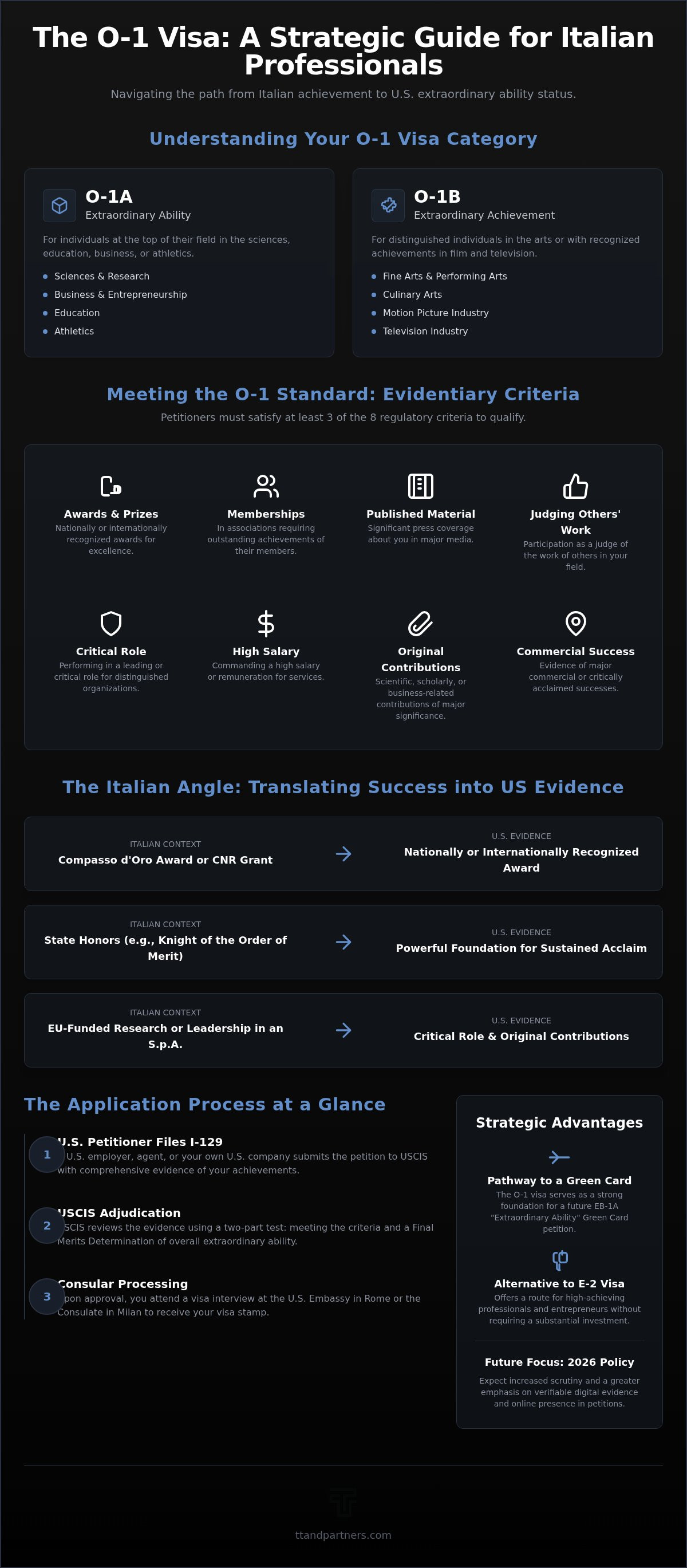
There are several O-1 visa categories available, each serving a distinct professional profile. The O-1A is reserved for individuals with extraordinary ability in the sciences, education, business, or athletics. In contrast, the O-1B category focuses on those in the arts or the motion picture and television industry. While the O-1A requires you to prove you're among the small percentage at the top of your field, the O-1B "distinction" standard is slightly more flexible, requiring proof of being prominent or well-known in your creative discipline.
O-1A vs. O-1B: Identifying Your Path
Choosing between these paths requires a clinical assessment of your portfolio. An Italian researcher specializing in renewable energy clearly belongs in O-1A, where peer-reviewed journals and patents form the core of the evidence. However, for an Italian fashion designer, the choice is more nuanced. If the work is purely creative, O-1B is the standard. If that designer has also built a multi-million euro brand, the business-centric O-1A might offer a more robust case. Italian entrepreneurs frequently find success in the O-1A category by highlighting venture capital funding, leadership in distinguished organizations, and significant commercial impact.
Sponsorship Models: Employers and Agents
Every petition requires a US-based petitioner. While many Italian professionals rely on traditional employer sponsorship through corporate transfers, this isn't the only option. Freelancers or artists with multiple engagements can utilize a US Agent. This agent acts as the petitioner, managing a comprehensive itinerary of projects across different clients, which allows for professional flexibility.
For Italian startup founders, the strategy shifts toward self-sponsorship through their own US entity. By incorporating a US LLC or corporation, the founder creates a legal bridge. The company, as a separate legal person, petitions for the founder's services. This model is particularly effective for those who want to maintain autonomy while satisfying the O-1 visa requirements for Italian citizens. Support staff essential to an artist's performance may follow on O-2 visas, while spouses and children under 21 are eligible for O-3 status. It's vital to remember that O-3 holders can study but generally don't have work authorization.
Evidentiary Criteria: Meeting the Extraordinary Ability Standard
The threshold for approval is objective yet interpretive. To satisfy the O-1 visa requirements for Italian citizens, one must present a portfolio that transcends mere competence. USCIS utilizes a two-part adjudicative process. First, you must meet at least three of the official USCIS O-1 criteria. Second, the officer performs a Final Merits Determination. This is a qualitative assessment where the officer looks at the totality of the evidence. They decide if you've reached a level of expertise that places you among the small percentage who've risen to the very top of their field. In the 2026 legal landscape, this means your documentation must not just exist; it must tell a cohesive story of sustained acclaim.
Documenting Prestigious Awards and Memberships
The Power of Published Material and Critical Roles
High-circulation Italian media serves as an excellent evidentiary pillar. Articles in Corriere della Sera or Il Sole 24 Ore that focus specifically on your work provide the published material USCIS seeks. You must also demonstrate you've played a critical or essential capacity for organizations with a distinguished reputation. Leading a flagship project for a historic fashion house or spearheading a division within a major Italian manufacturing firm qualifies. Original contributions must have a major significance. This isn't just about doing your job well; it's about shifting the industry standard or introducing a methodology that others have adopted. If you're uncertain how your specific Italian accolades align with these standards, you can consult with our legal team for a detailed portfolio evaluation.
The Italian Angle: Translating Success into US Evidence
Successfully navigating the O-1 visa requirements for Italian citizens hinges on your ability to contextualize European prestige for an American adjudicator. A primary challenge lies in the strategic translation of institutional hierarchies. While a US officer might not immediately grasp the significance of a grant from the Consiglio Nazionale delle Ricerche (CNR) or the competitive nature of a Horizon Europe fellowship, these accolades represent the pinnacle of scholarly and professional merit. You must provide the circulation data, selection percentages, and peer-review standards that elevate these Italian achievements to meet the O-1 Visa Eligibility Requirements.
Leveraging Italian Media and Institutional Recognition
Italian press coverage is a potent evidentiary tool, provided it's presented with technical precision. Clipping a feature from Il Sole 24 Ore or La Repubblica is only the first step. You need to include evidence of the publication's national circulation and its status as a leading voice in your industry. For researchers and innovators, university accolades and patent filings must be coupled with proof of their commercial application. A patent granted in Italy carries weight, but showing how that technology has been licensed or integrated into the US market creates a far more compelling narrative of international acclaim. This evidence bridges the gap between local success and the global standard USCIS expects.
Expert Testimonials and the 'Peer Group' Requirement
The architecture of a successful petition often rests on the strength of expert opinion letters. These testimonials shouldn't be mere letters of recommendation; they're analytical documents that map your career milestones to specific legal criteria. We recommend a balanced portfolio of letters from both Italian industry leaders and US-based peers. This dual perspective proves your reputation has crossed borders. In 2026, USCIS has maintained a high standard for 'consultation letters' from US labor organizations. If your field is unionized, such as in film or television, obtaining a written advisory opinion from the relevant peer group is a mandatory step that requires early coordination.
Finally, you must account for the 2026 reciprocity requirements for Italian citizens. While the petition may be approved for up to three years, the actual visa stamp issued at the embassy in Rome or consulate in Milan follows the specific reciprocity schedule between the US and Italy. This distinction between petition approval and visa duration is a technical nuance that requires careful planning to ensure your travel and work authorization remain in perfect harmony. Every document, from a grant award to a peer testimonial, must be curated to reflect a career that is both intellectually deep and internationally relevant.
The O-1 Application Process: From Petition to US Entry
The transition from Italian professional life to a US-based career follows a two-stage administrative architecture. First, your petitioner must secure an approval from USCIS within the United States. Only after this milestone is reached can you proceed to the second stage: the consular interview in Italy. Understanding the O-1 visa requirements for Italian citizens involves managing these distinct timelines with technical precision, ensuring that your professional commitments in Italy align with your projected US start date.
Filing the USCIS Petition (Form I-129)
The initial petition is filed using Form I-129. With standard processing times currently averaging 11 to 13 months, the strategic use of premium processing has become the industry standard for high-level talent. Since March 1, 2026, the fee for this expedited service is $2,965, guaranteeing a response within 15 business days. This is in addition to the base filing fee of $1,055. For those acting under an agent-petitioner model, the contract and itinerary must be meticulously detailed, documenting every engagement to avoid a Request for Evidence (RFE). While the overall O-1 approval rate reached 93.8% in early 2025, an RFE rate of 18.7% suggests that even strong cases face rigorous scrutiny regarding the "extraordinary" nature of the applicant's role. Common triggers for Italian applicants often include insufficient documentation of the prestige of Italian-specific awards or poorly translated press clippings.
Consular Interview in Italy: Rome and Milan
Once the I-129 is approved, the focus shifts to the US Embassy in Rome or the Consulate General in Milan. This phase begins with the DS-160 application and a fee of $205. Preparation for the interview requires more than just a collection of documents; it demands a clear, verbal articulation of your professional vision. You'll need to provide:
A complete copy of the approved O-1 petition and the I-797 approval notice.
Evidence of your intent to work exclusively within the specific field of extraordinary ability.
Compliance with 2026 security vetting protocols, including comprehensive social media disclosure rules.
The interview is the final hurdle in satisfying the O-1 visa requirements for Italian citizens. Consular officers in Rome and Milan are accustomed to evaluating high-level talent, yet they will still verify that your proposed activities in the US match the expertise documented in your petition. Upon entry to the US, maintaining your status requires strictly adhering to the professional activities outlined in your approved itinerary. If your career path requires a more personalized strategy to navigate these complex 2026 regulations, you should contact our firm for a strategic consultation.
Strategic Advantages and Legal Support for Italian Expats
The O-1 visa represents more than a temporary authorization to work; it's a strategic asset for the internationally mobile professional. One of its most significant benefits is the concept of "dual intent." While many non-immigrant visas require you to maintain a foreign residence you've no intention of abandoning, the O-1 allows you to seek permanent residency simultaneously. This flexibility is vital for those who view their US move as a permanent expansion rather than a brief assignment. It ensures that meeting the O-1 visa requirements for Italian citizens serves as a direct pipeline to long-term stability.
For Italian entrepreneurs, the O-1 often provides a more streamlined path than the E-2 Investment Visa. While the E-2 requires a substantial capital investment and rigorous proof of Italian ownership, the O-1 focuses entirely on your intellectual capital and professional merit. It's a meritocratic alternative that preserves your liquidity for business operations rather than tying it up in initial visa requirements. Managing cross-border business interests requires this kind of strategic foresight, especially when balancing an Italian S.r.l. with a new US entity. Our expertise in international litigation and business setups ensures that your corporate structure supports your immigration goals.
Transitioning from O-1 to Permanent Residency
The evidentiary standards for the O-1 visa share a significant overlap with the EB-1A Green Card for Extraordinary Ability. If you've already successfully documented your acclaim for an O-1 petition, the transition to a Green Card becomes a logical progression rather than a fresh start. You've already established a baseline of excellence that USCIS recognizes. Strategic planning allows you to build upon this foundation, using your time in the US to gather further evidence of sustained acclaim. You can learn more about the cost of a Green Card to better understand the long-term financial and administrative investment required for permanent residency.
Why Tosolini, Toniutti & Partners for Your O-1 Journey
Our firm operates at the precise intersection of the US and Italian legal systems. We don't just process forms; we curate professional narratives that bridge the cultural and legal gaps between Rome and Washington. We understand that an Italian academic degree or a specific national honor carries a weight that must be carefully translated for a US audience. By focusing on this specific cross-border corridor, we provide tailored strategies for Italian professionals, scientists, and entrepreneurs who require more than just standard immigration advice. If you're ready to begin your expansion, contact us for a strategic O-1 visa consultation to ensure your petition meets the highest standards of professional excellence.
Secure Your Professional Future in the United States
Mastering the professional transition between Italy and the United States requires more than just talent; it demands a meticulous orchestration of legal evidence and strategic timing. We've explored how translating Italian institutional honors and navigating 2026 procedural updates are essential steps in satisfying the O-1 visa requirements for Italian citizens. By aligning your intellectual legacy with US regulatory standards, you transform a complex administrative hurdle into a definitive career milestone. This process isn't merely about entry, but about establishing a foundation for long-term global expansion and potential permanent residency.
Success in this high-stakes environment depends on specialized US-Italy legal expertise and a proven track record with extraordinary ability petitions. Our firm provides the bilingual legal support necessary to manage complex documentation with the precision your career deserves. We invite you to schedule your O-1 visa consultation with our cross-border experts to refine your narrative and secure your standing in the US market. Your extraordinary achievements deserve a legal strategy that reflects the same level of excellence you bring to your field. We look forward to building your future together.
Frequently Asked Questions
Can an Italian entrepreneur sponsor themselves for an O-1 visa?
Yes, Italian entrepreneurs can effectively sponsor themselves by establishing a US legal entity, such as an LLC or Corporation, which then acts as the petitioner. The company must be a separate legal person from the individual. This structure satisfies the requirement for an employer employee relationship while allowing the founder to maintain operational control. It's a sophisticated strategy for those building a US presence without a traditional external employer.
What is the minimum salary required for an O-1 visa in 2026?
There is no federally mandated minimum salary for the O-1 visa; however, your compensation must be significantly higher than the industry average to meet the extraordinary ability criteria. USCIS evaluates your remuneration against prevailing wages for your specific role and geographic area. In 2026, providing certified data from professional associations or salary surveys is essential to prove that your high salary reflects your status at the top of your field.
How long does it take for an Italian citizen to get an O-1 visa?
The timeline varies based on your chosen processing speed. Standard adjudication currently takes approximately 11 to 13 months, while premium processing guarantees a response within 15 business days for a fee of $2,965. Once the petition is approved, you must factor in the wait times at the US Embassy in Rome or the Consulate in Milan for the visa interview, which can add several weeks to the overall process.
Do I need a university degree to qualify for the O-1 visa?
A university degree is not a mandatory requirement for the O-1 visa. Unlike the H-1B, which focuses on academic credentials, the O-1 prioritizes sustained national or international acclaim. While advanced degrees can support your case, USCIS focuses on your professional achievements, awards, and industry impact. Many successful Italian artists and entrepreneurs qualify based on their portfolio and peer recognition rather than their formal educational background.
Can I travel back to Italy while my O-1 petition is pending?
You can travel back to Italy while your petition is pending if you've requested consular processing. However, if you're currently in the US and filed for a change of status, departing the country will result in the abandonment of that specific request. Most Italian applicants choose consular processing from the outset, allowing them to manage their transition between countries without jeopardizing the underlying petition's validity during the 11 to 13 month standard wait.
What happens if my O-1 visa petition receives a Request for Evidence (RFE)?
Receiving an RFE means USCIS requires additional documentation to satisfy the O-1 visa requirements for Italian citizens. With an RFE rate of 18.7% in early 2025, this is a common part of the process. You'll have a specific window, typically 90 days, to submit a comprehensive response. This is a critical opportunity to refine your professional narrative and provide more granular evidence of your extraordinary ability or the prestige of your Italian accolades.
Is the O-1 visa better than the E-2 visa for Italian business owners?
The O-1 is often superior for those who prefer to leverage their intellectual merit over financial capital. While the E-2 requires a substantial investment and proof of Italian nationality, the O-1 focuses on your personal achievements. Additionally, the O-1 is a dual intent visa, making it a smoother bridge to a Green Card. The choice depends on whether your strength lies in your professional acclaim or your available investment liquidity.
Can my spouse work in the US on an O-3 visa?
Spouses and unmarried children under 21 who hold O-3 status are not authorized to work in the United States. They are permitted to live and study, but they must seek their own independent work authorized visa if they intend to pursue professional activities. As of 2026, the average processing time for the Form I-539 used by dependents is six to eight months, so early planning for family members is highly recommended.


Comments