

Adjusting Status from E-2 Visa to Green Card: The 2026 Strategic Guide

The E-2 visa is often celebrated for its professional flexibility, yet it remains an elegant trap for investors who mistake longevity for permanence. You've likely felt the weight of the renewal treadmill every few years or the quiet anxiety of a child approaching age 21. These are the inherent limitations of a non-immigrant status that requires constant proof of your intent to leave the country you've helped build.
It's entirely possible to secure your future by adjusting status from E-2 visa to green card, provided you manage the dual intent doctrine with surgical precision. This guide offers a clear architectural roadmap to permanent residency through EB-1, EB-2, EB-3, or EB-5 pathways. We'll examine the specific 2026 USCIS fee structures and the strategic timing required to maintain business continuity while anchoring your family's legacy in the United States.
Key Takeaways
Recognize the inherent limitations of the E-2 non-immigrant barrier and how to bridge the gap toward permanent residency with professional foresight.
Explore specialized pathways such as the EB-1C category for managers and the EB-2 NIW, which allow for a sophisticated pivot to permanent status.
Master the procedural timeline for adjusting status from E-2 visa to green card, ensuring compliance with the 90-day rule and USCIS intent standards.
Understand how to leverage business growth and capital investment to meet the 2026 EB-5 thresholds for a secure, long-term legacy.
Align your corporate architecture through strategic LLC incorporation to create a robust foundation for your residency application.
Table of Contents
The E-2 to Green Card Paradox: Understanding the Non-Immigrant Barrier
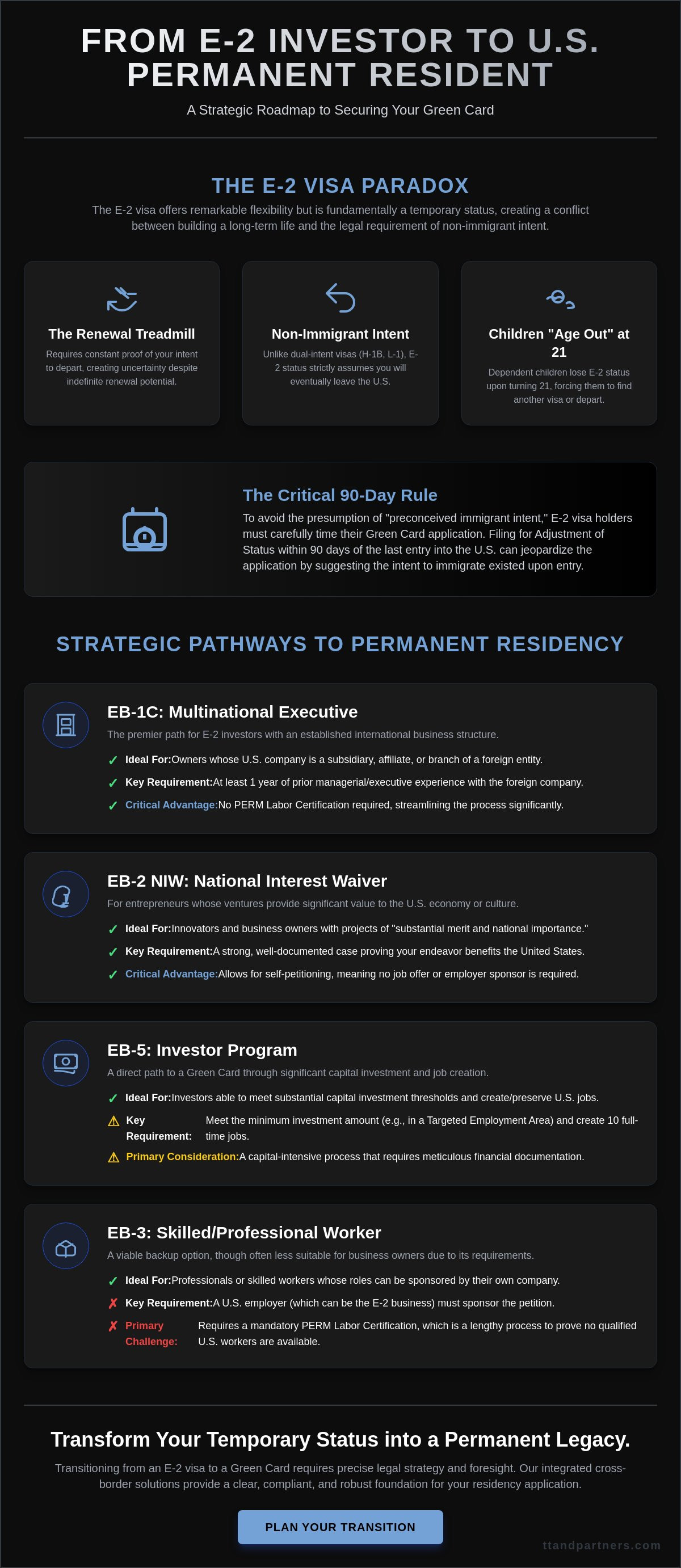
The E-2 visa is a masterpiece of professional flexibility for international entrepreneurs, but its legal structure contains a fundamental contradiction. Defined strictly as a non-immigrant category, the E-2 Investor Visa is predicated on the applicant's "intent to depart" the United States once their status terminates. Unlike other business visas, it doesn't possess an inherent mechanism for permanent residency. This creates a paradox where an investor may build a thriving enterprise over decades, yet they remain technically temporary guests within the American economic landscape.
This lack of a natural bridge means that adjusting status from E-2 visa to green card requires a deliberate, secondary legal strategy. The stakes are particularly high for families who've integrated into their local communities. While the investor and spouse can renew their status indefinitely, children lose their derivative E-2 status the moment they turn 21. Without a transition to permanent residency, these young adults face the abrupt necessity of finding independent visa sponsorship or leaving the country. It's a cliff that many families don't see until it's nearly too late.
Non-Immigrant vs. Immigrant Intent
The legal distinction between temporary and permanent residency is governed by the concept of intent. While H-1B and L-1 visas are classified as "dual intent," allowing holders to seek a Green Card openly, the E-2 is more restrictive. USCIS expects E-2 holders to maintain a residence abroad that they don't intend to abandon. Filing for a Green Card too early in an E-2 cycle can trigger scrutiny regarding whether the applicant misrepresented their intent upon entry. Successful transitions require careful timing, often adhering to the 90-day rule to avoid allegations of preconceived immigrant intent.
Why Italians Face Unique Strategic Choices
For Italian citizens, the transition is shaped by the specific nuances of the 2026 US-Italy treaty dynamics. Maintaining an Italian domicile is not just a legal formality; it's a strategic asset that preserves options under bilateral agreements. Investors must balance their American growth with their European roots to ensure tax efficiency and legal standing in both jurisdictions. Our E-2 Visa Guide 2026 provides the necessary groundwork for understanding these treaty-specific requirements. Transitioning successfully involves aligning these international interests with the complex process of adjusting status from E-2 visa to green card.
Employment-Based Pathways: EB-1, EB-2, and EB-3 Strategies
Transitioning from investor status requires identifying an immigrant petition that mirrors your professional contributions. While the official E-2 classification requirements focus on capital risk and active management, employment-based (EB) categories shift the focus toward your individual expertise or corporate structure. Adjusting status from E-2 visa to green card through these channels allows you to bypass the lottery systems associated with other visa types. It's about transforming your role from a treaty investor into a permanent pillar of the American workforce.
The EB-3 category remains a viable backup for professionals or skilled workers, though it's often the least preferred option for business owners. This is primarily due to the mandatory PERM labor certification, a process where the Department of Labor must verify that no qualified US workers are available for the position. As of June 2026, the Visa Bulletin indicates that EB-3 remains current for most countries, but the administrative burden makes it less agile than higher-preference categories. Successfully adjusting status from E-2 visa to green card hinges on selecting the path that offers the least resistance to your business continuity.
EB-1C: The Premier Path for E-2 Business Owners
The EB-1C category is a sophisticated tool for E-2 investors who operate within a multinational framework. If your US business is a subsidiary, affiliate, or branch of a foreign company where you served in a managerial capacity for at least one year, you may qualify. This pathway is exceptionally efficient because it eliminates the PERM process entirely. You must demonstrate that your US role involves high-level decision-making and supervision of professional staff. It's a natural evolution for those who've scaled their E-2 enterprise into a complex corporate structure.
The EB-2 National Interest Waiver (NIW) Advantage
For entrepreneurs whose ventures offer significant value to the US economy, the EB-2 NIW provides a compelling alternative. This category allows you to self-petition, waiving the job offer requirement if you can prove your endeavor has substantial merit and national importance. You must show you're well-positioned to advance this venture through your past record of success. This rigorous standard often parallels the criteria explored in our guide on O-1 Visa for Entrepreneurs, emphasizing extraordinary professional impact. If you're navigating these high-level requirements, you may wish to reach out for a strategic evaluation of your case profile.
The EB-5 Investor Route: Capital-Intensive Transition
The EB-5 pathway represents the most capital-intensive method for adjusting status from E-2 visa to green card. Unlike the employment-based categories discussed previously, EB-5 relies on the sheer weight of investment and job creation. In 2026, the minimum investment thresholds remain at $1,050,000 for standard areas and $800,000 for Targeted Employment Areas (TEAs). Investors must choose between a Direct Investment in their own enterprise or a Regional Center approach. For most active E-2 business owners, the direct route is the most natural progression, as it allows them to maintain full control over their operations while fulfilling the job creation mandate.
Many business owners look for strategies for converting an E-2 visa that leverage their existing business success. The transition isn't simply about writing a check. It's about proving that the capital is fully at risk and that the business has created at least 10 full-time positions for qualified US workers. This job creation requirement is the cornerstone of the EB-5 program and often the most challenging hurdle for smaller E-2 enterprises that operate with leaner staff models.
Converting E-2 Capital into EB-5 Eligibility
Tracing the source of funds is a rigorous exercise in transparency. Whether the capital originates from Italian assets or US-based earnings, the path from the investor's pocket to the business entity must be documented. Reinvested profits from an E-2 business can count toward the EB-5 threshold, but only after they've been distributed to the investor and taxed appropriately. This ensures the capital is personal and legally obtained. The 10-employee rule requires these positions to be permanent and full-time, excluding the investor's immediate family, which necessitates a robust scaling strategy.
EB-5 Timeline and Conditional Residency
Approval of the initial petition leads to a two-year conditional Green Card. This period is a testing ground where the investor must prove that the capital remained invested and the jobs were created. In 2026, the process of removing conditions through Form I-829 requires meticulous record-keeping of payroll and tax filings. The financial commitment is substantial. Beyond the investment itself, applicants must account for the cost of a Green Card in this high-tier category, which includes a Form I-526 filing fee of $11,160. It's a high-stakes pivot that anchors your business legacy in the US permanently.
Managing the Adjustment of Status (AOS) Process
The procedural culmination of your journey involves Form I-485, the application for adjusting status from E-2 visa to green card while physically present in the United States. This stage is more than a mere administrative filing; it's a legal transformation that requires impeccable timing. Unlike "dual intent" visas, the E-2 classification demands that you maintain an intention to depart at the end of your stay. When you file for a Green Card, you're signaling a shift in that intent, which can create friction if handled without professional foresight.
A primary concern for many investors is the USCIS benchmark often referred to as the "90-day rule." If you file your adjustment application too soon after entering the country on your E-2, the government may presume you had "preconceived intent" to stay permanently. This presumption can lead to a denial and potentially a permanent bar for fraud. To avoid this, investors must carefully map their travel and filing dates. As of June 2026, the filing fee for Form I-485 is $1,440, a cost that reflects the complexity of the adjudication.
During the pending process, your ability to travel and work is managed through ancillary applications:
Form I-131 (Advance Parole): Essential for international travel. Leaving the US without this while your AOS is pending usually results in the abandonment of your application.
Form I-765 (Employment Authorization): Provides a work permit that bridges the gap between your E-2 business role and your future as a permanent resident.
Status Continuity: Maintaining your E-2 status while the I-485 is pending is a prudent strategy to ensure business continuity if the AOS faces delays.
The I-485 Filing Window and Intent
The narrative of your transition is built on consistency. USCIS officers evaluate whether your move toward residency was a natural evolution of your business success or a planned bypass of immigration laws. Strategic timing involves balancing E-2 renewals with the priority dates listed in the June 2026 Visa Bulletin. If you're adjusting status from E-2 visa to green card, you must ensure your underlying non-immigrant status doesn't lapse, as a status gap can be fatal to your residency goals.
Consular Processing vs. Adjustment of Status
Choosing between adjusting domestically or processing at a consulate in Italy is a tactical decision. Consular processing can sometimes be faster, but it removes the safety net of being physically present in the US during adjudication. It also carries the risk of International Litigation if a visa is denied abroad, as entry back into the US may be blocked. For a personalized assessment of which procedural route secures your family's future, book a strategy session with our advisors today.
The Strategic T&P Approach: Integrated Cross-Border Solutions
Successful residency transitions aren't merely about legal filings; they're about the architectural integrity of your corporate and personal life across borders. Adjusting status from E-2 visa to green card represents a significant pivot that demands a synchronized effort between US and Italian counsel. This integrated approach ensures that your business growth in the United States doesn't inadvertently compromise your standing in Italy or create unforeseen tax liabilities. It's a holistic methodology where every corporate decision serves the dual purpose of commercial success and immigration compliance.
Preparing your enterprise for a Green Card audit requires a rigorous review of your operational history. USCIS will scrutinize the legitimacy of your investment and the consistency of your professional role. A coordinated strategy involves maintaining a clear paper trail of capital movement and ensuring that your business remains a viable, job-creating entity throughout the transition. This foresight protects the continuity of your business while securing the legacy you've built for your family in the American market.
Corporate Architecture for Residency
The foundation of an EB-1C petition often begins with a sophisticated LLC Incorporation strategy that establishes the necessary parent-subsidiary relationship. You must restructure your US entity to support a hierarchy where your leadership is clearly defined by managerial or executive oversight rather than daily operational tasks. For 2026 compliance, a Multinational Manager must primarily direct the management of the organization or a major component, exercising wide latitude in decision-making while supervising professional or managerial staff. Your organizational charts and payroll records must reflect this complexity to withstand federal scrutiny during the process of adjusting status from E-2 visa to green card.
Tax Residency and Global Asset Protection
Obtaining a Green Card triggers a shift from "Non-Resident Alien" to "Resident Alien" for tax purposes, bringing your global income into the US tax net. The US-Italy Tax Treaty provides essential protections against double taxation, but it requires careful navigation of the "tie-breaker" rules. You'll face new reporting requirements for Italian bank accounts and assets under FBAR and FATCA regulations, which can be daunting without expert guidance. To ensure your global portfolio remains protected while you anchor your future in the US, you should contact our team for a comprehensive cross-border evaluation.
Business Audit Checklist:
Verify the corporate link between the Italian parent company and the US subsidiary.
Confirm that the US business has at least one year of active operational history.
Audit payroll records to ensure the 10-employee threshold is met for EB-5 or professional staffing for EB-1C.
Document all capital distributions and reinvestments to prove the "at-risk" nature of funds.
Align your Italian domicile status with the requirements of the US-Italy Treaty.
Securing Your American Legacy: The Path Forward
Transitioning from the temporary constraints of a treaty investor status to the stability of permanent residency is a sophisticated pivot. It requires aligning your corporate architecture with long-term immigration objectives while navigating the nuances of the 2026 legal landscape. Whether you leverage the EB-1C multinational manager route or the capital-intensive EB-5 pathway, success depends on meticulous timing and the expert management of dual intent protocols.
Adjusting status from E-2 visa to green card isn't just a procedural filing; it's the ultimate step in anchoring your business and family in the United States. Our firm provides specialized US-Italy immigration expertise, ensuring your corporate and tax profiles remain integrated across jurisdictions. With a proven track record in complex E-2 to EB-1C transitions, we deliver the precision your international legacy deserves.
Schedule a strategic consultation with our cross-border experts to define your roadmap. Your journey from treaty investor to permanent resident is a testament to your vision; it's time to build the structure that makes that vision permanent.
Frequently Asked Questions
Can an E-2 visa holder apply directly for a Green Card?
No, the E-2 visa doesn't provide a direct, automatic path to permanent residency because it's strictly a non-immigrant classification. To obtain residency, you must first qualify under a separate immigrant category, such as EB-1, EB-2, or EB-5. Once that underlying petition is approved and a visa is available, you can begin the process of adjusting status from E-2 visa to green card through Form I-485.
How long does the transition from E-2 to Green Card take in 2026?
The timeline depends on your chosen immigrant category and current priority dates. In 2026, employment-based adjustment of status applications typically take between 8 and 18 months once the priority date is current. If you're pursuing an EB-5 investor green card, the total duration from the initial petition to receiving a conditional green card generally spans 2 to 4 years, depending on USCIS backlogs.
Will my E-2 visa be cancelled if I apply for a Green Card?
Filing a green card application doesn't automatically cancel your E-2 status, but it does change your legal profile regarding "immigrant intent." While your current E-2 remains valid for stay, you may face challenges re-entering the U.S. with an E-2 visa stamp after filing for residency. It's prudent to maintain your E-2 status as a secondary safety net while your adjustment application is pending with USCIS.
Can my existing E-2 business sponsor me for an EB-2 or EB-3 visa?
Yes, your E-2 business can act as a sponsor, provided the corporate structure meets specific regulatory requirements. For business owners, the EB-1C category for multinational managers is often the most effective route if a qualifying foreign parent company exists. Otherwise, many entrepreneurs choose the EB-2 National Interest Waiver, which allows them to self-petition and bypass the employer sponsorship and labor certification requirements entirely.
What is the "90-day rule" and how does it affect E-2 adjustment of status?
The 90-day rule is a USCIS guideline used to determine if an applicant misrepresented their intent when entering the U.S. on a non-immigrant visa. If you file for residency within 90 days of your last entry, the government may presume you had a "preconceived intent" to stay permanently. This presumption can lead to a denial for visa fraud, making strategic timing essential when adjusting status from E-2 visa to green card.
What happens to my E-2 dependents when I adjust status?
Your spouse and unmarried children under age 21 are eligible to file their own adjustment of status applications as derivative beneficiaries. This is a critical step for children approaching age 21, as it "freezes" their age for immigration purposes under certain conditions. Once their I-485 applications are filed, they're granted independent work and travel authorization, ensuring they can remain in the U.S. during the transition.
Is it better to adjust status in the US or use consular processing in Italy?
Adjusting status within the U.S. is generally superior for active investors because it allows for uninterrupted business management. You remain in the country with a pending status and receive interim work and travel permits. Consular processing at the U.S. Embassy in Italy may be faster in some instances, but it carries the risk of being unable to re-enter the U.S. if your immigrant visa is delayed or denied.
Can I use my E-2 investment funds to qualify for an EB-5 Green Card?
You can use your existing E-2 investment capital toward EB-5 requirements, but the funds must be personally owned and fully "at risk." In 2026, this means meeting the $800,000 or $1,050,000 thresholds. You must also prove the capital was legally obtained, which often involves distributing E-2 business profits to yourself as personal income, paying the required taxes, and then reinvesting that capital to create 10 new full-time jobs.



This is a very informative and well-structured guide on transitioning from an E-2 visa to permanent residency. I especially appreciate how it explains different pathways and the importance of strategic planning. The insights into the EB-2 Green Card Process are particularly helpful for entrepreneurs considering their long-term options.