

Residence Permit for US Citizens: 2026 Strategic Guide
- Gianni Mendes Toniutti, Esq.

- 8 hours ago
- 12 min read
The most critical moment of your Italian residency journey doesn't happen at a consulate in the United States, but within a frantic eight-day window after you touch down on Italian soil. You likely understand that moving to Italy requires more than just a passion for the Mediterranean lifestyle; it demands a rigorous adherence to a bureaucratic timeline that often feels unforgiving. The distinction between an entry visa and the actual residency permit remains one of the most stressful hurdles for American professionals and investors alike.
This guide provides a definitive roadmap for securing your permesso di soggiorno for US citizens in 2026, ensuring your transition from a visitor to a legal resident is both seamless and strategically aligned with your broader objectives. We'll explore the nuances of the 2026 digital filing updates, the specific requirements for high-net-worth investors under the updated tax regimes, and the critical eight-day mandate at the Questura. By integrating legal precision with a visionary approach to cross-border living, we'll help you transform a complex administrative process into a foundation for your new life in Italy.
Key Takeaways
Distinguish between the National Visa and the permesso di soggiorno for US citizens to establish a secure legal foundation for your residency from day one.
Execute the mandatory eight-day filing procedure with precision by navigating the postal kit system and the Questura’s administrative requirements.
Evaluate specialized residency paths, including Elective Residency and professional work permits, to match your specific financial profile and professional goals.
Align your residency status with international tax obligations, utilizing the US-Italy Tax Treaty to manage the complexities of cross-border fiscal residency.
Leverage your residency permit as a strategic asset for broader objectives, such as Italian LLC incorporation and long-term real estate investment.
Table of Contents
The Residence Permit Architecture: Visa vs. Permesso di Soggiorno
Establishing a life in Italy requires a sophisticated understanding of the structural layers within Italian immigration law. For many, the journey begins with the realization that a standard tourist entry is insufficient for long term professional or personal goals. While Americans enjoy visa free travel for short stays, the permesso di soggiorno for US citizens represents the formal transition from a transient visitor to a legal resident. It's the architecture upon which your legal standing, tax obligations, and social integration are built.
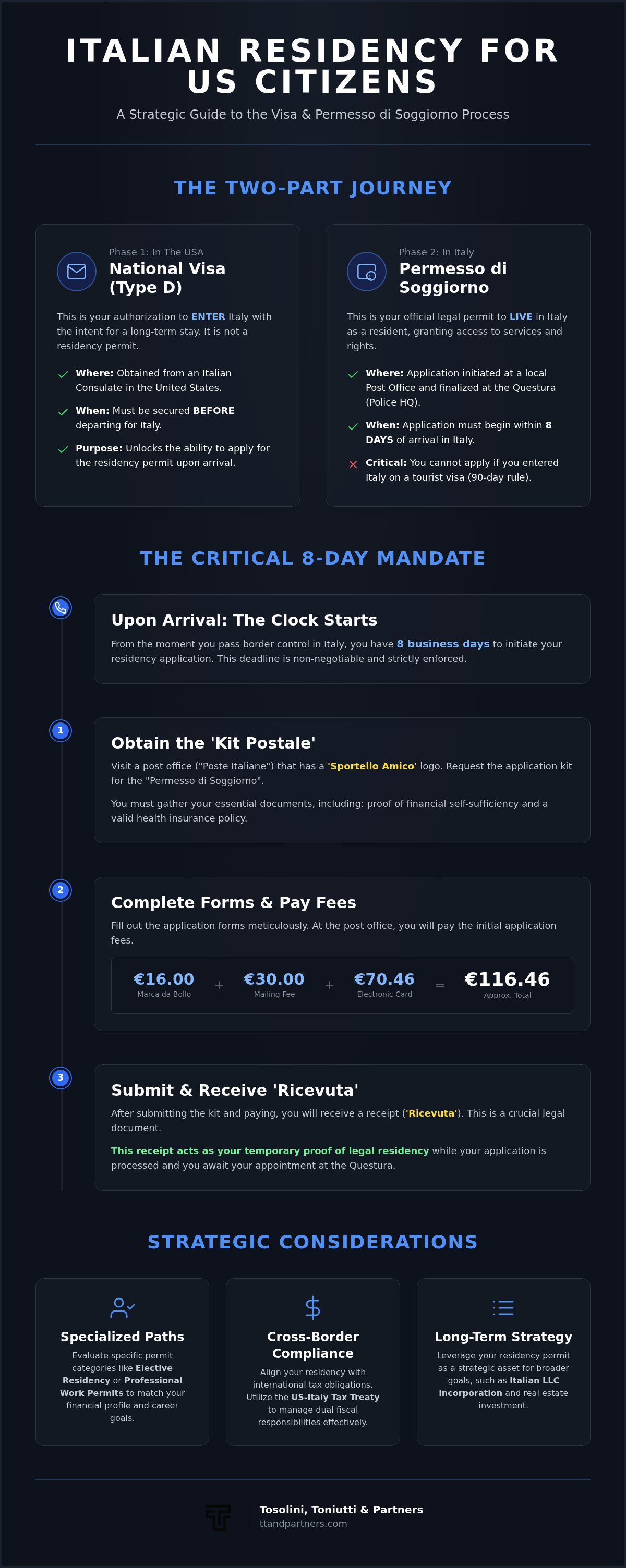
The 90 day rule serves as the primary boundary. Within the Schengen Area, US citizens can travel freely for up to 90 days in any 180 day period; however, this status is strictly for tourism or business meetings. To remain beyond this limit, you must secure a National Visa (Type D) before leaving the United States. This visa isn't the residency permit itself; rather, it's the specific legal authorization that permits you to enter Italy with the intent to stay. Choosing the correct permit category at this early stage is a strategic necessity, as the grounds for your visa will dictate the rights and limitations of your eventual residency. For a foundational perspective, this Permesso di Soggiorno Overview details the document's role within the broader European framework.
The Functional Difference Between Entry and Residency
It's helpful to view the visa and the permit as two halves of a single gateway. The visa, issued by the Italian Consulate in the United States, grants you the physical right to cross the border for a specific purpose, such as elective residency, work, or investment. Once you arrive, the permit becomes the dominant legal instrument. You can't apply for a residency permit directly within Italy if you entered as a tourist. The process is a sequential chain where the Consulate validates your initial eligibility and the local Questura (police headquarters) confirms your presence and ongoing compliance with Italian regulations.
Dual Citizenship and Residency Considerations
For some US citizens, the path to residency is paved by ancestral heritage rather than standard immigration channels. If you possess a direct line of Italian descent, you may be eligible for citizenship through Jure Sanguinis. This path bypasses the standard permit system entirely, as it recognizes you as a citizen from birth. Holding an Italian passport provides unrestricted residency throughout the European Union, removing the need for renewals or specific work authorizations. If you believe you qualify for this lineage based transition, seeking professional guidance can help clarify the documentation required to reconcile your US status with your Italian heritage and ensure a seamless integration into the Italian social fabric.
The 8-Day Mandate: Procedural Steps Upon Arrival in Italy
Arriving in Italy marks the transition from strategic planning to administrative execution. The first eight days of your stay are defined by a strict legal requirement to initiate the permesso di soggiorno for US citizens. This window is non-negotiable. It begins the moment you pass through border control or, if arriving from another Schengen country, the moment you file a declaration of presence. Missing this deadline can lead to complications with your residency status, potentially affecting your ability to travel or open local bank accounts.
The process centers on the 'Kit Postale', a specific application package available at post offices featuring the 'Sportello Amico' logo. You'll need to pay approximately €116.46 in initial fees, which covers the €16.00 administrative stamp, the €30.00 mailing fee, and the €70.46 electronic residence card fee. Once the post office accepts your kit, you'll receive a 'Ricevuta'. This receipt is a vital legal document. It serves as your temporary proof of legal residency while your application is pending, allowing you to remain in the country and even travel back to the United States under specific conditions.
The Application Package: Essential Documentation
Compiling the documentation requires meticulous attention to detail. You must demonstrate financial self-sufficiency, particularly if your income is derived from US-based sources. This often involves providing bank statements or tax returns that meet the minimum income thresholds set for 2026. Health insurance is equally critical; US citizens must present a policy that provides coverage within Italy, as US-based domestic plans are rarely accepted by the Questura. Ensuring these documents are professionally translated where necessary is a step that often requires expert legal oversight to avoid common filing errors.
The Biometrics Appointment and Final Issuance
The post office will provide you with an appointment date at the local Questura (Police Headquarters). During this meeting, officials will collect your fingerprints and verify the original versions of the documents you submitted in your postal kit. In 2026, processing durations vary by province, but applicants should prepare for a timeline of several months before the final electronic card is ready. Once approved, you'll receive a notification to return to the Questura for the collection of your residency card, which serves as your primary identification within Italy and the broader European Union.
Permit Categories for US Professionals and Investors
Selecting the appropriate residency category is a foundational decision that dictates your legal and financial flexibility within the European Union. For many, the permesso di soggiorno for US citizens is more than a residency document; it's a strategic tool for lifestyle design or business expansion. While some prioritize leisure, others seek to leverage Italy’s unique position within the Mediterranean market. Each path carries distinct requirements that must be reconciled with your long term professional goals.
The Elective Residency Trap: Passive Income Rules
The Elective Residency Permit remains a popular choice for retirees and high-net-worth individuals who don't intend to work in Italy. However, it requires absolute adherence to passive income rules. You've got to prove substantial recurring income from pensions, real estate rentals, or investment dividends. A common reason for denial among US applicants is the attempt to maintain active roles in US-based businesses. Under this status, any form of active employment, even remote work for a US employer, is strictly prohibited. This "trap" often surprises entrepreneurs who assume their US-sourced salary qualifies as passive wealth.
Investor and Entrepreneurial Paths
For those seeking active engagement, the Investor Visa offers a streamlined path. Unlike the US system, the Italian investment is only required after the visa is approved. Thresholds for 2026 include €250,000 for innovative startups or €500,000 for established companies. This path is often compared to the E-2 Visa Guide 2026: The Strategic Framework for Treaty Investors, though the Italian version provides a unique flat tax regime. As of January 1, 2026, new residents can opt for a flat annual tax of €300,000 on all foreign-source income, providing significant clarity for global wealth management.
Work permits, including the Lavoro Subordinato and Autonomo categories, are subject to the Decreto Flussi quotas. For 2026, the government has allocated 164,850 places for non-EU workers, with specific "click days" in January and February. Alternatively, the Digital Nomad Visa requires a minimum annual income of €28,000 and "highly qualified" professional status. Regardless of the path, securing a 'Nulla Osta' (security clearance) remains a critical precursor for work related permits. Finally, family reunification permits allow you to bring dependents, ensuring your residency strategy supports your entire household's integration into Italian life.
Cross-Border Compliance: Tax and Legal Considerations
Securing the permesso di soggiorno for US citizens is an administrative milestone, but it also triggers a shift in your global legal and fiscal profile. Many applicants conflate legal residency with fiscal residency; however, these concepts are governed by distinct criteria. While your residency card grants you the right to inhabit Italy, the 183-day rule determines where you owe taxes. If you spend more than 183 days in the country within a calendar year, the Italian government considers you a fiscal resident. This status subjects your worldwide income to Italian taxation, regardless of where that income is earned.
The US-Italy Tax Treaty exists to prevent double taxation, yet it doesn't exempt you from local reporting requirements. Italy imposes specific wealth taxes on assets held outside its borders. These include the IVIE, which is a 1.06% tax on foreign real estate, and the IVAFE, a 0.2% tax on foreign financial assets. Managing these overlapping obligations requires a dual-jurisdiction strategy that respects both Italian bureaucratic reality and US federal mandates. It's a delicate balance of transparency and optimization.
US Tax Obligations for Expats in Italy
It's a common misconception that moving abroad ends your relationship with the IRS. As a US citizen, you're subject to citizenship-based taxation. You must file US tax returns annually. For the 2026 tax year, the Foreign Earned Income Exclusion allows qualifying expats to exclude up to $132,900 of earned income. Additionally, Foreign Tax Credits can often offset Italian taxes paid, preventing you from paying twice on the same Euro. You must also report foreign bank accounts via FBAR if the aggregate value exceeds $10,000 at any point during the year. Compliance is mandatory.
Legal Protection and Dispute Resolution
Living in Italy doesn't insulate you from legal complexities in the United States, nor does it simplify Italian property disputes. Whether you're managing a real estate closing or navigating a commercial disagreement, having a legal partner who understands both systems is indispensable. For those facing more complex conflicts, our International Litigation 2026: A Strategic Guide to US-Italy Legal Disputes provides a framework for protecting your interests across borders. If you require personalized assistance with your residency or cross-border assets, we invite you to consult with our specialized legal team to ensure your transition remains compliant and secure.
Integrating Residency with US-Italy Business Strategy
For US entrepreneurs, the permesso di soggiorno for US citizens is more than a legal formality; it's a strategic entry point into the European single market. Securing residency allows you to manage local operations with a level of agility that remote management cannot replicate. It facilitates face-to-face negotiations, simplifies the opening of local commercial bank accounts, and provides the legal foundation required for many high-level business transactions. When your residency is integrated with a robust corporate framework, it transforms from a personal permit into a powerful business asset.
A critical component of this integration is the alignment of your US entities with Italian regulations. Understanding how to bridge your domestic success with overseas requirements often involves LLC Incorporation: A Strategic Guide to US Business Architecture in 2026. This ensures that your business structure supports your residency goals rather than complicating them. For international trade managers, holding a residency permit provides the legal stability needed to oversee complex supply chains and Mediterranean trade routes without the constraints of the 90-day tourist limit.
The Role of Corporate Structure in Residency
The choice between establishing an Italian branch or a subsidiary is a decision that ripples through your immigration strategy. A branch may offer certain tax simplifications, while a subsidiary provides a distinct legal personality that can sponsor specific work-related permits. This is particularly relevant for those operating under the E-1 Treaty Trader Visa: The 2026 Strategic Guide for International Business framework. Managing employees across borders requires a corporate architecture that respects both US labor expectations and Italian social security mandates, ensuring your expansion remains sustainable and compliant.
Next Steps: Consultation and Relocation Planning
The complexity of dual-jurisdiction compliance makes a pre-relocation legal audit a necessity for any high-net-worth individual or business owner. We believe that a successful move is built on a foundation of intellectual precision and proactive planning. Tosolini, Toniutti & Partners manages the end-to-end residency process, acting as the essential bridge between US expectations and the intricate reality of Italian bureaucracy. We coordinate the initial visa application, the filing of the permesso di soggiorno for US citizens, and the underlying corporate or real estate legalities. To begin your transition with confidence, you may contact our experts for a personalized Italian residency strategy tailored to your professional vision.
Securing Your Mediterranean Legacy
Establishing your life in Italy is a sophisticated endeavor that requires a synthesis of legal precision and strategic foresight. Success depends on more than just meeting the eight-day filing deadline; it requires a holistic approach that aligns your residency status with your long-term fiscal and professional objectives. Whether you're navigating the nuances of the elective residency path or integrating a complex corporate structure, the permesso di soggiorno for US citizens serves as the legal cornerstone of your new Mediterranean chapter.
Managing these cross-border complexities alone often leads to administrative friction or unforeseen tax liabilities. Tosolini, Toniutti & Partners specializes in US-Italy cross-border law, providing the expertise needed to resolve complex residency and citizenship cases. From initial visa strategy to comprehensive corporate and litigation support, our dual-jurisdiction team acts as your bridge between American expectations and Italian reality. We invite you to Secure Your Italian Residency - Contact Tosolini, Toniutti & Partners to begin your journey with confidence. Italy is not just a destination; it's a legacy you're building with every calculated step.
Frequently Asked Questions
Do US citizens need a visa to stay in Italy for more than 90 days?
Yes, US citizens must secure a National Visa (Type D) to remain in Italy beyond the 90-day tourist limit. This visa serves as the essential precursor for the residency permit. You must apply for it at the Italian Consulate with jurisdiction over your US residence before your departure. Entering as a tourist doesn't allow for a status adjustment within Italy; the visa establishes your specific legal grounds for a long-term stay.
How long does it take to get a Permesso di Soggiorno in 2026?
The timeline for a permesso di soggiorno for US citizens typically spans several months from the initial filing. While you must submit your application within eight days of arrival, the appointment for biometrics at the Questura often occurs weeks or months later. In 2026, processing durations vary by province. Your postal receipt serves as your legal proof of residency while the electronic card is being manufactured and finalized by the national authorities.
Can I work in Italy with a Permesso di Soggiorno for Elective Residency?
No, the Elective Residency Permit strictly prohibits any form of active employment or work activities within Italy. This category is designed for individuals with significant passive income, such as pensions, dividends, or rental returns. If you intend to engage in professional work or manage an Italian business, you should instead pursue a work permit or an investor visa. These provide the necessary legal authorization for active economic participation in the local Mediterranean market.
What happens if I miss the 8-day deadline to apply for the permit?
Missing the eight-day mandate can lead to serious legal consequences, including the potential denial of your residency application. Italian authorities strictly enforce this window as it marks your formal transition from a visitor to a resident. If you fail to file within this timeframe, you may be considered as staying in the country illegally. It's vital to prioritize the "Kit Postale" filing immediately upon your arrival to ensure your status remains fully compliant and secure.
Is the Permesso di Soggiorno the same as permanent residency?
No, a standard permit is a temporary residency document that requires periodic renewal based on its specific expiration date. Permanent residency, known as the EU Long-Term Residence Permit, is generally only available after five years of continuous legal residence in Italy. This long-term status provides greater stability and fewer renewal requirements. Most US citizens begin with a one or two-year permit before eventually qualifying for the permanent European residency framework after the required duration.
Can I bring my family to Italy on my residency permit?
Yes, you can bring your family members through the family reunification process. This typically requires demonstrating adequate housing and sufficient financial resources to support your dependents without relying on the Italian social system. Each family member will receive their own residency authorization linked to your primary permit. It's a strategic way to ensure your entire household transitions together while maintaining a unified legal standing within the Italian and European administrative systems during your long-term stay.
Does getting a residence permit in Italy affect my US citizenship?
Obtaining a permesso di soggiorno for US citizens has no direct impact on your US citizenship. You remain a US citizen with all associated rights and obligations. However, it does trigger significant cross-border tax responsibilities. You'll need to continue filing US tax returns and reporting foreign assets to the IRS. While your citizenship remains unchanged, your fiscal profile becomes more complex, requiring a coordinated strategy to manage the tax treaties between the United States and Italy.
How do I renew my Permesso di Soggiorno from the United States?
You cannot renew your residency permit from within the United States. The renewal process must be initiated in Italy at a local post office or Questura before your current permit expires. Typically, you should start this process at least 60 days before the expiration date. Because the procedure requires physical presence for biometrics and document submission, you must plan your international travel to ensure you're in Italy during this critical administrative window for your stay.


Comments