

Apply for a Permesso di Soggiorno in Italy: 2026 Checklist

If you’re researching how to apply for permesso di soggiorno in Italy, start by identifying the route that fits your reason for staying, not by assembling a generic document bundle. The permit route, application process, and logistics of moving are connected, but they are not interchangeable.
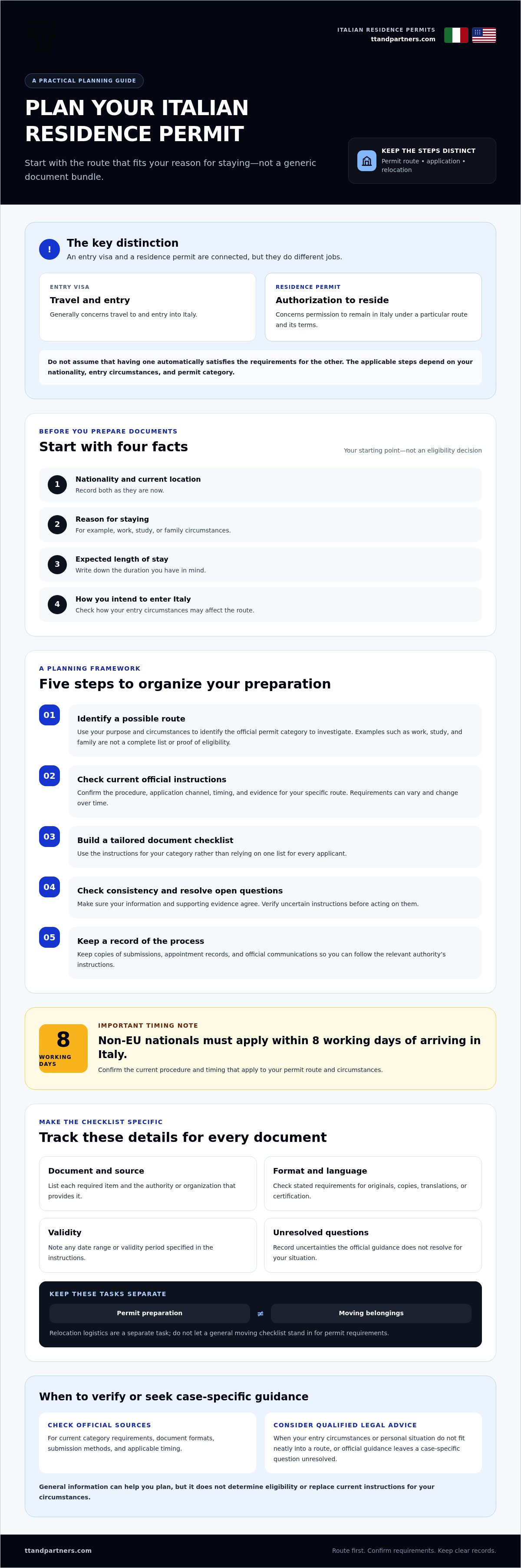
That distinction matters: requirements can vary by permit category and individual circumstances, while non-EU nationals must apply within eight working days of arriving in Italy. An entry visa and a residence permit also serve different purposes, and arranging your belongings is a separate relocation task. Treating these as one checklist can leave important questions unresolved.
This guide will help you identify a route to investigate before relocating, build a practical checklist around your circumstances, and understand the broad application sequence without mistaking general information for legal advice. It also separates residence-permit preparation from planning a move. Procedures and supporting documents can differ by category and change over time, so confirm current requirements through official sources and seek case-specific guidance when needed.
Table of Contents
What Is an Italian Residence Permit, and Who May Need One?
An Italian residence permit is authorization for a foreign national to reside in Italy under a particular route and its applicable terms. It is not simply another name for a visa. The overview of Italy’s residence permit offers background, but your circumstances determine which current official instructions to follow.
An entry visa generally concerns travel to and entry into Italy; a residence permit concerns authorization to remain there. The documents can be connected, but they serve different functions. Whether a visa is required, how it relates to a permit, and what steps follow entry depend on factors such as nationality, the circumstances of entry, and the intended permit category. No single sequence safely describes every applicant’s case.
How a residence permit differs from an Italian visa
A visa may be part of the process for someone planning a longer stay, while the residence permit addresses the right to reside under a specific basis. Don’t assume that holding one automatically satisfies the requirements for the other. Before travel or an application, check official guidance for your nationality and proposed route, including any applicable timing, submission method, and supporting evidence.
Which circumstances can affect the application route?
Your purpose for staying helps determine which official permit category to investigate. Work, study, and family circumstances are examples, not a complete list, and mentioning a category does not establish eligibility. Describe your intended stay accurately, then compare it with the relevant official category and its current requirements.
For a first review, write down:
Your nationality and current location.
Why you plan to stay in Italy.
Your expected length of stay and how you intend to enter.
These details can help you avoid preparing for a route that does not fit your situation. They also help you identify questions to resolve before committing to relocation arrangements. A general guide can explain the distinction between entry and residence, but it cannot determine your eligibility or replace current instructions from the relevant authorities.
Once you have identified a possible route, verify its rules against official sources. If your entry circumstances or purpose do not fit neatly into a category, qualified legal guidance can help clarify what to investigate before you decide how to proceed.
Before You Apply: Identify Your Route and Prepare Your Move
Before booking a move or assembling paperwork, make a clear record of the facts that may shape your application. Note your nationality, current location, reason for staying in Italy, and planned duration. These details are a practical starting point for identifying the official permit category to investigate, but they do not establish eligibility or confirm which procedure applies.
Check the relevant official instructions before making relocation commitments that would be difficult to reverse. The route, application channel, timing, and evidence can depend on your circumstances and may change. Use online checklists as prompts for research, not substitutes for current instructions for your permit category.
Build a route-specific preparation checklist
Once you have identified a possible category, use its official guidance to build your document list. For each item, record who issues it, the required format, whether a translation or other presentation is specified, and how long the document remains valid. Confirm each point against current instructions instead of assuming a document prepared for one route will work for another.
Route: The official permit category that appears relevant to your purpose.
Documents: Each listed item and the authority or organization that provides it.
Format and language: Any stated requirements for copies, originals, translations, or certification.
Validity: Whether the instructions specify a date range or validity period.
Open questions: Any uncertainty about your circumstances that the official guidance does not resolve.
Questions about how your entry circumstances or personal situation affect the route may call for qualified legal advice. That is different from confirming a document’s format, which you should check in the relevant official instructions. If the route remains unclear, contact the firm about Italian immigration assistance for case-specific guidance.
Keep household belongings on a separate relocation checklist
Residence authorization and the treatment of personal belongings are separate matters. A permit application does not, by itself, answer which rules may apply to items you bring or ship. Check current official customs guidance for your circumstances, and don’t rely on general assumptions about exemptions, declarations, duties, or import procedures.
For any enquiry, gather a basic record of the belongings involved, including an inventory, ownership information, timing, and intended destination. Keeping this information separate from your permit documents helps you direct each question to the appropriate official source. It also gives you a more organized basis for planning while you verify the application route relevant to you.
How to Apply for a Permesso di Soggiorno: A Practical Checklist
Use the steps below as a planning framework, not a universal procedure. The correct application channel, timing, and supporting evidence can depend on your permit category, nationality, and circumstances. Before acting, confirm the current instructions for your route through official sources. This guide can help organize that check, but it cannot replace the applicable instructions or case-specific legal advice.
Document lists vary by permit route, so confirm every requirement against the official guidance for your category.
Confirm the current submission channel and timing
Start with the instructions that match your intended permit category and circumstances. Verify where an application must be submitted, whether an appointment is required, and what deadline applies to your situation. Don’t rely on a channel or timing rule copied from a different category or an older online checklist.
Save or print the official instructions you relied on, and note the date you checked them. Keep any submission confirmation or other evidence of filing with those instructions. A dated record makes it easier to track what guidance applied when you prepared your application.
Assemble and check supporting documents
Organize your papers by purpose before completing forms. Identity records are a useful starting point, but confirm which ones are required for your case. Add route-specific evidence only after checking the instructions, rather than assuming another applicant’s document list applies to you.
Identity: List the identity records requested for your application and check whether originals, copies, or a particular format are specified.
Entry or current status: Identify any records related to how you entered or your current status that the route requires.
Purpose of stay: Gather evidence supporting the reason for your application, as specified for that category.
Additional evidence: Note any other documents the official instructions request for your circumstances.
For each item, confirm the issuing authority, language, translation or authentication rules, format, and validity period. If a requirement is unclear, ask the relevant authority or seek qualified advice before submitting. Retain copies of the completed form and supporting documents, and record any receipt or reference details provided.
What to verify before submitting
Check that the application form and every supporting document correspond to the same permit route, and that names and other identifying details are consistent. Confirm current fees, appointment requirements, submission instructions, and any additional procedural steps through official sources. These details may differ across categories and circumstances.
If you are unsure how the instructions apply to your case, request Italian immigration legal guidance before relying on assumptions. A careful final review can help you identify questions early, while the relevant authority’s current instructions remain the reference for filing.
What Can Delay an Application, and Which Requirements Need Separate Checking?
A single checklist cannot safely cover every residence-permit category. Evidence, submission details, and other requirements may differ according to the route and the applicant’s circumstances. Before relying on general guidance, verify the requirements for your specific category against current official instructions. An example list can help you prepare questions, but it cannot replace that check.
Preparation gaps can create avoidable uncertainty. A name on a form may be spelled differently from the name on a supporting record, a document may be incomplete or no longer valid, or online instructions may not reflect the current procedure. These issues do not mean an application will necessarily be delayed or refused, but they can make it harder to confirm that your submission is complete and consistent.
Common preparation gaps to check before submission
Set aside time for a final comparison of the application form and its supporting evidence. Review identifying details, dates, and the stated reason for the application. Then check each item against the latest official instructions for your permit category, including any specified format or validity requirements.
Compare names, dates, and other identifying details across the form and records.
Confirm that each required document is complete and meets the current instructions.
Check that you’re using guidance for your own permit route, not an old checklist or another applicant’s account.
Personal accounts can offer context about someone else’s experience, but they do not establish what applies to your case. If a requirement is unclear, verify it with the relevant official source rather than filling the gap with an assumption.
Keep permit, visa, and belongings requirements distinct
Immigration questions concern your permission to enter or reside in Italy and the procedure linked to your route. Questions about household belongings concern the movement of personal property, which is a separate matter. A visa or residence permit does not, by itself, establish how customs rules apply to items you bring or ship.
Check current official customs guidance for questions about personal belongings, and don’t infer exemptions, duties, declarations, or import steps from your immigration status. Keep a separate record of your relocation timing and relevant documents. If your planned move and permit preparation affect one another, ask a qualified professional to review the circumstances rather than assuming one checklist answers both sets of questions.
Careful source-checking is central to understanding how to apply for permesso di soggiorno in Italy without treating broad guidance as case-specific advice. If you need help assessing how your circumstances relate to Italian immigration requirements, request Italian immigration legal guidance.
After Submission: Track the Process and Decide When to Seek Legal Help
Submitting an application is a milestone, not a guarantee of approval or a reliable indicator of when a decision will arrive. Procedures and outcomes can differ according to the permit route and individual circumstances. After filing, keep your records organized and use the follow-up method specified by the relevant authority rather than relying on informal estimates or another applicant’s experience.
Create a reliable record of your application
Keep a dated file, digital or paper, containing the application form, supporting documents, submission confirmation, receipts, appointment records, and official correspondence. Record any reference numbers provided, along with the date and source of each notice. A clear timeline can help you respond accurately if the authority requests further information or you need to clarify a message.
Save copies of everything submitted, including the final version of each form.
Keep receipts, appointment details, reference numbers, and follow-up instructions together.
Note the date of official communications and any response steps they specify.
For status checks or additional requests, follow the instructions issued for your application. If a notice is unclear, use the relevant authority’s official channel to ask what action is required. Avoid interpreting a message from memory or relying on a general online post, especially if it could affect how or when you respond.
When case-specific legal guidance may be useful
Consider qualified advice if you’re uncertain about the correct permit route, the timing that applies to your circumstances, or how to address a request for further evidence. Professional review may also help when your personal situation does not fit the assumptions behind a standard checklist. Bring your application records and relevant communications so your questions can be considered in context.
Understanding how to apply for permesso di soggiorno in Italy includes knowing what to do after submission, while recognizing that general guidance cannot determine an individual outcome. For support with a specific Italian immigration matter, you can discuss Italian immigration assistance with Tosolini, Toniutti & Partners. Case-specific guidance can help clarify the issues to address, but no particular decision or processing time can be guaranteed.
Move Forward With a Clear, Case-Specific Plan
Understanding how to apply for permesso di soggiorno in Italy starts with identifying the route that fits your reason for staying, then checking its current official instructions. A well-organized checklist can help you prepare identity records and route-specific evidence, but no single document list applies to every applicant. Keep residence-permit tasks distinct from the separate questions involved in moving personal belongings.
After submitting, preserve your forms, receipts, appointment records, and official communications. Follow the relevant authority’s instructions for status checks or further requests, and seek qualified guidance if your route, timing, or evidence is unclear. General information can help you plan, but it cannot determine your eligibility or guarantee an outcome.
Tosolini, Toniutti & Partners provides Italian immigration assistance, including residence-permit support, for clients navigating matters between the United States and Italy. To discuss your circumstances, discuss your Italian residence permit application. With a verified route and a carefully prepared file, you can approach the next steps with greater clarity.
Frequently Asked Questions
How do I apply for a permesso di soggiorno in Italy?
Start by identifying the permit category that matches your reason for staying, then follow the current official instructions for that route. The submission channel, timing, and supporting evidence may depend on your nationality and circumstances. Organize identity, entry or status, purpose-of-stay, and other requested documents, and check their format and validity before filing. Keep copies of your application and any confirmation or reference details you receive.
When should I apply for a permesso di soggiorno?
Apply within the deadline that applies to your permit category and circumstances. Guidance for non-EU nationals states that applications are generally due within eight working days of arrival, but confirm the current rule and procedure for your specific route through official Italian sources. If you’re planning a move, check timing before travel so you can prepare the relevant documents and understand what steps may follow your arrival.
What documents do I need for a permesso di soggiorno?
The required documents depend on the permit category, so there isn’t one complete list for every applicant. You may need identity records, documents relating to entry or current status, and evidence supporting your reason for staying, along with other route-specific items. Follow the official checklist for your case. Before submitting, confirm requirements for translations, authentication, document format, and validity, and keep copies of everything you provide.
Can I apply for a permesso di soggiorno without an Italian visa?
Whether you need a visa before applying depends on your nationality, how you enter Italy, and the permit route involved. A visa concerns entry, while a residence permit concerns authorization to reside, and the relationship between them is not identical in every case. Don’t assume that visa-free entry removes other residence requirements, or that every applicant must follow the same sequence. Check official guidance for your circumstances before making travel plans.
How long does it take to get a permesso di soggiorno?
There’s no single processing time that applies to every application. The timeline can vary with the permit category, individual case, and steps required by the relevant authority. Check current official information and any appointment or follow-up instructions you receive, but avoid treating another applicant’s timeline as a reliable estimate for your case. Keep records of your submission and communications so you can follow the process through the appropriate official channel.
Does a permesso di soggiorno let me bring my personal belongings to Italy?
No, a residence permit doesn’t by itself determine how customs rules apply to personal belongings you bring or ship. Immigration authorization and the movement of household goods are separate questions. Check current official customs guidance for your circumstances rather than assuming that permit status establishes any exemption, declaration, duty, or import procedure. Keeping a separate inventory and record of ownership, timing, and destination can help you make a focused enquiry.
Can I renew or change my permesso di soggiorno?
Renewal or a change of permit route may be possible in some circumstances, but the rules and required evidence depend on your current permit and the reason for seeking a change. Don’t assume that renewal or conversion is automatic, or that the same deadline applies to every category. Check current official instructions before your permit expires or your circumstances change. If the right route or timing is unclear, consider qualified, case-specific legal guidance.


Comments