

How to Register a Foreign Birth in Italy: A 2026 Guide

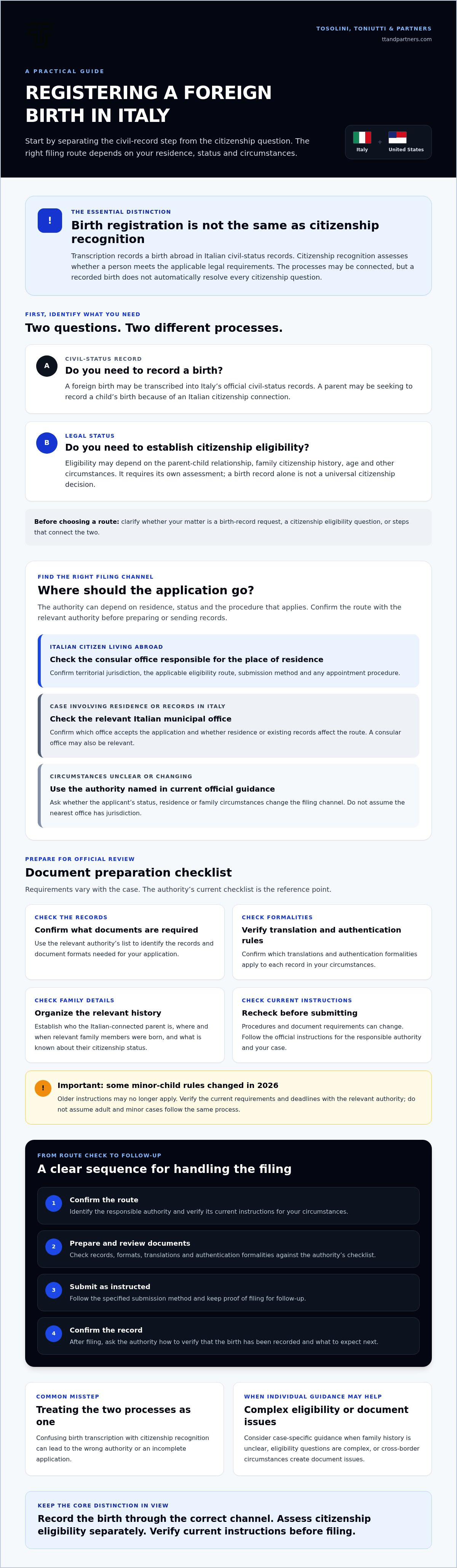
Registering a foreign birth in Italy and confirming Italian citizenship are two different steps. Treating them as one process can send you to the wrong authority or leave your application incomplete. If you’re researching how to register a foreign birth in Italy, first determine whether you’re recording a minor child’s birth or seeking citizenship recognition in a separate case.
It’s understandable to feel uncertain: filing authorities, document formats, authentication and translation requirements can vary with your circumstances. For an Italian citizen living abroad, the relevant consulate is generally the starting point for registering a child’s birth. Citizenship eligibility requires its own assessment. Rules and deadlines for some minor-child registrations changed in 2026, so older instructions may no longer apply.
This guide explains the distinction, how to identify the authority and filing route to check, and how to prepare documents for official review. It also covers when complex eligibility questions, cross-border circumstances or document issues may make individual legal guidance useful.
Table of Contents
What Does It Mean to Register a Foreign Birth in Italy?
Registering a foreign birth in Italy means having a birth that took place outside the country transcribed, or formally recorded, in Italian civil-status records. This adds the foreign birth to Italy’s system of official records. It is a civil-record step, not a universal decision that everyone involved qualifies for Italian citizenship.
That distinction matters. A parent may seek to record a child’s birth because of an Italian citizenship connection. An adult born abroad may instead need to establish whether they qualify under the rules that apply to their family history and circumstances. Before deciding how to register a foreign birth in Italy, clarify whether you need to record a birth, establish citizenship eligibility, or complete steps that connect the two.
Birth registration and Italian citizenship: how are they different?
Transcription records an event; citizenship recognition addresses legal status. The first concerns how a foreign birth is entered in Italian records. The second requires assessing whether the person meets the applicable citizenship rules. The processes may be related, but a recorded birth should not be treated as an automatic guarantee that every citizenship question has been resolved.
Citizenship claims may depend on the parent-child relationship and other details in the family’s history. The general background to Italian nationality law can help explain citizenship by descent, but it cannot determine an individual’s eligibility. Rules can change, so verify the framework that currently applies to your circumstances with the relevant authority or a qualified legal professional.
Who may need to ask about registering a foreign birth?
People born outside Italy who have an Italian parent or another possible citizenship connection may need to find out whether their birth should be recorded and which procedure applies. The answer can depend on facts such as the applicant’s age, the parent’s status and the family’s citizenship history. Establish these details before choosing a filing route.
Adult and minor cases may have different requirements, so check current rules rather than assuming they follow the same process. Start by organizing the basic facts: who the Italian-connected parent is, where and when relevant family members were born, and what is known about their citizenship status. If the family history is incomplete or the legal position is unclear, case-specific guidance may help you distinguish a record request from a citizenship determination before proceeding.
Which Italian Authority Should Receive a Foreign-Birth Registration?
The filing authority depends on your residence, status and the procedure that applies to your case. For an Italian citizen living abroad, the consular office responsible for that person’s place of residence is generally the first authority to check. An Italian municipal office may be involved in some circumstances. Don’t assume the same route applies to every family or that the nearest office has jurisdiction.
Use this table to identify where to begin, then confirm the route directly with the relevant authority. The details are a starting point, not a substitute for current, case-specific instructions.
Applying from outside Italy through a consular channel
Identify the consular authority responsible for your residence, rather than choosing the one that is easiest to contact. Check its current birth-registration instructions for who may apply, the required document format, the submission method and any appointment rules. Procedures can change, so confirm them on the authority’s official website before preparing or sending records. As one example of consular guidance, review these official registration requirements, then check the instructions of the office responsible for your own case.
When an Italian municipality may be involved
A municipal office may be relevant in some cases, but residence in Italy alone doesn’t establish which route applies. Ask the relevant authority to confirm who should receive the documents and whether another office must take part. Also distinguish the registry for Italian citizens living abroad from birth-record transcription. They are related administrative concepts, not interchangeable procedures. Check whether either affects how your application is handled.
If the authority or route remains unclear, resolve that question before filing. For complex citizenship or cross-border circumstances, Italian citizenship guidance may help you identify which issues need individual review.
What Documents and Formalities Might a Foreign-Birth Application Require?
There isn’t one document set for every foreign-birth registration. Use the receiving authority’s current checklist, since requirements can depend on your circumstances and where the record was issued. Treat the examples below as items to ask about, not as a guaranteed or complete list.
Before requesting records or arranging formalities, confirm the filing route and ask the responsible authority which versions it accepts. This can help avoid preventable problems, such as submitting a record that lacks information the office needs or preparing a translation in a format it won’t accept.
Build a case-specific document checklist
Ask whether the authority requires a long-form, certified or otherwise specific version of the birth record. Depending on the case, it may also request records establishing parentage or identity, such as a parent’s birth or citizenship record or identity document. Check each item against the receiving authority’s latest instructions before ordering it.
Compare names, dates and family details across all records. A spelling difference, a name change or inconsistent dates can prompt questions about how the documents relate to one another. Don’t alter official records yourself. If a discrepancy has a legitimate explanation, ask the authority what supporting evidence it accepts and how to present it.
Check translation, apostille, and certification rules
Foreign records may need formal authentication or translation, but the required steps depend on the issuing jurisdiction and the receiving authority’s rules. Before arranging an apostille, legalization, certification or translation, verify whether it is required for your document and which process the authority accepts.
Confirm the details as well: whether the authority needs an original or certified copy, whether it accepts a particular translation provider or format, and whether any validity limits apply. Requirements can differ between authorities and may change. A checklist from another consular office may not match the requirements for your case.
For a practical pre-filing review, organize the potential requirements in a simple table or checklist:
Birth record: Ask which certificate version and certification status are accepted.
Parentage and identity records: Confirm which records apply to your relationship and case.
Authentication: Check whether an apostille, legalization or another formality is required.
Translation: Verify whether translation is needed and which format or provider is acceptable.
Consistency: Compare names, dates and family details, and ask how to document any differences.
Careful preparation is central to how to register a foreign birth in Italy, but the competent authority’s current instructions remain decisive. If your records conflict or your family circumstances make the checklist difficult to interpret, seek case-specific guidance before submitting your application.
Submit Application and Respond to Follow-Up Requests
A well-organized application starts with choosing the right route, not with sending documents. Confirm that the authority you identified handles your case, then follow its current instructions. Channels, forms, appointment procedures and processing times can change, so verify each detail directly with the receiving authority before submitting.
Use this sequence to keep the process clear:
Confirm your case and filing route. Check that you’re using the procedure appropriate to the applicant’s circumstances.
Review the current checklist. Follow the receiving authority’s instructions, not a general online list or another office’s requirements.
Prepare and inspect the records. Compare names, dates, family details, signatures and copies against the checklist. Resolve inconsistencies or ask how to explain them before filing.
Submit as instructed. Confirm the accepted channel and whether an appointment, form or particular document format is required.
Keep a complete record. Save a copy of everything submitted and retain any receipt, confirmation or correspondence.
Prepare and submit a complete application
Before submitting, check that every required item is present and legible, and that copies or certifications match the authority’s instructions. Keep the documents in an orderly file so you can identify what was sent if the office follows up. An application that appears complete does not guarantee approval or establish a predictable decision date. The authority must assess the case under the applicable process.
What to do if the authority requests more information
Read any follow-up request carefully. Identify the specific record, clarification or correction sought, then confirm the response channel and deadline directly with the authority. Don’t assume there is a standard response period. Keep a copy of your reply and supporting material, along with proof that you sent it.
If the request raises questions about citizenship eligibility, conflicting family records or cross-border legal issues, consider getting case-specific advice before responding. A focused review can help clarify what the authority is asking and how the issue relates to your circumstances.
For help assessing a complex Italian citizenship or cross-border issue, contact the firm about your case.
After Registration: Verify the Record and Decide on Your Next Step
Once the authority confirms that the birth has been recorded, check what the confirmation establishes and whether further steps apply to your circumstances. If you need formal evidence, ask the office how to request confirmation or an extract from the civil-status record. The process depends on the authority, so follow its current instructions rather than assuming a particular format or delivery method.
Confirm what the registration outcome establishes
Review the confirmation or record carefully. Check that names, dates and other identifying details match the supporting documents. If you spot an error, ask the issuing authority how to request a correction. Keep the confirmation with your family records and ask whether any related administrative registration steps are needed in your case.
A birth entry is not, by itself, a universal determination of citizenship status. Its legal effect depends on the relevant facts and rules, including the circumstances of the parent-child relationship. If you need to know whether the registration confirms citizenship or whether a separate assessment is required, check with the competent authority or qualified legal counsel.
When cross-border legal guidance may be useful
Tailored advice may help if parentage is complex, family records contain discrepancies or your eligibility remains unclear after the authority’s response. These issues can involve both foreign documentation and Italian citizenship rules, which may change. A professional review can help identify the questions that need resolution, without replacing the authority’s decision or promising a particular outcome.
Tosolini, Toniutti & Partners works on US-Italy cross-border immigration matters and lists Italian citizenship among its services. If your next step depends on how the recorded birth relates to your family’s citizenship circumstances, you can review the firm’s Italian citizenship guidance options and request case-specific legal guidance.
In short, treat the record and citizenship status as related but distinct matters. As you consider how to register a foreign birth in Italy, keep the authority’s confirmation, verify whether any further registration or citizenship procedure applies, and seek individual guidance if the facts are not straightforward.
Take the Next Step With Clarity
Knowing how to register a foreign birth in Italy starts with separating the civil-record process from the question of citizenship eligibility. The right authority depends on your residence and circumstances, and you should confirm document, translation and authentication requirements against its current instructions. Once the birth is recorded, review the official confirmation and ask whether any further steps apply to your case.
Where family records conflict, parentage is complex or citizenship status remains uncertain, individual legal guidance may help clarify the issues. Tosolini, Toniutti & Partners focuses on US-Italy cross-border legal matters, and Italian citizenship is among the firm’s services. Discuss your Italian citizenship questions with the firm.
With the filing route confirmed and your records carefully prepared, you can move forward with a clearer understanding of what registration does and what it doesn’t decide.
Frequently Asked Questions
How do I register a foreign birth in Italy?
First identify whether you’re seeking to record a birth, establish citizenship eligibility or address both questions. If you’re an Italian citizen living abroad and registering a child’s birth, check the Italian consular office responsible for your residence. Confirm the current procedure, application channel and document checklist directly with that authority. Prepare the requested records, submit them as instructed, and keep copies and proof of submission.
Can I register a foreign birth directly with an Italian municipality?
Possibly, but don’t assume a municipality is the correct filing authority solely because you live in Italy or have family records there. The route depends on your circumstances and the authority’s current instructions. Contact the relevant consular office or municipal authority to confirm who should receive the application, whether another office must be involved and what procedure applies before sending documents.
What documents are needed to register a foreign birth in Italy?
The required documents depend on the case and the receiving authority’s current checklist. It may ask for a birth record in a particular form, along with records relating to parentage or identity. Treat these as examples to verify, not a universal list. Check that names, dates and family details are consistent across documents, and ask how to explain any differences before submitting the application.
Does registering a foreign birth automatically grant Italian citizenship?
No. Recording a foreign birth in Italian civil-status records and determining citizenship eligibility are related but distinct matters. A recorded birth does not, by itself, resolve every question about whether a person qualifies under the rules applicable to their circumstances. If you need confirmation of citizenship status, ask the competent authority or consult qualified legal counsel familiar with the relevant facts and current legal framework.
Do foreign birth records need an apostille or Italian translation?
They may, but requirements depend on where the record was issued and the receiving authority’s current instructions. Before arranging an apostille, other authentication or an Italian translation, confirm what applies to your document and case. Ask which document format, translation method and certification are accepted. Don’t rely on another consulate’s checklist as definitive, since its requirements may not match those of the authority handling your application.
How long does it take to register a foreign birth in Italy?
There isn’t a single timeline for every application. Processing can depend on the authority, the filing route, the completeness of the documents and whether further information is requested. Check current estimates directly with the office receiving your application, and ask how to follow up. A citizenship application may be a separate process with its own timeline, so don’t assume its processing estimates apply to birth-record transcription.
Can an adult register their own foreign birth in Italy?
An adult born abroad can ask the relevant authority how their birth record should be handled, but the applicable procedure depends on their circumstances. An adult’s case may involve a separate assessment of citizenship eligibility rather than simply recording a minor child’s birth. Gather family and citizenship records, then verify the correct filing route and current requirements with the competent authority before deciding how to proceed.


Comments