

How to Choose an International Litigation Attorney for a Cross-Border Dispute

The attorney with the strongest courtroom reputation may not be the right fit for a dispute spanning countries. If your matter involves the United States and Italy, the choice of forum, applicable law, and coordination across jurisdictions may all affect the strategy. An international litigation attorney should be able to assess those cross-border issues, not just the courtroom process in one country.
It’s reasonable to ask whether a general litigation lawyer can address issues that arise across legal systems. To evaluate counsel, find out how they will identify the relevant jurisdictions, coordinate the work, and connect those decisions to your objectives. Experience with disputes involving the United States and Italy can be particularly relevant when those jurisdictions are part of your matter.
This article explains what can make a dispute international, what to look for when assessing counsel and case strategy, and what to organize before seeking legal advice. Use it to prepare for a focused discussion and assess whether an attorney’s approach fits your dispute’s cross-border complexity.
Table of Contents
When Does a Dispute Need an International Litigation Attorney?
How Jurisdiction, Evidence, and Coordination Shape International Litigation
How to Compare International Litigation Attorneys for Your Case
What to Prepare Before Speaking With an International Litigation Attorney
Choosing US-Italy International Litigation Counsel: A Practical Next Step
When Does a Dispute Need an International Litigation Attorney?
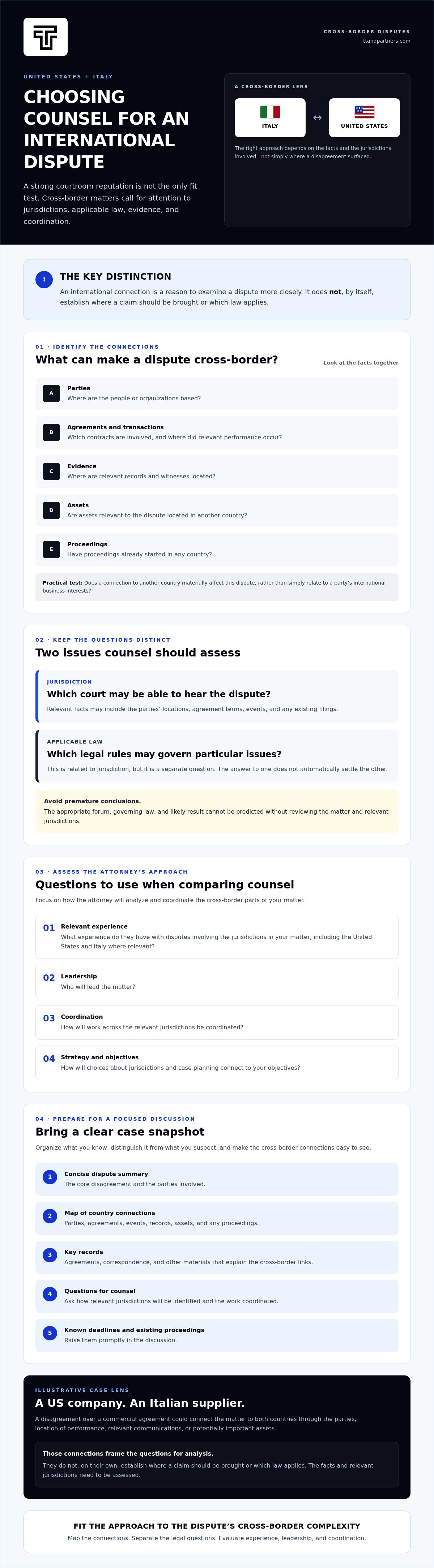
A dispute may call for cross-border legal analysis when important facts connect it to more than one country or legal system. Those connections might involve the parties, a contract, relevant evidence, assets, or proceedings already underway. An international element is a reason to examine the matter more closely, not proof that it must be heard in a particular country.
This section focuses on civil and commercial disputes, such as disagreements arising from business transactions or contracts. It does not address criminal defense. For a foundational overview of international litigation, see how cross-border matters can raise questions about jurisdiction, evidence, and the recognition or enforcement of judgments. Which questions matter in a particular case depends on its facts.
What makes a dispute cross-border?
Look beyond where the disagreement first surfaced. One party may be based in one country and another party elsewhere. A contract may relate to a transaction carried out across borders, witnesses or records may be located abroad, or assets relevant to a dispute may be in another country. These connections can make a matter cross-border even if some events occurred in one place.
For example, imagine a US company and an Italian supplier disagree over a commercial agreement. The parties, location of performance, relevant communications, and potentially important assets could connect the dispute to both countries. That scenario does not establish where a claim should be brought or which law applies. An international litigation attorney can assess those connections and identify the questions that need case-specific analysis.
By contrast, a dispute with parties, relevant events, records, and assets all connected to one country may be purely domestic, even if one party has international business interests unrelated to the claim. The practical test is whether a connection to another country materially affects the dispute, not simply whether the parties operate internationally.
When is a specialist attorney worth considering?
Consider seeking counsel with cross-border dispute experience if the matter involves a foreign party, evidence held overseas, proceedings in more than one country, or questions about pursuing a judgment against assets abroad. These are issues to discuss, not automatic conclusions about the right strategy. Their significance depends on the jurisdictions and the specific dispute.
Early advice can help clarify which facts need investigation and which procedural choices may affect later options. Some decisions can be difficult to revisit as a case progresses, so promptly raise any known deadlines and existing proceedings. Before recommending a path, counsel should review the facts and assess the relevant jurisdictions. Distinguish what you know from what you suspect, and bring agreements, correspondence, and other records that explain the cross-border connections.
How Jurisdiction, Evidence, and Coordination Shape International Litigation
Once you identify cross-border connections, map how they may affect case planning. Note who the parties are and where they are based, which agreements are involved, where relevant assets and records are located, and whether proceedings have started anywhere. This overview helps an international litigation attorney identify questions for closer analysis without assuming that one country’s courts or laws will control.
Which jurisdiction and law may matter?
Jurisdiction concerns which court may be able to hear a dispute. Applicable law concerns which legal rules may govern particular issues. These questions are related, but they are not the same, and the answer to one does not automatically settle the other.
Counsel may need to review the agreement’s terms, the parties’ locations, where relevant events occurred, and any existing filings. Those facts help frame the analysis, but none should be considered in isolation. Without reviewing the matter and relevant jurisdictions, it would be premature to predict the appropriate forum, governing law, or likely result.
How do evidence and proceedings cross borders?
Records and witnesses may be in different countries, and documents may use different languages or be held by separate organizations. These circumstances don’t automatically prevent a party from using the evidence, but they can affect how counsel plans to identify, preserve, and coordinate it. Procedures and requirements depend on the courts and jurisdictions involved, so don’t assume a step available in one place will work the same way elsewhere.
Preserve potentially relevant records in their existing form, and note where they are held and who may have relevant knowledge. Ask counsel to assess the matter before taking consequential procedural steps. If proceedings are underway or contemplated in more than one country, raise that promptly. Parallel proceedings and questions about whether a judgment may be recognized or enforced elsewhere require jurisdiction-specific review, not assumptions about automatic outcomes.
The U.S. Department of Justice's Office of Foreign Litigation describes a government function involving the United States’ interests in foreign courts. That role differs from representation in a private commercial dispute, but it illustrates why the identity of the parties and the purpose of a proceeding matter when assessing cross-border issues.
For a dispute involving the United States and Italy, an initial case discussion can help clarify which jurisdictions are involved and what questions to assess before deciding on next steps.
How to Compare International Litigation Attorneys for Your Case
Start your comparison with the dispute, not a firm’s label or reputation. Domestic litigation experience can be valuable, but it may not answer questions about coordinating work across countries, assessing another jurisdiction’s role, or managing evidence held abroad. Ask each prospective attorney to explain how their proposed approach relates to the facts, countries, and objectives of your matter.
Use the same questions with each candidate. The answers can show whether they understand the cross-border issues, explain uncertainties clearly, and have a practical plan for communication and coordination.
What experience should you ask about?
Ask about experience relevant to your dispute, not just broad descriptions. Has the attorney handled disputes connected to the same countries, a comparable transaction, or a similar stage of proceedings? Ask how that experience informs the questions they would investigate in your case, without requesting confidential details about other clients.
Clarify how the proposed team would assess whether counsel in another jurisdiction is needed and coordinate responsibilities. A firm’s general profile or directory ranking can help you identify candidates, but neither establishes that its experience suits your dispute. Treat rankings as one reference point, then assess fit through a direct discussion.
How can you assess communication and case fit?
Strong communication isn’t a promise of a particular result. It means counsel can explain options, material uncertainties, and the reasons for proposed next steps in terms you can follow. Ask how your goals, urgency, and existing documents would shape the initial assessment, and what information the team would need from you.
Notice whether the attorney separates confirmed facts from assumptions and identifies what remains unknown. A clear explanation of who will lead, how updates will be shared, and how you will be involved in decisions gives you a practical basis for comparing an international litigation attorney beyond credentials or rankings.
What to Prepare Before Speaking With an International Litigation Attorney
A clear, organized summary can make an initial discussion more useful. You don’t need to resolve legal questions in advance. Give counsel a reliable starting point: what happened, who is involved, which countries are connected, and what decisions or deadlines may be approaching. Separate confirmed facts from assumptions so the attorney can see what is known and what needs investigation.
Which documents and facts should you organize?
Begin with a short chronology. List key events in date order, identify the people or organizations involved, and note the countries connected to each event. Keep it concise. The aim is to show the shape of the dispute, not prepare a full legal argument.
Then gather materials that may help explain the matter. Depending on the dispute, these may include:
Relevant contracts, amendments, and other agreements.
Important correspondence and business communications.
Any court filings, notices, or documents from existing proceedings.
Prior communications with lawyers about the same matter.
Keep records intact, and don’t remove material just because it seems unhelpful. Note where important documents and assets are located and where potential witnesses may be found, if you know. Flag known deadlines or upcoming procedural dates for counsel to review promptly. If a date is uncertain, label it as unconfirmed rather than presenting it as fact.
What questions should you ask at an initial consultation?
Use the discussion to understand the assessment process and working relationship. Consider asking:
Which jurisdictional, procedural, or evidence questions need early review?
Could existing or potential proceedings in another country affect the analysis?
Who may need to be involved, and how would work across jurisdictions be coordinated?
Who will lead the matter, serve as the main contact, and explain material developments?
What work would be included in the proposed scope, and what are the next steps?
You can also ask how the attorney would assess your objectives alongside the available documents and known time constraints. The aim isn’t to obtain a guaranteed prediction at the first meeting. It is to understand what is clear, what remains uncertain, and what information is needed to evaluate options. For further background, consult International Litigation 2026: A Strategic Guide to US-Italy Legal Disputes.
If your dispute involves the United States and Italy, you can contact the firm to discuss your cross-border matter and the information that may help clarify the jurisdictions involved and potential next steps.
Choosing US-Italy International Litigation Counsel: A Practical Next Step
The right counsel should offer more than a broad international profile. Look for experience relevant to the countries and issues involved, a clear coordination plan, candid communication about uncertainties, and a strategy suited to your dispute’s goals and available information. These criteria help you move beyond comparing credentials and assess whether an attorney’s proposed approach fits your matter.
Does your dispute involve both the United States and Italy?
Identify how each country connects to the dispute. Are the parties based in different countries? Does an agreement, relevant evidence, or existing proceeding involve both? These details can help frame an initial discussion, but an international connection alone doesn’t establish that a particular firm is the right fit.
Tosolini, Toniutti & Partners handles litigation involving cross-border jurisdictions between the United States and Italy. Its international litigation service concerns disputes involving those jurisdictions, so a matter connected to other countries may fall outside that focus. The facts need to be reviewed to assess whether the firm’s work is relevant to your situation.
How to move from comparison to a case discussion
Prepare a concise summary of what happened, the countries connected to the parties, agreements, evidence, or proceedings, and the main question you want answered. Mention relevant records or known deadlines when outlining the matter. You don’t need a complete legal analysis. A clear account of the known facts gives counsel a practical basis for identifying what needs further review.
During a case discussion, ask what information counsel needs, who would assess the matter, and how possible next steps would be determined. An international litigation attorney must review the specific facts and relevant jurisdictions before assessing potential strategy or representation. A firm profile or general description cannot replace that case-specific review.
If your dispute appears to involve both the United States and Italy, you can contact the firm about a cross-border dispute to share its basic facts and ask whether a discussion is appropriate. This measured first step can help clarify whether the matter aligns with the firm’s stated focus, without presuming an outcome or course of action.
Choose Counsel With a Clear Cross-Border Plan
A cross-border dispute calls for more than a general assessment of the legal claim. Connections involving the parties, agreements, evidence, and proceedings can shape the questions counsel needs to examine. A strong choice of international litigation attorney rests on relevant experience, a clear coordination plan, candid communication about uncertainties, and a strategy suited to the matter.
Before speaking with counsel, organize a concise account of events, key documents, known deadlines, and the questions you need answered. This preparation can make an initial discussion more focused, while leaving jurisdiction-specific analysis to the attorney reviewing the facts.
Tosolini, Toniutti & Partners provides litigation support for disputes involving cross-border jurisdictions between the United States and Italy. The firm also works across US-Italy business operations, a relevant context when a dispute arises from commercial activity. Whether that experience fits your matter depends on its particular facts and connections.
If your dispute involves the United States and Italy, take a measured next step: contact Tosolini, Toniutti & Partners to discuss your cross-border matter and share the basic facts. A focused conversation can help identify the questions to consider and clarify possible next steps.
Frequently Asked Questions
What does an international litigation attorney do?
An international litigation attorney advises on disputes with material connections to more than one country or legal system. Counsel can assess the facts, identify jurisdictional and procedural questions, consider where evidence and assets are located, and develop a case strategy. If work across jurisdictions is needed, the attorney can explain how coordination may be approached. The specific role depends on the dispute, and legal advice should not be treated as a promise of a particular outcome.
When should I hire an international litigation attorney?
Consider seeking advice early if parties, evidence, assets, agreements, or existing proceedings connect your dispute to more than one country. Early assessment can help identify questions about jurisdiction, applicable law, evidence, and coordination before you make procedural decisions. It can also help you prepare relevant records and flag known deadlines. Whether specialist cross-border counsel is appropriate depends on the facts and jurisdictions involved.
Can one attorney handle a dispute involving two countries?
That depends on the dispute’s facts, the relevant jurisdictions, and the work required. One attorney may assess the overall matter and coordinate with other counsel where needed, but clarify who will advise on each jurisdiction-specific issue and who is authorized to appear in any relevant forum. Ask how responsibilities, communications, and decisions will be managed. The appropriate team structure should follow from the case, not an assumption that one lawyer can handle every issue.
How do I choose an international litigation attorney?
Compare how each attorney’s experience fits your dispute, including its countries, transaction type, and procedural stage. Ask who will lead the matter, how work across jurisdictions will be coordinated, and how you’ll receive updates. A thoughtful attorney should explain strategic options and material uncertainties clearly, without promising a result. Rankings and firm profiles may help you identify candidates, but assess fit through a direct discussion of your matter.
What documents should I bring to an international litigation consultation?
Bring a concise chronology of key events, the parties, and the countries connected to them. Gather relevant agreements, correspondence, existing filings, and prior legal communications, along with notes about where important records, assets, or potential witnesses are located, if known. Keep materials intact and distinguish confirmed facts from assumptions. Include any known deadlines for counsel to review. An organized overview helps the attorney understand the dispute and identify what information may still be needed.
Can a US attorney advise on a dispute involving Italy?
A US attorney may be able to assess aspects of a cross-border dispute involving Italy, but that doesn’t establish authority to appear in every relevant forum or advise on every issue under another jurisdiction’s law. Before engaging counsel, ask which parts of the matter the attorney can address, what qualifications and authority are relevant, and whether coordination with other counsel may be needed. The answer depends on the attorney’s credentials, the scope of work, and the specific jurisdictions involved.
Is international litigation the same as international arbitration?
No. Litigation generally refers to resolving a dispute through a court, while arbitration is a separate dispute-resolution process conducted outside the courts. Which process may be relevant depends on the dispute and any agreement between the parties. Don’t assume an international connection alone determines the forum. Have counsel review the relevant agreement, any existing proceedings, and the jurisdictions involved before assessing the available options.


Comments