

Enforcing US Judgments in Italy: 2026 Practical Guide

Can a US court judgment be recognized in Italy yet still not be ready to enforce against a debtor’s assets? That distinction is central to the enforcement of US judgments in Italy. Overlooking it can complicate an otherwise sound strategy.
If you hold a US judgment and the debtor or assets are in Italy, you may have questions about recognition, procedure, documents, and potential challenges. Recognition concerns whether the Italian legal system accepts the judgment’s effects. Enforcement involves the further steps needed to pursue compliance or execution. For judgments from the United States, the process generally falls under Italian Law No. 218/1995, but the applicable route and requirements depend on the judgment and the facts.
This guide explains the legal framework, the difference between recognition and enforcement, and issues that may affect your next steps. It also covers the records and procedural questions to address with counsel, including finality, service, public policy, authentication, and translation. A coordinated US-Italy legal assessment can help evaluate the judgment, identify potential hurdles, and shape an enforcement strategy before action is taken.
Table of Contents
Enforcement of US Judgments in Italy: What Recognition Actually Means
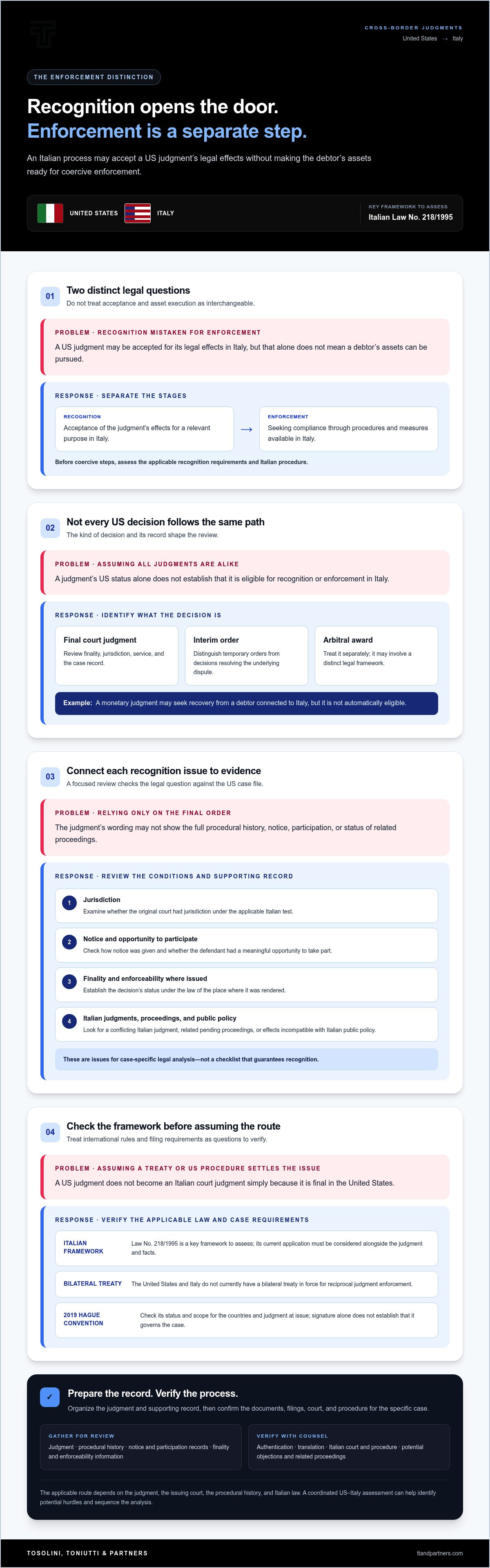
Recognition and enforcement are connected, but they are not the same step. Recognition concerns whether an Italian legal process accepts a US judgment’s legal effects for relevant purposes. Enforcement concerns pursuing compliance through procedures and measures available in Italy. A US court judgment does not become an Italian court judgment simply because it exists, even if it is final in the United States.
The distinction matters in practice. Recognition may allow a judgment to be relied on in Italy, while coercive steps against a debtor or assets require a separate assessment of the applicable procedure. Whether either step is available depends on factors such as the judgment, the court that issued it, the parties’ procedural history, and the Italian law that applies. The information below provides general orientation, not a prediction about a particular case or a substitute for case-specific legal advice.
How recognition differs from enforcement in Italy
Recognition is the legal acceptance of a foreign judgment’s effects for a relevant purpose in Italy. Enforcement is the process of seeking compliance through local procedures. If voluntary payment or performance has not occurred, the distinction is especially important: before coercive enforcement can proceed, the judgment may need to meet the applicable recognition requirements and follow the required Italian process.
For US judgments, Italian Law No. 218/1995 is a key framework to assess, subject to verification against current law and the facts of the case. The United States and Italy do not have a bilateral treaty currently in force for reciprocal judgment enforcement, so the applicable legal route should not be assumed from the judgment’s US status alone.
The 2019 Hague Judgments Convention is a separate international framework. Its status and scope should be checked for the countries and judgment at issue. A state’s signature alone does not establish that the convention governs a particular US-Italy case.
Which US judgments may raise cross-border enforcement issues?
A monetary judgment is a clear example: a creditor may seek to recover an amount from a debtor connected to Italy. But not every US money judgment is automatically eligible for recognition or enforcement. The judgment’s finality, the issuing court’s jurisdiction, service on the defendant, and other features of the case may affect the analysis.
Final court judgments should also be distinguished from interim orders, which may be temporary or issued before the underlying dispute is resolved. Arbitral awards are different from court judgments and may involve a distinct legal framework. Neither category should be treated as interchangeable with a final court judgment.
The subject matter and procedural history can shape the next steps. The record should show how the case proceeded and what the US court actually decided. To assess the enforcement of US judgments in Italy, review the US record alongside the Italian procedure and identify potential issues before taking action.
The Italian Legal Framework for Recognizing a US Court Judgment
Italian Law No. 218/1995 is a key framework for assessing recognition of a US judgment, but its current application must be considered alongside the judgment and the facts. The analysis is not a simple extension of US procedure. Italian law determines whether the decision can produce legal effects in Italy, while the law of the place where it was issued helps establish matters such as its finality and enforceability there.
Recognition conditions should be checked against the current statute and the case record. In broad terms, counsel may need to examine whether the original court had jurisdiction under the applicable Italian test, whether the defendant received proper notice and a meaningful opportunity to participate, and whether the judgment is final and enforceable under the law of the place where it was rendered. The review may also consider whether the decision conflicts with an Italian judgment, whether related proceedings are pending in Italy, and whether its effects would be incompatible with Italian public policy.
These are questions for legal analysis, not a checklist that guarantees recognition. A concern about service, jurisdiction, or a competing proceeding may have different consequences depending on the record and applicable law. For example, review the file to establish how notice was given and whether the defendant could participate, rather than relying only on the wording of the final order.
What recognition conditions should counsel examine?
A focused review connects each legal condition to evidence in the US case file. That may include the judgment itself, the procedural history, records concerning notice and participation, and information showing whether the decision is final and enforceable where issued. Counsel should also look for relevant Italian judgments or proceedings and assess any public-policy issue in context. The court and procedure for any requested declaration or enforcement measure must be verified for the specific case.
Why US state and federal judgments need case-specific review
The court that issued the judgment matters. State-court and federal-court judgments arise from different court systems, and the record may raise distinct questions about the source of jurisdiction, the proceedings, or the judgment’s status. Neither should be treated as automatically covered by one US-wide rule that settles recognition in Italy.
Keep the legal questions separate: the law governing the original proceedings helps determine what the judgment means and whether it is final or enforceable there; Italian law governs its recognition and the route toward enforcement in Italy. EU rules governing certain judgments between EU member states should not be assumed to apply simply because recognition is sought in Italy. The applicable framework depends on the countries and judgment involved.
A coordinated US-Italy review can connect the judgment’s procedural record with the Italian recognition test and clarify the next steps. Tosolini, Toniutti & Partners provides international litigation support for disputes involving the United States and Italy.
Common Challenges When Enforcing a US Judgment in Italy
A final US judgment is an important starting point, but it does not establish by itself that the decision can be enforced in Italy. The judgment’s status, the court’s jurisdiction, how the defendant was notified, and the procedural history may all require review under the applicable Italian recognition rules. A challenge also does not automatically defeat recognition. Its significance depends on the evidence, the objection raised, and the law that applies.
When assessing the enforcement of US judgments in Italy, avoid treating any single issue as decisive before reviewing the judgment and its record. A structured review can identify questions that need further analysis without predicting the outcome.
How jurisdiction, notice, and due process can affect recognition
The Italian recognition analysis may examine whether the US court had jurisdiction under the relevant Italian test. That is distinct from whether the US court considered itself authorized to hear the dispute. The basis for jurisdiction and its connection to the parties or case should therefore be clear from the judgment and procedural record.
Notice and the opportunity to participate also matter. Counsel may need to establish how the defendant was served, what notice was given, and whether there was a meaningful opportunity to respond. Preserve the judgment, service records, relevant court filings, and documents recording key procedural steps. A gap in the available record does not automatically determine the result, but it can make the issue harder to evaluate.
Public policy and conflicting judgments
Public policy is a legal checkpoint, not a general invitation to revisit whether the US court reached the right result. Italian recognition proceedings are not a second trial on the underlying dispute. A party’s disagreement with the findings or outcome should be distinguished from a specific legal objection that may matter under the applicable recognition rules.
Conflicting Italian decisions or related proceedings may also require close examination. Counsel will need to identify what each decision concerns, when the proceedings began, and whether the subject matter and parties overlap. Those details can affect how a potential conflict is assessed. The existence of another case alone does not establish its legal effect.
Rather than ranking these issues in the abstract, a case-specific review should connect each potential objection to the evidence and applicable law. Examine the full procedural history alongside the judgment, and verify the current Italian rules before choosing a procedural course.
How to Prepare a US Judgment for Recognition and Enforcement in Italy
Preparation is easier to manage when it follows a clear sequence: assemble the case record, assess whether the judgment may qualify for recognition, determine the Italian procedure, and then consider whether enforcement measures are appropriate. The exact court, filings, and order of steps must be verified for the specific case. Requirements may depend on the judgment and the facts, so use this overview as a starting point for legal assessment, not as a complete filing guide.
Documents to gather before an Italian legal assessment
Start with documents that show both what the court decided and how the case reached that decision. An initial review will often benefit from:
The complete US judgment and relevant orders, with available evidence of finality or enforceability.
Pleadings and other filings that help explain the claims, parties, and procedural history.
Service records and documents showing how notice was given and whether the parties had an opportunity to participate.
Information about related or potentially conflicting proceedings or judgments.
This is not an exhaustive list. Authentication, translation, and supporting-document requirements should be confirmed against current filing rules for the applicable procedure. Raise these questions early, before relying on a document format or translation prepared for a different purpose.
From recognition analysis to possible enforcement measures
Once the record is assembled, counsel can assess the judgment’s status and the recognition conditions, then identify the appropriate Italian court and procedure. If recognition is contested, a judicial determination may be required under the procedure that applies to the case. Verify the process and sequence rather than inferring them from the steps followed in the United States.
Enforcement is a subsequent, fact-dependent stage. The strategy may turn on identifying the debtor and determining whether assets that could be pursued are located in Italy. Those facts can inform the practical assessment, but they do not guarantee recovery. Consider the available measures and procedural requirements in light of Italian law and the circumstances.
For a broader view of cross-border coordination, see International Litigation 2026: A Strategic Guide to US-Italy Legal Disputes. A coordinated review of the US judgment and its record can clarify the procedural route and identify issues to address before filing. Tosolini, Toniutti & Partners provides international litigation support for US-Italy disputes.
Build a Cross-Border Strategy for Enforcing a US Judgment in Italy
A practical strategy starts with the evidence, not an assumption that a US judgment will automatically produce recovery in Italy. Review the decision alongside the procedural record, then consider how the judgment’s status, potential objections, and the debtor’s connection to Italy affect the available options. For the enforcement of US judgments in Italy, coordinated legal analysis can connect the US case history with the Italian recognition framework and the steps that may follow.
Questions that shape an enforcement strategy
Before deciding how to proceed, organize the key facts:
What was decided? Identify the rendering court, parties, subject matter, orders, and current procedural status.
What is the Italian connection? Consider the debtor’s relationship to Italy and whether potentially relevant assets may be located there.
What is the objective? Clarify whether the priority is payment, performance, or another practical outcome, and consider possible objections and alternatives.
These questions help focus the legal review and can reveal gaps in the record, such as uncertainty about finality, notice, or proceedings that may affect the assessment. Identifying a possible asset is useful for planning, but it does not establish that the asset can be pursued or that recovery will follow.
When to seek cross-border legal guidance
Early coordination can be valuable when Italian assets or proceedings make the order and timing of steps consequential. US counsel can help clarify the judgment and its procedural history; Italian counsel can assess the applicable recognition rules, potential objections, and local procedural sequence. Together, that analysis can inform a strategy grounded in the record rather than assumptions about how the judgment will be treated.
International litigation support involving the United States and Italy can bring those perspectives together. The review should address the case’s specific documents and legal framework without promising recognition or recovery. A practical first step is to discuss the judgment, relevant orders, and procedural records with Tosolini, Toniutti & Partners.
Plan the Next Step with Clarity
The enforcement of US judgments in Italy depends on more than whether a US court has issued a final decision. Recognition and enforcement are distinct stages, and the relevant Italian framework, procedural record, and potential objections need to be assessed in the context of the specific case.
A considered strategy begins with the judgment and its history: confirm its status, review how the parties were notified and able to participate, and identify any related Italian proceedings or assets that may affect the next steps. Authentication, translations, the appropriate court, and filing requirements also call for case-specific verification. Careful preparation can help bring legal analysis and practical objectives into alignment without assuming a particular outcome.
Tosolini, Toniutti & Partners provides international litigation support for US-Italy disputes and assists with legal matters connected to international business operations. Discuss your US-Italy judgment matter with the firm to explore a coordinated assessment of the judgment, relevant documents, and potential path forward.
Frequently Asked Questions
Can a US judgment be enforced in Italy?
Yes, a US judgment may be recognized and enforced in Italy if it meets the applicable Italian legal conditions and the required procedure is followed. Recognition gives the judgment legal effect for relevant purposes; enforcement involves steps to pursue compliance against the debtor. A final US decision alone does not guarantee enforcement. The enforcement of US judgments in Italy calls for review of the judgment, court, parties, procedural history, and potential objections under current Italian law.
Is recognition of a US judgment in Italy automatic?
Recognition may occur automatically if the judgment meets the applicable statutory conditions, but that does not mean a creditor can immediately use coercive measures against a debtor’s assets. Recognition and enforcement are separate stages. To pursue forced execution, a creditor generally needs a declaration of enforceability through the applicable Italian procedure. The correct court, filings, and sequence should be verified for the specific judgment and circumstances.
What requirements must a US judgment meet for recognition in Italy?
The assessment generally includes whether the original court had jurisdiction under the relevant Italian test, whether the defendant received proper notice and an opportunity to participate, and whether the judgment is final and enforceable where it was issued. Counsel may also examine whether it conflicts with an Italian judgment, whether related proceedings are pending in Italy, and whether its effects would violate Italian public policy. Each condition must be checked against current law and the case record.
How do I enforce a US money judgment in Italy?
Begin by gathering the judgment and procedural record, then assess eligibility under the applicable Italian rules. If the requirements are met, the creditor generally seeks a declaration of enforceability from the appropriate Italian court before pursuing execution measures. Identifying the debtor and potentially relevant assets can inform the strategy, but does not guarantee recovery. Verify the court, filings, supporting documents, and procedural sequence for the case.
Can the debtor challenge recognition of a US judgment in Italy?
Yes, a debtor may raise objections, but an objection does not automatically prevent recognition. Its effect depends on the legal grounds, evidence, procedural history, and applicable Italian law. Issues may include the original court’s jurisdiction, notice and opportunity to participate, public policy, or conflicting decisions and proceedings. The Italian process is not a general retrial of the US dispute, and the likely effect of an objection requires case-specific analysis.
What documents are needed to enforce a US judgment in Italy?
An initial review typically starts with the complete judgment, relevant orders, and evidence of finality or enforceability. Pleadings, service records, and filings that explain how the case proceeded may also help counsel assess recognition conditions and potential objections. Authentication, translation, and filing requirements depend on the case and procedure, so verify them under current rules before submission. This is a preparation guide, not an exhaustive document list.
How long does it take to enforce a US judgment in Italy?
The timeframe depends on whether recognition is contested, the procedure, and the subsequent enforcement steps. As a general estimate, an uncontested enforceability proceeding may take one to six months; a contested matter before the Court of Appeal may take about one to one and a half years. An appeal may add two to three years. These are estimates, not guarantees, and separate execution steps may extend the overall timeline.


Comments