

Applying for Italian Residency from the USA: The 2026 Strategic Guide
- Gianni Mendes Toniutti, Esq.

- May 30
- 12 min read
What if the defining challenge of your Italian relocation isn't the physical move, but the invisible legal architecture required to sustain it? Many professionals find that applying for Italian residency from the USA presents a complex landscape of consular discretion and rigorous financial scrutiny. You likely recognize the tension between the dream of a Mediterranean life and the reality of complex bureaucratic hurdles. It's natural to feel concerned about tax exposure or the precise requirements of the Permesso di Soggiorno. We believe that a successful transition requires more than just paperwork; it demands a strategic alignment of your US-based assets with Italian law.
This guide offers a clear, predictable roadmap to mastering the legal nuances of your move. You'll gain a comprehensive understanding of the 2026 visa landscape, from the specific passive income thresholds of the Elective Residence Visa to the highly skilled requirements of the Digital Nomad pathway. We'll outline exactly how to secure your residency permit while ensuring your professional standing remains intact. By following this structured approach, you can transform a confusing process into a precise, successful acquisition of your new life in Italy.
Key Takeaways
Understand the critical distinction between temporary Schengen visits and the strategic legal framework required for a long-term National (Type D) visa.
Identify the most secure pathway for your profile by comparing the 2026 requirements for the Elective Residency and Digital Nomad visas when applying for Italian residency from the USA.
Navigate the two-phase application sequence, ensuring you meet the strict eight-day window for the Permesso di Soggiorno upon arrival.
Learn how to document US-based financial assets and property arrangements to satisfy the rigorous standards of the Italian consulate network.
Map your trajectory from initial residency to permanent EU status and the eventual milestone of Italian citizenship through naturalization.
Table of Contents
Navigating the Legal Landscape of Italian Long-Term Relocation
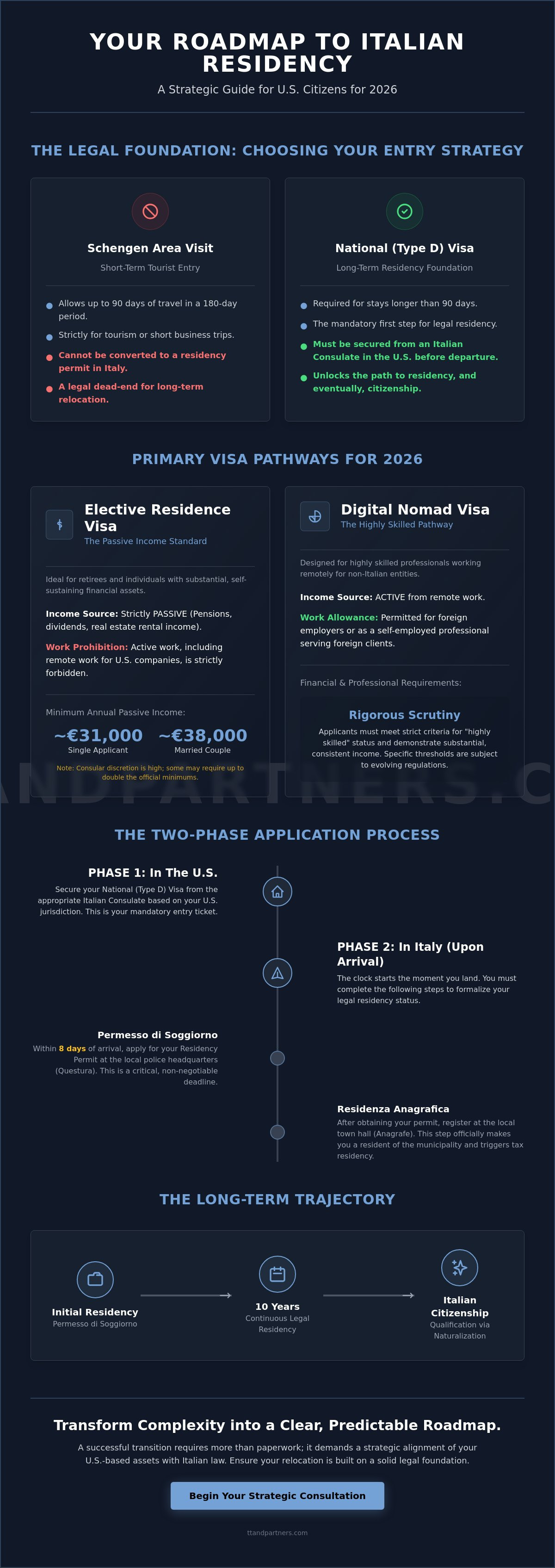
Relocating to Italy involves more than a change of scenery; it's a transition between two distinct legal systems. For many, the process of applying for Italian residency from the USA begins with understanding that residency is a multi-layered legal status, not a simple arrival. In the 2026 regulatory environment, Italian authorities have tightened the alignment between visa issuance and local registration. This means your strategy must be cohesive from the moment you contact the Italian Consulate in your US jurisdiction. These consulates act as the primary gatekeepers, and their discretionary power over National (Type D) visas determines the viability of your entire relocation plan.
Establishing legal residency is also the mandatory foundation for those looking toward the future. Under Italian nationality law, a non-EU citizen typically requires ten years of continuous legal residency to qualify for citizenship through naturalization. Without the correct initial residency architecture, that clock never starts. Precision at the entry stage ensures that your years spent in Italy actually count toward your long-term goals.
The Schengen Limitation vs. Residency
US passport holders often rely on the Schengen Agreement for short-term stays, which allows for 90 days of travel within any 180-day period. It's a common mistake to assume this period can be extended or converted while on Italian soil. It cannot. A tourist entry is a legal dead end for residency. If you intend to stay beyond 90 days, you must secure a National (Type D) visa before leaving the United States. Overstaying a Schengen entry doesn't just lead to fines; it can result in a ban from the entire Schengen Area, effectively terminating your residency ambitions before they begin. You don't want to risk your future on a misunderstanding of these rigid timelines.
The Definition of Residency under Italian Law
Confusion often arises between the Permesso di Soggiorno and Residenza Anagrafica. The Permesso di Soggiorno is your right to stay in the country, while the Residenza Anagrafica is your registration in the local town hall's population registry. You need both to be considered a legal resident. While the AIRE (Registry of Italian Citizens Residing Abroad) is a system for Italian citizens living in the USA, understanding how Italy tracks its population helps you navigate the local Anagrafe system.
This registration also triggers significant shifts in your financial life. Once you're a legal resident, you're generally considered a tax resident of Italy. This means your global income becomes subject to Italian taxation, requiring a sophisticated approach to manage potential double-exposure with your US obligations. If you have questions about how these legal layers interact with your specific situation, you can reach out through our contact page to discuss your strategy.
Primary Visa Pathways for US Citizens in 2026
Selecting the right entry point is the most critical decision when applying for Italian residency from the USA. In 2026, the distinction between active and passive income pathways is sharper than ever. Italian consulates now strictly enforce the boundaries of each visa category, making it essential to align your professional and financial status with the correct legal framework. You can find official visa information from the Italian Embassy to see the current list of available categories and jurisdictional requirements.
Elective Residency: The Passive Income Standard
The Elective Residence Visa (ERV) remains the premier choice for retirees and those with significant private wealth. However, it's not a catch-all solution for remote workers. This visa strictly prohibits any form of active work, including remote employment for US companies. For a single applicant, the minimum required passive income is approximately €31,000 to €32,000 annually. If you're applying as a married couple, this threshold rises to a range between €38,000 and €40,000. Acceptable sources include social security, pensions, dividends, and registered real estate rental income. Consulates often exercise significant discretion; some may require income levels twice the official minimum to ensure financial stability.
The Digital Nomad and Investor Alternatives
The Italian Digital Nomad visa, introduced in 2024, has matured into a sophisticated pathway for high-earning professionals. It requires a minimum annual income of €28,000, which is approximately €2,333 per month. Unlike the ERV, this category is specifically designed for "highly skilled" workers who perform remote tasks. It bridges the gap for those who don't fit the traditional retirement profile but want to maintain their US professional ties while living in Italy. The typical processing time for this visa is 30 to 60 days, making it one of the most efficient routes available.
For high-net-worth individuals, the Investor Visa offers a strategic, fast-track entry. This "Golden Visa" requires a capital commitment of €250,000 in an innovative startup or €500,000 in an Italian limited company. While the thresholds are higher, the flexibility it provides regarding physical presence and work authorization is unparalleled. If you're managing complex assets across borders, you might consider how Italian immigration strategies can be tailored to your specific investment portfolio. For those pursuing self-employment or standard work visas, success often depends on the "Decreto Flussi" quotas, which are released annually and limit the number of entries for specific industries.
Financial Requirements and Property Ownership Standards
Securing a visa is merely the legal permission to enter; establishing residency is the act of anchoring your life within the Italian territory. This physical presence is validated through two primary pillars: a registered domicile and a resilient financial profile. When applying for Italian residency from the USA, the quality of your documentation is often more important than the quantity of assets. Italian authorities prioritize the continuity and stability of your resources over a single, large bank balance. They seek a clear alignment between your financial architecture and your intended lifestyle in Italy.
Vetting Property for Residency Approval
A common error is presenting a temporary booking or a short-term Airbnb receipt. These documents lack the legal weight required for residency. To satisfy the consulate, you must provide either a deed of ownership or a long-term lease agreement that has been officially registered with the Agenzia delle Entrate. This registration provides the state with a record of your housing security and is a non-negotiable requirement. For many, the strategic benefits of a real estate closing prior to the application are significant. Owning a property eliminates the uncertainty of lease renewals and demonstrates a profound commitment to the local community, which consulates view favorably.
Financial Proof: Beyond the Bank Statement
Proving your financial integrity involves a meticulous assembly of US-based records. Consulates typically demand the last two years of your US tax returns to verify the source and consistency of your wealth. For those on an Elective Residence pathway, Social Security award letters and pension statements serve as the gold standard of passive income proof. Every document issued in the US must undergo a specific authentication process. This includes professional translation into Italian and the attachment of an Apostille to verify its international legal standing.
A frequent pitfall is the failure to distinguish between liquidated assets and recurring income. Italy seeks to ensure you won't need to work locally, so showing a reliable stream of funds is more persuasive than a static savings account. Precision in these filings prevents the administrative delays that often derail relocation timelines. If you're unsure about how your US-based business or personal assets will be viewed, you can discuss your specific financial structure through our contact page to ensure your application meets the consulate's rigorous standards.
The Two-Phase Application Process: From US Consulate to Italy
Relocation is a journey of two distinct legal theaters. Act one takes place on American soil. Act two unfolds within the administrative halls of your chosen Italian municipality. Applying for Italian residency from the USA requires a synchronized performance between these two stages. If you fail to transition correctly from the visa phase to the permit phase, your legal status becomes fragile. It's a structured sequence where the National Visa serves as your entry ticket, but the residency permit provides your legal foundation.
Step 1: The Consular Interview in the USA
Your objective in the first phase is securing the National (Type D) Visa from the Italian Consulate with jurisdiction over your US residence. You'll need to compile the "Visto per l’Italia" file with surgical precision. A compelling "Letter of Intent" often serves as the intellectual heart of this file. It should articulate your vision for a life in Italy and your connection to the local heritage. Be prepared for the $136 application fee, which is the current equivalent of the €116 standard. Consular officers exercise significant subjective discretion during this interview. They aren't just checking boxes; they're evaluating the viability of your long-term presence and financial resilience.
Step 2: Arrival and the Permit of Stay
Once you land, a new clock starts. You have exactly eight working days to initiate the conversion of your visa into a residency permit. If you arrived via another Schengen country, you must first file a "Dichiarazione di Presenza" at the local police headquarters. Your primary destination is the local Poste Italiane office to request the "Kit Giallo". This yellow-striped envelope contains the forms for your initial Permesso di Soggiorno application.
Submitting this kit involves several specific costs. You'll pay a €16 tax stamp (marca da bollo), a €30 postal service fee, and a €30.46 electronic permit production fee. There's also a €40 government contribution for permits valid up to one year. Upon submission, you'll receive the "Ricevuta". This receipt is a vital legal document. It provides proof of your lawful status while you wait for your appointment at the Questura for fingerprinting and final verification. During this interim period, you maintain your right to stay in Italy, even if the final card takes months to arrive. This receipt ensures that your life can proceed with legal certainty as the bureaucracy completes its cycle.
Strategic Continuity: Beyond Residency to Italian Citizenship
The journey of relocation doesn't end with the issuance of a residency card. It's a long-term legal evolution that transforms a temporary stay into a permanent life. For many, the ultimate objective of this process is the acquisition of Italian citizenship. This transition requires a decade of meticulous compliance and strategic planning. While the initial act of applying for Italian residency from the USA provides the legal entry, maintaining that status without interruption is what secures your future in the European Union. After five years of continuous legal residence, you may apply for permanent EU residency, which offers greater stability and fewer renewal requirements.
Naturalization vs. Jure Sanguinis
Naturalization is a distinct path from Jure Sanguinis. While those with Italian roots may claim citizenship by descent, US citizens without direct lineage must commit to ten years of legal residency. During this decade, you must avoid prolonged absences that could reset your residency clock. Italian authorities are strict about the continuity of your presence. You must also demonstrate cultural integration through a B1 level Italian language certification. This linguistic milestone is more than a hurdle; it's a testament to your social immersion in your new community. Failing to prepare for this requirement can delay your naturalization by years.
The Role of Specialized Legal Counsel
Relocating your life often means relocating your professional interests. Protecting US business assets while residing in Italy involves complex jurisdictional coordination. As you transition into long-term residency, the potential for cross-border legal disputes increases. Having access to sophisticated international litigation support is essential for families managing high-value assets across two continents. It ensures that your interests in the United States remain secure while you build a legacy in Italy. This level of protection is rarely found in DIY applications or general immigration services.
DIY approaches often falter when faced with the intersection of Italian immigration law and US financial structures. True strategic continuity requires a holistic view of your legal architecture. You can reach out to Tosolini, Toniutti & Partners for a consultation that aligns your immediate residency goals with your long-term vision of citizenship. Professional guidance ensures that every filing, from the first visa to the final naturalization decree, is executed with precision. We believe in building a foundation that respects your past while securing your future in Italy.
Securing Your Mediterranean Legacy
Relocation is a matter of architectural precision. You've seen that applying for Italian residency from the USA requires a delicate balance between your US financial structures and Italian administrative demands. From the $136 consular fee to the critical eight-day window for the residency permit, every detail serves as a pillar for your future stability. By integrating your property acquisitions and professional assets into a cohesive legal strategy, you transform a complex process into a predictable roadmap. Our firm offers a specialized US-Italy legal bridge, providing the expertise in E-1, E-2, and O-1 visas alongside comprehensive real estate and corporate support. Secure your cross-border future—schedule a consultation with our Italian immigration experts today. Your vision of a life in Italy is within reach when it's built on a foundation of professional foresight and legal clarity. We're here to ensure your transition is as seamless as it is enduring.
Frequently Asked Questions
Can I work remotely for a US company while on an Italian Elective Residency Visa?
No, you cannot legally perform any active work, including remote employment for a US company, while holding an Elective Residency Visa. This visa category is reserved exclusively for individuals with passive income sources such as pensions, social security, or dividends. If you intend to maintain your professional ties and work from Italy, the Digital Nomad Visa is the designated pathway for highly skilled remote workers in 2026.
How much passive income is required for a US citizen to move to Italy?
When applying for Italian residency from the USA via the elective route, you must demonstrate a minimum annual passive income of approximately €31,000 to €32,000 for a single applicant. For married couples, this requirement increases to a range between €38,000 and €40,000. It's essential to remember that individual consulates often exercise discretion and may require higher amounts to ensure your long-term financial self-sufficiency.
Does buying a house in Italy automatically grant me residency?
Purchasing property in Italy does not automatically grant you legal residency or a visa. While owning a home satisfies the critical housing requirement for many visa types, you must still qualify for a specific visa category based on your income or professional status. Real estate ownership is a powerful supporting element of your application, but it remains a separate legal matter from your immigration status.
How long does the Italian residency application process take from the USA?
The timeline depends on the specific visa pathway you select for your move. The Elective Residence Visa typically takes four to eight months to process at a US consulate, while the Digital Nomad Visa offers a faster route, often concluded within 30 to 60 days. You should also account for the time needed to finalize your residency permit with local authorities once you arrive on Italian soil.
What is the difference between an Italian visa and an Italian residence permit?
A visa is the legal document that allows you to enter the country, while a residence permit is what allows you to stay. You obtain your National (Type D) visa from an Italian consulate in the United States before your departure. Within eight working days of your arrival in Italy, you must apply for the Permesso di Soggiorno to establish your lawful residency status.
Can I include my family members in my Italian residency application?
You can include dependents in your application, but this requires meeting higher financial thresholds. For the Elective Residence Visa, the minimum income requirement increases by approximately 5% to 20% for each dependent child. Successful family relocation involves coordinating the family cohesion process to ensure every member receives the correct legal authorization to reside in the territory.
Do I need to speak Italian to apply for residency as a US citizen?
There is no formal language requirement for the initial visa or residency permit application. You can navigate the first phases of applying for Italian residency from the USA without speaking the language. However, if your long-term goal is Italian citizenship through naturalization, you will eventually need to pass a B1 level language exam as part of that specific legal process.
What happens to my US tax status if I become an Italian resident?
US citizens remain subject to US taxation regardless of where they live due to citizenship-based taxation rules. When you become a legal resident of Italy, you will likely become an Italian tax resident as well, meaning your global income is subject to local reporting. This creates a dual-taxation environment that requires sophisticated cross-border planning to manage your assets and utilize existing tax treaties effectively.


Comments