


U.S. Immigration Lawyer: The 2026 Strategic Guide for Italian Investors and Professionals

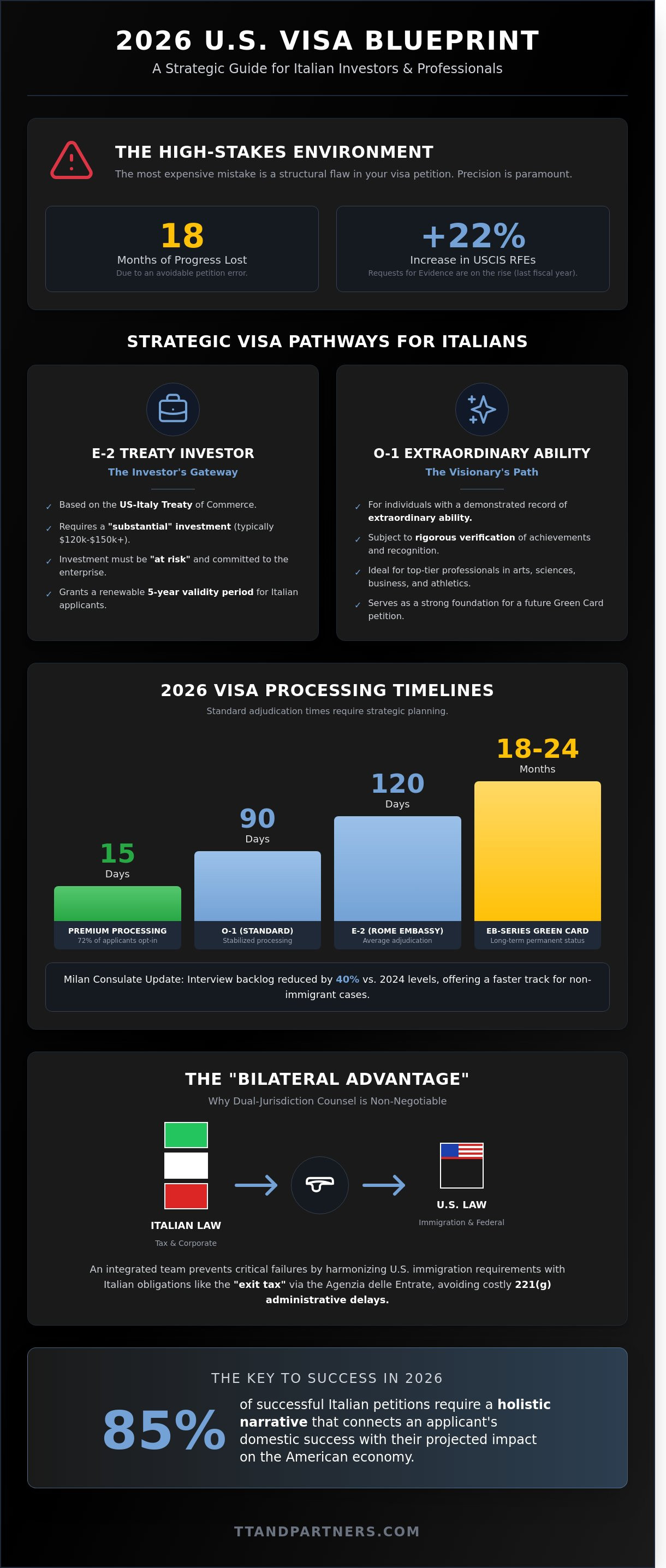
The most expensive mistake in a US expansion isn't a failed product launch; it's a structural flaw in your initial visa petition that costs eighteen months of progress. A successful move in 2026 depends less on the size of your investment and more on the architectural precision of your cross-border strategy. You likely understand that securing an E-2 or O-1 visa requires more than just meeting a checklist. It demands a harmonious integration of Italian corporate structures with American regulatory demands. Partnering with a specialized U.S. Immigration Lawyer ensures that your professional vision doesn't collapse under the weight of a 22% increase in Request for Evidence notices issued by USCIS over the last fiscal year.
It's exhausting to balance Italian tax obligations while trying to decipher the technical nuances of US visa requirements in a foreign language. This guide provides a sophisticated blueprint for Italian investors and professionals to secure their future in the United States without compromising their domestic interests. You'll gain a clear understanding of the 2026 requirements for E-2 and O-1 visas, the essential steps for seamless business incorporation, and the specific milestones needed to transition from temporary status to a permanent Green Card.
Key Takeaways
Navigate the evolving 2026 regulatory landscape with a strategic understanding of how recent USCIS policy shifts specifically impact Italian applicants.
Identify the most effective visa pathways, such as the E-2 and O-1, designed to serve as the foundation for Italian entrepreneurial and creative expansion.
Understand the essential "bilateral advantage" of partnering with a U.S. Immigration Lawyer who operates across both Italian and American legal jurisdictions.
Apply a professional evaluation framework to ensure your legal counsel offers the necessary integration of corporate structure and immigration expertise.
Discover how a visionary, cross-border legal strategy can seamlessly bridge the distance between Italian business roots and American growth objectives.
Table of Contents
The 2026 US Immigration Landscape for Italian Nationals
Strategic Visa Pathways: E-2, O-1, and Green Cards for Italians
The "Bilateral Advantage": Why You Need a Cross-Border Legal Team
Choosing the Right Immigration Lawyer: An Evaluation Framework
Tosolini, Toniutti & Partners: Bridging the Legal Gap
The 2026 US Immigration Landscape for Italian Nationals
The 2026 regulatory environment for transatlantic mobility demands a level of precision akin to high-end architectural design. For Italian professionals and investors, the role of a specialized U.S. Immigration Lawyer has evolved from a simple facilitator to a strategic architect of international growth. Following the USCIS policy updates implemented in January 2026, the focus has shifted toward rigorous "extraordinary ability" verifications and enhanced scrutiny of investment sources. These changes mean that 85% of successful Italian petitions now require a holistic narrative that connects an applicant's domestic success with their projected impact on the American economy.
The foundation of this migration remains the US-Italy Treaty of Commerce and Navigation. This historic agreement provides a unique structural advantage for Italian citizens. Understanding the specific E-2 Investor Visa requirements is essential for entrepreneurs looking to deploy capital in the US market. By 2026, the definition of "substantial investment" has become more nuanced, often requiring a minimum threshold of $150,000 for service-based industries to ensure the venture's long-term viability. A seasoned **U.S. Immigration Lawyer **ensures that every element of the business plan aligns with these shifting federal expectations while respecting the cultural context of the Italian applicant.
Current Trends in Visa Processing Times
Efficiency in 2026 is defined by the strategic use of premium processing. While standard E-2 adjudications at the US Embassy in Rome currently average 120 days, the O-1 visa for individuals with extraordinary ability has seen a stabilization at 90 days for non-expedited cases. EB-series immigrant visas, particularly the EB-2 NIW, maintain a longer horizon of 18 to 24 months. Data from the first quarter of 2026 shows that 72% of Italian business applicants now opt for the 15-day premium processing service to mitigate the risks of market volatility. Meanwhile, the Consulate in Milan has reduced its interview backlog by 40% compared to 2024 levels, offering a faster alternative for non-immigrant categories than many US-based adjustment of status tracks.
The Strategic Importance of Dual-Jurisdiction Legal Counsel
Relocation is not a singular event but a complex dialogue between two legal systems. Managing the "federal" requirements of the US must occur in harmony with Italian "local" obligations. This is why dual-jurisdiction expertise is vital. An effective relocation strategy coordinates directly with the Agenzia delle Entrate to address the "exit tax" implications for high-net-worth individuals moving their fiscal residence. It's a partnership that balances US immigration law with Italian tax compliance. The Italian Consulate plays a pivotal role in the final issuance phase, and any discrepancy between the US-filed petition and the local interview documentation can lead to a 221(g) administrative delay. Precision in this cross-border coordination prevents the structural failures that often derail less meticulous applications. Success in 2026 depends on this integrated, vision-driven approach to legal mobility.
Strategic Visa Pathways: E-2, O-1, and Green Cards for Italians
Success in the American market requires a structural blueprint as precise as an architectural masterplan. For Italian citizens, the legal landscape offers unique advantages rooted in long standing bilateral agreements. Selecting the right path depends on your professional capital, whether it's liquid assets for investment or intellectual property in creative fields. Consulting a specialized U.S. Immigration Lawyer allows you to align these legal categories with your long term commercial goals.
E-2 Visa: The Investor’s Gateway
The E-2 Treaty Investor Visa remains the most effective tool for Italian entrepreneurs looking to establish a physical presence in the United States. In the 2026 fiscal environment, a "substantial investment" is generally defined by the nature of the business; however, capital injections starting at $120,000 are typically seen as viable for service based industries. The investment must be "at risk," meaning the funds are committed to the enterprise before the visa is granted. Italian applicants benefit from a five-year validity period, which is renewable indefinitely as long as the business remains operational and generates more than a marginal income. A compliant US business plan must include five-year financial projections and a hiring schedule that proves the venture will contribute to the local economy.
O-1 Visa: Highlighting Italian Excellence
The O-1 visa caters to individuals who possess extraordinary ability in sciences, arts, education, business, or athletics. For Italian professionals in fashion, industrial design, and culinary arts, this category offers a prestigious alternative to the H-1B lottery system. While the H-1B is subject to an annual cap and a random selection process, the O-1 is merit based and available year round. To qualify, you must meet at least three of the eight specific criteria established by the government. Documenting international recognition is essential; this includes press coverage in major publications, high salaries, or original contributions of significance. You can find the full list of requirements for the O-1 visa for extraordinary professionals on the official USCIS portal. This pathway is particularly attractive for tech innovators who have secured venture capital or received prestigious industry awards.
The Path to Permanent Residency (Green Card)
Transitioning from a temporary visa to a Green Card requires a shift from non-immigrant intent to immigrant intent. For high skilled Italians, the EB-2 National Interest Waiver (NIW) is a powerful mechanism. It allows professionals to bypass the lengthy labor certification process if they can prove their work has "substantial merit and national importance." Alternatively, the EB-1A category is reserved for those at the very top of their field, offering a direct route to residency without a specific US job offer. For those focusing on family unity, I-130 petitions facilitate the relocation of spouses and unmarried children under 21. Navigating these timelines is critical; an U.S. Immigration Lawyer can synchronize the expiration of your current status with the filing of your adjustment of status application to avoid any gaps in legal presence. If your goals involve sustainable growth and permanent relocation, exploring a strategic partnership with legal experts ensures your transition is seamless and legally sound.
EB-5 Investment: Requires a minimum of $800,000 in targeted employment areas as of current 2024/2025 regulations.
Family Petitions: Marriage based Green Cards involve a rigorous interview process to verify the authenticity of the relationship.
Dual Intent: While E-2 is not a "dual intent" visa, careful planning allows for a transition to permanent categories like EB-2 or EB-3.
The "Bilateral Advantage": Why You Need a Cross-Border Legal Team
Hiring a budget, US-based attorney might seem like a pragmatic way to reduce initial costs. This approach often backfires because a domestic lawyer in Florida or Texas rarely understands the nuances of Italian tax law or the specific documentation requirements of the U.S. Consulate in Rome. You need a U.S. Immigration Lawyer who operates with a foot in both worlds. This bilateral approach ensures that the narrative of your investment matches the legal requirements of both jurisdictions. Tosolini, Toniutti & Partners functions as a strategic bridge. We reconcile the rigid structures of Italian Civil Law with the precedent-heavy nature of US Common Law. Our presence in Milan and New York isn't just a convenience; it's a structural necessity for maintaining the integrity of your application.
The gap between these two legal systems is wide. Italian entrepreneurs often struggle with the "at-will" nature of US contracts or the specific way "source of funds" must be proven. According to 2023 Department of State data, Italian nationals received 2,458 E-2 visas, but many applications faced delays due to inconsistent documentation between the Italian entity and the US subsidiary. By maintaining a physical presence in both Milan and Naples, as well as New York and Miami, we eliminate the six-hour communication lag. We handle the following elements to ensure a seamless transition:
Verification of Italian corporate assets to meet US "at-risk" investment criteria.
Coordination with Italian accountants to ensure tax compliance under the 1984 US-Italy Tax Treaty.
Direct representation at the U.S. Consulate in Rome or the Consulate General in Milan.
Real-time updates that respect both European and American business hours.
Corporate and Real Estate Synergy
Your visa's success depends on your US business structure. Choosing between an LLC and a C-Corp isn't just a tax decision; it's an immigration strategy. In 2023, approximately 15% of visa denials for small-scale investors stemmed from improper corporate capitalization or structures that didn't allow for "direct and develop" control. We manage the incorporation process alongside the immigration petition. This includes overseeing real estate closings in Miami or NYC, ensuring that lease agreements or property deeds satisfy the specific requirements of an E-2 or L-1 visa. Relying on a specialized U.S. Immigration Lawyer to manage these moving parts prevents the administrative friction that typically occurs when using separate firms for corporate law and immigration.
Cultural and Linguistic Precision
Legal errors often hide in the margins of translation. To ensure accuracy and avoid costly delays, working with a professional language service is essential; many applicants discover Translators USA for certified document translation. A "procura" isn't exactly a "power of attorney" in the US sense, and "capitale sociale" carries different weight than "share capital" in Delaware. These linguistic nuances matter when a USCIS officer reviews your petition. Since April 1, 2024, USCIS filing fees have increased significantly, making the cost of a "Request for Evidence" (RFE) higher than ever. We understand the Italian entrepreneurial mindset, we know how to translate your domestic success into a compelling US business case. From the first meeting in Milan to the final closing in NYC, we provide a unified experience that respects your heritage while positioning you for success in the American market.
Choosing the Right Immigration Lawyer: An Evaluation Framework
Selecting a U.S. Immigration Lawyer requires a rigorous vetting process similar to choosing a lead architect for a complex urban development. You aren't just hiring a legal representative; you're commissioning a structural blueprint for your international expansion. Precision, historical context, and technical mastery are the only metrics that matter. A successful relocation depends on the integrity of the legal foundation you build today.
The first criterion is specific experience with the 1851 Treaty of Commerce and Navigation between Italy and the United States. This historical document governs the E-2 Investor Visa, yet many generalist firms lack the depth to navigate its specific nuances. In 2023, E-2 visa issuances for Italian nationals increased by 14 percent, creating a more competitive environment at the consulates in Rome and Milan. Your attorney must demonstrate a track record of handling these specific treaty cases with a success rate that reflects an understanding of Italian corporate structures.
Integration is the second pillar of a professional evaluation. A fragmented approach, where legal advice is detached from corporate reality, often leads to administrative delays. The most effective firms integrate corporate incorporation and immigration services under one vision. They don't just fill out Form I-129; they craft a 120-page business plan that reflects the functional DNA of your enterprise. This holistic method ensures that the narrative presented to the Department of State is consistent with your tax filings and operational goals.
Transparency in fees and timelines defines professional maturity. The current processing window for E-2 treaty investor visas at the US Consulate in Rome typically spans 4 to 6 months. A firm that provides a vague timeline or hides "administrative costs" lacks the professional confidence required for high-stakes immigration. Demand a fixed-fee structure that covers every stage of the process, from initial filing to the final interview. Finally, ensure the firm maintains staff across both time zones. A legal crisis in New York at 3:00 PM shouldn't wait until the next business day in Milan for a resolution.
Key Questions to Ask Your Potential Attorney
Direct inquiries reveal a firm's intellectual depth. Don't settle for generalities. Ask specifically: "How many E-2 visas have you secured for Italian citizens in the last 24 months?" Inquire if they handle the corporate incorporation and the 5-year financial projections in-house. It's also vital to ask how they coordinate with your Italian Commercialista to ensure compliance with the 1984 US-Italy Tax Treaty, avoiding double taxation pitfalls.
Red Flags to Avoid in US Immigration Services
Avoid firms that offer "guarantees" of success. Ethical legal practice recognizes that final decisions rest with a consular officer, and promising a result is a violation of professional standards. Be wary of organizations without a physical office or a verifiable track record in the Italian market. Firms that don't understand the specific document formatting requirements of the Rome or Milan consulates often trigger unnecessary Requests for Evidence (RFEs), which can delay your project by 90 days or more. A true **U.S. Immigration Lawyer **prioritizes technical accuracy over marketing promises.
To ensure your US expansion is built on a foundation of legal excellence and strategic foresight, consult with our expert partners today to begin your evaluation.
Tosolini, Toniutti & Partners: Bridging the Legal Gap
Legal strategy demands the same structural integrity as a well-designed skyscraper. At Tosolini, Toniutti & Partners, we approach the law through a lens of architectural precision, ensuring that every case rests on a solid foundation of fact and foresight. Our firm operates from three strategic hubs that allow us to act as a seamless bridge for clients who require a U.S. Immigration Lawyer capable of navigating the complex urban fabric of American bureaucracy. We don't view legal services as a series of isolated transactions. Instead, we see them as the blueprint for your international future, where every filing and every argument serves a larger, visionary purpose. Our global footprint includes three key locations designed to serve the Italian-American corridor:
New York: 1325 Avenue of the Americas, situated in the heart of Manhattan's commercial district.
Miami: 407 Lincoln Road, Miami Beach, our gateway to the burgeoning Florida market.
Milan: Via Marsala 40/C, providing direct access to the Italian business community.
The TT and Partners methodology is built on a commitment to precision, vision, and deep-seated partnership. We analyze the context of every application, looking past immediate needs to identify potential risks or opportunities five years down the line. Our process begins with a rigorous consultation that functions like a site survey. We examine your professional assets, corporate structures, and long-term goals to determine which legal framework provides the most stability. This intellectual rigor ensures that our clients don't just enter the United States; they arrive with a strategy that supports sustainable growth and clear pathways to permanent residency.
A Legacy of Italian-American Legal Excellence
Since our inception in New York over 20 years ago, we've specialized in the intersection of Italian ambition and American opportunity. Our firm handles high-stakes litigation and complex corporate structures that go beyond simple immigration paperwork. In 2019, our team managed the U.S. expansion of a prominent Milanese luxury brand, securing L-1A visas for their executive team and coordinating the acquisition of their flagship Madison Avenue location. This holistic approach ensures that legal hurdles don't stifle creative or commercial momentum, allowing the brand's aesthetic vision to translate perfectly into the American market.
Your Strategic Partner in the USA
Securing a visa is just the first stone in the foundation. We provide ongoing support to ensure your business remains compliant with evolving Department of Labor and USCIS regulations. For international families, we offer a steady hand in managing the complexities of dual-residency life, from tax implications to educational transitions. Our role as your U.S. Immigration Lawyer evolves as your needs grow. Whether you're scaling a tech startup or protecting a family legacy, our partnership provides the clarity needed to thrive in a foreign environment. Your journey begins with a conversation. You can schedule a strategic consultation with our experts to begin mapping your American future today. We believe in building relationships that are as timeless and functional as the projects our clients pursue.
Design Your 2026 Expansion with Precision
The 2026 U.S. immigration landscape demands a structural approach where legal strategy meets business reality. Success for Italian professionals hinges on mastering the E-2 and O-1 pathways, as these specific visas offer the most robust framework for long-term growth. Navigating these requirements effectively means looking beyond the paperwork; it's about integrating corporate, real estate, and immigration law into a single, cohesive plan. By engaging a specialized U.S. Immigration Lawyer, you ensure that every legal element of your transition aligns with both Italian and American standards. Our team operates from 5 strategic hubs in NYC, Miami, Orlando, Milan, and Naples to provide this dual-jurisdiction support. We've refined our methodology to bridge the gap between these two markets, focusing on the specific 2026 regulatory shifts that affect Italian investors. You don't have to navigate this complexity alone. Our experts bring the precision of specialized visa expertise and the vision of a full-service corporate firm to your project. Success in the United States starts with a foundation built on expert insight and cross-border synergy.
Book a strategic cross-border consultation with our experts today. It's time to build your American future with confidence.
Frequently Asked Questions
Do I need a lawyer in Italy or the US for my immigration case?
You must hire a lawyer licensed to practice in the United States because only they can legally represent you before federal agencies like USCIS. While some firms maintain physical offices in Rome or Milan, their credentials must come from a US State Bar. This ensures your representative has the authority to sign Form G-28 and manage your case through the Department of State systems.
How much does a US immigration lawyer cost for an Italian applicant?
Professional fees typically range from $3,500 for basic non-immigrant petitions to $15,000 for complex investor or talent-based cases. Most reputable firms charge a flat fee for defined projects rather than hourly rates. Initial strategy consultations generally cost between $250 and $600 depending on the attorney's seniority and the complexity of the 2024 fee schedule.
Can I get an E-2 visa by buying an existing business in Florida?
Buying an existing business in Florida is a valid path to an E-2 visa if the investment is substantial and the business is active. You'll need to demonstrate an investment of at least $100,000 and prove the enterprise isn't marginal. The business must have the capacity to employ at least 2 full-time US workers within the first 5 years of operation.
What is the difference between an E-1 and an E-2 visa for Italians?
The E-1 visa is for individuals engaged in substantial international trade, whereas the E-2 is for those making a significant capital investment. For an E-1, at least 51 percent of the trade volume must be between the US and Italy. A U.S. Immigration Lawyer can help determine if your business model fits the trade or investment criteria based on your 2023 financial records.
How long does it take for an Italian citizen to get a Green Card?
Processing times currently range from 12 months for immediate relative petitions to over 28 months for certain employment-based categories. These timelines depend on the specific visa bulletin priority dates and the current backlog at the Nebraska or Texas Service Centers. Italian applicants often face shorter waits than citizens of countries with higher visa demand like India or China.
Can I move to the US with my family if I have an O-1 visa?
Your spouse and unmarried children under 21 can move with you using O-3 dependent visas. They'll be allowed to stay for the same duration as your O-1 status, which is usually granted in 3-year increments. While your dependents can't work in the US on this visa, they're permitted to enroll in full-time study at any accredited school or university.
Does the Italian Consulate in Milan have different requirements than Rome?
Both consulates follow the same federal guidelines, but Milan handles the majority of non-immigrant visa interviews while Rome focuses on immigrant visas. You'll need to follow the specific security protocols and appointment scheduling systems unique to each location. Consulting a **U.S. Immigration Lawyer **ensures your documentation meets the local standards of the 2024 reciprocity table for Italian citizens.
What happens if my US visa application is denied?
If your application is denied, the consular officer will provide a written notice citing the specific legal grounds, such as Section 214(b) or 221(g). You don't have a formal right to appeal a consular decision, but you can often reapply with new evidence. It's critical to analyze the refusal letter immediately to see if a waiver of inadmissibility is required for a second attempt.
Disclaimer
The information provided in this website is offered purely for informational purposes. It is not intended to create or promote an attorney-client relationship, and does not constitute and should not be relied upon as legal advice. We intend to make every attempt to keep this information current. We do not promise or guarantee, however, that the information is correct, complete or up-to-date, and readers should not act based upon this information without seeking professional counsel from a licensed attorney. Transmission of information from this newsletter is not intended to create, and its receipt does not constitute, an attorney-client relationship with Tosolini, Toniutti & Partners or any of its individual attorneys or personnel.
Disclaimer
The information provided in this website is offered purely for informational purposes. It is not intended to create or promote an attorney-client relationship, and does not constitute and should not be relied upon as legal advice. We intend to make every attempt to keep this information current. We do not promise or guarantee, however, that the information is correct, complete or up-to-date, and readers should not act based upon this information without seeking professional counsel from a licensed attorney. Transmission of information from this newsletter is not intended to create, and its receipt does not constitute, an attorney-client relationship with Tosolini, Toniutti & Partners or any of its individual attorneys or personnel.


This is a very informative and practical guide for Italian investors and professionals exploring opportunities in the U.S. I especially appreciate the clear focus on immigration strategies and important considerations. For complex cases, an Immigration Case Second Opinion Arlington can also help provide valuable clarity before making key decisions.