

O-1 Visa Consultation Letters for Italians: A 2026 Strategic Guide
- Gianni Mendes Toniutti, Esq.

- Jun 17
- 11 min read
Updated: Jul 2
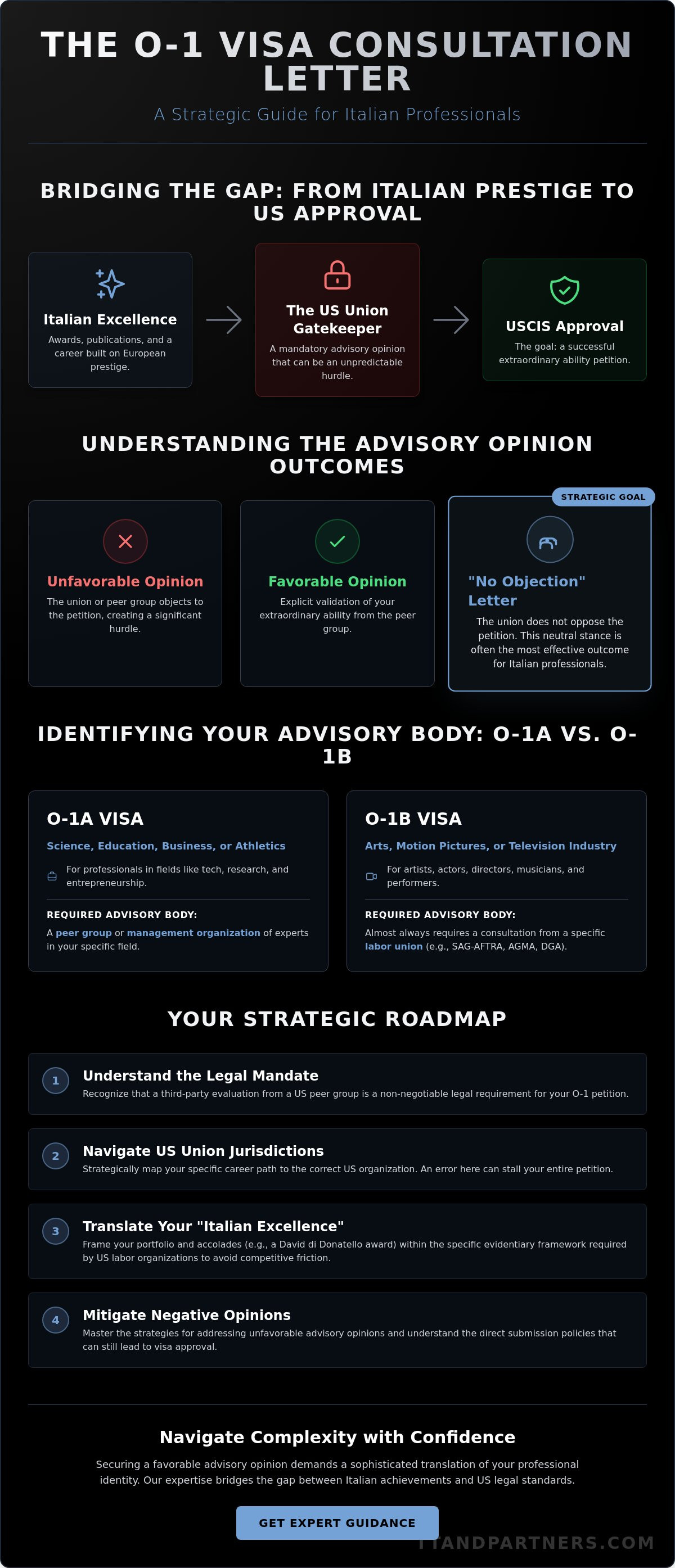
The most significant hurdle to your American expansion isn't the depth of your portfolio, but how that excellence is interpreted by a US labor union unfamiliar with your European prestige. When seeking O-1 visa consultation letters for Italians, the mandatory advisory opinion often feels like an unpredictable gatekeeper rather than a procedural step. You've likely felt the frustration of trying to map your career achievements onto a rigid American framework, fearing that a domestic peer group might view your entry as competition rather than a contribution.
We understand that securing a favorable advisory opinion requires more than just a list of awards; it demands a sophisticated translation of your professional identity. This guide provides the strategic roadmap you need to identify the correct jurisdiction and obtain a "no objection" letter with confidence. We'll examine the 2026 USCIS evidentiary standards, the nuances of peer group selection, and the precise methods for presenting Italian accolades to ensure your extraordinary ability petition stands on a foundation of professional consensus.
Table of Contents
What is an O-1 Visa Consultation Letter and Why is it Mandatory?
An advisory opinion, commonly referred to as a consultation letter, is a written evaluation from a recognized US peer group, labor organization, or management organization. This document serves as a critical evidentiary pillar in any extraordinary ability petition. USCIS mandates this third-party expert review to ensure that an applicant's entry into the US labor market is justified by their exceptional status. For those navigating O-1 visa consultation letters for Italians, this requirement often poses a unique challenge. US labor organizations are inherently protectionist, focusing on the preservation of domestic standards, which can create friction when evaluating high-level international talent whose prestige was built outside the American union system.
The consultation process generally results in one of three outcomes: a favorable opinion, an unfavorable (negative) opinion, or a "no objection" letter. While a favorable opinion explicitly validates your extraordinary ability, a "no objection" letter is frequently the most strategic result for Italian professionals. It indicates that the union has reviewed the credentials and decided not to oppose the petition. This neutral stance is often sufficient for USCIS to proceed with an approval, provided the rest of the evidence is robust and clearly presented.
The Legal Foundation of Advisory Opinions
The requirement for an advisory opinion is rooted in federal regulations designed to protect the interests of US workers. A comprehensive O-1 Visa Overview reveals that the standards differ significantly between the O-1A and O-1B categories. O-1A petitions, covering business, science, and athletics, often utilize peer groups or management organizations. In contrast, O-1B petitions for the arts, motion pictures, or television almost always require a consultation from a specific labor union. Understanding this gatekeeper role is essential because the peer group acts as a bridge between your Italian achievements and the American regulatory environment.
Peer Groups vs. Labor Organizations
Identifying the correct entity is a matter of technical precision. If a formal labor union exists for your specific occupation, such as SAG-AFTRA for actors or AGMA for opera singers, their opinion is non-negotiable. However, in many business or specialized technical niches, a formal union may not exist. In these instances, a "peer group" composed of experts in the field or a management organization can provide the necessary advisory opinion. If you're operating in a highly specialized Italian niche where no US equivalent exists, the strategy shifts toward demonstrating that no appropriate organization can be found. For complex cases involving niche Italian industries, securing expert legal guidance is vital to ensure the peer group selection aligns with USCIS expectations and avoids unnecessary delays.
Identifying the Correct US Peer Group for Italian Professionals
Selecting the appropriate advisory body is far more than a clerical task; it's an exercise in strategic positioning. While the Official USCIS O-1 Visa Requirements provide a broad framework, they don't account for the unique prestige markers of the Italian professional landscape. For example, an Italian actor decorated with a David di Donatello must ensure their peer group understands the award's equivalence to an Academy Award. When securing O-1 visa consultation letters for Italians, the USCIS Address Index serves as a useful starting point, but it isn't an exhaustive directory. Relying solely on that list without considering the specific nuances of your career can lead to jurisdictional errors that stall your petition.
The complexity increases for those with multi-disciplinary portfolios. An Italian fashion designer who also directs high-budget commercials may find themselves at a crossroads between a management organization and the Directors Guild of America (DGA). In such cases, the strategy involves identifying the primary occupation or, in some instances, obtaining dual consultations to satisfy USCIS scrutiny. Choosing the group most likely to recognize international excellence is essential to avoid a generic or lukewarm response.
Common Unions for Italian Artists and Performers
Consultations for Italian Entrepreneurs and Scientists
O-1A applicants in business or science often operate in fields where no formal labor union exists. This absence is actually a strategic advantage. Instead of a protectionist union, you can leverage expert letters from recognized US professional associations. These bodies are often more inclined to recognize global innovation and can provide the necessary "no objection" stance without the competitive friction typical of the arts. Key considerations for these applicants include:
Identifying associations with high industry standing in the US.
Ensuring the organization has the authority to speak on "extraordinary ability" within the niche.
Utilizing the lack of a union to provide more targeted, favorable expert testimony.
Refining this selection process early ensures your petition isn't met with unexpected resistance. If you're uncertain about which jurisdiction governs your specific niche, consulting with a strategist who understands both Italian achievement and US labor law can clarify the path forward.
Strategic Preparation: Securing a Favorable Advisory Opinion
Success in obtaining O-1 visa consultation letters for Italians depends on the intellectual architecture of your request. A common error is submitting a raw, uncurated petition to a labor organization, expecting them to sift through hundreds of pages of Italian documentation. Instead, your approach must be guided by a strategic cover letter that distills your "Italian Excellence" into a narrative that resonates with the specific peer group. This letter shouldn't merely list achievements. It must contextualize your "sustained national or international acclaim" within the current US market.
The timing of this request is critical. While premium processing now offers adjudication within 15 business days as of March 2026, labor unions don't operate on the same clock. You should initiate the consultation process once your portfolio is refined but before the final assembly of the USCIS filing. Leveraging high-profile US-Italy business connections during this phase can significantly bolster your request. A recognizable American name often bridges the gap between foreign prestige and domestic labor standards, making it easier for the union to issue a favorable opinion.
Translating Credentials and Accolades
Presenting Italian honors requires a sophisticated touch. Status as a "Cavaliere" or "Commendatore" must be framed not just as a cultural honor, but as a recognition of industry leadership that meets the rigorous O-1 visa requirements. Similarly, work with iconic brands like Ferrari, Armani, or Leonardo should be presented as evidence of your role in industry-leading projects. The successful Italian O-1 petition is built upon the artful translation of European prestige into the language of American labor protection.
The Role of the Petitioner and Sponsor
The reputation of your US sponsor carries significant weight when approaching a labor union. A well-established petitioner signals that your entry into the US labor market is supported by a legitimate entity with professional standing. When drafting the "Request for Consultation," the goal is to minimize the risk of a negative response by presenting your case as a "no objection" scenario. For a deeper understanding of how these elements fit into the broader application, review our O-1 Visa: The Complete 2026 Guide to Extraordinary Ability Visas for the US. This strategic preparation ensures that the peer group views your arrival as an enrichment of the American professional landscape.
Overcoming Negative Consultations and Objections
A negative advisory opinion isn't an automatic denial, but it does shift the burden of proof heavily onto the petitioner. Under the current "Direct Submission" policy, labor unions have the authority to bypass the applicant and send their objections directly to USCIS. This creates a strategic vulnerability, as you might not see the specific criticisms until a Request for Evidence (RFE) is issued. When managing O-1 visa consultation letters for Italians, it's vital to remember that USCIS, not the union, holds the final authority. The adjudicator must conduct a final merits determination, weighing the totality of your evidence against the union's protectionist stance. Since fiscal year 2025 saw an RFE rate of 19.7% for O-category cases, being prepared for a challenge is statistically prudent.
If a union claims your achievements don't meet the "extraordinary" threshold, your response must be a surgical legal rebuttal. You aren't just arguing with the union; you're proving to USCIS that the union's evaluation is factually or legally flawed. This often happens when a US organization fails to grasp the cultural or industrial weight of Italian institutions. An objection based on a misunderstanding of Italian industry standards can be dismantled with the right evidentiary support.
Rebutting Factual Errors in Union Letters
When a US union ignores the prestige of Italian industry standards, such as credits with RAI or high-level work at Cinecittà, you must introduce independent expert testimony. These experts provide the context that the union lacks. If the union's objection is particularly aggressive or contains clear factual errors regarding your field, the most prudent path might be a strategic withdrawal and re-filing. This allows you to submit a more refined portfolio that preemptively addresses the union's concerns before they reach the adjudicator's desk.
Handling the 'Peer Group' Objection in Business
Italian entrepreneurs often face skepticism from US trade associations that may view them as market competitors rather than unique talents. To override peer doubt, focus on objective criteria like high-salary evidence or your critical role in a distinguished organization. These metrics are harder for a peer group to dismiss than qualitative artistic achievements. For a detailed breakdown of these business-centric strategies, see our O-1 Visa for Entrepreneurs: A Strategic Guide to US Extraordinary Ability in 2026.
The "No Labor Organization" argument remains a powerful jurisdictional defense. If a union objects but doesn't actually represent your specific niche, their opinion can be legally neutralized. Proving that no appropriate labor organization exists for your unique specialization allows you to substitute the union letter with peer group evidence that is often far more favorable. If you've received a negative consultation or anticipate resistance from a US union, contact our legal team to develop a robust rebuttal strategy that protects your professional future in the United States.
Expert Legal Guidance for US-Italy O-1 Petitions
The complexity of an O-1 petition lies in the delicate equilibrium between international prestige and domestic labor protection. For the Italian professional, success isn't merely a matter of proving talent; it's about ensuring that talent is recognized within a foreign regulatory framework that often prioritizes its own members. A law firm with deep US-Italy roots is essential for this transition. We don't just process documents. We translate a lifetime of European achievement into the specific evidentiary language required by American adjudicators. Tosolini, Toniutti & Partners serves as the intellectual bridge for these high-stakes transitions, ensuring that your professional narrative remains intact while meeting every technical USCIS standard.
Navigating the nuances of dual-jurisdiction careers requires a strategic foresight that general immigration firms often lack. Whether you're managing cross-border business interests or a multi-disciplinary artistic career, the consultation phase is where many petitions succeed or fail. Securing the correct O-1 visa consultation letters for Italians is a proactive defensive measure. While we previously noted the 19.7% RFE rate for O-category cases in fiscal year 2025, many of those challenges stem from weak or misaligned advisory opinions. Obtaining a "no objection" letter before the initial filing significantly reduces the risk of a pause in your premium processing timeline.
A Strategic Partnership for Italian Talent
Our community of strategic thinkers has extensive experience engaging with US labor unions and peer groups across the full spectrum of O-1 categories. We understand the internal logic of organizations like AGMA, SAG-AFTRA, and various management groups. By meticulously curating your Italian portfolio, we ensure that every accolade and industry credit is presented with the precision required by US adjudicators. This comprehensive support extends from the initial evaluation of your "extraordinary ability" to the final issuance of your visa, providing a seamless path for Italy's most distinguished professionals.
Take the Next Step in Your US Career
A mandatory consultation letter shouldn't be the barrier that prevents your expansion into the American market. It's a procedural requirement that, when handled with sophistication, can actually strengthen the merits of your case. Our team is ready to guide you through the complexities of the advisory opinion process, turning a potential obstacle into a testament of your global standing. Don't leave your American future to chance. Schedule a consultation with our US-Italy immigration experts today and begin the process of formalizing your extraordinary status in the United States.
Advancing Your Professional Legacy in the United States
The transition from a celebrated Italian career to a recognized American authority hinges on the strategic alignment of your achievements with US labor standards. We've explored how identifying the correct peer group and meticulously preparing your portfolio can transform a mandatory requirement into a powerful endorsement of your talent. Successfully navigating O-1 visa consultation letters for Italians is a complex process; however, it's also an opportunity to define your standing at the pinnacle of your field.
Our bilingual legal team specializes in bridging the cultural and legal gap that often separates Italian excellence from American regulatory approval. With a proven track record in O-1 extraordinary ability petitions and specialized expertise in US-Italy cross-border immigration, we ensure your narrative remains compelling and legally sound. Don't leave your American expansion to chance. Secure your O-1 visa with a strategic consultation from Tosolini, Toniutti & Partners. Your global professional journey is ready for its next significant chapter, and we're here to ensure your transition is as seamless as your achievements are extraordinary.
Frequently Asked Questions
Is a consultation letter required for every O-1 visa petition?
A written advisory opinion is a mandatory evidentiary component for almost all O-1 petitions. Exceptions are rare and only apply if you can conclusively prove that no appropriate peer group or labor organization exists in the United States for your specific niche. For the vast majority of applicants, this document is a non-negotiable legal requirement that must be secured before the final filing.
Can I submit my O-1 petition while the consultation letter is still pending?
No, you shouldn't file your petition without the completed advisory opinion. USCIS regulations require the consultation letter to be included as part of the initial filing package at the time of submission. Filing an incomplete petition will likely result in a Request for Evidence (RFE) or an immediate denial, which can significantly disrupt your professional timeline and increase costs.
What happens if the labor union issues a negative consultation letter?
A negative letter doesn't result in an automatic denial of your visa. USCIS maintains the final authority and conducts a final merits determination to assess the totality of your evidence. You can overcome these objections by providing robust documentation and expert testimony that counters the union’s specific concerns, proving that you indeed meet the extraordinary ability criteria regardless of their stance.
How long does it typically take to get a response from a US labor union?
Most US labor unions provide a response within two to four weeks. Since these organizations don't adhere to the 15-day window provided by USCIS premium processing, it's vital to initiate the request early. Planning for this window ensures that your O-1 visa consultation letters for Italians are ready when you're prepared to move forward with the formal government filing.
Can an Italian professional association provide the O-1 consultation letter?
No, the advisory opinion must come from a US-based peer group, labor union, or management organization. While letters from Italian associations are excellent for proving your national acclaim, they don't fulfill the specific regulatory requirement. The consultation process is designed to evaluate your impact on the American labor market, which necessitates a domestic perspective from a US organization.
What is the difference between a 'favorable' and a 'no objection' letter?
A favorable letter explicitly validates your extraordinary ability and supports your entry, whereas a "no objection" letter simply states the union doesn't oppose your petition. For many Italian professionals, a "no objection" letter is a perfectly acceptable and strategic outcome. USCIS views both as meeting the mandatory requirement, allowing the adjudicator to proceed with the final merits determination.
How much do US labor unions charge for an advisory opinion in 2026?
Most US labor unions charge administrative processing fees for issuing advisory opinions, which typically range between $250 and $500. These fees are separate from the standard USCIS filing fees and are paid directly to the reviewing organization. Prices vary depending on the specific union and whether you require an expedited review for a time-sensitive project.
Do I need a consultation letter for an O-1 visa extension?
You generally don't need a new consultation letter for an extension if you're continuing with the same employer and the same job duties. However, if you're changing employers or if there's a significant shift in the nature of your professional activities, a new advisory opinion is required. It's always best to verify your specific situation to ensure total compliance with updated 2026 regulations.


Comments