

E-2 Visa Business Plan Common Mistakes: A 2026 Strategic Guide

Updated: Jul 2
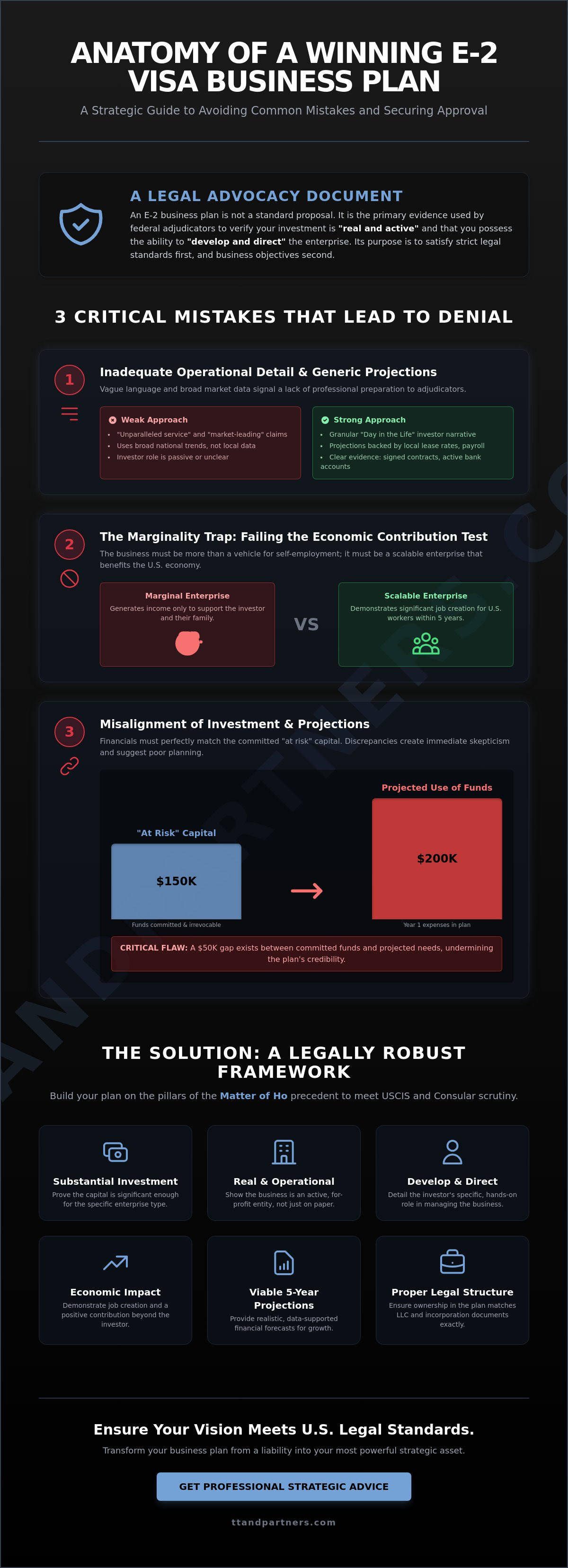
An E-2 visa business plan is not merely a financial forecast; it is a sophisticated legal advocacy document designed to withstand the rigorous scrutiny of a federal adjudicator. You likely feel the weight of this distinction as you grapple with the ambiguous definition of a "substantial" investment or the looming threat of the marginality rule. It's natural to feel concerned when even a minor oversight can lead to a Request for Evidence or a flat denial. Understanding E-2 visa business plan common mistakes is the first step in transforming a standard document into a strategic asset that secures your professional future in the United States.
We'll show you how to navigate these complexities by aligning your vision with the strict requirements of the Matter of Ho precedent. This guide identifies the critical errors that compromise applications and provides a clear framework for projecting US hiring needs with professional precision. We'll explore how to demonstrate that your enterprise is real and operational while ensuring your job creation strategy meets 2026 standards. By the end of this article, you'll have a strategic roadmap to build a plan that passes both USCIS and Consular review on your first attempt.
Table of Contents
The Strategic Role of a Business Plan in E-2 Visa Success
The E-2 business plan is a comprehensive 5-year legal and financial roadmap required by the US Department of State. It functions as the primary evidence used to prove the "real and active" nature of the investment, moving far beyond the scope of a standard commercial proposal. For a Consular officer, this document serves as the roadmap to verify the investor's specific ability to develop and direct the enterprise. In 2026, a successful plan must align with current economic realities and industry-specific benchmarks, providing a vision that is both ambitious and grounded in operational fact. Avoiding E-2 visa business plan common mistakes requires a shift in perspective; you aren't just presenting a business idea, but rather proving its viability within a strict regulatory framework.
Adjudicators in 2026 are placing a greater emphasis on the "real and operational" nature of the business. This means your plan requires more than just optimistic numbers. It needs support from concrete evidence like signed contracts, lease agreements, and active bank activity. A business like Nu Scape Designs would, for example, use its project portfolio and active client contracts to satisfy this requirement. If these elements are missing, the plan fails to meet the "at risk" investment threshold. A well-constructed plan bridges the gap between your entrepreneurial vision and the technical requirements of US immigration law. This precision is what separates a successful application from one that falls victim to E-2 visa business plan common mistakes.
Why a Standard Bank Business Plan Usually Fails
Standard bank plans prioritize debt service and creditworthiness. They're designed to convince a lender that a loan can be repaid with interest. In contrast, an E-2 visa business plan must prioritize job creation and regional economic impact. Adjudicators look for specific regulatory language required by USCIS and the Department of State that generic bank templates simply don't include. Relying on these "fluff" filled templates is the fastest way to receive a Request for Evidence (RFE), as they fail to address the unique legal standards of treaty investor status. The strategy is clear: the document must serve the law first and the business second.
Aligning Business Architecture with Your Visa Strategy
The way you handle your LLC incorporation directly influences the business plan's internal logic. It's vital to ensure the ownership structure detailed in the plan matches your legal formation documents exactly. Discrepancies here suggest a lack of professional precision and can lead to immediate skepticism from officers. The "Develop and Direct" clause must be the heartbeat of your operational narrative. It explains how you, as the investor, will manage the enterprise on a daily basis. Without this clarity, the plan remains a static document rather than a visionary tool for growth. Success depends on the harmony between your legal structure and your operational goals.
Mistake #1: Inadequate Operational Detail and Generic Projections
Vague descriptions are the hallmark of an amateur application. When an adjudicator reads a plan filled with "market leading" or "unparalleled service" without supporting data, they see a lack of professional preparation. Among E-2 visa business plan common mistakes, failing to provide a granular "Day in the Life" narrative for the investor is particularly damaging. The officer needs to see exactly how you'll "develop and direct" the enterprise, from managing complex supply chains to overseeing local recruitment. If your role is indistinguishable from a passive shareholder, the visa is unlikely to be granted.
Market analysis often falls into the trap of using broad national trends that lack local relevance. A tech startup in Austin shouldn't rely on general US software growth; it needs local competitive analysis and specific regional benchmarks. In 2026, revenue projections must be backed by verifiable data points, such as local lease rates or comparable industry payroll figures. This level of precision is essential for E-2 Treaty Investors who must prove their business is real and active. If you're unsure how to structure these complex details, reaching out for professional strategic advice can ensure your narrative remains cohesive and compliant.
The Five-Year Growth Requirement
Treaty standards demand a projection that spans exactly five years. This timeline isn't arbitrary; it demonstrates the enterprise's long-term viability and its capacity to contribute to the US economy. You must justify revenue growth without appearing unrealistically optimistic. This balance is achieved by linking every dollar of projected income to a specific marketing tactic or operational expansion. For example, a Year 3 revenue spike should correspond with a documented plan to hire additional sales staff or open a second location. Each figure must be a logical consequence of your stated business strategy.
Operational Timelines and Milestones
A common oversight is neglecting the pre-opening or expansion timeline. The business must be "ready to commerce" at the time of application, meaning the foundations must be laid. Your plan should define clear milestones for equipment acquisition, lease execution, and initial hiring phases. These dates shouldn't be guesses. They should reflect the reality of your industry's setup time. By documenting these steps, you prove that the investment capital is already "at risk" and the business is not merely a theoretical concept. Clear milestones show the adjudicator that you have a disciplined approach to the transition from investment to operation.
Mistake #2: The Marginality Trap – Failing the Economic Contribution Test
The marginality test represents the most significant hurdle for treaty investors in 2026. By definition, a marginal business is one that doesn't have the present or future capacity to generate more than enough income to provide a minimal living for the treaty investor and their family. This is the leading reason for E-2 denials because the business plan often portrays a scenario of simple self-employment rather than a robust enterprise. To avoid E-2 visa business plan common mistakes, your document must proactively prove that the venture will have a significant economic impact within the United States. A non-marginal business must demonstrate the capacity to hire US workers within five years.
Adjudicators look for evidence that the business will grow beyond the individual investor's personal needs. If the financial projections suggest that all profits are consumed by the owner's living expenses, the application will likely be flagged as marginal. You need to demonstrate that the business possesses the inherent vitality to contribute to the local economy through job creation, tax revenue, and the procurement of local services. Proving non-marginality is about showing that your business is an engine of growth, not just a personal paycheck.
Projecting US Job Creation Accurately
Vague hiring projections are a critical weakness that triggers immediate scrutiny. Simply stating you'll "hire staff" isn't enough for a 2026 application. You must provide specific job titles, detailed responsibilities, and competitive salary ranges based on actual local benchmarks. It's vital to differentiate between W-2 employees and 1099 contractors. USCIS generally places much higher value on W-2 employees because they represent stable, long-term US job creation. A well-designed hierarchical organizational chart should clearly illustrate the investor's supervisory role, showing that you're managing a professional team rather than performing every technical task yourself.
Financial Proof of Non-Marginality
Your financial tables must show sufficient net profit after all expenses, including a realistic owner's draw. If the remaining capital is negligible, it suggests the business cannot sustain future growth or additional hiring. While it's common for startups to show lower profits in the initial 12 to 24 months, your narrative must explain how the business will pivot toward significant profitability by Year 3. Use industry standards to justify your personnel costs and operational overhead. This transparency builds trust with the Consular officer, proving that your projections are rooted in commercial reality. By addressing these E-2 visa business plan common mistakes, you position your enterprise as a legitimate contributor to the American economic landscape.
Mistake #3: Misalignment Between Investment and Financial Projections
One of the most frequent E-2 visa business plan common mistakes involves a fundamental disconnect between the capital described in the narrative and the actual proof of funds provided in the financial exhibits. To satisfy the "at risk" requirement, capital must be irrevocably committed to the enterprise before the visa is granted. Adjudicators in 2026 are increasingly critical of plans that show a high investment figure on paper that isn't reflected in bank statements or paid invoices. Simply having cash in a business account doesn't constitute an investment; the funds must be spent or legally bound to the business's operational needs.
The "Spend-Down" table has become a critical component of a 2026 E-2 business plan, functioning as an itemized audit of your investment's deployment. It provides a transparent view of how every dollar has been utilized, from initial LLC setup to the acquisition of specialized equipment. This table serves as a bridge between the "Uses of Funds" and the physical evidence of the investment, such as wire transfers and vendor receipts. Within the business plan narrative, you must also address the "Source of Funds" to ensure consistency with the broader legal strategy. If you need assistance aligning your financial roadmap with regulatory expectations, you can contact our strategic advisors for a professional review.
Substantiality vs. Minimums
While there's no official statutory minimum investment amount, successful investments in 2025 typically ranged from $80,000 to over $300,000. Adjudicators apply a proportionality test, which measures the investment against the total cost of establishing or purchasing the business. A $50,000 investment in a service-oriented consultancy requires a different strategic narrative than a $500,000 investment in a manufacturing facility. You must link the "substantial" nature of your capital to specific industry benchmarks to prove that the amount is sufficient to ensure the business's success. Smaller investments face greater scrutiny in 2026, making it vital to provide stronger evidence that the business is viable and not marginal.
Documenting the 'At Risk' Capital
Uncommitted funds sitting in a bank account are a primary trigger for an RFE and remain one of the most persistent E-2 visa business plan common mistakes. To avoid this, your business plan projections should focus on capital that is already spent or held in escrow. Signed contracts and lease agreements can also be treated as "at risk" capital if they represent a binding financial obligation. It's essential that the "Uses of Funds" table in your plan matches the evidentiary documents in your E-2 Visa application. This alignment demonstrates a level of professional precision that satisfies the deeper examination of the investor now common in 2026 Consular interviews.
Crafting a Matter of Ho Compliant Business Plan with Legal Precision
The architectural foundation of any successful investment visa application is the Matter of Ho precedent. Established in 1998, this ruling dictates the specific legal standards for business plans in both E-2 and EB-5 categories. It transforms the document from a simple commercial proposal into a legally binding narrative that proves your venture is more than just a theoretical concept. Many E-2 visa business plan common mistakes stem from ignoring these technical requirements, leading to a perceived lack of "credibility" during the adjudication process. A plan that satisfies Matter of Ho isn't just a collection of optimistic numbers; it's a cohesive proof of the enterprise's viability and economic potential.
To withstand the increased scrutiny of 2026, where officers probe the investor's background and specific management role with greater depth, your plan must rest on six essential pillars. These include a granular business description, a comprehensive marketing strategy, a clear organizational structure, a specific personnel hiring plan, documented milestones, and realistic 5-year financials. When these elements are woven together with legal precision, the result is a document that anticipates every potential objection before it's raised. A lawyer-led approach to business planning significantly reduces the risk of receiving a Request for Evidence (RFE) by ensuring every claim is backed by regulatory language and verifiable data.
The Legal-Business Synergy
Our firm specializes in bridging the gap between Italian business culture and the rigid requirements of the US legal system. It's vital to review your business plan alongside other treaty options, such as the E-1 Visa, to ensure you've selected the most efficient path for your specific trade or investment goals. While the E-2 is a non-immigrant visa, a well-structured plan should also account for future Green Card strategies. By building an enterprise that exceeds the marginality threshold from day one, you create a stronger foundation for potential permanent residency down the line. This holistic approach ensures your US venture is positioned for long-term growth, not just initial entry.
Next Steps: Professional Review and Filing
Submitting a business plan that hasn't been vetted by an immigration attorney is a risk that few serious investors can afford. In 2024, the E-2 visa approval rate remained high at approximately 90.1%, but the 51,047 visas issued in FY 2025 reflect a more disciplined and normalized adjudication process. Your business plan serves as your primary defense during the Consular interview; it's essentially the script from which you'll speak. If the document is weak or contains E-2 visa business plan common mistakes, your verbal testimony will struggle to fill the gaps. We invite you to contact Tosolini, Toniutti & Partners for a comprehensive E-2 strategy consultation to ensure your business architecture meets the highest standards of international law.
Securing Your Professional Legacy in the United States
Building a successful US enterprise requires more than just capital; it demands a document that speaks the language of federal adjudicators. You've seen how a compliant strategy rests on granular operational detail and a clear commitment to US job creation. By addressing E-2 visa business plan common mistakes, such as vague hiring timelines or uncommitted investment funds, you transform a potential hurdle into a clear pathway for approval. Precision in these early stages ensures that your business vision is viewed as a credible, active, and non-marginal contribution to the American economy.
Our firm bridges the gap between visionary entrepreneurship and the rigorous standards of US-Italy treaty law. We provide a comprehensive integration of LLC architecture and visa strategy, ensuring your plan meets every Matter of Ho requirement with professional precision. Secure your E-2 investment with a legally-sound business plan; contact our cross-border experts today to refine your strategy. Your expansion into the American market is a bold step toward global growth. With a meticulously crafted strategy, you can move forward with the confidence that your professional future is built on a stable and compliant foundation.
Frequently Asked Questions
What is the most common reason an E-2 business plan is rejected?
The most frequent cause for rejection is "marginality," where the enterprise appears to exist solely to provide a minimal living for the investor and their family. This is often one of the E-2 visa business plan common mistakes that suggests a lack of scalability or economic impact. Officers look for evidence that the business will hire US workers and grow beyond a single-person operation within five years.
Does an E-2 business plan need to follow the 'Matter of Ho' standard?
Yes, every compliant plan must adhere to the Matter of Ho precedent established in 1998. This legal standard requires a comprehensive description of the business, including its marketing strategy, organizational structure, and 5-year financial projections. Without this framework, the plan lacks the technical weight needed for a successful adjudication in 2026.
How many employees do I need to show in my E-2 business plan?
There is no fixed statutory number of employees, but the plan should typically project hiring three to five US workers over the first five years. The goal is to show the business is not marginal. These projections must be realistic for your specific industry and location to avoid triggering a Request for Evidence during the review process.
Can I write my own E-2 business plan using a template?
Using a generic template is possible but highly discouraged for treaty investor applications. Most templates focus on bank financing rather than immigration requirements, which is a major source of E-2 visa business plan common mistakes. A custom, lawyer-led plan ensures that the narrative addresses specific regulatory hurdles and the "at risk" investment nature of the capital.
How long should an E-2 visa business plan be?
A professional plan usually spans 25 to 40 pages, depending on the complexity of the industry. It's not about the page count, but about covering the essential pillars of Matter of Ho with precision. Every page should serve a purpose, replacing vague qualifiers with concrete data and operational milestones that prove the business is ready to commence.
What is the 'marginality' rule in an E-2 visa application?
The marginality rule states that a business cannot be the investor's only source of income if it doesn't also contribute to the US economy. Essentially, the venture must have the capacity to generate more than enough profit to support you and your family. Demonstrating job creation for US workers is the most effective way to satisfy this requirement.
Do I need to show my source of funds in the business plan?
Yes, the narrative in your business plan must align perfectly with your source of funds documentation. While the plan focuses on how the money is used, it should mention the total investment amount to ensure consistency with your legal filing. Any discrepancy between your financial tables and your bank statements can lead to significant delays or a denial.
Can I change my business plan after the E-2 visa is approved?
Businesses naturally evolve, and minor operational changes are expected after approval. However, if you make a "material change," such as switching to a completely different industry or ownership structure, you may need to file an amended petition with USCIS. It's best to consult with your legal team before making significant strategic shifts to your US operations.



Comments