

E-2 Visa vs. EB-5 for Italian Investors: The 2026 Strategic Comparison Guide
- Gianni Mendes Toniutti, Esq.

- Jun 18
- 12 min read
Updated: Jul 1
The pursuit of a transatlantic expansion often begins with a fundamental question: should an Italian entrepreneur prioritize immediate operational speed or the enduring security of permanent residency? For many, the choice between the E-2 visa vs EB-5 for Italian investors isn't merely a matter of capital; it's a strategic decision about family legacy and the preservation of Italian wealth. You understand that while the E-2 offers a swift, renewable entry, the uncertainty of long-term status for children can overshadow even the most successful U.S. venture.
We provide a precise roadmap to help you weigh the $800,000 EB-5 investment against the agile, substantial requirements of the E-2 treaty visa. You'll gain clarity on protecting your capital while securing unrestricted work authorization and a clear path to a green card. This comparison explores the specific procedural landscape at the U.S. Embassy in Rome and the documentation standards required to transform Italian success into American permanence.
Table of Contents
The Fundamental Choice: Speed (E-2) vs. Permanence (EB-5) for Italians
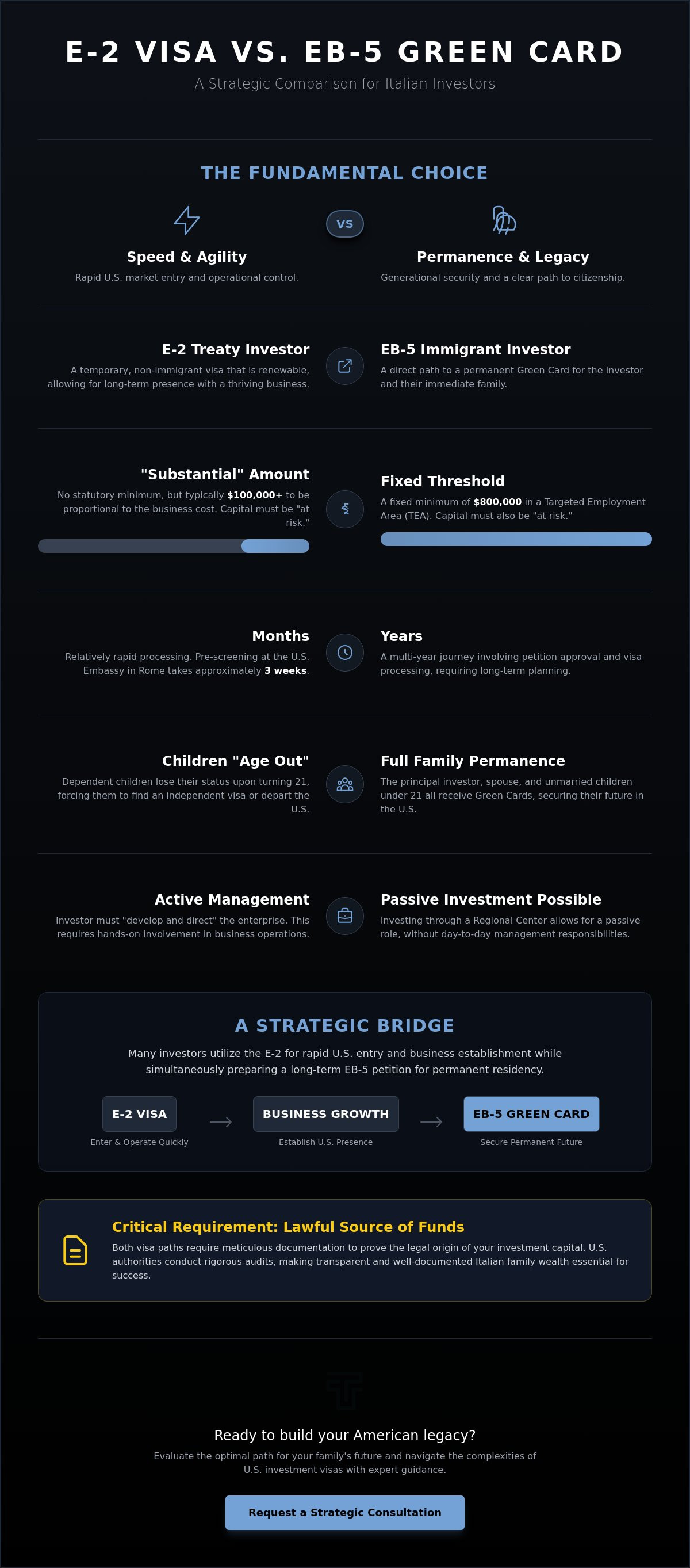
The decision-making process for an Italian entrepreneur looking toward the United States is rarely about capital alone; it's a structural choice between immediate operational agility and the enduring security of a family legacy. In the 2026 landscape, the strategic comparison of the E-2 visa vs EB-5 for Italian investors remains the central debate for those navigating transatlantic expansion. The E-2 Treaty Investor Visa, built upon the historic US-Italy Treaty of Commerce, offers a remarkably efficient entry point. It allows for rapid deployment of resources and a pre-screening time at the U.S. Embassy in Rome of approximately three weeks. Conversely, the EB-5 Immigrant Investor Visa Program represents a more profound commitment, requiring a minimum of $800,000 in Targeted Employment Areas to secure a direct path to permanent residency.
Choosing between these paths requires analyzing three key metrics:
Investment Scope: E-2 requires a substantial but undefined amount, whereas EB-5 demands a fixed, high-capital threshold.
Processing Velocity: E-2 status can be obtained in months; EB-5 is a multi-year journey toward a Green Card.
Residency Vision: E-2 is a temporary bridge; EB-5 is a permanent foundation.
Non-Immigrant vs. Immigrant Intent
The E-2 is strictly a non-immigrant classification. While it can be renewed every five years as long as the business thrives, the law requires you to maintain an intent to depart the U.S. eventually. This requirement creates a legal ceiling for those seeking total integration. The EB-5 removes this boundary entirely. It's designed for those who envision their future as American citizens, offering the freedom to travel and reside without the constant necessity of proving a temporary stay. Understanding these nuances in the E-2 visa vs EB-5 for Italian investors is essential when planning for the next decade of your professional life.
Family Longevity and Aging Out
Italian families often prioritize the educational and professional futures of their children. Under E-2 status, children are protected only until they reach 21. At that threshold, they "age out" and must secure their own independent visas or leave the country. The EB-5 eliminates this anxiety by providing a permanent Green Card for the entire family unit. This transition ensures that students can access domestic tuition rates and unrestricted work authorization, reflecting a truly human-centered approach to immigration strategy. If you're ready to evaluate which path fits your family's vision, you can contact us for a strategic consultation.
Financial Architecture: Substantial Investment vs. Minimum Capital Thresholds
The financial commitment represents the most tangible divergence between these two paths. When evaluating the E-2 visa vs EB-5 for Italian investors, one must look beyond the initial dollar amount to the underlying logic of the capital structure. The E-2 visa operates on a principle of proportionality; there's no statutory minimum, yet the investment must be "substantial" enough to ensure the business's success. In contrast, the EB-5 program is defined by rigid, high-capital thresholds designed to stimulate the American economy through significant job creation. This distinction often makes the E-2 Visa the preferred entry point for boutique Italian startups and service-sector firms that require agility over sheer scale.
Both programs share the "at risk" requirement. This legal standard dictates that the capital must be subject to potential loss; a passive deposit in a bank account doesn't qualify as an investment. For an Italian entrepreneur, this means the funds must be committed to the enterprise, whether through the purchase of equipment, inventory, or the signing of a commercial lease. While the E-2 allows for a more modest entry point, often starting around $100,000 for successful applications, the EB-5 demands a more significant liquidity event to meet the official USCIS EB-5 requirements.
The E-2 Substantiality Test
The proportionality test measures the investment against the total cost of either purchasing an existing business or establishing a new one. For a high-capital industry like manufacturing, a "substantial" investment might reach several hundred thousand dollars. However, for an Italian consulting or design firm, a lower amount may suffice if it fully covers the operational needs. You must also avoid the marginality trap. The business cannot simply provide a minimal living for the investor; it must demonstrate the capacity to contribute to the U.S. economy and employ American workers within five years.
EB-5 Tiers and TEA Zoning in 2026
In 2026, the EB-5 program remains bifurcated into two primary tiers. Investing in a Targeted Employment Area (TEA), which includes rural locations or zones with high unemployment, requires $800,000. Projects outside these zones necessitate a $1,050,000 commitment. Many high-net-worth Italian families gravitate toward TEA infrastructure projects because they often offer a more structured path for capital preservation. The investment must create at least 10 full-time jobs for U.S. workers. If you're uncertain which financial tier aligns with your current liquidity, you can discuss your portfolio with our strategic advisors.
Documenting Italian Wealth: Navigating Source of Funds Audits
The lawful source of funds requirement represents the most rigorous phase of the application process. When debating the E-2 visa vs EB-5 for Italian investors, one must prepare for a level of financial transparency that far exceeds standard European banking audits. While E-2 Treaty Investor visa rules require proof that the investor has possession and control of the funds, the EB-5 program demands an exhaustive audit of the capital's entire lifecycle. The path from an Italian bank account to a U.S. enterprise must be unbroken; any gap in the narrative of these funds can lead to a Request for Evidence (RFE) or an outright denial.
Italian entrepreneurs often possess diverse portfolios involving real estate holdings, corporate dividends, and family inheritances. Navigating this complexity requires a strategic approach to documentation that respects both Italian legal traditions and U.S. immigration standards. Successfully bridging these two worlds is often simplified when an investor has already secured their Italian citizenship, as it establishes a clear, documented history within the Eurozone's regulatory framework.
Tracing Assets from Italy
For many Italians, the primary source of investment capital is the liquidation of high-value real estate. To satisfy U.S. authorities, you must provide the "Atto di Vendita", the official deed of sale executed before an Italian notary. This document serves as the cornerstone of your financial narrative. Your "Dichiarazione dei Redditi" (Italian tax returns) for the past five to seven years must be translated and presented to prove that your wealth was accumulated through lawful professional activity. Scrutiny is relentless. You must also ensure that the currency transfer from Euros to Dollars complies with both European Central Bank regulations and U.S. anti-money laundering statutes.
Gifts and Inheritances
If your capital originates from a family gift, U.S. law requires you to prove the "source of the source." This means the donor must also document how they originally obtained the funds. In cross-border cases between Italy and the U.S., a formal gift affidavit is mandatory. This legal statement must clarify that the funds are a gift, not a disguised loan, and that no repayment is expected. For inherited wealth, the "Dichiarazione di Successione" is the vital document. It proves the legal transfer of assets and ensures the capital is eligible for either E-2 or EB-5 classification. If you need assistance structuring your financial documentation, you can contact our experts for a confidential review.
Operational Dynamics: Active Management vs. Regional Center Passivity
The operational soul of your U.S. venture depends on how much control you wish to exert over daily decisions. In the strategic assessment of the E-2 visa vs EB-5 for Italian investors, the degree of involvement often dictates the final choice. The E-2 classification mandates that the investor "develops and directs" the enterprise. This isn't a passive role; it requires a presence that shapes the brand's evolution on American soil. Conversely, the EB-5 program offers a bifurcated path: the active Direct Investment or the passive Regional Center route.
Italian entrepreneurs often prefer the Direct EB-5 when they're scaling a proven European model. This path allows for a sophisticated LLC incorporation that mirrors the investor's aesthetic and professional values. However, it carries the significant burden of creating 10 permanent, full-time jobs directly on the company payroll. For many, the E-2 serves as an ideal "beta test," allowing the investor to stabilize operations and understand the local market before committing to the rigorous job-creation mandates of a permanent immigrant visa.
Risk mitigation looks different in each scenario. In the E-2 framework, the primary risk is operational; if the business fails to remain a "real and operating" entity, the visa loses its foundation. In the EB-5 framework, especially through Regional Centers, the risk is often focused on capital preservation and the successful removal of conditions on the Green Card. You must decide if you'd rather manage a business or manage an investment.
Direct Investment for Italian Entrepreneurs
Maintaining absolute control over your U.S. business architecture ensures that every hire and every strategic pivot aligns with your vision. This hands-on approach is rewarding but demanding. Direct EB-5 investors must navigate complex U.S. labor laws while ensuring their enterprise remains viable enough to sustain the required workforce. It's a path for the builder and the visionary who refuses to delegate the soul of their business to a third party. It requires a deep understanding of the American regulatory environment and a commitment to long-term growth.
Regional Centers: The Passive Path
For high-net-worth families whose primary objective is residency rather than daily business management, Regional Centers are the definitive choice. Approximately 95% of all EB-5 investors choose this route because it allows for "indirect" job counting. In 2026, this means jobs created by the project's overall economic impact count toward your residency requirement, even if they aren't on your personal payroll. This structure acts as a buffer, shifting the operational risk to experienced U.S. developers. However, Italians must perform rigorous due diligence to ensure the project's capital preservation strategy is sound. If you're ready to determine which operational model aligns with your lifestyle, you should schedule a strategic architectural review of your case.
The 2026 Strategic Path: Bridging from E-2 to EB-5
The transition from a temporary treaty status to permanent residency is a sophisticated evolution that many successful families undertake. This "Bridge Strategy" isn't merely a legal maneuver; it's a phased approach to the American dream that respects both your capital and your time. Many find that the immediate entry provided by the E-2 allows them to build the very enterprise that will eventually support their immigrant petition. This sequential logic solves the primary tension in the E-2 visa vs EB-5 for Italian investors debate: the need for immediate operational speed versus the desire for generational permanence. By entering the U.S. rapidly, you can oversee your investment's growth while your legal team prepares the exhaustive documentation required for a permanent Green Card.
Concurrent Filing for Italians in the US
One of the most significant advantages for those already on American soil is the ability to file for an adjustment of status concurrently with an EB-5 petition. If you're currently holding an E-2 or an O-1 visa, you don't have to wait for your underlying petition to be approved before seeking residency benefits. This tactical shift grants you a "quasi-status" that includes an Employment Authorization Document (EAD). It allows you to work outside your original visa constraints, providing a level of professional freedom that was previously unavailable. Additionally, obtaining "Advance Parole" ensures you can maintain your business ties in Italy, allowing for international travel without abandoning your pending application. It's a layer of operational flexibility that secures your stay during the long USCIS adjudication periods.
Dual Citizenship and Naturalization
The ultimate objective for many is the security and prestige of a dual U.S. and Italian passport strategy. Holding both nationalities offers unparalleled global mobility and ensures a safety net for your children's future. Once your conditional residency is established, the focus shifts to the I-829 petition. This is the final audit where you prove that your capital remained "at risk" and the 10 required jobs were successfully created. Successfully navigating this final step transforms your presence from a visitor into a permanent part of the American fabric. Five years after receiving your initial residency, you may become eligible for naturalization, completing the journey from a treaty investor to a citizen. If you're ready to design your unique path, you can contact Tosolini, Toniutti & Partners to design your US-Italy investment roadmap.
Designing Your Transatlantic Legacy in 2026
Navigating the nuances of the E-2 visa vs EB-5 for Italian investors requires more than just capital; it demands a clear vision for your family's future. You've seen how the E-2 provides the agility necessary for immediate market entry, while the EB-5 offers the generational security of permanent residency. Whether you choose the active management of a direct venture or the passive safety of a regional center, the decision rests on your specific long-term goals and liquidity. Each path presents unique structural advantages that can be tailored to your professional ambitions.
Tosolini, Toniutti & Partners brings decades of experience in US-Italy cross-border immigration law to your project. Our team provides the specialized bilingual support essential for navigating complex Italian financial audits and ensuring your documentation meets the highest standards. We've established a record of success across E-1, E-2, and EB-5 pathways, protecting your capital while securing your status. It's time to build your American foundation on a bedrock of legal precision.
Schedule a Strategic EB-5 vs. E-2 Consultation with Our US-Italy Legal Experts. Your future in the United States deserves a strategy as refined as your vision.
Frequently Asked Questions
What is the minimum investment for an EB-5 visa for an Italian investor in 2026?
The minimum investment for an EB-5 visa is $800,000 if the project is located within a Targeted Employment Area (TEA). Projects situated outside these rural or high-unemployment zones require a capital commitment of $1,050,000. These thresholds are established by current federal regulations and are expected to remain stable through the end of 2026.
Can I change my status from an E-2 visa to an EB-5 green card while in the US?
You can transition from an E-2 visa to an EB-5 green card through a process known as adjustment of status. Italian investors currently residing in the United States under E-2 status can take advantage of concurrent filing. This allows you to apply for residency while maintaining your operational presence, often securing a work permit and travel authorization while your petition is pending.
How long does the E-2 visa last for Italian citizens compared to the EB-5?
For Italian citizens, the E-2 visa is valid for up to 60 months and can be renewed indefinitely as long as the business remains operational. Each entry into the U.S. typically grants a two-year period of stay. In contrast, the EB-5 leads to a conditional green card valid for two years, followed by permanent residency once the job-creation requirements are satisfied.
Can I use a gift from my family in Italy for my EB-5 investment?
You may use a gift from family members in Italy to fund your EB-5 investment, provided the transfer is documented with a formal gift affidavit. U.S. authorities require evidence that the donor obtained the funds through lawful means, such as the sale of real estate or professional earnings. This "source of the source" documentation is a critical component of the audit process for the E-2 visa vs EB-5 for Italian investors.
Does the E-2 visa lead to a Green Card for Italians?
The E-2 visa does not directly lead to a green card because it is a non-immigrant classification. It requires you to maintain an intent to depart the U.S. eventually, though it can be renewed for decades. To obtain permanent residency, Italian investors must transition to an immigrant category, such as the EB-5 or an employment-based green card, through a separate application process.
What is the "Source of Funds" requirement for Italian investors?
The "Source of Funds" requirement mandates that every Euro invested is traced back to a lawful origin through a clear narrative. For Italian investors, this involves presenting "Dichiarazione dei Redditi" (tax returns) and "Atto di Vendita" (notarized deeds) for property sales. You must demonstrate an unbroken path of capital from your Italian accounts to the U.S. enterprise to satisfy anti-money laundering standards.
Is it better to invest in a Regional Center or a direct business?
Choosing between a Regional Center and a direct business depends on your desired level of operational involvement. Regional Centers offer a passive investment route favored by those seeking residency without the burden of daily management and direct hiring. Direct investment is better suited for entrepreneurs who wish to maintain absolute control over their business architecture and hiring decisions.
Do my children get Green Cards if I apply for an EB-5 visa?
Your unmarried children under the age of 21 are eligible to receive green cards as dependents on your EB-5 petition. This provides them with permanent residency, domestic tuition rates at universities, and unrestricted work authorization. It's a fundamental advantage in the E-2 visa vs EB-5 for Italian investors comparison, as it prevents children from "aging out" of their legal status.


Comments