

Best State for LLC for Non-Residents: A Strategic Comparison for 2026
- Gianni Mendes Toniutti, Esq.

- Apr 12
- 13 min read
What if the most critical blueprint for your US market entry isn't your product design, but the invisible legal architecture of the state you select? You've likely realized that facing 50 distinct sets of regulations creates more than just administrative noise; it creates a risk of structural instability. Many international founders fear the weight of double taxation or the vulnerability that comes with public registries. We understand that you seek a solution that reflects the same precision and foresight you apply to your own projects.
Finding the best state for llc for non-residents requires a deep understanding of how tax efficiency and privacy laws intersect with your long-term vision. This comparison for 2026 will show you how to choose a jurisdiction that acts as a robust foundation for your global growth. We'll explore how specific choices can minimize your administrative burden while securing your assets and supporting future E-2 or O-1 visa applications. By the end of this analysis, you'll have a clear framework for selecting a corporate home that offers both functional excellence and strategic longevity.
Key Takeaways
Understand why state selection serves as the architectural foundation of your US presence, defining your legal framework regardless of where your global clients are located.
Compare the unique advantages of Delaware, Wyoming, and New Mexico to identify the best state for llc for non-residents based on your specific requirements for prestige or privacy.
Learn how to leverage charging order protection and sophisticated privacy laws to safeguard your LLC interests against personal liabilities and public disclosure.
Discover how to strategically align your corporate structure with E-2 and E-1 visa goals, ensuring your LLC meets the critical investment and trade criteria for US residency.
Gain insights into a precision-engineered approach to cross-border expansion that integrates state selection with long-term strategic business and real estate objectives.
Table of Contents The Architecture of Entry: Why State Selection is a Strategic Foundation The "Big Three" Comparison: Delaware vs. Wyoming vs. New Mexico Beyond the Fees: Privacy, Legal Precedent, and Asset Protection Strategic Alignment: Connecting Your LLC to Visa and Immigration Goals Navigating the Incorporation Process with TT and Partners
The Architecture of Entry: Why State Selection is a Strategic Foundation
Choosing the right jurisdiction isn't a mere administrative checkbox. It's the blueprint for your entire US operation. A non-resident LLC functions as a flow-through entity, offering international founders a level of flexibility that traditional corporate structures lack. For entrepreneurs seeking the best state for llc for non-residents, the decision determines the legal reality of the business, regardless of where the end-users reside. This choice dictates everything from your privacy levels to the complexity of your annual filings.
Many founders chase the cheapest state without considering long-term scalability. This is a mistake. The ideal choice aligns with your 5-year business vision. If you plan to raise venture capital by 2028, Delaware's established case law provides a stable framework that investors trust. If you prioritize asset protection and zero state taxes, Wyoming or Nevada might serve your needs better. The goal is to build a structure that doesn't require a costly "renovation" as the business matures.
In the specific context of the US-Italy corridor, the LLC acts as a bridge. It harmonizes the rigid requirements of European tax systems with the agile nature of US commerce. It allows for a seamless flow of capital and intellectual property, provided the foundation is set correctly from day one. You aren't just forming a company; you're designing a cross-border vehicle for growth.
LLC vs. Corporation for Non-Residents
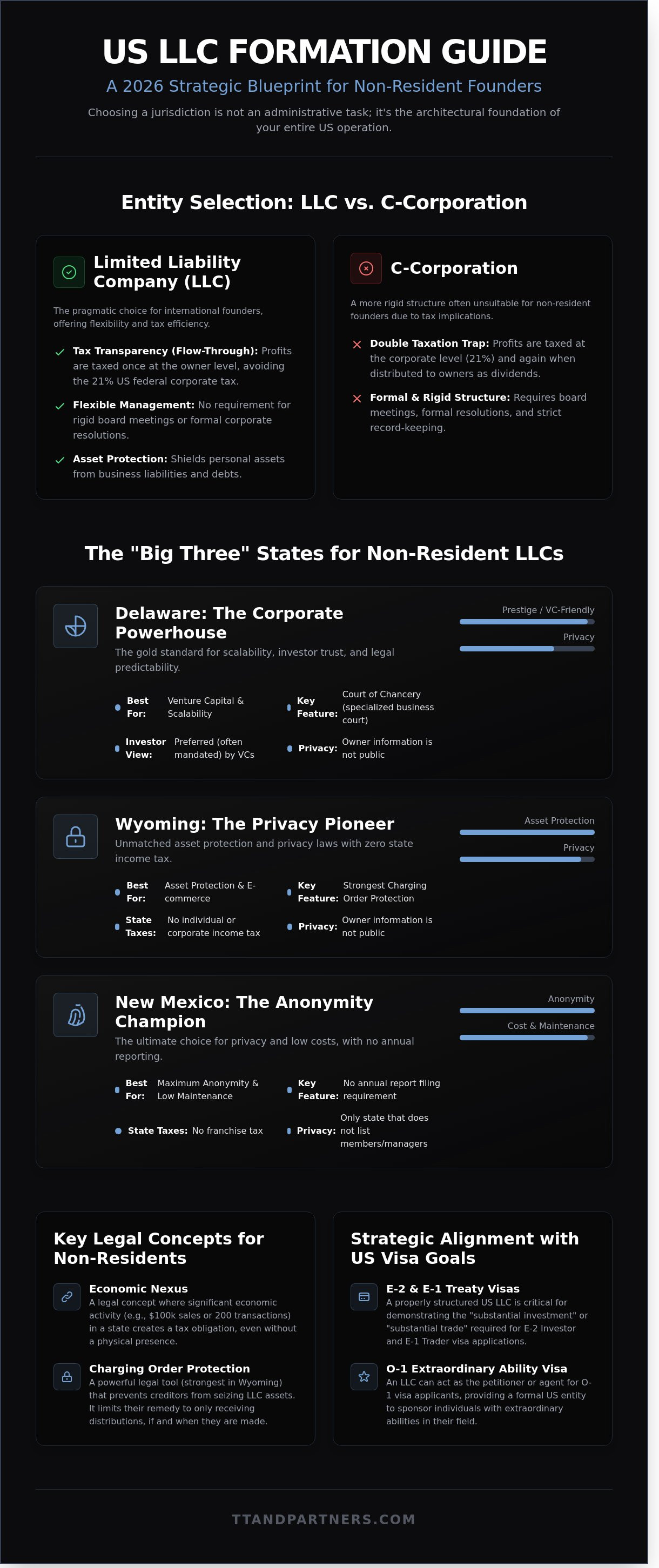
Corporations often fall into the double taxation trap, where profits are taxed at the entity level and again when distributed as dividends. The Limited Liability Company (LLC) circumvents this through tax transparency. Profits flow directly to the owners, avoiding the 21% federal corporate rate. This structure offers a flexible management framework that doesn't require the rigid board meetings or formal resolutions of a corporation. It's a pragmatic choice for international owners. Integrating these elements into your LLC incorporation strategy ensures the business remains scalable as your US footprint grows.
The Legal Concept of "Nexus"
In the 2026 digital marketplace, presence is no longer strictly physical. Economic nexus now dictates your legal and tax obligations. This concept, solidified by the 2018 Wayfair decision, means that reaching a specific revenue threshold, often $100,000 or 200 transactions, triggers a requirement to register in that state. Your Registered Agent acts as the vital jurisdictional anchor for the entity. They manage official legal documents and ensure compliance with state mandates. Identifying the best state for llc for non-residents involves analyzing where your economic activity will concentrate. A strategic selection minimizes unnecessary filings while protecting your intellectual and financial assets.
The "Big Three" Comparison: Delaware vs. Wyoming vs. New Mexico
Choosing a jurisdictional home for your entity is a decision of structural integrity. For international founders, the search for the best state for llc for non-residents usually concludes in one of three locations: Delaware, Wyoming, or New Mexico. Each state offers a distinct framework designed to support different scales of operation and privacy requirements. While the SBA guide to business structures provides a fundamental understanding of the LLC entity, non-residents must look closer at state-level statutes to find the right fit for their global strategy.
Delaware: The Corporate Powerhouse
Delaware's reputation isn't merely marketing; it's a sophisticated legal infrastructure. The state's Court of Chancery uses specialized judges instead of juries to resolve business disputes. This creates a predictable environment for international litigation. Most venture capital firms and angel investors mandate Delaware registration before they'll commit funds. It's the standard for scalability. Global banks also recognize Delaware entities with ease, which simplifies the process when you're ready to open a US bank account or secure credit lines.
Wyoming: The Privacy Champion
Wyoming remains a top contender for the best state for llc for non-residents because it balances privacy with lean operations. It was the first state to create the LLC in 1977 and continues to lead in member protection. Wyoming doesn't list member or manager names on the public record, allowing for high levels of anonymity. In 2026, the annual report fee is a modest $60, making it more affordable than Delaware's franchise tax. The state also offers robust charging order protections, which ensures that a member's personal liabilities don't easily jeopardize the assets held within the company.
New Mexico: Minimalist Efficiency
New Mexico is the jurisdiction of choice for those who value simplicity and low overhead. It's the only state that requires neither an annual report nor an annual fee. Once the initial registration is complete, the entity remains active without recurring state filings. This "set it and forget it" model is ideal for solo entrepreneurs or digital nomads who don't plan on seeking external US investment. Privacy levels in New Mexico are comparable to Wyoming, as the state doesn't require the disclosure of members in the Articles of Organization. It's a lean, functional solution for businesses that prioritize cost-efficiency over institutional prestige.
To ensure your chosen structure aligns with your long-term vision, you may wish to consult with our strategic partners who specialize in cross-border entity management.
Beyond the Fees: Privacy, Legal Precedent, and Asset Protection
Selecting the Best States for Non-Resident LLCs isn't merely a calculation of initial filing fees. It's an architectural decision that defines the structural integrity of your enterprise. A Delaware LLC carries a specific weight in global commerce; it signals to vendors and financial institutions that your venture operates within a sophisticated legal framework. This prestige factor translates into smoother onboarding with payment processors and increased trust during high-stakes negotiations. It's the difference between a temporary structure and a permanent monument.
Charging order protection serves as a critical safeguard for your interests. It ensures that personal liabilities don't compromise the entity's assets. By 2026, the regulatory environment has shifted due to federal transparency mandates. While states like Wyoming offer robust internal privacy, every foreign owner must now navigate the Corporate Transparency Act (CTA) requirements. Choosing the best state for llc for non-residents requires balancing state-level anonymity with these mandatory federal disclosures. States like California or Florida often attract founders with low entry costs, but they impose heavy administrative burdens. California's $800 annual minimum franchise tax creates a recurring financial drain that often outweighs any initial savings.
The Intangible Value of Delaware Law
Delaware's Court of Chancery provides a level of predictability that's unmatched globally. With over 230 years of established case law, managers can rely on the Business Judgment Rule to protect their strategic decisions. This legal clarity is vital for international litigation and complex dispute resolution. It ensures that the architectural intent of the business remains intact even under legal pressure. The court's expertise allows for rapid resolutions, which is a significant advantage for non-resident managers who can't afford prolonged legal battles.
State-Level Tax Nuances for Foreigners
Tax obligations extend beyond the federal level. Delaware's $300 annual franchise tax is a fixed cost, whereas states like Wyoming or South Dakota remain the default for many because they lack state-level income taxes entirely. For an Italian founder, the US-Italy Tax Treaty of 1999 might mitigate double taxation at the federal level, but state-level nuances persist. The best state for llc for non-residents is often one where the local tax code doesn't create a secondary nexus of liability. Consider these primary options:
Wyoming: Offers zero state income tax and minimal reporting requirements.
Nevada: Provides strong asset protection but carries higher initial filing fees.
Delaware: Delivers high prestige and unmatched legal certainty for scaling.
Success depends on aligning these legal structures with your long-term vision. A well-chosen state acts as a foundation that supports growth rather than a constraint that limits it. The focus shouldn't be on the cheapest entry point, but on the most resilient framework for your international operations.
Strategic Alignment: Connecting Your LLC to Visa and Immigration Goals
Your corporate structure serves as the architectural framework for your American presence. Selecting the best state for llc for non-residents involves more than comparing filing fees; it requires a vision of how the entity supports your long-term immigration path. The LLC acts as the vessel for your professional identity, holding the assets and contracts that prove your business's viability to federal authorities.
Securing an EIN for non-residents immediately after formation is the first step in this process. Without this federal tax ID, you can't open the business bank accounts necessary to demonstrate the "at-risk" nature of your investment. In the eyes of US Citizenship and Immigration Services (USCIS), an LLC without an EIN is a dormant shell, not a functional enterprise.
For those pursuing the E-1 Treaty Trader visa, the LLC must facilitate "substantial trade." This isn't just about the volume of transactions, but the continuity of the trade flow between the US and your home country. Choosing a state with robust logistics infrastructure or favorable international trade regulations can simplify the documentation of these exchanges during your 2026 application process.
LLC Formation for E-2 Visa Success
The E-2 Investor Visa requires a clear, documented path of capital. When you register your LLC, the capitalization must be transparent. You'll need to show the funds moving from your personal accounts into the state-registered entity. Using your LLC to secure commercial leases or equipment contracts before your visa interview demonstrates operational readiness. This physical and legal footprint proves the business isn't speculative. To ensure your state choice aligns with specific treaty requirements, consider consulting with an Italian immigration lawyer who understands the nexus between corporate structure and visa eligibility.
The O-1 Visa and the US Entity
Entrepreneurs often use their LLC as the petitioner for an O-1 visa. This requires establishing a "nexus" between your extraordinary ability and the US market. While any state can host an LLC, Delaware’s legal prestige provides a professional veneer that can bolster an application. The sophisticated Chancery Court system in Delaware signals to adjudicators that the petitioner is part of a high-standard corporate environment. This structural credibility is vital when proving that your US entity has the capacity to employ a person of extraordinary talent.
Building a business that stands the test of federal scrutiny requires precision from day one. If you're ready to align your corporate structure with your immigration strategy, contact our team for a strategic consultation.
Navigating the Incorporation Process with TT and Partners
Establishing a corporate presence in the United States requires more than just submitting digital forms to a Secretary of State. At TT and Partners, we view legal structures through the lens of precision engineering. Just as a building requires a foundation capable of supporting its eventual height, your US entity must be built to withstand evolving tax regulations and international reporting requirements. We don't just file paperwork; we design the 2026 business architecture that allows your capital to move efficiently across borders.
Our methodology provides a holistic view of your expansion. Selecting the best state for llc for non-residents is only the first step in a much larger sequence. For many of our clients, a Delaware or Wyoming LLC serves as the gateway to significant real estate acquisitions or venture capital entries. We coordinate the entire timeline from initial jurisdiction analysis to the final closing of a property or the first board meeting. This integrated approach ensures that your corporate governance remains functional and compliant from day one.
Choosing a law firm over a generic incorporation website offers a level of protection that automated platforms cannot replicate. A website won't tell you how a specific state's laws interact with the 1984 US-Italy Tax Treaty or how the Corporate Transparency Act (CTA) impacts your privacy in 2025 and 2026. We provide attorney-client privilege and bespoke legal advice, ensuring your structure isn't just a template, but a strategic asset tailored to your specific risk profile.
Our Cross-Border Expertise
We specialize in bridging the gap between the Italian and US legal systems. Our team understands the nuances of the Italian civil code and how it translates to American common law. We manage every technical detail, including obtaining your Employer Identification Number (EIN) and ensuring long-term compliance with state and federal filing dates. For high-net-worth investors, we provide personalized strategy sessions to align US holdings with global estate planning goals.
Begin Your US Journey Today
Success in the American market depends on getting the structure right the first time. Correcting a poorly chosen jurisdiction later can lead to expensive re-domiciliation fees or unnecessary tax liabilities in states like California, where the minimum annual franchise tax remains $800 regardless of activity. Identifying the best state for llc for non-residents based on your specific industry is the most effective way to protect your margins. Don't leave your expansion to chance or a basic algorithm. We invite you to contact Tosolini, Toniutti & Partners for a strategic consultation to evaluate your jurisdictional needs and begin building your US future.
Architecting Your American Expansion for 2026
Choosing the right jurisdiction is more than an administrative hurdle; it's the structural foundation of your international venture. Whether you prioritize Delaware's 100 plus years of Chancery Court precedent or Wyoming's robust asset protection statutes, your choice must align with your long-term vision. Selecting the best state for llc for non-residents requires a holistic view that integrates corporate law with your personal immigration trajectory. For entrepreneurs targeting 2026, the synergy between your business entity and E-2 or O-1 visa requirements is critical. Our team brings decades of experience in navigating US-Italy cross-border complexities to ensure your legal framework is both functional and resilient. We manage everything from complex corporate structuring to real estate closings with the precision of a master architect. You don't just need a filing; you need a strategic design that withstands the pressures of international markets. Success isn't found in a template. It's built through strategic partnership and meticulous attention to detail. Your vision deserves a foundation that's as ambitious as your goals.
Frequently Asked Questions
Can a non-US resident own 100% of a US LLC?
Yes, a non-US resident can legally own 100% of a US LLC. The United States government imposes no citizenship or residency restrictions on the ownership of these business entities. This structural flexibility allows international entrepreneurs to build a professional presence within the American market. It's a foundational advantage for those seeking global scalability. You'll simply need to ensure your operating agreement reflects this total ownership clearly to maintain corporate transparency.
Do I need a US address to form an LLC in Delaware or Wyoming?
You don't need a personal US address to form an LLC in Delaware or Wyoming. State laws require a Registered Agent with a physical office in the state of incorporation to receive legal documents. This agent acts as your structural link to the local jurisdiction. You can manage all other business operations from your home country. This setup ensures your entity remains compliant with Section 132 of the Delaware General Corporation Law.
What is the cheapest state for a non-resident to form an LLC in 2026?
Wyoming remains the most cost-effective option for international founders in 2026. The state's annual report fee is 62 dollars, which is significantly lower than the 300 dollar minimum franchise tax in Delaware. For those seeking the best state for llc for non-residents, Wyoming provides a lean financial framework without sacrificing professional prestige. It's a strategic choice for businesses that prioritize low overhead and high privacy.
Will I have to pay US taxes if I live in Italy and own a Wyoming LLC?
You won't necessarily pay US income tax if your business doesn't have a physical presence or Effectively Connected Income in the United States. Under the US-Italy Tax Treaty signed in 1999, profits are typically taxed in the country where the owner resides. If you don't have employees or a warehouse in the US, your Wyoming LLC functions as a pass-through entity. You'll still need to file Form 5472 and Form 1065 annually.
Do I need a US visa to open an LLC for my business?
You don't need a US visa to form or own a limited liability company. Ownership is a legal right that doesn't require physical entry into the country. You can execute all formation documents digitally from any global location. However, if you plan to work physically within the US for your company, you'll need a valid work visa like an E-2 or L-1. Business ownership alone doesn't grant residency rights.
How long does it take to form a US LLC as a non-resident?
Forming a US LLC typically takes between 24 hours and 15 business days depending on the state's current workload. Wyoming offers rapid processing, often completing filings within 3 business days. Delaware's standard turnaround is roughly 10 business days, though they offer 24-hour expedited services for an additional fee. These timelines allow you to establish your corporate foundation quickly and begin international operations without lengthy delays.
What is the best state for an LLC if I want to apply for an E-2 visa?
Florida and Delaware are the top choices for entrepreneurs pursuing an E-2 treaty investor visa. Florida provides a robust commercial landscape for the physical business operations that E-2 requirements demand. When choosing the best state for llc for non-residents for visa purposes, the state's economic ecosystem matters more than just low fees. You must demonstrate a real, active investment. These states offer the professional infrastructure needed to satisfy US Citizenship and Immigration Services.
Do I need an ITIN to start a US business?
You don't need an Individual Taxpayer Identification Number (ITIN) to register your business entity. You can obtain an Employer Identification Number (EIN) for your LLC by submitting Form SS-4 to the IRS via fax or mail without an ITIN. This EIN is the primary identifier you'll use to open a US business bank account. While an ITIN is useful for personal tax filings later, it's not a prerequisite for the initial formation process.


Comments