

Buying a Business in the US for E-2 Visa: The Legal Guide

Updated: 5 days ago
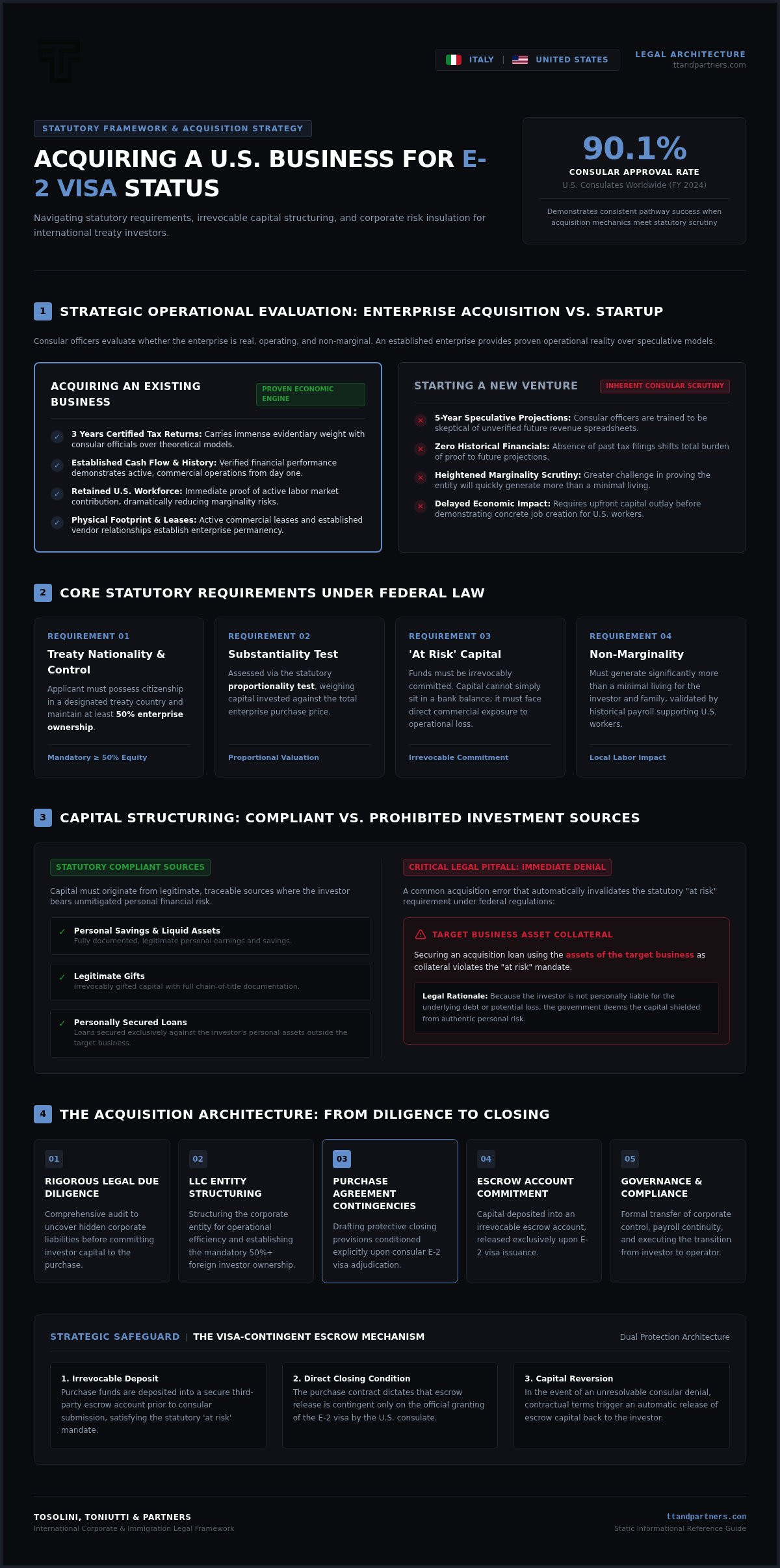
Did you know that despite increasing scrutiny on investment sources, the E-2 visa approval rate at U.S. consulates remained as high as 90.1% in fiscal year 2024? For many international investors, buying a business in the US for E-2 visa purposes represents the most sophisticated path toward American residency, yet it brings a unique set of anxieties. It's natural to feel concerned about committing significant capital before your status is secured or struggling to align complex corporate closing schedules with rigid immigration timelines.
We believe that a successful acquisition is not merely a transaction, but a carefully composed architecture of corporate law and immigration strategy. This guide will provide you with the exact legal framework required to protect your investment through strategic contract contingencies while ensuring full compliance with treaty investor requirements. You'll discover how to navigate due diligence, structure your LLC for maximum efficiency, and manage the transition from investor to operator with professional precision and visionary clarity.
Table of Contents
The Strategic Framework: Buying an Existing US Business vs. Starting From Scratch
Essential E-2 Visa Legal Requirements for Business Acquisitions
Corporate Due Diligence: Protecting Your Capital and Your Visa
Structuring the Purchase Agreement with E-2 Visa Contingencies
Navigating the Closing and Transition Process with Legal Counsel
The Strategic Framework: Buying an Existing US Business vs. Starting From Scratch
Choosing between a startup and an acquisition is the first critical decision in your cross-border journey. While a new venture offers total creative control, buying a business in the US for E-2 visa purposes provides a structural foundation that startups simply cannot match. An existing enterprise arrives with a history of cash flow, established vendor relationships, and a physical footprint. This tangible reality aligns perfectly with the E-2 Investor Visa requirement that the enterprise must be real and operating. You aren't just presenting a dream to a consular officer; you're presenting a proven economic engine.
Risk Mitigation Through Existing Operations
One of the primary hurdles for any applicant is the marginality rule. The government must be convinced the business won't just provide a minimal living for you and your family. Historical financial records are your strongest defense here. If a business has consistently generated profits and supported a US workforce, the risk of a marginality denial drops significantly. Retaining an established team is equally vital. It shows an immediate economic contribution to the US labor market, satisfying the active investment standard from day one. You're buying a machine that's already in motion, which provides a sense of security that speculative startups lack.
Consular Perceptions of Operational Longevity
Consular officers are trained to be skeptical of five-year startup projections. They've seen countless business plans that never materialize. In contrast, three years of certified tax returns carry immense weight. These documents validate the commercial reality of the enterprise far better than any spreadsheet could. An existing customer base and active leases further prove that the business is a permanent fixture in its community. This level of operational maturity requires sophisticated cross-border corporate planning to ensure the transition of ownership is seamless. Strategic thinkers recognize that coordinated legal counsel is essential during this phase. If you're ready to begin this transition, you can contact our team to discuss the corporate architecture of your acquisition.
Essential E-2 Visa Legal Requirements for Business Acquisitions
Succeeding in buying a business in the US for E-2 visa status requires more than a simple bill of sale. It demands a rigorous adherence to the statutory framework defined by federal law. The core requirement is that you must be a national of a treaty country and possess at least 50% ownership of the enterprise; for investors exploring treaty-country eligibility or broader mobility pathways, check out McKinsey Citizenship and Residency Solutions. However, the true complexity lies in demonstrating that the investment is substantial and the capital is genuinely at risk. The government applies a proportionality test, comparing the amount invested against the total purchase price. You must meet the official E-2 visa qualifications by proving the investment is sufficient to ensure the business's successful operation and growth.
The 'At Risk' Capital Requirement in Acquisitions
Funds must be irrevocably committed to the purchase before final visa approval. This means the capital is already spent or held in a secure escrow account contingent only on the visa being granted. You cannot simply show a high bank balance; the money must be active. Capital must originate from legitimate sources, such as personal savings, gifts, or loans secured by your personal assets. A critical trap to avoid is securing an investment loan using the target business assets as collateral. This violates the at risk principle because the investor isn't personally liable for the potential loss, which can lead to an immediate denial of the application.
Overcoming the Marginality Hurdle
The marginality doctrine remains a frequent cause for concern. A business is considered marginal if it doesn't have the present or future capacity to generate more than a minimal living for you and your dependents. When acquiring an existing enterprise, your strongest insulation is a robust hiring plan and historical payroll data. By demonstrating that the business supports multiple US workers, you prove its significant economic contribution to the local community. For a deeper dive into these standards, read our E-2 Visa Guide 2026: The Strategic Framework for Treaty Investors. Navigating these nuances requires a strategic partner who understands both corporate law and immigration. If you need help structuring your acquisition, you can reach out to our legal team for a detailed consultation.
Corporate Due Diligence: Protecting Your Capital and Your Visa
Due diligence is the intellectual foundation of a secure investment. While financial audits verify the past, legal due diligence protects your future by identifying dormant risks. When buying a business in the US for E-2 visa purposes, you aren't just acquiring physical assets; you're inheriting a legal history. A comprehensive review must uncover tax liens, pending litigation, or environmental liabilities that could jeopardize your capital and your standing with immigration authorities. We view this process as a meticulous deconstruction of the target enterprise to ensure every component is sound.
Asset Purchase vs. Stock Purchase Agreements
The structure of your transaction dictates your liability profile. In an asset purchase, you selectively acquire specific components of the business, such as equipment, inventory, and goodwill. This structure typically allows you to leave historical corporate debts behind, creating a clean slate for your new venture. Conversely, a stock purchase involves buying the equity of the existing entity. While this preserves the business's operational history and credit, it also means you inherit every legal obligation the company has ever incurred. From an immigration perspective, a stock deal might simplify the transfer of certain contracts, but the increased exposure to hidden liabilities often makes asset deals the preferred choice for risk-averse investors.
Reviewing Material Contracts and Operational Licenses
Operational continuity depends on the strength of your material contracts. You must analyze the assignability of commercial leases to ensure your physical business location remains secure post-closing. If a landlord refuses to consent to a lease transfer, your visa application could fail due to a lack of physical premises. Similarly, you must examine vendor agreements and intellectual property rights to safeguard your ongoing commercial operations. Every agreement should be scrutinized for "change of control" clauses that might trigger termination upon your arrival.
Proper entity structuring is vital during this phase. Our guide on LLC Incorporation: A Strategic Guide to US Business Architecture in 2026 details how to build a compliant corporate home for these acquired assets. Finally, don't overlook employment contracts. Auditing these agreements ensures that your hiring plan remains compliant with the marginality standards discussed in previous chapters. Every contract is a structural element in your broader corporate architecture, and their integrity determines the stability of your visa status.
Structuring the Purchase Agreement with E-2 Visa Contingencies
The purchase agreement is the definitive blueprint for your American enterprise. When buying a business in the US for E-2 visa purposes, this document must do more than transfer ownership; it must function as a sophisticated legal shield. A standard commercial contract rarely accounts for the specific demands of immigration law, leaving investors vulnerable to capital loss if a visa is refused. We advocate for a structured approach that begins with a precise Letter of Intent (LOI) and culminates in a purchase agreement fortified by explicit safeguards. This process ensures that your capital remains protected until the legal right to operate the business is fully secured.
The Mechanics of an Immigration Escrow Account
Utilizing a secure escrow account is the most effective way to balance the "at risk" mandate with capital protection. Consular officers accept escrow arrangements because the funds are considered irrevocably committed once they leave your personal control. The escrow agreement acts as a neutral gatekeeper, holding the purchase price in a dedicated account. Funds are only released to the seller upon the occurrence of a specific legal trigger: the issuance of your E-2 visa. If the visa isn't granted, the agreement dictates the immediate return of the capital to you. This structure satisfies the government's requirement that the investment is active while ensuring you aren't left without a business and without your funds.
Drafting Effective Contingency Clauses
Precision in language is paramount when drafting visa contingencies. A well-constructed clause might state: "This Agreement shall be deemed null and void, and all funds held in escrow shall be returned to the Buyer, in the event that the Buyer's E-2 treaty investor visa application is denied by the U.S. Department of State." Beyond this core statement, the contract must allocate sufficient time for the adjudication process. Given that consular processing times generally range from 2 to 4 months in 2026, the closing date must be flexible enough to accommodate these government timelines.
You should also define clear dispute resolution mechanisms. If a seller challenges the return of escrowed funds after a denial, the contract needs to provide a swift path to resolution that avoids protracted litigation. Managing these intersecting timelines and legal requirements requires a coordinated strategy. If you're ready to secure your investment with professional oversight, you can contact us to structure your purchase agreement today. By integrating these protections early, you transform a high-risk transaction into a controlled, visionary transition.
Navigating the Closing and Transition Process with Legal Counsel
The closing process is the bridge between transactional intent and operational reality. While the purchase agreement provides the blueprint, the closing represents the actual construction of your new corporate life. Managing this phase requires a dual perspective where corporate formalities and immigration mandates align perfectly. When buying a business in the US for E-2 visa purposes, the transition must be handled with surgical precision to ensure no compliance gaps emerge during the handoff from seller to buyer. We believe that unified legal counsel is the only way to maintain this balance, preventing the administrative friction that often plagues cross-border acquisitions.
Finalizing the Corporate Transfer
Formalizing the transfer involves a suite of execution documents that go beyond a simple wire transfer. You must secure executed bills of sale for all tangible assets and formal corporate resolutions authorizing the transaction. Assignment documents for intellectual property and commercial leases are equally vital. Once the ownership shift is complete, you must update state corporate registries and local operational permits to reflect the new management. A critical step is the transition of Employer Identification Numbers (EIN) or the establishment of new ones for the acquiring entity, ensuring your tax reporting remains compliant with federal standards from the first day of operation.
Assembling the E-2 Visa Submission Package
The final transactional documents serve as the evidentiary heart of your visa petition. You must organize closing statements, escrow release verifications, and updated corporate structures into a cohesive narrative that proves the investment is substantial and active. This package isn't just a collection of papers; it's a professional presentation of your commercial viability. Consular officers will scrutinize these documents to confirm the capital is fully committed and the business is ready to support the US economy. This requires a level of detail that generic checklists often overlook.
Preparation for the consular interview is the final hurdle. You'll need to articulate your vision for the company and demonstrate your capacity to direct its growth. Unified legal counsel is indispensable here, as they manage both the corporate closing and the immigration filing to prevent conflicting information. Strategic thinkers understand that this holistic approach minimizes the risk of delay. For those seeking professional oversight during this delicate phase, we invite you to visit Tosolini, Toniutti & Partners Contact for tailored strategic execution. Successful business transitions are rarely accidental; they're the result of coordinated expertise and a commitment to professional excellence.
Architecting Your Success in the American Market
Building a commercial future in the United States requires more than just capital; it demands a masterfully designed legal structure. We've explored how acquiring an existing enterprise provides the operational evidence consular officers respect, while rigorous due diligence and strategic contract contingencies safeguard your investment. By integrating immigration safeguards directly into your corporate architecture, you transform a complex international transaction into a secure, predictable transition.
The path of buying a business in the US for E-2 visa status is most effective when corporate law and immigration strategy are treated as a single, unified discipline. Our firm provides bespoke cross-border corporate architecture and comprehensive oversight for international treaty investors, ensuring every legal detail aligns with your long-term vision. We invite you to secure your US business acquisition and visa strategy with Tosolini, Toniutti & Partners. With the right legal foundation, your transition to the American market will be as seamless as it is successful. We're ready to help you build your legacy.
Frequently Asked Questions
Can I use an escrow account to satisfy the E-2 visa investment requirement when buying a business?
Yes, utilizing an escrow account is a standard and effective strategy for buying a business in the US for E-2 visa applicants. It satisfies the "at risk" requirement because the funds are irrevocably committed to the transaction, yet it protects your capital by making the final release contingent upon visa approval. Consular officers accept this arrangement because it demonstrates a real and active investment while mitigating your personal financial risk.
What is the difference between an asset purchase and a stock purchase for an E-2 visa?
An asset purchase involves acquiring specific components like equipment and goodwill, which allows you to avoid inheriting the seller's historical corporate liabilities. A stock purchase involves buying the entire legal entity, which preserves operational history but transfers all past legal and tax obligations to you. Most international investors prefer asset purchases to ensure a clean corporate slate, though stock deals might be necessary to maintain specific grandfathered contracts.
How long does the legal process take when buying a US business for an E-2 visa?
The total timeline typically spans several months as it involves two parallel tracks. Corporate due diligence and closing usually require 30 to 60 days, while E-2 visa consular processing times generally range from 2 to 4 months in 2026. If you're already in the U.S. and filing for a change of status, premium processing can shorten the adjudication to 15 business days, though this doesn't provide a travel visa stamp.
What happens to my invested funds if my E-2 visa application is denied by the consulate?
If your visa is denied, the fate of your funds depends entirely on the specific contingency clauses in your purchase agreement. We structure these contracts so that a visa refusal triggers an automatic voiding of the sale and the immediate return of all funds held in escrow. Without these explicit legal safeguards, your capital could remain trapped in a business you don't have the legal status to manage or operate within the United States.
Does the business I am buying need to have existing US citizen employees to qualify?
The business doesn't strictly require "US citizen" employees, but it must employ "US workers," which includes citizens, green card holders, and other authorized residents. To overcome the marginality hurdle, the enterprise must demonstrate the capacity to support more than just the investor and their family. Acquiring a business with an existing payroll of 3 to 5 employees provides a strong evidentiary foundation for a successful treaty investor application.
Can I buy a franchise instead of an independent existing business for an E-2 visa?
You can certainly buy a franchise, as these models often provide the proven operational structure and financial history that consular officers find persuasive. However, the franchise agreement must be carefully reviewed to ensure you retain sufficient "direct and develop" control over the enterprise. If the franchisor exerts too much operational authority, the government may argue that you aren't the primary director of the business, which is a core treaty requirement.


Comments