

Buying Property in Italy as a US Citizen: A 2026 Legal Guide

What if buying a home in Italy gives you property rights, but no right to live there? For US buyers, separating ownership from immigration status is essential. This buying property in Italy as a US citizen legal guide explains the legal steps, due diligence, tax questions, and residence limits to consider before committing.
It’s reasonable to expect a clear sequence, reliable documents, and a secure transfer. Yet an offer or preliminary contract can be binding. Check the property and its legal position before signing or paying a deposit. The notary oversees the transaction, while independent legal advice can help protect your individual interests.
This guide outlines the purchase process, the professionals involved, and questions to raise about title, planning, transaction documents, and taxes. It also explains why owning a home doesn’t automatically grant permission to reside in Italy, and which immigration or US tax questions call for separate advice. With the right checks in place, you can assess the purchase before making commitments that may be difficult to unwind.
Table of Contents
Buying Property in Italy as a US Citizen: What Ownership Does and Does Not Mean
Italian Property Purchase Requirements: Documents, Parties, and Legal Roles
Due Diligence Before You Sign: Title, Planning, and Property Condition
Taxes, Signing, and Closing: Build a Buyer Checklist Before Committing
Plan the Purchase Around Your US and Italy Legal and Residence Position
Buying Property in Italy as a US Citizen: What Ownership Does and Does Not Mean
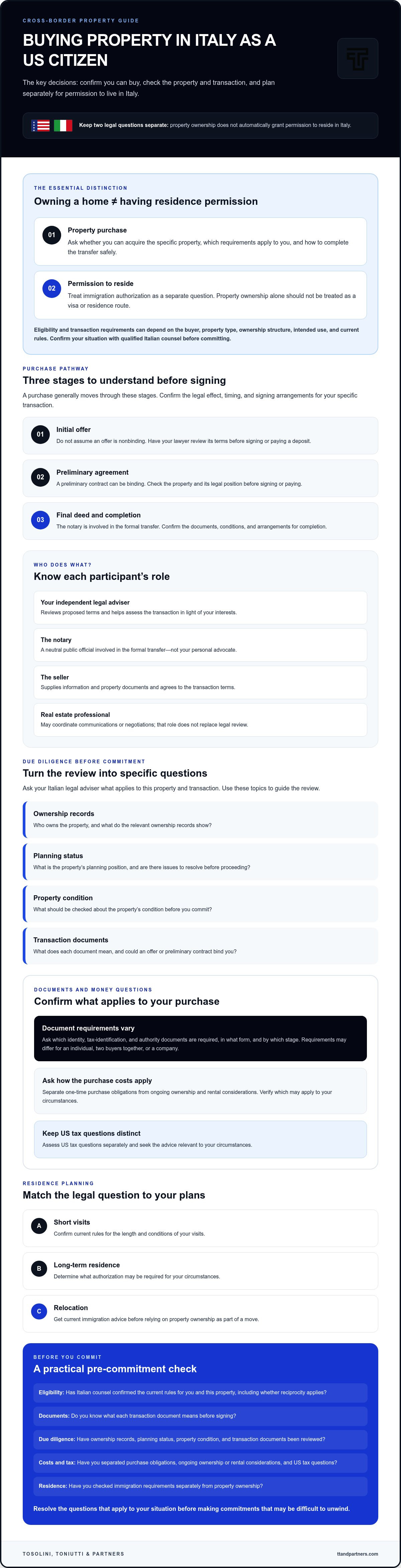
A cross-border property purchase raises several separate legal questions: whether you can acquire a particular property, how to complete the transaction safely, and whether you may live in Italy. Each needs its own answer. This buying property in Italy as a US citizen legal guide explains those distinctions, with a focus on acquisition, transaction steps, due diligence, and residence planning.
Eligibility rules and transaction requirements can change or depend on the buyer’s circumstances. Before making an offer or signing documents, ask qualified Italian counsel to confirm the current rules that apply to you. The property type, ownership structure, intended use, and your personal circumstances may all matter. Treat eligibility as an early due diligence question, not an assumption to resolve after you have committed.
Can a US citizen buy property in Italy?
A US citizen’s ability to purchase may depend on applicable rules, including the principle of reciprocity. That principle describes how one country may extend rights based on the treatment of its citizens by another. Ask Italian counsel how it applies to your specific purchase. A general explanation cannot establish that a particular buyer or property qualifies.
Keep the legal questions distinct. Permission to own real estate is not the same as Italian citizenship, immigration status, or authorization to reside. Before proceeding, ask counsel to review your buyer status, the property type, and the proposed ownership arrangement. Confirm which documents and transaction conditions apply.
Does buying a home give you the right to live in Italy?
No. Don’t assume that purchasing a home grants permission to reside in Italy. Ownership and immigration authorization are separate matters, and property ownership alone should not be treated as a visa or residence route.
Consider your plans in three parts:
Short visits: Confirm the current rules governing the length and conditions of your visits.
Long-term residence: Determine what authorization may be required for your circumstances.
Relocation: Get current immigration advice before relying on property ownership as part of a move.
A home may support a plan to spend time in Italy, but it doesn’t determine whether that plan is legally permitted. Address residence questions before purchase commitments become difficult to unwind. If a transaction raises cross-border concerns, coordinated legal guidance can help you assess the purchase alongside your US and Italy circumstances.
Italian Property Purchase Requirements: Documents, Parties, and Legal Roles
A purchase generally moves from an initial offer to a preliminary agreement and then to the final deed and completion. Confirm the name, legal effect, signing arrangements, and timing of each stage for your specific transaction. Don’t assume a document described informally as an offer is nonbinding. Ask your lawyer to review its terms before you sign or pay.
Each participant has a distinct role. The seller supplies information and documents about the property and agrees to the transaction terms. A real estate professional may help coordinate communications or negotiations, but that role does not replace legal review. Your own legal adviser can assess the proposed terms in light of your interests. The notary is a neutral public official involved in the formal transfer, not your personal advocate.
Which documents should a US buyer ask about first?
There is no universal document checklist for every buyer. Ask your Italian legal adviser which identity, tax-identification, and authority documents are required, in what form, and by which stage. An individual purchaser, two people buying together, and a company purchasing property may need different evidence of identity or authority. Confirm the requirements before signing, especially if a buyer cannot attend in person or someone else will act on their behalf.
Use this checklist as a set of questions, not a definitive document list:
Identity: Which current identity documents must each buyer provide, and how must they be submitted? Confirm the requirements for every purchaser.
Tax identification: Is an Italian tax identification number needed for the planned transaction, and how should the buyer obtain or present it? Confirm the process and timing.
Authority: If a buyer is an entity or someone will sign for a buyer, what evidence of authority is required? Confirm the documents and signing arrangements.
Transaction papers: Which offer, preliminary agreement, and final deed documents apply, and what are their consequences? Have counsel review them before signing.
What does the Italian notary do in a property transaction?
The notary oversees the formal transaction, checks legal compliance, prepares and registers the final deed, and collects applicable taxes. This important role does not replace independent buyer-side legal review of the proposed terms, risks, or your particular circumstances. Ask your lawyer and notary to clarify who is responsible for each document, what must be completed before signing, and how signing and completion will be handled.
A clear division of responsibilities can help identify missing information before commitments become difficult to unwind. For advice on a specific cross-border purchase, you can discuss a real estate closing with Tosolini, Toniutti & Partners.
Due Diligence Before You Sign: Title, Planning, and Property Condition
A compelling listing and a seller’s assurances can help you understand how a property is presented, but they don’t establish that its ownership, permitted use, records, or physical condition match that description. Review supporting documents and arrange suitable professional checks before signing an offer or preliminary agreement, or paying a deposit. This buying property in Italy as a US citizen legal guide treats due diligence as a coordinated review, not a single search or inspection.
The appropriate records, checks, and professionals can vary with the property and its location. Ask qualified Italian counsel how ownership and relevant encumbrances should be checked, which local records apply, and what those records do and don’t establish. Compare the seller’s identity and claimed ownership with the names, boundaries, and property descriptions in the available documents. Don’t assume that one record resolves every title or legal concern.
Questions to put to your professional team
Question to ask: Do the ownership information and property description align across the relevant records and transaction papers?Professional to consult: Italian legal adviser.Verify: Appropriate records, current checking methods, ownership, boundaries, and any relevant encumbrances.
Question to ask: Does the property’s planning status support its existing and intended use?Professional to consult: Italian legal adviser and qualified local technical professional.Verify: Applicable planning information, local records, and compliance questions specific to the property.
Question to ask: Does the physical condition fit the listing and your intended use?Professional to consult: Independent property inspector or other appropriately qualified technical specialist.Verify: The building’s condition and whether further technical or environmental assessment is appropriate.
Question to ask: Do the offer and other transaction documents reflect the reviewed facts and agreed terms?Professional to consult: Your independent legal adviser.Verify: Consistency across the documents, outstanding questions, and the consequences of signing.
Match each check to the right expertise
Legal, technical, and environmental questions are related, but they aren’t interchangeable. A legal review can identify questions about ownership, records, or contractual terms. A technical professional can assess the building and relevant planning matters. An environmental specialist may be appropriate if property-specific concerns warrant it. Ask your advisers to identify the scope and limits of each review rather than assuming one professional’s assessment covers every risk.
Before proceeding, make a written list of unresolved questions, the professional responsible for each one, and the documents or findings needed to answer it. If an important point remains unclear, ask your legal adviser what it means for the proposed terms and timing before you commit.
Taxes, Signing, and Closing: Build a Buyer Checklist Before Committing
A purchase budget should account for more than the agreed price. Before committing, distinguish costs associated with completing the purchase from obligations that may continue while you own the property. The exact treatment depends on the transaction and your circumstances. Ask qualified Italian and US tax professionals to review the relevant questions instead of relying on a general estimate.
Tax treatment depends on current law and the buyer’s facts.
Which tax and cost questions should buyers verify?
Ask your advisers to identify applicable purchase taxes, professional fees, and ongoing ownership obligations, and explain when each may arise. The answers may depend on factors such as the property’s intended use, how it will be owned, and your individual circumstances. Ask separately about potential rental income or a future sale if either is part of your plan. Confirm current rules with qualified advisers. Don’t rely on unverified rates, thresholds, exemptions, or filing dates.
Cross-border funding also deserves careful review. Discuss currency transfers, the source and documentation of funds, and any related US and Italy tax or reporting questions with the professionals responsible for those areas. Keep transaction records together, and ask what evidence you should retain. This gives your advisers context to assess the purchase rather than treating the closing as an isolated event.
What should happen before signing or transferring funds?
Use this sequence before making a commitment:
Clarify the terms. Confirm the property, agreed price, proposed timing, payment schedule, and any conditions in writing. Resolve differences between conversations and draft documents.
Complete the review. Have your legal adviser consider the transaction documents alongside the due-diligence findings. List unanswered questions and decide who must address each one before you proceed.
Confirm obligations and funds. Ask your advisers to explain expected transaction costs, ongoing obligations, payment arrangements, currency transfer considerations, and any records needed for your circumstances.
Proceed only with advice. Before signing, ask counsel to explain the legal effect and consequences of each proposed agreement. Independently verify payment instructions through a trusted channel before sending funds, especially if details have changed or arrived unexpectedly.
Confirm with your legal adviser, notary, and other relevant professionals who is responsible for each step, which documents remain outstanding, and how signing and completion will be handled. Don’t sign or transfer funds simply because a deadline has been proposed. First understand the commitment and the protections available to you.
If you need guidance on coordinating legal review with the closing process, contact the firm about your real estate closing.
Plan the Purchase Around Your US and Italy Legal and Residence Position
A property decision is more complete when you consider how you’ll use the home, where you expect to spend your time, and which tax questions cross borders. These plans are connected, but they aren’t interchangeable: owning property doesn’t settle your residence eligibility or tax position. This buying property in Italy as a US citizen legal guide ends with a practical reminder: align the purchase review with your intended use, then verify immigration and tax questions with the appropriate advisers.
How should your intended use shape the legal review?
Start by identifying the purpose of the purchase. A second home, a rental investment, and a possible relocation raise different questions. Use this checklist to prepare for advice:
Personal use: Clarify how you expect to access and maintain the property, what ongoing responsibilities may apply, and whether your plans for time in Italy require separate residence authorization.
Rental or investment: Confirm that the intended use is permitted, and ask qualified advisers to assess applicable tax treatment and management obligations for the property and ownership structure.
Possible relocation: Seek current immigration advice before treating the purchase as part of a residence strategy. Ownership alone doesn’t establish permission to live in Italy.
These are starting points, not a complete legal or tax checklist. The right questions depend on the property, your ownership arrangements, and your individual plans.
When is cross-border legal support useful?
Consider coordinated legal review if transaction documents, the proposed ownership arrangement, or the movement and documentation of funds raise questions in both the United States and Italy. A cross-border perspective can help identify issues to resolve before you make commitments that may be difficult to unwind. Keep legal review distinct from specialist tax advice and current immigration guidance, which address separate parts of your plan.
Tosolini, Toniutti & Partners lists real estate closings among its services and focuses on US and Italy cross-border legal matters. If you have a planned purchase and want to discuss transaction-specific questions, discuss your Italian property transaction. Bring a clear outline of the property’s intended use, the proposed ownership structure, and any documents or concerns you want reviewed.
Make Your Next Step a Well-Reviewed One
A sound purchase starts with clear boundaries between property ownership, transaction due diligence, residence permission, and tax advice. Confirm current eligibility and transaction requirements with qualified Italian counsel, review the property and documents before committing, and seek separate immigration and tax guidance for your plans.
This buying property in Italy as a US citizen legal guide has shown why intended use matters: a second home, rental investment, and possible relocation can raise different questions. The right professional review helps connect those questions without assuming that ownership answers them all.
Tosolini, Toniutti & Partners lists Italian real estate closings among its services and focuses on US and Italy cross-border legal matters. If you have a planned purchase and questions about its documents, ownership structure, or closing, discuss your cross-border legal questions.
With careful preparation and advice suited to your circumstances, you can approach the purchase with greater clarity and make decisions that support the life you envision in Italy.
Frequently Asked Questions
Does buying property in Italy give a US citizen residency?
No, don’t assume that owning property grants permission to reside in Italy. Purchasing real estate and having immigration authorization are separate legal matters. Whether and how long you may stay depends on current rules and your individual circumstances, not simply on owning a home. If you’re considering a move, verify the appropriate immigration route with a qualified adviser before relying on a property purchase as part of your residence plans.
What documents does a US citizen need to buy property in Italy?
Document requirements depend on the buyer, transaction, and current Italian procedures, so there isn’t one checklist that applies to everyone. Ask qualified Italian counsel to confirm which identity and tax-identification documents are relevant, as well as any documents needed for your ownership arrangement or signing method. Request a transaction-specific list before making commitments or arranging signatures, and confirm the required form and timing for each item.
Do I need an Italian lawyer to buy property in Italy?
Whether a lawyer is legally required should be confirmed under current rules, but independent legal advice can help protect your interests. Your adviser can review transaction documents, identify questions to raise with the notary and other professionals, and assess issues before you commit. The notary and your own lawyer have different roles. Before engaging professionals, clarify who advises you, what each review covers, and who is responsible for each step.
What taxes do US citizens pay when buying property in Italy?
There isn’t one tax treatment that applies to every US buyer. Purchase-related taxes and ongoing ownership obligations may depend on the property, transaction, intended use, ownership structure, and applicable law. Ask a qualified Italian adviser to confirm current Italian obligations for your specific purchase. Separately, discuss relevant US tax questions with an appropriately qualified professional. Avoid relying on general estimates or assuming that another buyer’s tax position applies to you.
Can I rent out a property in Italy as a US citizen?
Before planning rental income, verify whether the intended use is permitted and what tax or administrative obligations may apply. Requirements can depend on the property, rental model, and your circumstances, so don’t assume that permission to purchase settles the rental questions. Ask qualified local and tax advisers to confirm the current rules before committing to an investment plan or relying on projected rental income.
What should I check before signing an Italian property purchase agreement?
Before signing, ask qualified advisers to confirm the parties, property description, agreed terms, payment arrangements, relevant records, planning questions, and any conditions in the document. The right checklist depends on the transaction and current law. Have counsel explain the agreement’s legal effect and consequences before you commit. A listing, seller assurance, or informal description can’t replace review of the underlying documents and property-specific information.


Comments