

Buying Property in Italy as a US Citizen: The 2026 Legal & Strategic Guide
- Gianni Mendes Toniutti, Esq.

- Jun 19
- 11 min read
Updated: Jul 1
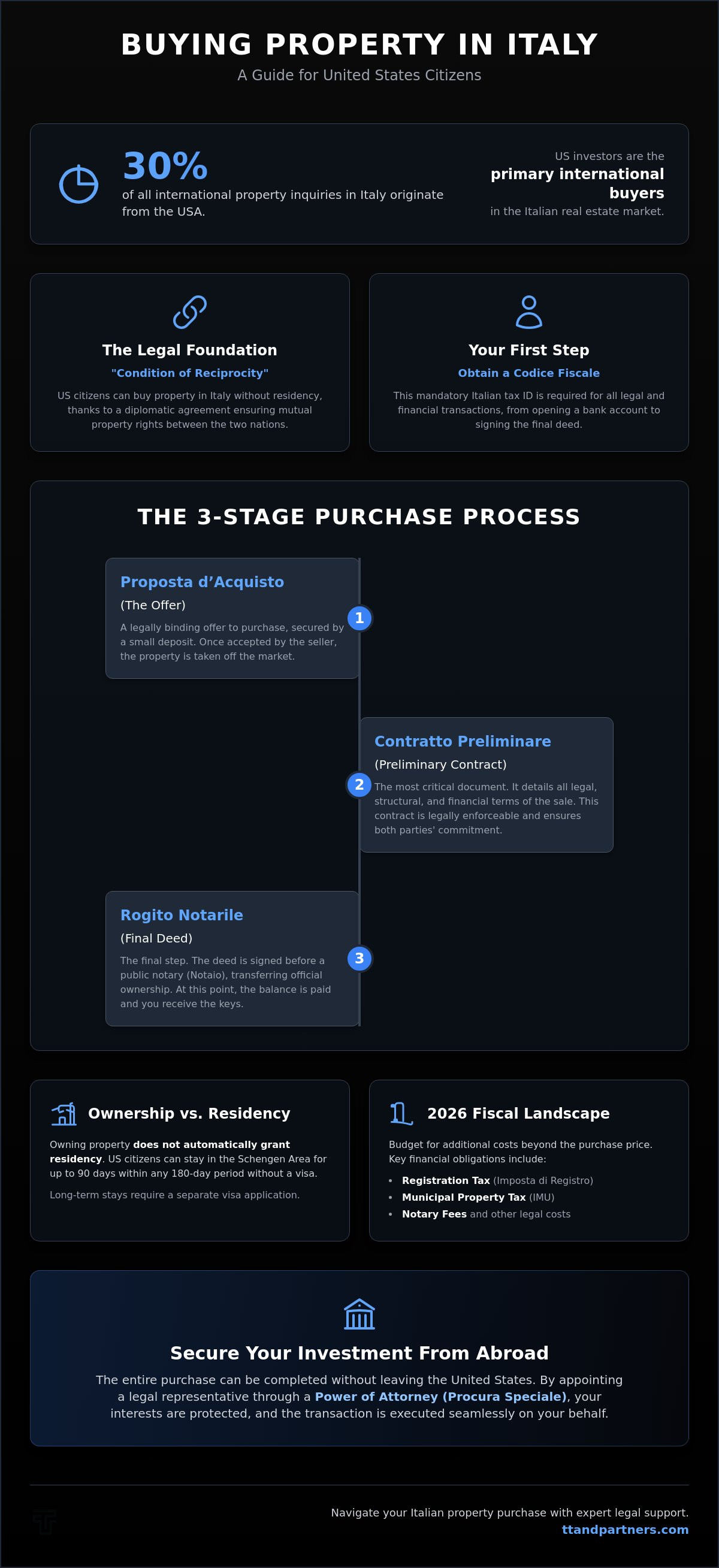
Americans account for 30% of all international property inquiries in Italy, positioning US investors as the primary architects of the country's modern foreign real estate landscape. You likely recognize that buying property in Italy as a US citizen represents more than a lifestyle choice; it's a complex cross-border transaction that requires bridging the gap between American expectations and the specificities of Italian Civil Law. It's natural to feel a sense of hesitation when faced with unfamiliar legal structures or the nuances of tax reporting across two different jurisdictions.
This guide provides the professional foresight needed to secure your investment while ensuring the process remains as harmonious as the architecture you seek to acquire. We'll provide a clear roadmap of the purchase process, from the initial Codice Fiscale to the final deed in front of a notary. You'll gain a precise understanding of how property ownership impacts your immigration status and discover the strategic legal protections necessary to safeguard your capital in 2026.
Table of Contents
The Legal Foundation: Can US Citizens Buy Property in Italy in 2026?
The legal landscape of 2026 remains welcoming for international investors, yet the structural integrity of your investment depends on a clear understanding of the Italian Civil Code. Many prospective buyers ask whether residency is a prerequisite for ownership. The short answer is no. Buying property in Italy as a US citizen is a right protected by international agreements, allowing you to hold title regardless of where you spend your year. This legal openness stems from a specific diplomatic arrangement that ensures American buyers are treated with the same respect as domestic ones. While the process is accessible, it demands a level of precision that mirrors the complexity of the properties themselves.
Understanding Reciprocity and the Italian Civil Code
Central to this right is the "Condition of Reciprocity" (Condizione di Reciprocità). Governed by Article 16 of the Italian Civil Code, this principle states that foreigners enjoy the same civil rights as Italian citizens if their home country offers the same rights to Italians. Since the United States allows Italian nationals to purchase real estate freely, the Italian Ministry of Foreign Affairs maintains a reciprocal status for Americans.
This treaty-based foundation provides a stable environment for cross-border transactions, ensuring that your property rights are enforceable and durable. For a broader Italian real estate market overview, it's helpful to look at how these legal structures have historically supported the growth of international communities. These treaties act as a bridge, connecting two distinct legal systems through mutual recognition and long-term stability.
The Codice Fiscale: Your Mandatory Tax Identifier
The first tangible step in your journey isn't visiting villas; it's obtaining your Codice Fiscale. This alphanumeric code serves as your unique tax identifier in Italy. It's the key that unlocks every subsequent door in the purchase process, from signing contracts to opening bank accounts.
Most buyers secure this through the Italian Consulate in their home jurisdiction in the United States. It's a straightforward administrative task, but the timeline can vary. It's wise to secure this number at least a month before you intend to make an offer. Without it, the legal machinery of the Italian state won't acknowledge your participation in the market. This identifier links your identity to the Italian fiscal system, providing the transparency required for high-value international investments.
As we look toward the fiscal realities of 2026, the Italian market continues to reward those who prioritize legal foresight over haste. The purchase process is designed to be deliberate. By establishing your legal presence through the Codice Fiscale and confirming your rights under reciprocity, you lay a foundation that's both secure and compliant. This meticulous approach isn't just about following rules; it's about honoring the heritage of the property you're about to inhabit. Buying property in Italy as a US citizen requires this blend of respect for tradition and modern legal strategy.
The 3-Stage Italian Real Estate Purchase Process for Americans
Transitioning from the conceptual foundation to the physical acquisition requires a shift in perspective. For those used to the American system of escrow accounts and title insurance, the Italian methodology can feel exposed. However, The 3-Stage Italian Real Estate Purchase Process is a time-tested sequence designed to provide absolute finality. Buying property in Italy as a US citizen involves navigating three distinct legal milestones: the Proposta d’Acquisto (Offer), the Contratto Preliminare (Preliminary Contract), and the Rogito Notarile (Final Deed).
The Proposta is more than an expression of interest; it's a binding commitment often secured by a small deposit. Once the seller signs, the property is effectively off the market, and the focus shifts to the most critical document in the entire transaction. This phase sets the stage for the detailed due diligence that follows.
The Binding Power of the Preliminary Contract
In Italy, the Contratto Preliminare, or Compromesso, functions as the transaction's legal skeleton. Because the Italian system lacks the safety net of title insurance, this contract must detail every structural, historical, and legal aspect of the property. It's the moment where the specific terms of the sale are etched into law. This document incorporates the Caparra Confirmatoria, a security deposit that carries heavy penalties. If you withdraw after signing, you forfeit this amount. If the seller defaults, they are legally required to pay you double your original deposit. This mechanism replaces the American reliance on escrow, placing the financial risk directly on the parties involved to ensure a high level of commitment.
Closing Day: The Rogito and the Italian Notary
The Rogito is the final act, performed in the presence of a Notaio. It's essential to understand that the Notaio is a public official responsible for the integrity of the transaction and the collection of taxes, not a private advocate for either party. They read the entire deed aloud in Italian. If you don't possess native-level fluency, the law requires a bilingual representative to ensure you're fully aware of your obligations. This is the moment where the final balance is paid and the keys are exchanged. To ensure your interests are protected during this high-stakes exchange, you might consider professional legal support for your real estate closing to provide the advocacy the Notaio cannot. This final registration officially transfers the property into your name, concluding the acquisition with the weight of Italian State authority.
Beyond the Deed: Navigating Residency, Visas, and the 90-Day Rule
The Elective Residency Visa (ERV) for Homeowners
The Elective Residency Visa is the most prestigious path for homeowners who don't intend to work locally. It requires a documented passive income of approximately €31,000 per year for a single applicant. This income must be entirely independent of active employment, sourced instead from pensions, real estate holdings, or stable investment portfolios. When buying property in Italy as a US citizen, your Italian home serves as the mandatory proof of lodging, providing a physical anchor for your application. However, the process is rigorous. Consulates often deny applications if the financial narrative is inconsistent or if the link between the applicant and their passive wealth isn't transparent. Once the visa is granted, the next priority is applying for a Permesso di Soggiorno within eight days of your arrival in Italy. This permit is what truly transforms your house into a legal residence.
Property and the Path to Italian Citizenship
For those with ancestral ties, property ownership serves as a strategic foundation for Italian Citizenship claims. If you choose to process your Jure Sanguinis application within Italy, you must establish "residenza" in the municipality where you apply. This involves a formal registration at the local Anagrafe and a subsequent visit from the municipal police to verify your presence. Owning your home eliminates the volatility of the rental market and provides the stability required for these administrative checks. It also signals a long-term commitment to the Italian state, moving beyond the status of a temporary visitor to someone invested in the nation's future. Whether you're navigating the newly established Digital Nomad Visa for remote professionals or traditional residency paths, your property remains the central pillar of your Italian identity.
Financial and Tax Implications for US Buyers
Success in the Italian market requires a dual-lens approach to financial planning. You aren't merely managing a purchase price; you're orchestrating a cross-border fiscal strategy that must satisfy two distinct jurisdictions. Buying property in Italy as a US citizen involves a sophisticated understanding of how transaction taxes, municipal duties, and international treaties interact to define the true cost of ownership. The 2026 fiscal landscape rewards those who move beyond surface-level budgeting toward a more precise, structural view of their investment.
Primary Residence vs. Second Home (Prima Casa)
The distinction between a "prima casa" (primary residence) and a second home is the most impactful fiscal decision you'll make. For private resales, the registration tax is 9% of the property's cadastral value. If you commit to moving your legal residency to the municipality within 18 months of the deed, this rate drops to 2%. While the savings are significant, the legal requirements are strict. Claiming these incentives without a genuine intent to reside can trigger audits and the retroactive application of the higher rate plus penalties. For new builds, VAT replaces registration tax, typically at 10% for second homes and 4% for primary residences, rising to 22% for luxury classifications.
Transaction Costs and Professional Fees
Prudent investors should budget an additional 10% to 15% of the purchase price to cover closing costs. This includes notary fees, which generally range from 1% to 2.5%, and real estate agency commissions. Italy utilizes a "Price-Value" system for residential resales between private individuals. This allows the registration tax to be calculated based on the cadastral value, a government-assigned value that is often lower than the market price. To ensure the security of your capital during the transfer, the "Conto Corrente Dedicato" (Notary Escrow Account) provides a safe harbor for funds until the deed is registered. If you require expert guidance to navigate these financial nuances, you can consult with our team for a real estate closing that prioritizes your fiscal security.
Beyond the initial purchase, ownership brings ongoing obligations. The IMU (municipal property tax) for second homes averages 0.86% of the cadastral value, with some municipalities reaching a 1.14% ceiling. These payments are due in two installments each June and December. For US taxpayers, the journey continues at home. You must adhere to FBAR and FATCA reporting requirements for foreign assets. Fortunately, the long-standing US-Italy Tax Treaty prevents double taxation on rental income, ensuring your Italian investment remains a harmonious part of your global portfolio. Buying property in Italy as a US citizen is a long-term commitment that thrives on this level of professional foresight.
Strategic Legal Support for International Property Closings
The final phase of buying property in Italy as a US citizen requires a shift from aesthetic appreciation to technical scrutiny. Unlike the American market, where real estate agents often act as fiduciaries for their specific clients, Italian agents are neutral mediators. They facilitate the deal and collect commissions from both the buyer and the seller. This lack of exclusive advocacy makes independent legal representation for your Real Estate Closing a strategic necessity rather than an optional luxury. Protecting your interests in a system without standardized title insurance requires a proactive, legally focused approach that bridges the gap between US expectations and Italian realities.
The Power of Attorney (Procura Speciale)
Executing a transaction from across the Atlantic is a common practice for modern investors. The Procura Speciale, or Special Power of Attorney, allows you to appoint a legal representative in Italy to sign documents on your behalf. To be valid, you must sign this document before a US Notary and then have it authenticated with an Apostille. This specialized certificate ensures international recognition under the Hague Convention. It's essential that this document is drafted with a limited scope. A well-constructed Procura defines the specific property and the maximum price; it ensures your representative's authority is confined strictly to the intended transaction. This method offers the efficiency busy professionals require without sacrificing control over their capital.
Due Diligence: Compliance and Title Search
The absence of title insurance in Italy places the burden of due diligence squarely on the buyer's legal team. Technical compliance, or "urbanistic" regularity, is the most common point of failure in Italian transactions. You must ensure the property possesses a Certificato di Abitabilità, or Certificate of Habitability, and that the current floor plan matches the records at the Land Registry. Discrepancies here can prevent future resales or lead to significant fines. Your legal counsel should also investigate the following:
Pre-emption Rights: In rural areas, neighboring farmers may have the legal right to match your offer. A thorough search must confirm these rights have been formally waived.
Hidden Liens: A deep title search at the Conservatoria ensures the property is free of undisclosed mortgages or judicial seizures.
Succession Issues: Verifying that all previous heirs have legally consented to prior transfers of the property.
Strategic foresight also involves preparing for the unexpected. Should disputes arise post-closing, having a team capable of managing International Litigation ensures that your rights are defended in both the US and Italian courts. Coordinating your property acquisition with your broader estate planning ensures that your Italian heritage remains a blessing for future generations. By prioritizing these legal safeguards, buying property in Italy as a US citizen becomes a secure, legacy-building achievement that stands the test of time.
Securing Your Italian Heritage with Professional Foresight
The path to ownership in the 2026 market is defined by a balance of aesthetic vision and legal precision. Success depends on mastering the three-stage purchase process while navigating the delicate intersection of Italian Civil Law and American fiscal obligations. You've seen that buying property in Italy as a US citizen is a manageable journey when you prioritize technical due diligence and a clear residency strategy. By establishing a firm legal foundation today, you ensure your investment remains a source of harmony and value for decades to come.
Our firm brings decades of experience to every real estate closing. With bilingual attorneys admitted in both jurisdictions, we provide the comprehensive support you need to align your property goals with your immigration strategy. We invite you to schedule a consultation with our US-Italy cross-border legal experts to begin your journey with absolute confidence. Your vision of an Italian lifestyle is within reach; let's build the strategic framework to make it a reality.
Frequently Asked Questions
Do I need a visa to buy a house in Italy as an American?
No, you don't need a visa to purchase real estate in Italy. The legal principle of reciprocity allows Americans to hold title to property regardless of their residency status or visa holdings. The only administrative requirement to begin the transaction is obtaining a Codice Fiscale, which serves as your mandatory tax identification number for all Italian contracts.
Can I stay in Italy indefinitely if I own a home there?
Ownership does not grant you the right to stay in Italy beyond the standard Schengen Area limits. As a US citizen, you're restricted to 90 days within any 180-day period unless you obtain a formal residency visa. Buying property in Italy as a US citizen is a financial investment that remains separate from your legal right to reside in the country long-term.
What is the role of the Italian Notary in the purchase process?
The Notaio is a neutral public official responsible for ensuring the legal integrity of the property transfer and the collection of state taxes. Unlike a private attorney, the notary doesn't represent the buyer or the seller. They verify the identity of the parties, confirm the property's title, and record the final deed in the public Land Registry to finalize the sale.
How long does it typically take to close on a property in Italy?
A typical real estate transaction in Italy requires three to six months from the initial offer to the final deed. This duration allows for the mandatory three-stage contract process and the necessary technical due diligence. Delays often stem from the time required to gather historical certificates or to coordinate the schedules of the parties and the notary.
Can I get a mortgage from an Italian bank as a US citizen?
What taxes will I owe annually on my Italian property?
Annual ownership costs include the IMU municipal property tax and the TARI waste collection tax. The IMU rate for second homes generally ranges from 0.86% to 1.14% of the property's cadastral value. These taxes are payable in two installments each year, typically due by June 16th and December 16th, and require a local bank account or a fiscal representative for processing.
Is it possible to buy a house in Italy remotely from the US?
You can complete the entire purchase process without traveling to Italy by utilizing a Procura Speciale. This specific Power of Attorney allows a trusted representative to sign the preliminary and final contracts on your behalf. The document must be signed before a US notary and authenticated with an Apostille to be legally recognized by the Italian notary during the closing.
What happens to my Italian property if I pass away?
Italian inheritance laws typically apply to real estate located within Italy, which may include "forced heirship" rules for immediate family members. However, under EU Regulation 650/2012, you can specify in your will that the laws of your home country should govern your estate. This strategic planning is essential when buying property in Italy as a US citizen to ensure your assets are distributed according to your wishes.


Comments