

Buying Property in Italy as an American: The 2026 Legal & Strategic Guide

Owning a historic villa in the Italian countryside doesn't grant you the legal right to live there for more than ninety days. Many investors mistakenly believe that buying property in Italy as an American serves as an automatic gateway to residency, only to find themselves entangled in a web of unexpected tax obligations and immigration hurdles. It's understandable to feel a sense of hesitation when your vision for a legacy is met with the opaque complexities of a foreign legal system. You deserve a transition that's as seamless as the architecture you admire.
This guide provides the intellectual framework and technical precision necessary to master the Italian acquisition process while aligning your investment with your long-term residency goals. We'll clarify the specific role of the Italian Notary, outline the 2026 fiscal responsibilities for non-residents, and define the strategic path toward a secure, legally sound deed. By the end of this analysis, you'll understand how to protect your interests and transform a real estate transaction into a permanent foundation for your future in Italy.
Table of Contents
The Legal Framework: Can Americans Legally Buy Property in Italy?
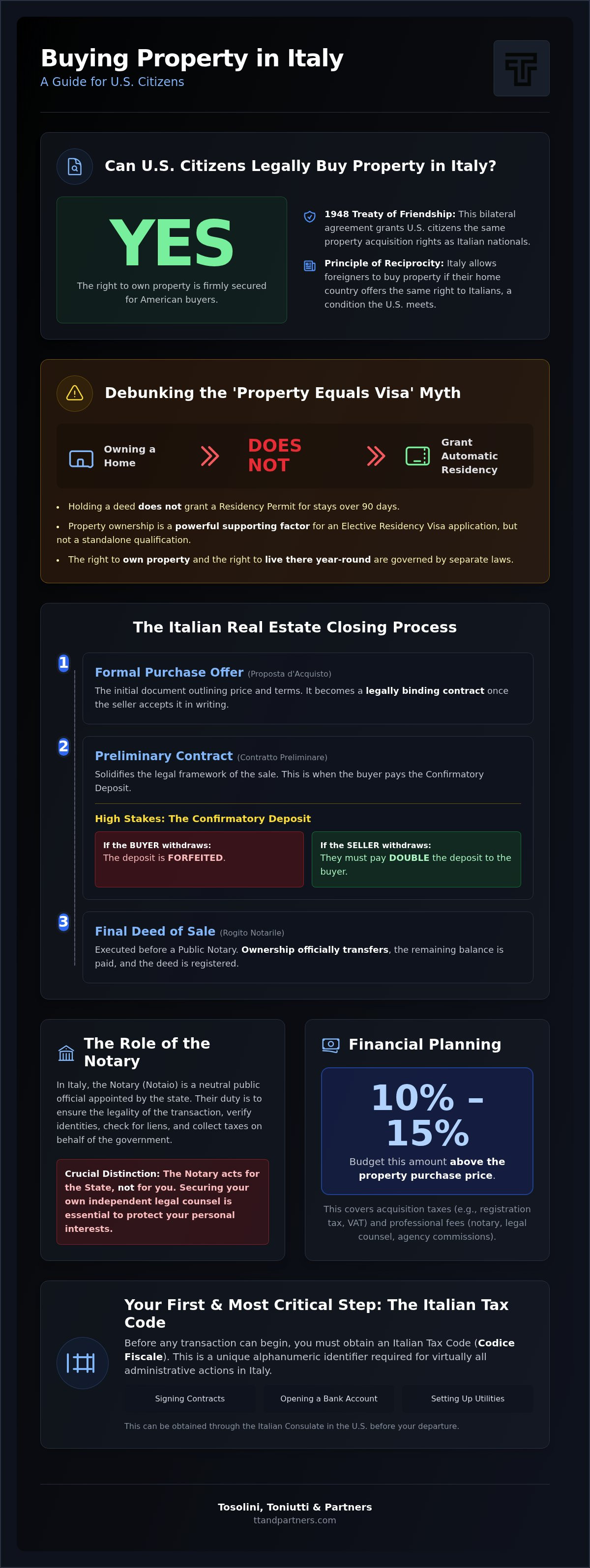
The prospect of acquiring a historic villa or a modern metropolitan apartment often begins with a fundamental question regarding legal eligibility. For those considering buying property in Italy as an American, the answer is a definitive yes. This right is anchored in the Principle of Reciprocity, which dictates that foreigners may purchase assets in Italy if their own nation extends similar privileges to Italian citizens. Before navigating these specific statutes, understanding real estate as a legal concept helps clarify that property ownership is a bundle of rights that exists independently of your nationality.
This relationship finds its bedrock in the 1948 Treaty of Friendship, Commerce, and Navigation between the United States and Italy. This historic agreement ensures that American investors enjoy the same protections and acquisition rights as Italian nationals, creating a stable environment for international capital. It eliminates the need for special government permits or discretionary approvals that citizens of non-reciprocal nations might face. However, it's vital to distinguish between the legal right to hold title and the legal right to occupy that property year-round, as these are governed by entirely separate bodies of law.
Debunking the 'Property Equals Visa' Myth
A common misconception among US buyers is that a high-value real estate transaction serves as a shortcut to residency. It doesn't. Holding a deed does not automatically grant a Residency Permit, the formal document required for stays exceeding 90 days. While property ownership is a powerful supporting factor for an Elective Residency Visa application, it is not a standalone qualification. As of August 2026, the reciprocity condition remains fully active, ensuring that US citizens maintain unrestricted access to the Italian market without the need for additional diplomatic clearances or local partnership requirements.
The Essential Italian Tax Code
Your journey into the Italian market cannot proceed without the Italian Tax Code. This alphanumeric identification number is the primary key for every administrative action in the country. You'll need it to sign the preliminary contract, open a local bank account, and establish utility connections. Most buyers obtain this through the Italian Consulate in the US before their departure. It's a straightforward process, but it remains the most critical technical step for anyone buying property in Italy as an American. If you require assistance coordinating these preliminary filings, you can reach out to our team at contact us.
The Italian Real Estate Closing Process: A Structural Overview
Buying property in Italy as an American involves a rigorous three-tier legal choreography that differs significantly from the escrow models found in the United States. The journey begins with the Formal Purchase Offer, a document that becomes a binding contract once the seller accepts it in writing. This initial agreement defines the price, the timeline for completion, and any specific contingencies. It is followed by the Preliminary Contract, where the legal framework of the transaction is solidified. At this stage, the buyer pays a Confirmatory Deposit, which carries heavy legal weight under the U.S. and Italy reciprocal rights established by long-standing diplomatic treaties. If you withdraw from the deal after this point without a valid legal reason, you forfeit the deposit. Conversely, if the seller defaults, they are legally required to pay you double the amount received.
The process culminates in the Final Deed of Sale, executed before a Public Notary. This is the moment when ownership officially transfers and the remaining balance is paid. Based on 2026 market data, buyers should budget between 10% and 15% above the purchase price to cover these transaction costs, including taxes and professional fees. After the signing, the Notary registers the deed with the Italian Revenue Agency to ensure the transaction is recorded in the public land registry and all relevant taxes are properly remitted to the state.
The Role of the Italian Notary
In the Italian system, the Notary serves as a neutral public official who acts on behalf of the State. They verify the identities of the parties, ensure the property is free of undisclosed encumbrances, and collect the relevant acquisition taxes. It is a common mistake for US buyers to assume the Notary is their personal legal representative. Because the Notary's duty is to the legality of the transaction rather than your specific investment interests, securing independent legal counsel is essential. Professional oversight ensures that the fine print of the Preliminary Contract protects your goals before you reach the final signing table.
Due Diligence and Property Inspections
Technical verification is the most critical phase of buying property in Italy as an American in 2026. You must confirm Urban Planning Compliance, which ensures the physical state of the building matches the permits filed with the local municipality. Discrepancies can lead to significant fines or even the inability to sell the property in the future. Additionally, a Land Registry Search and a search for existing liens are mandatory to ensure the title is clean. If you are navigating these technical requirements from abroad, our firm can provide the specialized real estate closing support necessary to safeguard your interests throughout the acquisition.
Strategic Considerations for US Buyers in 2026
Beyond the legal mechanics of the closing process, buying property in Italy as an American in 2026 requires a sophisticated approach to capital management and asset protection. While the allure of low-cost renovation programs continues to capture headlines, the fiscal reality is often more complex. These initiatives typically carry strict restoration deadlines and significant technical obligations. Current market data suggests that a comprehensive refurbishment of a historic structure ranges between €600 and €1,200 per square meter. For many investors, these costs can quickly eclipse the initial purchase price, making traditional acquisitions a more predictable alternative for preserving long-term value.
Financing also remains a primary strategic hurdle. Italian lenders generally limit non-resident mortgages to a loan-to-value ratio of 50% to 60%. With fixed interest rates for international buyers currently sitting between 3.5% and 5.5%, many US investors find that cash offers or financing secured against US assets provide superior leverage. For those managing high-value portfolios, the choice of ownership structure is paramount. Utilizing a US LLC or an Italian Limited Liability Company can provide essential liability protection and tax efficiency, particularly for properties intended for the short-term rental market, which has seen increased demand following the 2024 launch of the Digital Nomad Visa.
Currency Management and Financial Compliance
Managing the volatility of the Euro-Dollar exchange rate is critical during a transaction that can span several months. Even minor fluctuations can significantly alter the final cost of your investment. Furthermore, you must navigate rigorous anti-money laundering regulations. Italian financial institutions require an exhaustive audit trail for all international wire transfers before funds can be released for a closing. To ensure your capital is positioned correctly and compliant with local banking standards, you should consider contacting TT&P for specialized escrow and financial coordination support.
Historic Preservation and Restoration Standards
Properties of significant historical or architectural interest are often subject to the oversight of the Fine Arts Superintendency. This government body must approve any modifications to the structure, from facade repairs to internal layout changes. Navigating these restrictions requires a specialized technical team to ensure that all work meets the 2026 standards for historic preservation. While the aggressive building bonuses of previous years have evolved, specific tax incentives still exist for energy-efficiency upgrades in compliant restorations. It is essential to verify that all previous work on the property was performed with valid permits, as unpermitted changes become the legal and financial burden of the new owner upon transfer of the deed.
Taxation and Cross-Border Legal Obligations
The financial architecture of buying property in Italy as an American is defined by a dual-layered fiscal responsibility. You must navigate both the immediate transaction levies and the long-term ownership taxes that sustain the local infrastructure. For private resales, the Imposta di Registro (Registration Tax) is calculated based on the property’s cadastral value. If the property serves as your primary residence and you establish residency within 18 months, this rate is 2%. For second homes, it rises to 9%. Acquisitions of new builds from developers operate under a Value Added Tax (VAT) system. This ranges from 4% for primary residences to 10% for standard second homes, reaching 22% for luxury estates.
Annual ownership involves the IMU (Municipal Property Tax) and TARI (Waste Tax). In 2026, IMU rates for second homes typically fluctuate between 0.46% and 1.06% of the cadastral value. While primary residences are generally exempt, this exemption rarely applies to non-residents unless they hold formal residency status. If you decide to sell within five years of purchase, a capital gains tax (Plusvalenza) of 26% applies to the profit. After five years of ownership, this tax is waived entirely. The US-Italy Double Taxation Treaty provides a critical safeguard here. It allows you to claim credits for taxes paid in Italy against your US liability, ensuring your investment isn't eroded by redundant taxation.
US Reporting Requirements for Italian Assets
Owning international real estate triggers specific disclosure obligations with the IRS. Under FBAR and FATCA regulations, you must report Italian bank accounts used for property maintenance if they exceed specific aggregate thresholds. While the property itself isn't always reported on a standard return, any rental income generated must be disclosed. For those considering a more permanent move, understanding the fiscal implications of How Much Is a Green Card? can help you prepare for the total cost of cross-border residency.
FIRPTA and Exit Strategies
A well-designed investment requires a clear exit strategy. When selling your Italian asset, you must account for US tax reporting on the capital gain, even if the Italian Plusvalenza is no longer applicable. Disputes over title or contract breaches can occasionally escalate into complex cross-border conflicts. In such cases, the enforcement of foreign judgments requires a sophisticated understanding of International Litigation 2026 standards. To ensure your fiscal structure is optimized for both acquisition and eventual sale, you can consult with our cross-border tax specialists.
The Path to Residency: Aligning Property with Your Move
Buying property in Italy as an American often serves as the physical anchor for a broader immigration strategy. While the deed itself isn't a travel document, it satisfies the "suitable accommodation" requirement for several long-stay visas. The Elective Residency Visa remains a premier choice for those with significant passive income. In 2026, a single applicant must demonstrate approximately €31,000 in annual passive income, plus an additional 20% for a spouse. Ownership provides the permanence that consulates look for during the vetting process.
For remote professionals, the Digital Nomad Visa has been a viable path since its introduction in April 2024. This category requires proof of specialized remote work and a minimum income threshold. Owning your home eliminates the need to navigate the competitive rental market or provide temporary lease agreements. Additionally, high-net-worth individuals might leverage property acquisition as part of an Italian Investor Visa, which offers a streamlined path for those committing significant capital to the national economy. If you have ancestral ties, your new home can serve as the residency base needed to finalize Italian citizenship by descent, effectively bridging your past with your future.
The Permesso di Soggiorno Process
Securing your visa is only the first stage of the journey. Within eight days of arriving in Italy at your new property, you must apply for the Permesso di Soggiorno, or residency permit. This involves submitting a formal application kit through a local post office and attending an appointment at the Questura (police headquarters) for fingerprinting. This permit is what truly grants you the right to live in the country long-term. If your move is motivated by business interests rather than retirement, our E-2 Visa Guide 2026 provides the strategic framework necessary for treaty investors operating between the US and Italy.
Estate Planning and Inheritance Law
Protecting your investment requires a sophisticated understanding of Italian inheritance law. Unlike the US system of testamentary freedom, Italy follows a "forced heirship" doctrine. This means certain portions of your estate are legally reserved for "legitimate heirs," such as children and spouses, regardless of your written wishes. Drafting a specific Italian Will is the most effective way to manage these cross-border complexities and ensure your property remains a legacy for your family. To align your US estate plan with Italian requirements, you can Consult TT&P for comprehensive legal coordination.
Securing Your Italian Legacy
The journey of buying property in Italy as an American is a sophisticated endeavor that requires balancing aesthetic vision with technical legal precision. Success depends on recognizing that a deed is more than just a certificate of ownership; it's a strategic asset that must be integrated with your long-term tax and residency objectives. You've explored the structural nuances of the Italian closing process and the critical importance of independent due diligence. By aligning your acquisition with the 2026 fiscal and immigration landscapes, you transform a simple transaction into a permanent foundation for your international lifestyle.
Our bilingual legal team specializes in high-value cross-border real estate transactions, providing comprehensive support from the initial contract review to the final residency permit application. Secure your Italian investment with expert cross-border legal counsel—Contact Tosolini, Toniutti & Partners today.
Your vision of a home in Italy is within reach when backed by professional certainty and a clear strategic path.
Frequently Asked Questions
Do I need a visa to buy property in Italy as an American?
You don't need a visa for the specific act of buying property in Italy as an American. The 1948 Treaty of Friendship ensures that US citizens enjoy reciprocal rights, allowing them to acquire real estate under the same legal framework as Italian nationals. While the purchase itself is unrestricted, you'll still need a Codice Fiscale to sign contracts. Remember that owning a home doesn't change your 90-day limit for stay within the Schengen Area.
What is the total cost of buying a house in Italy including taxes?
Buyers should budget between 10% and 15% above the purchase price to cover taxes and professional fees. If you're purchasing a second home from a private seller, the Registration Tax is 9% of the cadastral value. For new builds, VAT ranges from 10% for standard homes to 22% for luxury estates. These costs include notary fees, legal counsel, and agency commissions, making it essential to calculate your total liquidity before making a binding offer.
Can I get a mortgage from an Italian bank as a US citizen?
US citizens can obtain Italian mortgages, but requirements are stricter for non-residents. Italian banks typically offer a loan-to-value ratio of 50% to 60%, meaning you'll need a down payment of at least 40%. Interest rates in 2026 for these products range from 3.5% to 5.5%. Because the application involves extensive cross-border income verification, many Americans find that cash offers or US-based financing provide a more efficient path to a successful closing.
What is the difference between a Notary and a lawyer in Italy?
The Notary is a neutral public official who works for the State to ensure the transaction's legality and tax collection. They don't represent your personal interests or negotiate terms on your behalf. An independent lawyer, however, provides dedicated advocacy for the buyer. Your attorney reviews contracts, performs deep due diligence, and protects your investment from hidden liabilities. Hiring a lawyer is the only way to ensure your specific strategic goals are prioritized.
Does buying property in Italy grant me permanent residency?
Owning a home doesn't grant you residency rights. You're still subject to the Schengen Area 90/180-day rule, which limits your stay to three months within any six-month period. To live in Italy full-time, you must apply for a specific visa, such as the Elective Residency Visa. While buying property in Italy as an American supports your residency application by proving you have suitable housing, it isn't an automatic gateway to a permit.
How long does the property buying process take in Italy?
The property buying process typically takes between three and six months from the initial offer to the final deed. This timeline accounts for the three main stages: the binding offer, the preliminary contract, and the final signing before the Notary. Delays often occur during the technical due diligence phase or when coordinating international wire transfers. Ensuring all technical documents, such as the energy certificate and building permits, are ready can help streamline the progression.
Can I buy property in Italy through a US LLC?
You can buy Italian property through a US LLC, which provides enhanced liability protection and sophisticated estate planning benefits. This structure requires careful coordination to comply with both Italian corporate laws and US tax treaties. While it adds a layer of complexity to the registration process, it allows for more efficient management of the asset. It's vital to ensure the LLC is correctly recognized by the Italian Revenue Agency to avoid any administrative hurdles.
What are the tax implications of owning property in Italy for Americans?
Owning Italian real estate involves both local and US tax obligations. Locally, you'll pay annual municipal taxes like IMU and waste collection fees. For US reporting, you must disclose foreign bank accounts under FBAR and FATCA rules if specific thresholds are met. The US-Italy Double Taxation Treaty ensures you aren't taxed twice on the same gains. Managing these cross-border requirements requires a clear understanding of how your Italian assets interact with your US tax filings.


Comments