

Choosing a US State to Form an LLC for Foreigners: The 2026 Strategic Guide
- Gianni Mendes Toniutti, Esq.

- Jun 8
- 11 min read
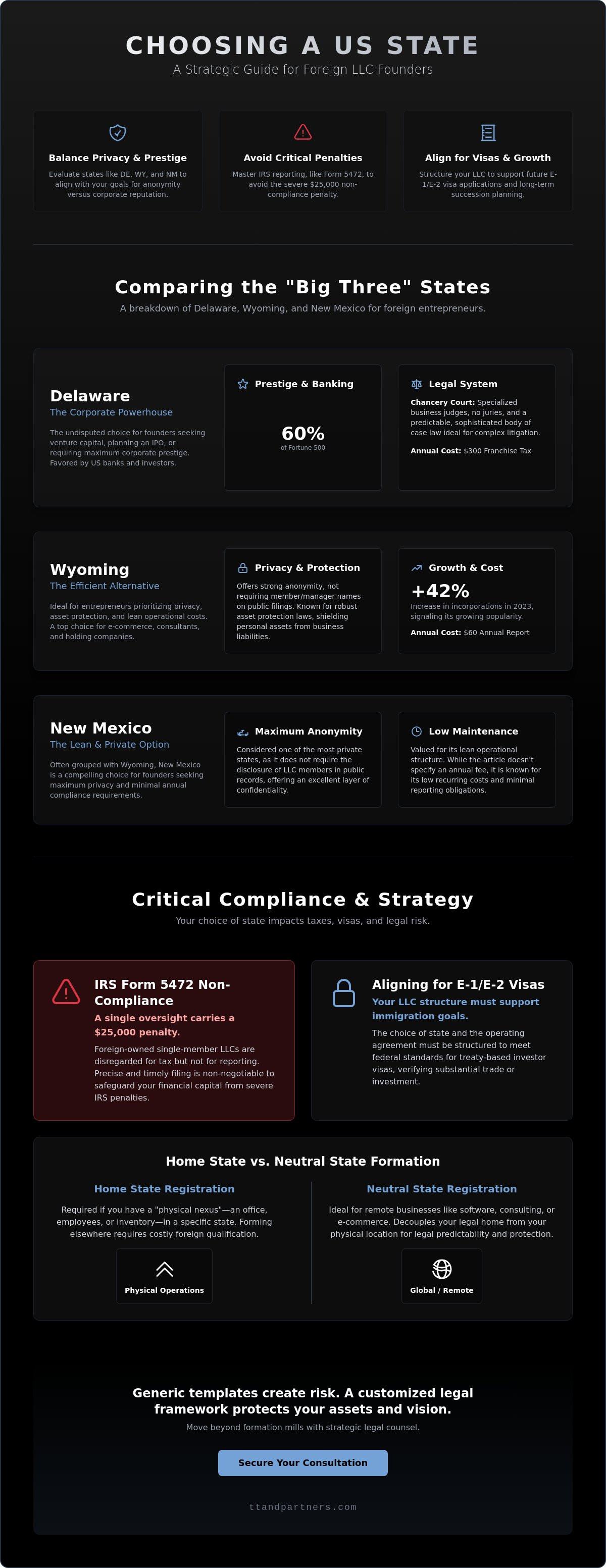
While Delaware’s legal prestige attracts 60% of Fortune 500 companies, this traditional choice often proves counterintuitive for non-resident entrepreneurs who prioritize privacy and lean operational costs. The process of choosing a US state to form an LLC for foreigners isn't merely a matter of administrative preference; it's a foundational decision that dictates your future tax exposure and eligibility for treaty-based investor visas. You likely feel the pressure of an evolving regulatory environment where a single oversight in IRS reporting, such as an incomplete Form 5472, carries a $25,000 penalty. Precision in these early stages is the only way to safeguard your intellectual and financial capital.
We recognize the complexity of balancing robust asset protection with the rigorous demands of US banking and federal transparency. This guide provides a strategic framework to help you select a jurisdiction that supports your long-term vision, whether you're seeking the anonymity of Wyoming or a corporate structure designed to facilitate a future E-2 or E-1 visa application. We will examine the distinct fiscal landscapes of Wyoming, Delaware, and New Mexico to ensure your business remains both harmonious and compliant within the global market.
Key Takeaways
Distinguish between "Home State" and "Neutral State" registrations to ensure your entity aligns with your physical operations or remote business model.
Evaluate the strategic advantages of Delaware, Wyoming, and New Mexico when choosing a US state to form an LLC for foreigners to balance privacy with corporate prestige.
Master the critical IRS reporting requirements, including Form 5472, to avoid the $25,000 non-compliance penalty that threatens foreign-owned entities.
Align your corporate structure with federal immigration standards to support future E-1 or E-2 visa applications through verified investment and trade.
Move beyond generic formation templates to implement a customized legal framework that addresses international litigation risks and succession planning.
Table of Contents
The Fundamental Choice: Home State vs. Neutral State Formation
Selecting a jurisdiction is an act of corporate architecture. For the international founder, the decision rests on whether the business maintains a physical footprint or operates as a borderless digital entity. When choosing a US state to form an LLC for foreigners, you must first determine if you'll trigger a "physical nexus." If your enterprise requires a local warehouse, an office, or employees in a specific state, that state becomes your Home State. However, for consultants, software developers, and remote traders, a Neutral State like Wyoming or Delaware offers a strategic advantage. It allows you to decouple your legal domicile from your physical location, providing a protective layer of predictable law. This is particularly relevant when the Limited Liability Company (LLC) is intended to serve as a global holding vehicle.
Understanding Physical Nexus for Non-Residents
In 2026, the definition of "doing business" remains a rigorous standard. A physical nexus is generally established if your LLC maintains a physical office, employs staff who reside within the state borders, or stores inventory in a local fulfillment center. Ignoring these ties leads to the necessity of Foreign Qualification. This administrative hurdle requires you to register your Neutral State LLC in the state where you actually operate. It doubles your filing fees and annual report obligations. If your operations are concentrated in a high-tax state, forming your entity there from the outset is often the most efficient path. If you're unsure about your specific footprint, you can contact our legal team to evaluate your nexus risks.
The Legal Doctrine of Internal Affairs
The state you choose acts as the arbiter of your internal corporate life. Under the legal doctrine of internal affairs, the laws of the state of formation govern disputes between members and the interpretation of your operating agreement. This is why Delaware's Chancery Court is revered. It offers a specialized bench of judges who decide cases without juries, relying on decades of sophisticated case law. When choosing a US state to form an LLC for foreigners, you aren't just picking a tax rate; you're selecting the legal framework that will protect your interests during litigation. Predictability is a premium asset. A well-chosen state ensures that your corporate structure remains a stable foundation for growth rather than a source of legal ambiguity. Choosing the wrong state initially can lead to hidden costs that far outweigh the savings of a cheaper filing fee.
Comparing the "Big Three" States for Foreign Investors: DE, WY, and NM
Once you've determined your physical nexus requirements, the selection process shifts to a comparison of long term maintenance and institutional prestige. For most non residents, the choice narrows to Delaware, Wyoming, or New Mexico. Each jurisdiction offers a distinct value proposition tailored to specific business life cycles. When choosing a US state to form an LLC for foreigners, you must weigh the upfront simplicity against the recurring administrative obligations that define your entity's operational health.
Delaware: The Corporate Powerhouse
Delaware remains the jurisdiction of choice for founders with global ambitions. It's home to 60% of Fortune 500 companies, a statistic that underscores its dominance in the US corporate landscape. This prestige is a functional asset. US banks and venture capital firms often mandate a Delaware formation to streamline their own due diligence. However, this reputation comes with a fixed cost. Beyond the initial filing fee of $90 to $110, you must pay a flat annual franchise tax of $300 by June 1st each year. While it offers privacy through the use of a registered agent, the primary draw remains a legal environment optimized for complex equity structures and future IPOs.
Wyoming and New Mexico: The Efficient Alternatives
For entrepreneurs prioritizing lean operations and asset protection, Wyoming and New Mexico provide compelling alternatives to the Delaware model. Wyoming saw a 42% increase in incorporations in 2023, largely driven by its pro business stance and low annual report fee of $60. It's particularly beneficial for family owned enterprises through its "Close LLC" status, which simplifies management structures. New Mexico represents the most budget friendly entry point. It requires a one time $50 filing fee and, uniquely, no annual reports or state level fees. Both states provide robust charging order protection, ensuring that a member's personal liabilities don't easily compromise the LLC's assets. Establishing a clear legal architecture requires professional oversight. You can consult with our specialists to determine which state aligns with your specific asset protection goals.
The "privacy myth" has been reshaped by federal transparency mandates. While many competitors still market these states as total anonymity zones, the reality is more nuanced. As of a FinCEN interim final rule in March 2025, domestically formed LLCs are not currently required to file a Beneficial Ownership Information (BOI) report. This provides a temporary reprieve from federal disclosure, yet choosing a US state to form an LLC for foreigners still requires a commitment to IRS transparency. Regardless of the state's internal privacy laws, your entity remains subject to federal reporting standards that no state level statute can override.
IRS Compliance and Tax Treaty Synergy for Non-US Owners
Many founders mistake "tax-neutral" for "reporting-free." When choosing a US state to form an LLC for foreigners, you'll find that the federal reporting burden remains constant across all 50 jurisdictions. A single-member LLC owned by a non-US person is typically classified as a disregarded entity. This classification doesn't mean you're invisible to the IRS; it means the entity's tax obligations flow through to the owner. You must obtain an Employer Identification Number (EIN), even without a Social Security Number, to open a corporate bank account and satisfy annual disclosure requirements. Failure to file Form 5472, along with a pro forma Form 1120, triggers a mandatory $25,000 penalty. This fine applies even if your LLC generated zero revenue during the fiscal year, making administrative precision a non-negotiable priority.
Effectively Connected Income (ECI) vs. FDAP
The IRS distinguishes between income "Effectively Connected" with a US trade or business and "Fixed, Determinable, Annual, Periodical" (FDAP) income. If you're "Engaged in a Trade or Business" (ETBUS), your profits are taxed at standard US graduated rates. Passive income, such as dividends or royalties, usually faces a flat 30% withholding tax. Bilateral tax treaties, like the long-standing agreement between the US and Italy, provide a sophisticated mechanism to mitigate this exposure. These treaties often reduce withholding rates or provide credits to prevent double taxation. Aligning your state selection with your home country's treaty benefits ensures your corporate structure remains fiscally efficient and legally sound.
2026 Reporting Requirements: The Corporate Transparency Act
Federal transparency standards now supersede state-level privacy statutes. While Wyoming and Delaware offer internal member anonymity, the Corporate Transparency Act (CTA) demands clarity regarding beneficial owners at the federal level. As of the March 2025 FinCEN interim final rule, domestically formed LLCs experienced a temporary filing reprieve, but a final rule is anticipated in 2026. You must maintain a rigorous compliance calendar to monitor these shifting mandates. Choosing a US state to form an LLC for foreigners requires a commitment to federal visibility that no "privacy state" can circumvent. Maintaining your entity's standing requires a proactive approach to these evolving transparency frameworks to avoid both criminal and civil penalties.
Aligning State Selection with US Visa Strategies (E-1 and E-2)
Your corporate entity is the bridge between your capital and your legal residency. When choosing a US state to form an LLC for foreigners, the decision becomes a critical component of your immigration file. Consular officers don't just look at the filing receipt; they examine whether the entity is a real, operating commercial enterprise capable of supporting the investor and the US economy. An LLC isn't merely a tax vehicle. It's the sponsor of your legal status. Ensuring the structure satisfies the "marginality" test is essential for both initial approval and future renewals.
The E-2 Visa Investment Vehicle
For E-2 Treaty Investor applicants, the LLC must demonstrate a substantial investment, typically starting around $100,000. While Wyoming's low fees are attractive, a Delaware LLC often carries a level of institutional prestige that resonates with officers during the adjudicative process. It's not enough to have a "paper company." You must prove a real intent to do business. This includes having a physical lease or a clear operational footprint in your chosen state. If your long term goal involves showcasing extraordinary talent, you should also consider how your LLC structure supports a future visa O-1 application. As of March 1, 2026, the premium processing fee for visa petitions increased to $2,965, making it vital to get your corporate architecture right the first time to avoid costly delays.
E-1 Visas and International Trade
The E-1 visa requires the LLC to serve as a vehicle for continuous international trade. Specifically, more than 50% of the LLC's trade volume must occur between the US and your treaty country. In this context, choosing a US state to form an LLC for foreigners requires a focus on robust record-keeping. Your state of formation dictates the statutes governing your corporate books, which are essential for proving trade volume during visa renewals. Your business cannot exist solely to provide a minimal living for the investor. It must have the capacity to grow and hire US workers. A well-structured Operating Agreement that defines member roles and capital contributions is the best defense against USCIS scrutiny.
To ensure your corporate structure meets the rigorous demands of the State Department, schedule a strategic consultation with our immigration and corporate specialists.
Strategic Implementation: Why Legal Counsel Outperforms Formation Mills
Treating the birth of your US enterprise as a simple clerical exercise is a foundational risk. Many entrepreneurs view the administrative act of filing as the end of the journey, yet for a non-resident, it's merely the beginning of a complex legal lifecycle. When choosing a US state to form an LLC for foreigners, the process must go beyond ticking boxes on a digital platform. A professional legal strategy ensures that your corporate architecture isn't just compliant today, but resilient against future regulatory shifts. Professional legal introductions often serve as the primary gatekeeper to securing a robust US banking relationship, a hurdle that automated services rarely address with the necessary depth. Banks require more than a set of articles; they require a narrative of legitimacy that only a law firm can provide.
The Risks of Generic Online Filings
Automated platforms operate on volume, not strategy. They frequently provide "one-size-fits-all" operating agreements that fail to account for the specific needs of a foreign owner. These generic documents often lack the clauses required to satisfy USCIS during a visa renewal or to protect a member from personal liability in a cross-border context. The cost of fixing a poorly structured entity often exceeds the initial savings of a budget filing service by a significant margin. Ensuring your LLC incorporation is compliant with both US federal mandates and your home country's tax laws is a task that requires human intellect and foresight. Automated tools don't warn you about the $25,000 IRS penalty for missing a Form 5472 filing. They simply file what you tell them, even if the information is strategically flawed.
Comprehensive Cross-Border Support
Strategic implementation requires managing the delicate intersection of corporate law, tax treaties, and immigration goals. For Italian investors, this means navigating the specific nuances of the US-Italy tax treaty while maintaining a structure that supports long term residency. Your LLC shouldn't exist in a vacuum. It must be integrated with international litigation protections to safeguard your global assets from domestic US disputes. Customizing your LLC for cross-border estate planning ensures that your US market presence remains a lasting legacy rather than a temporary experiment. Choosing a US state to form an LLC for foreigners is a decision of high consequence. It demands a partner who understands the global implications of every local filing. Our collective approach ensures that your US venture is built on a foundation of professional precision and aesthetic excellence.
Architecting Your Global Future in the United States
The decision of choosing a US state to form an LLC for foreigners represents the intersection of fiscal responsibility and visionary growth. You've seen that while Delaware offers prestige and Wyoming provides efficiency, the true value lies in how these structures align with your long term immigration and asset protection goals. A well architected entity isn't just a legal requirement; it's a strategic asset that facilitates banking relationships and visa eligibility.
Our firm brings decades of experience in US-Italy cross-border law to every engagement. We specialize in the precise integration of E-1, E-2, and O-1 visas within your corporate framework, offering full service support that extends from initial incorporation to complex real estate closings. We invite you to Schedule a Strategic Consultation for Your US Business Expansion. Your journey into the American market deserves a foundation built on professional excellence and intellectual depth. We look forward to helping you build a legacy that transcends borders.
Frequently Asked Questions
Do I need to visit the US to form an LLC as a foreigner?
You don't need to visit the United States to complete the formation process. Statutory requirements allow for digital filings through a registered agent who maintains a physical address in your state of choice. This allows you to establish a legal presence while remaining in your home country.
Which state is the cheapest for a non-resident LLC in 2026?
New Mexico currently offers the lowest entry and maintenance costs. The state requires a one-time $50 filing fee and, unlike its peers, mandates no annual reports or franchise taxes. This makes it an efficient choice for those prioritizing a lean corporate structure with minimal recurring fees.
Can a foreign-owned LLC open a US bank account remotely?
Opening a US bank account from abroad is challenging but achievable through specialized digital platforms or professional legal introductions. Most traditional institutions require a physical visit, yet a well-structured LLC with a verified EIN can often access modern banking solutions. Professional guidance is usually necessary to bridge this administrative gap.
Is Delaware really the best state for every foreign business?
Delaware isn't always the optimal choice. While it's the gold standard for venture capital and future IPOs, the $300 annual franchise tax is often unnecessary for solo entrepreneurs or digital consultants. When choosing a US state to form an LLC for foreigners, you must weigh legal prestige against your actual operational needs and budget.
What are the annual maintenance requirements for a Wyoming LLC?
Wyoming requires you to file an annual report and maintain a registered agent with a physical address in the state. The report fee is a minimum of $60 for most entities. You must submit this filing by the first day of the month in which you originally incorporated to keep your entity in good standing.
How does an LLC help me get an E-2 Treaty Investor visa?
An LLC serves as the official vehicle for your "substantial investment" in the US market. To qualify for an E-2 visa, the entity must be a real, operating commercial enterprise rather than a passive holding company. The state you select must support a business plan that demonstrates the company's capacity to hire US workers.
Do I need an ITIN or SSN to start a US company?
You don't need an ITIN or SSN to incorporate or obtain an EIN for your business. The IRS allows foreign owners to apply for an EIN using a specialized process that doesn't require US taxpayer identification. This number is essential for opening corporate bank accounts and fulfilling federal reporting duties.
What happens if I forget to file Form 5472 for my LLC?
Failing to file Form 5472 results in a mandatory $25,000 penalty. The IRS has automated its detection systems to flag non-compliance among foreign-owned disregarded entities. Choosing a US state to form an LLC for foreigners won't protect you from this federal requirement, as it applies regardless of your state's internal privacy laws.


Comments