

Choosing an Immigration Lawyer: A National Guide to U.S.-Italy Matters

If you searched for an immigration attorney to handle cross-border matters, the key question is whether the lawyer’s experience fits your situation, especially if it involves both the United States and Italy. Choosing counsel is less about physical proximity than understanding the U.S. pathway, the Italian connection, and how both may shape your plans.
It’s understandable to feel uncertain when several processes seem relevant or when the right next step depends on personal, professional, or family circumstances. This guide will help you identify a pathway to discuss, organize useful information before a legal conversation, and assess counsel for a matter involving both countries.
We’ll look at how U.S. options such as E-1, E-2, and O-1 visas or a Green Card relate to Italian citizenship and residency matters. We’ll also explain why coordination can matter when your plans involve the United States and Italy. A clear account of your goals, history, and documents helps you have a more focused conversation and assess whether counsel’s experience fits your case.
Key Takeaways
Start with the outcome you want, then identify which immigration pathway may fit your circumstances.
For a matter involving both countries, assess whether counsel can distinguish and connect the relevant U.S. and Italian objectives.
Compare counsel on experience with the relevant pathway, cross-border coordination, communication, and scope, rather than relying on years in practice alone.
Prepare a concise brief with your objective, relevant dates, current immigration position, and supporting documents before a legal discussion.
Learn how Tosolini, Toniutti & Partners’ U.S.-Italy focus connects with its visa, Green Card, and Italian immigration services.
Table of Contents
Why the Right Immigration Lawyer Starts With Your Case, Not a Directory Listing
It can be difficult to tell whether your situation calls for a work visa, an investment pathway, permanent residence, or help with Italian immigration. A directory listing may help you find names, but it won’t show which legal question needs answering or whether your goals involve one country or two. Start by stating the outcome you want and the facts that shape it. That gives you a practical basis for assessing the issue and the counsel suited to it.
Case fit means matching the legal pathway your circumstances call for with counsel’s experience in that type of matter. This is more useful than choosing by a broad label alone. Immigration law covers distinct national systems, and similar everyday goals can raise different legal questions depending on a person’s circumstances. The general overview in Understanding Immigration Law explains why rules and processes vary across countries.
Identify the outcome before choosing a legal pathway
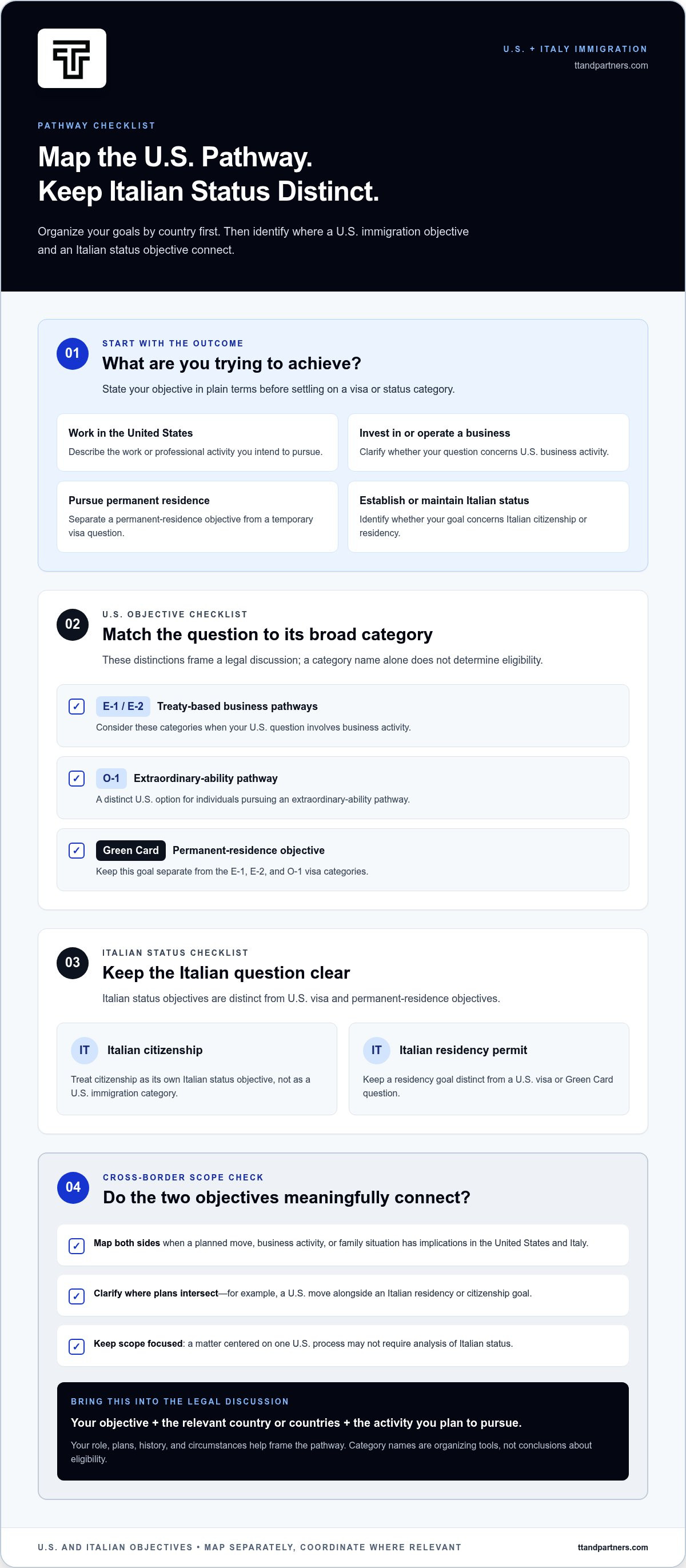
Describe your objective in plain terms before settling on a visa category. Are you seeking to work in the United States, invest in or operate a business, pursue permanent residence, or establish or maintain Italian status? These are starting points for a legal discussion, not a determination of eligibility. That assessment depends on the details of your situation and the applicable pathway.
Separate your immediate question from your longer-term plan. Someone exploring a temporary work opportunity may also be considering a future move with family. A business owner may need to clarify whether the current issue is a U.S. visa or a broader plan involving operations in both countries. These objectives can overlap, but they are not one undifferentiated problem. Avoid assuming that a familiar visa label answers your specific question.
Recognize when a matter has a cross-border dimension
A question focused on a single U.S. process may not require analysis of Italian status. A cross-border dimension becomes relevant when the desired outcome also involves Italian residency or citizenship, or when business, family, or investment plans connect activity in both countries. For example, someone planning a move to the United States while pursuing an Italian residency goal may need to understand how the two objectives fit into a broader plan.
Not every immigration matter is cross-border. The useful distinction is whether a decision in one country is meaningfully linked to a legal objective in the other. The question is not simply where counsel is based, but whether your matter calls for U.S.-only guidance or a coordinated perspective on U.S. and Italian objectives. Clarifying that scope early helps keep the legal discussion focused and makes it easier to identify the experience relevant to your case.
U.S. Immigration and Italian Status: Map the Pathway Before Comparing Counsel
A cross-border immigration matter is not simply one application viewed from two places. First identify which legal objectives relate to the United States, which relate to Italy, and where your plans connect. This helps ensure that a decision about one country is considered alongside relevant goals in the other. The perspective is useful when a planned move, business activity, or family situation has implications on both sides.
Begin with the U.S. question. The U.S. Immigration System Overview provides general context about how the system is structured. The appropriate route still depends on your circumstances and intended outcome.
Match the U.S. immigration question to its broad category
E-1 and E-2 are treaty-based business pathways, while O-1 is a distinct option for individuals pursuing an extraordinary-ability pathway. A Green Card relates to a permanent-residence objective and is not interchangeable with those visa categories. These broad distinctions help frame the initial question without deciding eligibility based on a label alone.
If your plans involve business activity in the United States, clarify whether your question concerns a treaty-based business pathway or a different professional objective. Someone pursuing an extraordinary-ability pathway has a separate category to discuss. Your role, plans, and history matter, so category names are an organizing tool, not a conclusion.
For a focused legal discussion, describe the activity you intend to pursue and the result you hope to achieve before comparing categories. This keeps the conversation anchored in your situation rather than a general list of visas. E-1, E-2, and O-1 matters call for different analysis, so consider which pathway relates to your goal.
Keep Italian immigration goals distinct but connected
Italian citizenship and an Italian residency permit are separate objectives from a U.S. visa or permanent residence. They concern Italian status, while a U.S. visa addresses a U.S. immigration objective. Treating these as distinct questions helps prevent one process from being mistaken for an answer to the other.
The objectives can still connect within your broader plans. Someone considering a move to the United States while maintaining a residence or citizenship goal in Italy may need to map both. A business owner with activity connected to both countries may likewise need to distinguish the U.S. immigration question from the Italian status question. The aim is to coordinate where goals intersect, not to assume every U.S. immigration matter requires cross-border counsel.
The right pathway depends on your objective and facts, not on a visa label chosen in advance. If your plans connect U.S. immigration with Italian status, a discussion of U.S.-Italy immigration matters can help frame the questions and clarify which objectives need to be considered together.
How to Assess an Immigration Lawyer for a Cross-Border Case
Compare counsel based on the legal work your situation may involve, not a broad claim of experience. General immigration practice can cover different categories, while your matter may turn on a particular pathway or objectives that connect the United States and Italy. Years in practice can offer context, but they don’t show by themselves whether counsel’s experience fits your specific question.
Useful counsel connects the legal route to your defined goal. Use the criteria below to structure a conversation and compare how each one relates to your case.
Compare experience with the pathway you need
Distinguish broad immigration experience from experience relevant to your category. If your central question concerns an investment-based pathway, the E-2 visa strategy guide can help you frame the subject for discussion. If your objective relates to extraordinary ability, the O-1 visa guide provides relevant context. Neither guide determines an individual’s eligibility. Use them to identify the right subject for a case-specific conversation.
Ask how the experience described relates to the issue you’re bringing forward. A long career may span many kinds of matters, but duration alone doesn’t establish depth in every category or familiarity with a cross-border dimension. Look for explanations that connect the pathway to your stated objective, rather than relying only on a general description of services.
Assess communication and cross-border coordination
Clear communication supports informed decisions. You should be able to understand the proposed scope, how the legal discussion is organized, and which facts may affect the analysis. For a U.S.-Italy matter, assess whether the conversation identifies relevant objectives in both countries without treating separate processes as one.
No adviser can responsibly promise a particular immigration outcome. A measured explanation of the issues, uncertainties, and next steps is more useful than certainty unsupported by an assessment of your facts. If your matter calls for connected U.S. and Italian context, the cross-border immigration contact page provides a way to begin a focused discussion.
Prepare for an Immigration Consultation With a Clear, Useful Brief
A focused consultation begins with a clear account of your situation, not a perfectly assembled file. A short written brief can organize the facts, make priorities visible, and surface questions that need legal guidance. You don’t need to decide which pathway applies before the discussion. Describe what you know and where you’re uncertain.
Organize facts, timeline, and goals
Use this sequence to prepare a practical overview. Keep it factual and concise, especially if your plans involve activity in both the United States and Italy.
State your intended outcome. In a few sentences, explain whether you’re seeking to work, invest in or operate a business, pursue permanent residence, or address an Italian immigration goal. Note longer-term plans separately from the immediate question.
Write a short timeline. List relevant travel, work, investment, and family events in chronological order. Include dates you know, and mark approximate dates rather than presenting uncertain details as exact.
Summarize your current immigration position. Describe your present status or situation in each country relevant to the question. Include related applications, decisions, or previous advice if they help explain the background.
Record important dates and deadlines. Note upcoming travel, business plans, family changes, or other decisions that may affect timing. Distinguish fixed dates from preferred planning targets.
Organize available records. Group relevant documents by topic, such as identity, travel, work, investment, or family history. Keep originals and copies orderly, and make a simple index so you can locate records during the discussion.
These materials provide context. No single record or document guarantees a particular outcome. If a document is missing or a date is unclear, note that rather than delaying preparation while trying to make the file appear complete.
Prepare questions that clarify strategy and scope
Bring questions that turn your overview into a useful discussion. For example, ask:
Which broad legal pathway appears relevant to my stated objective, and what facts might change that initial assessment?
Do my U.S. and Italian goals need to be considered together, or are they separate matters?
What would the proposed scope of representation cover, and how would updates be communicated?
After reviewing this overview, what additional information may be needed?
Clear questions help you understand both the direction of the legal analysis and its boundaries. If your matter involves U.S. and Italian goals, an organized brief can make the first conversation more precise without requiring you to know the answer in advance.
How Tosolini, Toniutti & Partners Supports U.S.-Italy Immigration Matters
Once you’ve identified your goal, considered which pathway may apply, and prepared the relevant facts, look for counsel whose work reflects the scope of your matter. Tosolini, Toniutti & Partners focuses on U.S.-Italy cross-border immigration and business operations, serving clients nationally. The firm’s focus is relevant when a U.S. immigration question sits alongside an Italian residency or citizenship objective, or when business plans connect the two countries.
The firm addresses the legal objectives in view, with attention to each client’s circumstances. A focused discussion can distinguish the U.S. question from the Italian one, identify where they intersect, and frame next steps around your facts and intended outcome. No visa category or service should be understood as a promise of eligibility or approval.
Connect immigration strategy to business or relocation goals
For clients with U.S. business or professional objectives, the firm handles E-1, E-2, and O-1 visa matters. These are distinct pathways, so a useful discussion starts with the nature of your goal rather than assuming one category fits every business or career plan. The relevant facts and legal requirements need individual consideration.
Business formation may also be part of a broader plan. When a client’s U.S. objective involves establishing a business, the firm supports LLC incorporation alongside its immigration and business operations work. This can put the immigration question in context without treating business formation as a substitute for immigration analysis.
A practical starting point is to clarify whether your immediate need centers on a business-related immigration pathway, an extraordinary-ability objective, or a business operation that forms part of a larger plan. That distinction helps organize what to discuss and keeps category-specific questions tied to your circumstances.
Plan connected U.S. and Italian legal objectives
The firm also supports Green Card matters, Italian citizenship, and Italian residency permits. These services address different objectives: a U.S. permanent-residence goal is distinct from a question about citizenship or residency in Italy. If your plans involve both countries, consider how each objective fits into the broader plan while keeping the separate legal questions clear.
For instance, you may be weighing a U.S. business move while also addressing an Italian status goal. The appropriate next step depends on your priorities, history, and relevant facts. A focused discussion can help frame which matters need attention and how the U.S. and Italian objectives relate, without presuming that one answer applies across both systems.
If you’re looking for an avvocato immigrazione utah for a matter connected to U.S. and Italian goals, share your objective and key facts with Tosolini, Toniutti & Partners to discuss your immigration matter and the path ahead.
Set Your Next Step in Motion
A cross-border plan can evolve as personal, professional, or business priorities change. Turn what you know today into a clear starting point: identify the decision you need to make, the facts that shape it, and what remains uncertain. This gives legal guidance a practical focus without requiring you to have every answer in advance.
If you’re seeking immigration counsel for a matter involving both countries, look beyond a general label and consider how your immediate question fits into your wider U.S.-Italy plans. A thoughtful discussion can help define the issues to address now and distinguish them from decisions that may arise later. Your first conversation can establish a considered direction without settling the entire journey.
When you’re ready to discuss your circumstances, contact Tosolini, Toniutti & Partners about your U.S.-Italy immigration matter. Bring the objective and key facts you’ve gathered, and take the next step with greater clarity.
Frequently Asked Questions
Does immigration law work the same way nationwide?
Not entirely. Many U.S. immigration matters involve federal processes, but the relevant pathway and analysis still depend on a person’s circumstances and objective. A general overview can explain broad concepts, but it can’t determine whether someone qualifies or predict a decision. Two people seeking to work in the United States, for example, may have different histories and plans. Case-specific legal review helps identify which facts and questions matter.
Can an immigration lawyer help if I live far from the firm?
Yes. Tosolini, Toniutti & Partners serves clients nationally in U.S.-Italy matters, so distance from the firm doesn’t by itself prevent you from raising your legal question. Describe your intended outcome, current circumstances, and relevant dates. If you’re considering an avvocato immigrazione utah, focus on the legal issue and the firm’s experience with the relevant U.S.-Italy matter.
What does an immigration lawyer do?
An immigration lawyer evaluates legal options and explains the work relevant to a person’s circumstances. Depending on the matter, that may involve reviewing case information, identifying questions that need answers, and providing guidance on a visa or permanent-residence issue. For instance, someone whose work plans have changed may need to understand how those changes relate to the original objective. The specific assistance depends on the matter and agreed scope.
How much does an immigration lawyer cost?
There isn’t one reliable fee that applies to every immigration matter. The work involved can vary with the issue and the scope of assistance. Before engaging counsel, ask what the proposed fee covers, how additional work would be addressed, and whether separate expenses may apply. A general article can’t estimate your legal fees, so discuss the specific scope and fee structure with the firm.
When should I speak with an immigration lawyer?
Consider speaking with a lawyer before making a consequential immigration decision, such as committing to a move or building a business plan around an immigration pathway. A discussion may also be useful if your circumstances have changed since you last considered your options. Prepare a brief account of what has changed, what decision is approaching, and when you hope to act. The right timing depends on the details of your situation.
Do I need a lawyer for an E-2 visa?
Whether legal assistance is appropriate depends on the facts of your proposed investment and the questions involved. An online overview can introduce the E-2 pathway, but it can’t assess your individual circumstances or assure an outcome. A lawyer can discuss how your plans relate to the pathway and what information may matter. Review a dedicated E-2 guide for background, then raise questions specific to your investment plans in a legal discussion.
Can one law firm help with both U.S. and Italian immigration matters?
Yes. A firm focused on U.S.-Italy cross-border work can address related objectives in both countries. Someone planning a U.S. move while pursuing an Italian citizenship or residency goal, for example, may need to discuss each objective distinctly. Tosolini, Toniutti & Partners handles U.S. immigration matters and Italian immigration matters. Which services are relevant depends on the person’s facts and intended outcome; connected goals don’t make the legal processes identical.


Comments