

US Real Estate POA Guide for Overseas Clients

The closing date is approaching, but you’re overseas and can’t be there to sign. A US real estate power of attorney for overseas clients may allow someone you trust to act for you, but its usefulness depends on whether the authority fits the transaction and the parties handling the closing can accept it.
Before authorizing someone to act on your behalf, clarify which tasks they may handle and how the document must be prepared and signed. A power of attorney can help keep a transaction moving, but broad or poorly coordinated authority may create uncertainty when closing documents are due.
This guide explains when a power of attorney may be appropriate, how to define its scope for a specific property transaction, and how to coordinate preparation, signing, and delivery from overseas. It also explains how the title company, lender, or other transaction participant’s requirements can affect the process.
Table of Contents
When Does an Overseas Client Need a US Real Estate Power of Attorney?
A US real estate power of attorney for overseas clients is written authority that lets an appointed agent take specific actions for someone in a property transaction. The person granting the authority is the principal; the person authorized to act is the agent. The title company, lender, and other transaction participants are separate parties. Their closing processes and document requirements can affect how the POA is used.
An agent may be useful when the principal is abroad and travel, distance, or signing logistics make it difficult to complete a transaction step in person. For example, a buyer who cannot attend a scheduled closing might authorize an agent to sign specified documents, if the POA and the transaction requirements allow it. A general overview of the concept appears in this Power of Attorney Overview, but a real estate POA needs to be considered in the context of the particular deal.
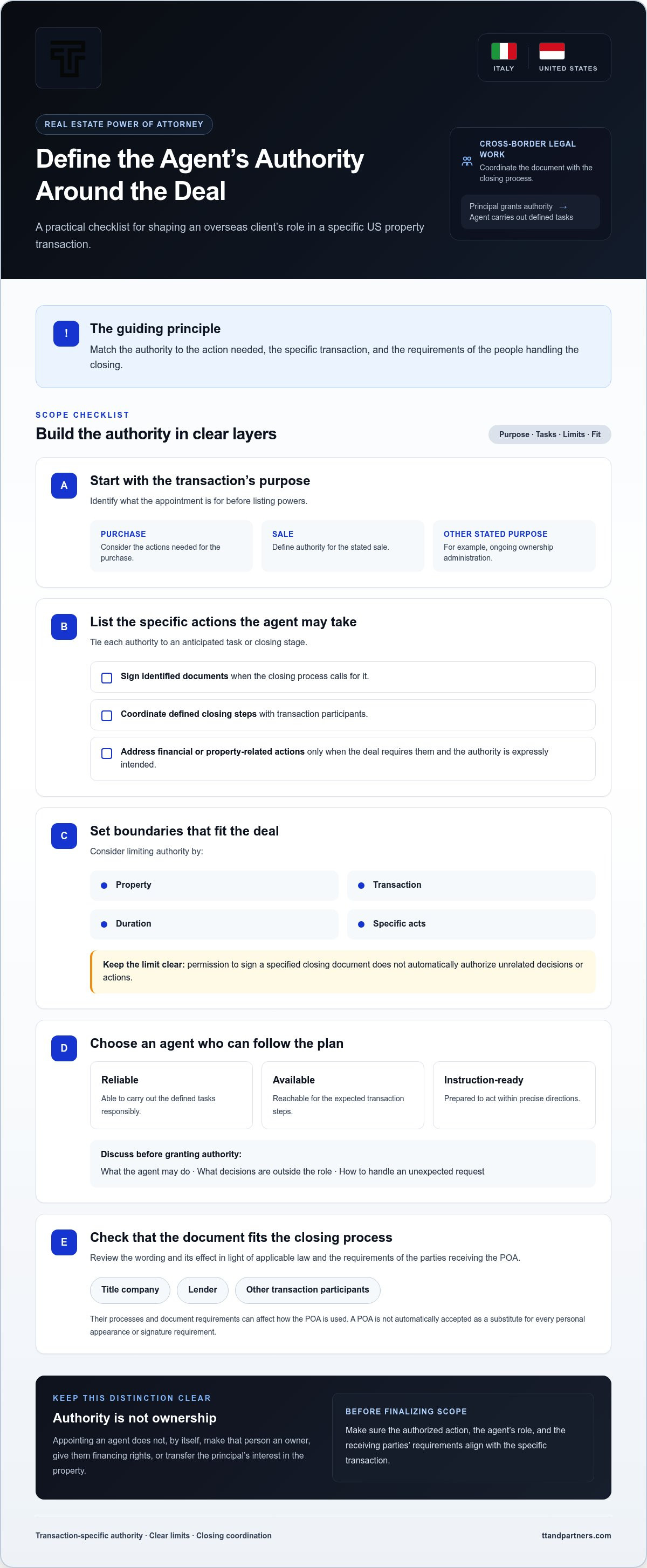
The authority is not the same as ownership. Appointing an agent does not, by itself, make that person an owner, give them financing rights, or transfer the principal’s interest in the property. Nor does a POA automatically replace every personal appearance or signature requirement. Its practical effect depends on the authority granted and the applicable legal and transaction requirements.
What can an agent do in a US property transaction?
A POA may authorize an agent to sign specified transaction documents or coordinate defined closing actions for a purchase, sale, or other stated purpose. Match the document’s scope to the agent’s expected tasks. Authority to sign one closing document, for instance, does not automatically authorize unrelated decisions or actions beyond the transaction.
This distinction matters to the principal and the people handling the closing. A clearly described role helps establish what the agent may do, while the receiving participants determine how the document fits their process. The agent’s authority comes from the POA, not simply from being a relative, business associate, or person assisting with logistics.
When might a POA be preferable to attending in person?
Travel may be impractical when a signing or closing step falls while the principal is overseas, unavailable, or unable to reach the relevant location. An agent can provide a way to complete authorized actions without the principal’s physical attendance, while keeping the agent’s authority within the limits set in the document.
Weigh that option against travelling to complete the steps personally. The transaction timeline and the requirements of the parties receiving the POA affect whether using an agent is workable. Coordinating early can show whether the proposed scope and signing method fit the closing process. A POA is a possible tool, not a necessary or universally accepted substitute for appearing in person.
The key question is whether the authority, the action required, and the closing process align. A transaction-specific review helps define the agent’s role without treating the POA as a transfer of ownership or blanket permission to act.
How to Define the Agent’s Authority for the Specific Real Estate Deal
Start with the transaction’s purpose, not a generic list of powers. A POA for a purchase may need to cover different actions from one for a sale, ongoing ownership administration, or another defined purpose. Connect each authority to an anticipated task so the principal and agent understand what the appointment covers and where its limits lie.
Map the transaction before setting the scope. Identify the documents or decisions for which the agent may be needed, then consider whether to limit the authority by property, transaction, duration, or specific acts. These boundaries should reflect the closing plan and applicable requirements, not assumptions about what every transaction needs. Review the document’s wording and effect in light of applicable law and the receiving participants’ requirements.
Which powers should the document address?
Consider each proposed power in relation to a specific action or stage. Depending on the transaction, the document may address:
Signing identified purchase or sale documents when the closing process calls for it.
Communicating with or coordinating among transaction participants about defined closing steps.
Handling financial or property-related actions only when the deal requires them and the authority is expressly intended.
For example, permission to sign a specified closing document should not be treated as permission to make unrelated property decisions. The principal should understand what the agent may do, what falls outside the agent’s role, and whether the scope matches the transaction. Sample wording found elsewhere may not suit a particular deal or satisfy its requirements, so don’t assume any phrase is universally valid legal language.
How should an overseas client choose an agent?
Choose someone reliable, available for the expected transaction steps, and able to follow precise instructions. Before authorizing them, discuss the actions they may need to take, the decisions they cannot make, and how to handle an unexpected request. Clear communication helps the agent act within the intended role instead of having to infer the principal’s preferences under closing pressure.
A carefully scoped authorization can address concerns about giving someone broader authority than the transaction requires. It also helps the principal assess whether the selected person can carry out the defined tasks. Choose the agent and set the scope together: even a trusted person needs clear direction, while precise limits make expectations easier to communicate and follow.
This transaction-specific approach keeps the POA connected to the closing rather than treating it as a form prepared in isolation. Cross-border real estate closing guidance can help bring the proposed authority, transaction documents, and overseas logistics into the same review.
How Can an Overseas Client Sign a US Real Estate POA?
The right signing method depends on more than where you are located. Applicable state law, the place where you sign, and the requirements of the title company, lender, or other party receiving the document can all affect execution. For a US real estate power of attorney for overseas clients, establish those requirements before arranging notarization or authentication. A method accepted for one transaction may not be accepted for another.
Identify the state law relevant to the document and transaction, then establish what form of execution the receiving participants will accept. Resolve these details before booking an appointment or signing, since corrections or additional formalities can affect the closing schedule.
What should the client verify before choosing a signing method?
Confirm the recipient’s requirements alongside the applicable legal formalities. For the specific transaction, establish whether the document needs witnesses, a particular notarial certificate, authentication, or a translation. Consider whether the principal’s location creates additional steps. These are transaction-specific questions, not universal requirements.
State law: Identify the rules relevant to the POA and the property transaction.
Recipient acceptance: Clarify what the title company, lender, or other recipient requires for the document it will rely on.
Execution details: Determine whether witnesses, specific notarization, or further authentication are needed.
Signing location: Establish whether the country where the principal signs affects the required process.
An apostille or other authentication may be relevant in some circumstances, but don’t assume one is required or that it replaces notarization or other formalities. Translation needs can also vary. Confirm the requirements before preparing the final signing set, so the document’s execution matches the recipient’s expectations.
Can the POA be signed remotely while the principal is overseas?
Remote notarization may be an option, but availability and recognition depend on applicable rules and the receiving party’s requirements. Don’t assume a remote process is available simply because the signer is overseas, or that it will be accepted simply because the document was notarized online.
Other possible routes may include signing before a consular notary or using a local notary where the principal is located. These are options to assess in context, not guaranteed substitutes for one another. The relevant state law, the signer’s location, and the recipient’s document requirements all shape the decision.
Before committing to a route, share the proposed execution method with the transaction participants and allow time to address requested changes. Coordinating the POA with the closing can help avoid signing a document in a form that causes delay or needs to be redone. Cross-border real estate closing support can bring document formalities and overseas signing logistics into the transaction review.
What Is the Step-by-Step Process for Using a POA in a US Closing?
A smooth process starts with the closing, not the signing appointment. Work backward from the transaction’s key dates to identify when the agent’s authority is needed, what the receiving parties require, and how the executed document must reach them. For a US real estate power of attorney for overseas clients, early coordination connects the document to the actual transaction instead of treating preparation and closing as separate tasks.
Prepare and review the POA before arranging execution
Before signing, gather the transaction details and confirm the actions the agent may need to take. Review the POA’s scope and execution against applicable state law and the requirements of the title company, lender, or other intended recipient. Resolve questions about witnessing, notarization, authentication, and delivery before arranging the signing. This sequence can identify issues while there is still time to address them.
Identify the need. Determine which closing or transaction actions the principal cannot conveniently complete personally, and when the agent may need to act.
Gather transaction details. Share relevant property and deal information, expected documents, key stages, and the participants involved with the professionals coordinating the closing.
Confirm document requirements early. Establish what applicable law and the receiving participants require for the POA’s content and execution. Clarify any witness, notarial, authentication, translation, or delivery requirements that apply to this transaction.
Prepare and review the document. Align the proposed authority with the agent’s expected tasks and the transaction process. Resolve questions before the principal signs rather than assuming a general document will fit.
Arrange execution and any additional formalities. Once the signing method and requirements are established, coordinate the principal’s appointment and any further steps identified during review.
Deliver and coordinate use. Send the executed document to the relevant transaction participants using the agreed method. Ensure the agent understands when to act and which actions remain outside the authorization.
Coordinate delivery, closing, and any later changes
Keep the principal, agent, and closing participants aligned on responsibilities and timing. The principal should know when the document has been delivered and what actions the agent is expected to take. The agent should understand the limits of the authorization and how to handle a request that appears to fall outside it. Confirm transaction-specific deadlines and next steps with the professionals involved, because timing and procedures can differ by deal.
If circumstances change, don’t assume an amendment or revocation automatically updates the document held by everyone involved. Seek qualified legal guidance on the appropriate steps and coordinate any change with the relevant transaction participants. Acceptance and processing times can vary, so allow room in the closing schedule for questions or revisions.
For help coordinating a POA with the broader closing process, work with cross-border counsel on your real estate closing.
How Can Cross-Border Counsel Help Overseas Clients Complete a US Real Estate Closing?
A power of attorney is one part of a property transaction, not a substitute for considering the closing as a whole. Cross-border counsel can assess the proposed authority alongside the purchase, sale, or other real estate matter, connecting the agent’s role with the documents and steps expected in the transaction. This coordinated approach is especially relevant when the principal is abroad and signing arrangements need to fit the closing process.
For overseas clients, the key is to examine the POA in context: what the agent is expected to do, which formalities may apply, and what the transaction participants require. Considering these details together is more useful than starting with a generic form. Tosolini, Toniutti & Partners handles real estate closings in the United States and Italy and works on US-Italy cross-border legal matters, providing relevant context for coordinating international considerations with a property closing.
What does transaction-specific legal coordination address?
Coordination begins with the deal itself. For a purchase, counsel can consider the actions the agent may need to take as the transaction advances. For a sale, the focus may be on the seller’s anticipated signing and closing steps. The POA’s scope can then be reviewed alongside applicable legal formalities and the document requirements identified by the relevant title company, lender, or other participant.
This does not mean that a particular POA will necessarily be accepted or produce a specific outcome. Legal coordination helps identify questions early, clarify how the document relates to the closing, and address overseas signing logistics in context. It also gives the principal a clearer view of the agent’s proposed authority and how it fits the transaction.
What information should an overseas client prepare?
A focused initial discussion is easier when the main transaction details are at hand. Consider gathering:
Transaction overview: Whether the matter involves a purchase, sale, or another property purpose, and its current stage.
Anticipated representation: The actions or signing steps the agent may need to handle, and when they are expected.
Property state: The state where the property is located, which helps frame the applicable legal questions.
Timing: Known closing or signing deadlines and any steps already scheduled.
Relevant communications: Messages or instructions from transaction participants identifying document, execution, or delivery requirements.
These details help place the US real estate power of attorney for overseas clients within the transaction’s actual sequence. They also make it easier to distinguish established requirements from points that still need review, without assuming one signing method or document format will suit every closing.
For coordinated guidance on the POA and the broader closing, contact Tosolini, Toniutti & Partners about your US real estate closing.
Set the Closing Up for a Clear Next Step
Before authorizing an agent, use the upcoming transaction as the reference point for every decision: what needs to happen, who must act, and how the document fits the closing process. A deliberate approach to a US real estate power of attorney for overseas clients can clarify the agent’s role while leaving room to address the requirements of your specific transaction.
You don’t need to resolve every detail alone. A discussion grounded in your property transaction can bring the POA and closing considerations into the same conversation. Share the transaction stage, anticipated representation, and any document instructions you’ve received to make that discussion more focused.
Contact Tosolini, Toniutti & Partners to discuss your US real estate closing and take the next step with greater clarity.
Frequently Asked Questions
Can an overseas client use a power of attorney to buy US real estate?
Yes, an overseas buyer may authorize an agent to take specified steps in a US property purchase. A US real estate power of attorney for overseas clients should be considered alongside the actual documents and decisions involved, such as signing an identified purchase document. Establish whether the relevant transaction participants will accept the arrangement and whether any step still requires the buyer’s personal participation before relying on the agent.
Does a US real estate power of attorney need to be notarized abroad?
Not necessarily. The answer depends on applicable state requirements, where the principal signs, and what the recipient requires. Before setting an appointment, establish whether the signing needs witnesses or a particular notarial certificate, and whether the recipient has instructions about the document’s format. This helps avoid arranging an execution method that doesn’t fit the transaction. Assess requirements for the specific closing rather than assuming they match another deal.
Does a power of attorney signed overseas need an apostille?
An apostille isn’t required in every case, and obtaining one doesn’t by itself establish that a POA will be accepted. The need for authentication depends on the document’s execution, applicable rules, and the receiving party’s requirements. For example, a title company may have instructions about how it wants an overseas-signed document authenticated or delivered. Clarify those instructions before arranging notarization or authentication instead of treating an apostille as an automatic step.
Can an agent sign all documents at a US real estate closing?
No, an agent’s authority isn’t automatically unlimited. Whether the agent can sign a particular document depends on the POA’s scope and the requirements applying to that closing. Identify the expected signing documents in advance, then compare each with the agent’s authorization. A document outside that authority may need the principal’s own signature or another arrangement, so don’t assume appointing an agent covers every item in the closing package.
What should a US real estate power of attorney include?
It should reflect the intended transaction and the specific actions the principal wants the agent to take. For example, if representation is needed only for a defined signing stage, consider whether the authorization clearly covers that task rather than unrelated property matters. Review the document’s scope and execution in context, including the recipient’s instructions. A general template or sample clause may not account for the details of a particular closing.
Can I revoke a real estate power of attorney after signing it?
You may be able to revoke or change an authorization, but the process and effect depend on the document, applicable rules, and the transaction’s status. Get legal guidance on the appropriate steps and how to notify the parties relying on the POA before taking action. If the agent has already signed documents or closing actions are underway, ask how the proposed change may affect those steps before assuming it will undo them.


Comments