

U.S. Estate Tax for Non-Resident Italians: A 2026 Guide

Could buying U.S. property create an estate-tax issue for your heirs even if you live in Italy? A US real estate closing for Italian buyers involves more than completing a transaction. The ownership structure and records can matter later, so it is useful to consider them before acquiring or transferring assets.
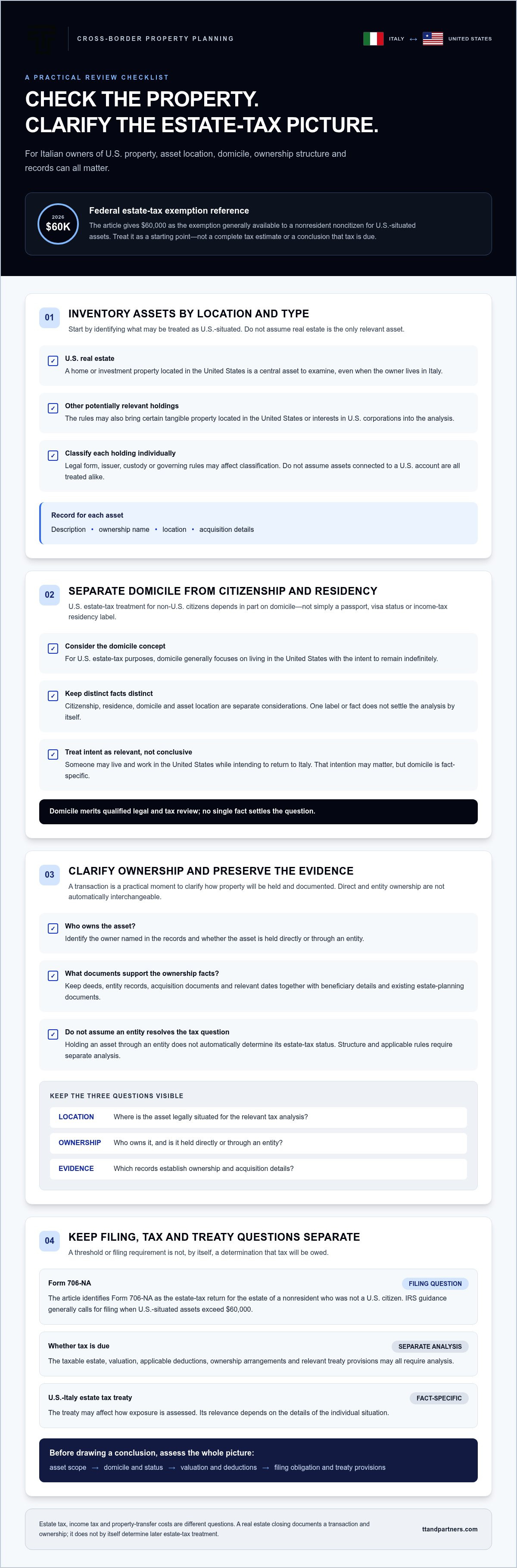
U.S. estate-tax treatment for non-U.S. citizens depends in part on domicile, not simply citizenship, visa status, or income-tax residency. For 2026, the federal estate-tax exemption generally available to a nonresident noncitizen is $60,000 for U.S.-situated assets. The U.S.-Italy estate tax treaty may affect how exposure is assessed, so the details of an individual situation matter.
This guide explains which assets may fall within the rules, how domicile differs from residency, and what the treaty may mean for Italian owners and their heirs. It also sets out practical questions to consider before purchasing or transferring U.S. assets, and the records that can help clarify ownership. Reviewing these points during a property transaction can connect the purchase to broader cross-border planning.
Table of Contents
U.S. Estate Tax for Non-Resident Italians: Why Asset Location Matters
U.S. assets owned by an Italian living abroad may be subject to U.S. federal estate tax in some circumstances. The answer depends on more than the owner’s passport. Domicile, asset location and classification, and the ownership structure can all matter. These issues are especially relevant when a property purchase forms part of a wider cross-border estate plan.
Estate tax applies to a deceased person’s taxable estate. Income tax generally applies to income, while property-transfer costs arise from a transaction. These are different tax questions. A real estate closing involves transaction and ownership documents, but does not by itself determine how a property will be treated for estate-tax purposes later.
For 2026, the federal estate-tax exemption generally available to a nonresident noncitizen is $60,000 for U.S.-situated assets. Treat this as a starting point, not a complete estimate of tax or a conclusion about whether tax is due. The taxable estate, applicable deductions, ownership arrangements, and relevant treaty provisions all require separate analysis. This overview of U.S. estate tax for non-resident aliens provides context, but individual planning depends on the facts and current law.
Does Italian citizenship determine U.S. estate-tax treatment?
No. Citizenship, residence, domicile, and asset location are distinct considerations. For U.S. estate-tax purposes, domicile generally focuses on living in the United States with the intent to remain indefinitely. It is not determined solely by immigration or income-tax residency labels. For example, someone may live and work in the United States while intending to return to Italy. That intention may be relevant, but no single fact settles the analysis. Domicile is fact-specific and merits qualified legal and tax review.
Which U.S. assets should Italian non-residents identify?
Start with U.S. real estate, then inventory other potentially relevant holdings rather than assuming property is the only asset to consider. The rules may also bring certain tangible property located in the country or interests in U.S. corporations into the analysis. Whether a particular asset is treated as U.S.-situated can depend on its legal form and circumstances, so broad labels may not be enough.
For a prospective buyer, a US real estate closing for Italian buyers is a practical time to clarify how the property will be held and documented. Keep these questions distinct:
Location: Where is the asset legally situated for the relevant tax analysis?
Ownership: Who owns it, and is it held directly or through an entity?
Evidence: Which deeds, agreements, and records show the ownership and acquisition details?
These steps identify the issues, but do not determine liability. A complete inventory and clear transaction records give advisers a stronger basis for assessing the estate-tax questions that follow.
How U.S. Estate-Tax Rules Assess a Non-Resident’s Estate
After identifying an asset’s location and the owner’s relevant status, separate the questions that are often treated as one. Does the asset fall within the U.S. estate-tax rules for a nonresident noncitizen? How is it valued, and what deductions or treaty provisions may apply? Does the estate have a filing obligation, and will tax be due? Each question calls for its own analysis.
For a nonresident noncitizen, potential U.S. estate-tax exposure depends on the person’s legal status and how the assets are classified under current rules. Citizenship and domicile are not interchangeable. Citizenship describes a person’s nationality; domicile is a tax-law concept that may depend on residence and intent. Living in the United States for work, for example, does not alone establish whether someone is domiciled there for estate-tax purposes. The facts and applicable law must be assessed together.
What does U.S.-situated property mean for estate-tax analysis?
U.S. real estate is a clear starting point. A home or investment property physically located in the United States is a central asset to examine, even if its owner lives in Italy. The owner’s location and the property’s location are separate facts. Other holdings may need closer review because their legal form, issuer, custody, or governing rules can affect their classification.
For a complete inventory, record each asset’s description, ownership name, location, and acquisition details. Do not assume every asset connected to a U.S. account is treated alike, or that holding an asset through an entity automatically resolves its estate-tax status. Those conclusions depend on the applicable rules and structure. Transaction documents prepared during a US real estate closing for Italian buyers can also help establish the facts for later estate analysis.
What filing and threshold questions need current verification?
The IRS identifies Form 706-NA as the estate-tax return for the estate of a nonresident who was not a U.S. citizen. Its guidance generally calls for filing when the value of U.S.-situated assets exceeds $60,000. That is a filing question, not a conclusion that tax will necessarily be owed. Confirm the current instructions and how they apply to the particular estate.
Keep the sequence clear:
Scope: Determine which assets are included under the applicable rules.
Valuation and deductions: Establish the figures and adjustments relevant to the taxable estate.
Filing and payment: Assess filing requirements separately from whether the final calculation produces tax due.
The IRS guidance on estate tax for non-U.S. citizens is a useful reference for the form and filing framework. If a property purchase connects to future planning, organized ownership and closing records can support a more precise review. Tosolini, Toniutti & Partners provides legal support for U.S.-Italy cross-border real estate matters. Explore cross-border real estate legal support.
Compare U.S. Property Ownership Questions Before Choosing a Structure
Choosing how to hold U.S. property is not simply a choice between an individual name and a company name. The structure affects title, decision-making, records, and how an interest may pass to others. Its estate-tax consequences cannot be determined in isolation: the owner’s circumstances, the asset, and current law all matter. Neither direct ownership nor entity ownership is automatically simpler or more tax-efficient.
Use the comparison below to organize the discussion, not as a recommendation. It separates three questions that can otherwise become blurred during a purchase.
Direct individual ownership
Estate-tax questions: How might the property be classified and valued, and how does it fit with the owner’s wider asset picture?
Administration: Whose name appears on title, and do the owner’s succession intentions align with existing estate-planning documents?
Transaction implications: Do the deed and purchase records reflect the intended ownership and clearly document the acquisition?
Entity ownership
Estate-tax questions: How is the ownership interest treated under applicable rules? Does using an entity change the analysis or only the form of ownership?
Administration: Who governs the entity, maintains its records, and makes decisions about the property or a future transfer?
Transaction implications: What formation, governance, reporting, and ongoing administrative steps affect the purchase and later ownership?
Direct ownership: what should the buyer assess?
With direct ownership, the individual holds title to the real estate. The deed can make the named owner clear, but title alone does not resolve succession or tax questions. Consider who is intended to benefit, how the property fits alongside other assets, and whether existing documents express the same plan. A US real estate closing for Italian buyers is an opportunity to align transaction records with that broader picture.
Entity ownership: what does it change, and what does it not?
An entity places a legal structure between the individual and the property. It does not, by itself, establish a particular estate-tax result. Formation and ownership can introduce separate legal, tax, reporting, and administrative questions, including decisions about governance and future transfers. An LLC incorporation strategy guide can help frame structural considerations, but the right analysis depends on the planned ownership and transaction.
Before deciding, map the intended owners and beneficiaries, identify who will manage the asset, and consider how a later sale or transfer would be handled. Then assess the structure through coordinated legal and tax analysis rather than selecting an entity or jurisdiction by default. This keeps the purchase structure connected to the owner’s longer-term intentions.
Prepare for a U.S. Property Purchase or Estate-Planning Review
A focused review starts with a clear picture of what is owned, how it is held, and what the owner intends for the property. Organizing this information before a purchase or ownership change helps legal and tax advisers work from the same facts. It can also make missing or inconsistent records easier to spot, without assuming that one document answers every estate-planning question.
Build the picture in sequence:
Identify the assets. List U.S. real estate and other potentially relevant U.S.-connected holdings, with a short description of each.
Record ownership. Note the individual or entity named on title, any co-owners, and how each interest is held.
Set out relevant dates. Include acquisition dates, ownership changes, and dates of any planned purchase or transfer.
Clarify intentions. Record who is intended to benefit from the property and how that intention relates to existing succession documents.
Which records help clarify the ownership picture?
Gather current title records and deeds, purchase agreements and closing documents, acquisition records, entity formation and governance documents, and relevant wills or other estate-planning papers. A timeline connecting the acquisition, title changes, and planning documents can make discrepancies easier to identify. Core records include deeds, purchase and acquisition documents, entity records, and existing succession documents. Keep sensitive personal information secure, and do not send private records through an unsecured channel.
For a US real estate closing for Italian buyers, consistent names and dates across the purchase file and ownership records are especially useful. If an entity is involved, include documents showing who owns or controls it, rather than relying on the entity name alone. The aim is to make the ownership history understandable, not to predict a tax result from paperwork in isolation.
How should buyers coordinate legal and tax questions?
Separate transaction questions from tax conclusions. Real-estate counsel can review purchase documents, title, and ownership mechanics, and clarify whether the transaction records reflect the intended structure. Questions about domicile, asset classification, valuation, deductions, filing, or potential tax liability require tax analysis under current law. Estate-planning documents may raise additional legal issues. Keeping these roles distinct helps each adviser address the right question.
Start coordinating before signing purchase documents or changing an ownership structure, while the proposed arrangement is still under discussion. Share the same asset list and ownership timeline with the relevant advisers, and note any unresolved questions. Tosolini, Toniutti & Partners handles real-estate closings in the United States and Italy and provides legal support for U.S.-Italy cross-border matters. To discuss the legal aspects of a cross-border property transaction, contact the U.S.-Italy legal services team.
Plan the Next Step with U.S.-Italy Real-Estate Legal Support
Take a clear sequence of steps: identify where the property and other relevant assets are located, establish which legal-status questions may matter, compare ownership structures, and prepare records showing how the property is held. This gives legal and tax discussions a more useful starting point than treating the purchase, ownership, and estate plan as unrelated decisions.
The aim is not to predict a tax result from closing documents. It is to understand the transaction’s ownership arrangements and records, then identify where separate tax analysis may be needed. For buyers considering U.S. property while based in Italy, cross-border coordination can keep the transaction and broader ownership plan in view.
When can closing counsel add value to the planning process?
Closing counsel can review transaction documents, title, and proposed ownership arrangements, and clarify how they fit together in the purchase. Tosolini, Toniutti & Partners handles real-estate closings in the United States and Italy, with legal support for U.S.-Italy cross-border matters. This work can support coherent transaction documentation, but it does not replace a tailored determination of estate-tax treatment, filing obligations, or potential tax liability.
A purchase may involve decisions about who holds title or whether an entity will own the property. Reviewing those decisions as part of the transaction can surface legal and documentation questions for further consideration. Tax conclusions remain a separate analysis under current rules.
What should the reader bring to an initial discussion?
Prepare a concise summary of citizenship, current residence, property plans, and present ownership status. Organize available title and purchase records, acquisition details, and any entity documents connected to the property. Note the intended ownership arrangement and any planned changes. This overview helps focus the discussion on the transaction’s legal structure without requiring every issue to be resolved in advance.
Write down the questions you want addressed. Separate practical closing matters, such as how title will be recorded, from estate-tax questions that need tax analysis. If documents contain sensitive personal information, use an appropriate secure method to share them rather than sending them through an unsecured channel.
For a US real estate closing for Italian buyers, these preparations can help frame the transaction clearly and connect it to wider U.S.-Italy ownership considerations. Arrange a cross-border legal consultation to discuss legal support for your property transaction.
Make Your Next Property Decision with Clarity
A U.S. property can become part of a family’s plans across borders, so its purchase deserves more than a decision about location or immediate use. Consider the ownership arrangement as part of the property’s longer-term purpose: who will make decisions, how the asset fits into your plans, and what you want future records to show.
That perspective makes a US real estate closing for Italian buyers a useful point to align transaction documents with ownership intentions. Legal review can clarify how the proposed purchase is documented and identify cross-border questions that may need separate tax analysis. The aim is not to assume a particular outcome, but to approach the transaction with a clearer view of the decisions ahead.
Tosolini, Toniutti & Partners supports real-estate transactions and legal matters involving U.S.-Italy considerations. If you are preparing for a purchase or reviewing an existing arrangement, discuss your U.S.-Italy real-estate transaction. Take the next step by discussing your transaction with the firm and clarifying the legal structure and records involved.
Frequently Asked Questions
Is a non-resident Italian subject to U.S. estate tax on U.S. real estate?
Potentially. U.S. real estate owned by a nonresident Italian may be included in the U.S. estate-tax analysis because of its location. Whether tax is ultimately due depends on the owner’s circumstances, the property’s value and ownership, applicable deductions, and any treaty relief. Keep the deed, purchase records, and documents showing later ownership changes together so the estate can establish what the owner held and when.
Does Italian citizenship determine whether U.S. estate tax applies?
No. Italian citizenship alone does not decide the outcome. U.S. estate-tax analysis distinguishes citizenship from domicile, a status that may depend on where someone lives and whether they intend to remain there indefinitely. A person’s visa or income-tax residency label will not necessarily resolve domicile. Travel history, home arrangements, and evidence of intent may be relevant, so preserve records that help explain the person’s circumstances for qualified review.
How much U.S. estate tax could a non-resident owe?
There is no single amount for every estate. For 2026, the federal exemption generally applicable to nonresident noncitizens is $60,000 for U.S.-situated assets, and federal rates are progressive from 18% to 40%. The final calculation depends on the taxable estate, allowable deductions, and any applicable treaty provisions. A filing threshold does not itself establish the tax owed; the estate’s facts and current rules determine the calculation.
Can an Italian non-resident hold U.S. property through an LLC?
Yes, an Italian non-resident can hold property through a U.S. LLC, but forming one does not automatically remove estate-tax exposure or produce a particular tax result. The LLC changes the ownership structure and can add governance, recordkeeping, tax, and reporting considerations. Before transferring property into an entity, assess how the ownership interest will be treated, how the LLC will be administered, and how future transfers fit the owner’s plans.
What happens if a non-resident owner dies holding U.S. property?
The estate may need to establish the deceased owner’s interest, determine whether a U.S. estate-tax return is required, and address any tax due before assets can be released or transferred. The IRS form generally used for a nonresident noncitizen’s estate is Form 706-NA. Financial institutions may require an IRS Transfer Certificate before releasing certain U.S. assets, so heirs should retain ownership and valuation records and obtain advice on the estate’s filing steps.
Does the U.S.-Italy tax treaty cover estate tax for Italian non-residents?
Yes. The U.S.-Italy estate and inheritance tax treaty, signed in 1955 and still in force, addresses estate and inheritance taxation. It includes rules relevant to determining where certain assets are situated and mechanisms, including tax credits, intended to mitigate double taxation. It does not cover gift taxes, and its application to a particular estate depends on the facts and treaty provisions. Qualified cross-border tax review is important before relying on treaty relief.
Do Italian buyers need to review estate-tax issues before closing on U.S. property?
Reviewing these questions before finalizing ownership documents can help buyers understand how the proposed title and any entity structure fit their plans. A US real estate closing for Italian buyers is also a practical time to organize the deed, purchase agreement, ownership records, and intended-beneficiary information. Transaction counsel can address closing documents, while estate-tax exposure requires separate analysis tailored to the buyer’s status and assets.


Comments