

Italian Visa for US Retirees: Living in Italy in 2026

Before choosing a visa, ask whether your retirement plans fit the requirements for living in Italy long term. The Italian visa for American retirees is often associated with the elective-residence route, but a retirement plan, a visa application, and permission to reside are not the same thing.
Entering Italy for a visit does not by itself authorize a long-term move. This guide explains the difference between a national visa and a residence permit, and why retirees with qualifying income often consider the elective-residence route. It also covers what to investigate about income, supporting documents, and residence formalities after arrival. Reviewing these points before making relocation commitments can help you identify questions to resolve and assess how your plans fit Italy’s residence framework.
Table of Contents
Italian visa for American retirees: Does a US citizen need permission to live in Italy?
How Italy’s elective residence visa fits an American retirement plan
Elective residence visa, citizenship, or another route: which path should retirees compare?
Applying for an Italian retiree visa: the planning sequence and residence formalities
Italian visa for American retirees: Does a US citizen need permission to live in Italy?
Permission to visit Italy is not permission to reside there indefinitely. A US passport may support short-stay travel under applicable rules, but it does not by itself authorize a permanent or extended move. The distinction matters from the start: a holiday is planned around entry conditions, while retirement in Italy requires a separate residence pathway and preparation.
A national long-stay visa is an entry route for someone intending to stay beyond a short visit, subject to current Italian rules and the applicant’s circumstances. It is not the same as a residence permit, which involves separate residence formalities after arrival. Requirements and procedures depend on the route and current consular guidance, so review official information before making plans or commitments.
Neither a retirement plan nor property ownership in Italy automatically creates the right to live there long term. A home may be part of a relocation plan, but it does not replace the immigration permission required for the intended stay. US citizenship alone also does not establish eligibility for a particular Italian residence route.
Short stays and long-term residence are different
Short-stay travel and long-term residence serve different purposes. The Schengen Area visa policy offers general context on the framework that includes Italy, but travelers should verify current rules for US passport holders through official sources before departure. A short-stay allowance is limited by applicable conditions; it should not be treated as an automatic bridge to retirement residence.
Consider the difference between spending a defined period in Italy as a visitor and moving there to live. The second plan calls for residence planning before relocation, including identifying a route that fits the purpose of the stay and understanding the steps that may follow entry. Treating the plans as interchangeable can leave important immigration questions unresolved after travel arrangements are in place.
What the term Italian retiree visa usually refers to
The phrase “Italian retiree visa” commonly points to the elective residence visa, a route retirees may examine when they intend to live in Italy without pursuing a work-based route. It is not a blanket category for every retiree. Assess the current eligibility criteria and evidence requirements against your circumstances.
The Italian visa for American retirees is best understood as a residence-planning question, not a single application that guarantees an outcome. A temporary visit permits travel under short-stay rules; long-term residence requires a separate, appropriate pathway. Start by clarifying how long you intend to stay and what you plan to do in Italy. Those details help determine which rules and documents to investigate.
How Italy’s elective residence visa fits an American retirement plan
Retirees who plan to support themselves without taking up employment in Italy commonly examine the elective residence visa. Its purpose differs from a work-based immigration route: the central question is whether your circumstances fit the residence category and its current requirements, not simply whether you have retired in the United States. The route may suit a retirement plan, but approval is not automatic.
Financial self-sufficiency is a key part of the assessment. Consider the source and reliability of your resources, then compare your supporting evidence with the current official criteria that apply to your consular jurisdiction and case. A pension, investment income, or rental income may be relevant, but those examples alone do not establish eligibility. The authority’s current requirements and assessment govern.
The elective residence route is generally associated with living in Italy without relying on local employment. If you expect to work remotely, provide services, or operate a business while living there, do not assume those activities fit this route. Their compatibility depends on applicable rules and individual facts, so clarify the issue before building a retirement plan around this visa. Assess the Italian visa for American retirees against the life you intend to lead, not just the label “retirement.”
Income, resources, and the no-work distinction
Start by listing your anticipated resources and activities. Separate recurring income from assets you may draw on, and note whether any planned activity involves work or business operations. Then compare your situation with current official criteria. Avoid relying on a figure repeated in an older article or treating another applicant’s experience as a universal standard. Requirements and assessments can depend on current rules and individual circumstances.
This distinction can change which route is worth investigating. Someone living on retirement resources may face a different immigration question from someone who plans to keep earning through work. Before preparing an application, identify the purpose of each income source and describe any intended work or business activity.
Evidence retirees may need to organize
Consular instructions and personal circumstances determine which records are relevant. Use these document categories as a starting point for reviewing current instructions, not as a definitive checklist:
Income and resources: Records explaining the source, continuity, and availability of pension or other funds.
Identity and civil records: Documents establishing identity and, where applicable, relevant family circumstances.
Accommodation: Evidence addressing your planned living arrangements, if required by current instructions.
Arrange each record so it supports a clear account of your plans. A coherent file can help you spot missing evidence before submission, but it cannot replace official criteria or guarantee a decision. Cross-border immigration guidance can help connect visa planning, supporting records, and later residence formalities.
Elective residence visa, citizenship, or another route: which path should retirees compare?
The right pathway depends on more than age or retirement status. Begin with the legal basis for living in Italy: are you planning a non-working retirement, do you have a separate basis to claim Italian citizenship, or will you continue working? These routes address different circumstances. Owning property in Italy does not by itself grant the right to reside there.
Use this comparison as a starting point, not a determination of eligibility. The Italian visa for American retirees is not one universal category. A route that fits a non-working plan may not suit someone intending to earn income through work, and a possible citizenship claim should be assessed separately.
When citizenship by descent is a separate question
Citizenship by descent concerns whether you may qualify for Italian nationality through family lineage. It is not another name for a residence visa, and the analysis turns on its own legal criteria and supporting records. If your ancestry may be relevant, review citizenship and immigration as separate parts of relocation planning rather than assuming that one automatically changes the other.
Why a route comparison depends on the intended lifestyle
Write down what daily life in Italy would involve. A plan based on retirement resources differs from one that includes remote work, consulting, or operating a business. Those activities may affect which immigration route is appropriate. Identify them before choosing a pathway instead of treating “retired” as a complete description of your situation.
Keep three other planning questions distinct:
Legal residence: What permission fits the intended length and purpose of your stay?
Tax residence: How could living in Italy affect tax obligations in Italy and the United States?
Healthcare: What coverage and access arrangements would apply to your circumstances?
These issues can interact, but they are not interchangeable. Tax residence and healthcare planning call for separate, current analysis alongside immigration review. Coordinated legal guidance can help clarify how residence options and supporting documents fit together, while tax and healthcare questions need to be evaluated on their own terms.
Applying for an Italian retiree visa: the planning sequence and residence formalities
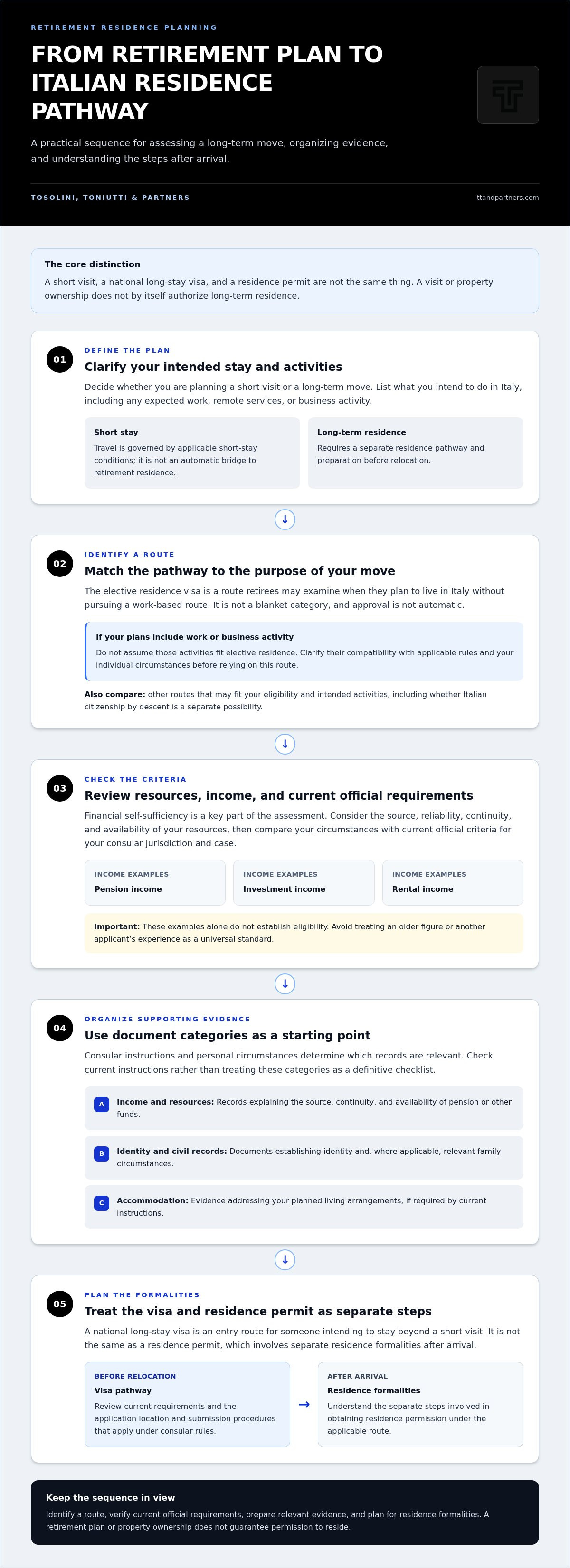
Approach the application as a sequence, not a single document. Identify the route that fits your plans, confirm current requirements, organize the relevant evidence, submit through the applicable consular process, and prepare for residence formalities after arrival. Each stage builds on the previous one. Following that order can help prevent travel and housing decisions from getting ahead of the legal plan.
Process summary: Choose a potential route, verify current official instructions, prepare the evidence they require, apply under the competent consular authority’s procedure, and address the residence permit process after arrival.
Identify the route. Match your intended stay and activities to a potential immigration category.
Check official requirements. Review the current instructions of the competent Italian consular authority.
Prepare evidence. Organize identity, financial, and other supporting records according to the applicable checklist.
Submit the application. The correct location and submission procedure depend on current consular rules.
Plan for arrival. Treat the visa and subsequent residence formalities as distinct steps.
Before submitting the visa application
Use the competent Italian consular authority’s current instructions to determine where and how to apply. Application location, appointment arrangements, document formats, and supporting evidence can depend on the applicable consular process. Do not treat a generic list as a definitive checklist. Review the instructions that apply to your circumstances before assembling your final file.
Organize identity records, financial evidence, and other supporting documents so the information is easy to follow. Requirements can change, and individual circumstances may affect what is requested. Review document-specific instructions, including whether records need particular forms or handling, rather than assuming that a list from another application applies to yours.
After arrival: the residence permit
A national visa and an Italian residence permit are different parts of the residence process. The visa relates to entry under the approved route; the residence permit is a separate formal step connected with staying in Italy. Receiving a visa does not necessarily complete every residence obligation.
Before travel, verify the current permit application deadline, competent office, required documents, and procedure through official guidance. These details should be confirmed for the relevant route and circumstances; outdated deadlines or generalized instructions can mislead. Include time to understand the post-arrival steps in your move plan, alongside housing and other practical arrangements.
Because the visa application and residence formalities connect across borders, legal review can help clarify how the route, supporting records, and next steps fit together. For Italy residence planning, coordinated guidance can help you assess the process without assuming eligibility or a particular outcome.
Plan an Italian retirement move with a clear legal pathway
A well-planned move begins by defining what you intend to do in Italy, then matching that plan to a residence route and its current requirements. Consider how long you expect to stay, whether you plan to work, what route may fit your circumstances, and what residence formalities follow. Addressing these questions before committing to a move can help keep immigration decisions aligned with your plans.
The phrase Italian visa for American retirees can sound like one standard solution, but eligibility and process depend on the route and individual case. A legal review can help clarify how the selected pathway relates to supporting records and post-arrival steps. It can also identify issues that need separate attention, without treating a general checklist as a promise of approval.
A practical pre-move decision checklist
Before making substantial relocation commitments, write down the practical outline of your plan. Use these questions to organize your next steps:
Length of stay: Is your plan a temporary visit or a long-term move? The answer changes which immigration questions need attention.
Planned activities: Will you live on retirement resources, or do you expect to work, consult, or run a business? Describe the intended activities clearly.
Potential route: Identify the pathway that may match your purpose, then compare your circumstances with its current official criteria.
Residence formalities: Include required steps after entry in your plan, and verify current procedures and deadlines through official guidance.
Separate advice: Treat immigration planning as distinct from tax, healthcare, and financial advice. These areas can affect a move, but each requires analysis suited to its own rules and your circumstances.
This sequence helps surface unanswered questions while there is still time to address them. For example, a plan that includes work may call for a different immigration analysis from one based solely on retirement resources. The goal is to make the facts of your intended life in Italy clear enough for an informed review, rather than choosing a route by assumption.
When cross-border legal guidance can help
Tosolini, Toniutti & Partners focuses on legal matters connecting the United States and Italy, including Italian immigration procedures and residence permits. The firm’s cross-border guidance can help you understand how route selection, supporting documentation, and residence formalities fit together, and which parts of your circumstances call for closer review.
A review should be individualized. Requirements can depend on the route, current official instructions, and the details of your case; no general checklist can guarantee eligibility or an outcome. Bringing your intended length of stay, work plans, and available records into the discussion can make the legal questions more precise.
To discuss your circumstances and the residence pathway you’re considering, contact the Italian immigration team.
Shape your Italy plans into a considered next step
A retirement move becomes more manageable when the legal pathway is considered alongside the life you hope to build. Before making commitments, note what remains undecided: how long you intend to stay, what activities you expect to pursue, and which details need current official confirmation. A short planning document can make the next conversation more focused.
The Italian visa for American retirees is not a single answer for every household. Your circumstances, goals, and supporting records matter. An individualized review can help you understand which questions apply to your case and what to clarify before moving forward, without promising a particular eligibility decision or result.
Ready to review your options? Request a discussion about your Italy move with Tosolini, Toniutti & Partners to establish a clearer starting point for your plans.
Frequently Asked Questions
Can an American retire in Italy without a visa?
An American may be able to visit Italy under applicable short-stay rules, but that permission does not authorize indefinite residence. If you plan to make Italy your home rather than visit temporarily, identify an appropriate residence pathway. Check the current rules for your passport and travel dates, and do not assume repeated visits or home ownership establish permission to live there long term.
What is the Italian elective residence visa for retirees?
The elective residence visa is a route commonly considered by retirees who plan to live in Italy without working. Applicants need to assess whether their circumstances and evidence meet current criteria; retirement alone does not determine eligibility. If you are considering an Italian visa for American retirees, start by listing expected income sources and intended activities, then compare them with current official instructions.
Can I work in Italy with an elective residence visa?
No. The elective residence route is intended for residence without work, so do not assume it permits employment, remote work, consulting, or business activity. If you expect to continue working in any form, describe the planned activity before choosing an immigration pathway. This distinction can affect which route to investigate. Check the applicable rules against current official guidance and the details of your situation.
Does buying a home in Italy qualify an American retiree for a visa?
No. Buying a home does not by itself qualify an American for a visa or grant the right to reside in Italy. Property ownership may be relevant to your practical plans or to evidence requested for a particular application, but it is not a substitute for meeting immigration criteria. Before purchasing with a move in mind, consider the property decision separately from the question of which residence pathway may fit.
What is the difference between an Italian visa and an Italian residence permit?
A visa and an Italian residence permit serve different roles in the residence process. A national long-stay visa is associated with entering Italy under a particular route; the residence permit is a separate formal step related to staying in the country. They are not interchangeable documents. Before travel, confirm the current process for your route, including what to do after arrival.
Can an American retiree move to Italy through Italian citizenship by descent instead?
Possibly, if the person qualifies for Italian citizenship through descent under the rules that apply to their family history. This is a citizenship question, not a retiree visa category, and eligibility depends on individual circumstances and supporting records. If citizenship is recognized, the person’s position differs from that of someone relying on a residence visa. Treat the two pathways as separate legal assessments.
How long does it take to get an Italian retiree visa?
There is no reliable universal processing estimate for every applicant. Timing can depend on the current consular procedure, appointment availability, the application and its supporting evidence, and any further review required. Avoid making non-refundable or time-sensitive relocation arrangements based on an assumed decision date. Use the competent consular authority’s current information for planning, and allow flexibility while your application is under consideration.
Do American retirees need to apply for a residence permit after arriving in Italy?
Generally, a person entering on a national long-stay visa must address a separate residence-permit process after arrival. Verify the exact deadline, submission procedure, and competent office using current official instructions for the visa route and circumstances. Do not assume the visa alone completes every formal step. Include the permit application in your move plan, and keep relevant documents accessible as you travel.


Comments