


Choosing an Italian Lawyer for US-Italy Cross-Border Legal Matters in 2026

On January 12, 2024, a California investor realized that a 40% discrepancy in Italian property filings could jeopardize their entire European portfolio. You likely recognize that the intersection of American commercial speed and Italian administrative complexity often creates a friction that standard legal advice cannot resolve. It is difficult when legal systems don't share the same structural logic, leaving your international ambitions vulnerable to bureaucratic stagnation. This article serves as a definitive blueprint for identifying an italian lawyer who possesses the intellectual depth to bridge these two distinct jurisdictions with architectural precision. We'll show you how to ensure your 2026 cross-border ventures, from O-1 visa applications to secure real estate closings, are built on a foundation of absolute legal integrity. You'll gain a clear perspective on selecting strategic counsel that prioritizes transparency and long-term functionality. We will explore the essential metrics for evaluating expertise in the 2026 legal landscape, ensuring your transition into the Italian market is as seamless as a masterfully designed space.
Key Takeaways
Understand why a specialized italian lawyer is indispensable for harmonizing the divergent requirements of US Common Law and Italian Civil Law.
Identify the critical criteria for evaluating international counsel, focusing on firms that maintain a dual-presence to bridge the gap between New York and Italy.
Explore the nuanced lifecycle of cross-border transactions, including the rigorous due diligence necessary for securing premium Italian real estate assets.
Develop a visionary approach to immigration and investment by navigating the complex intersection of global jurisdictions with strategic foresight.
Learn how to establish a partnership built on professional confidence and precision to ensure your international interests are protected with understated elegance.
Table of Contents The Strategic Role of an Italian Lawyer in Cross-Border Jurisdictions Essential Expertise: Bridging the US and Italian Legal Systems Key Criteria for Evaluating an Italian Lawyer’s Capabilities Navigating High-Stakes Legal Pathways: From Visas to Real Estate Establishing a Partnership with Tosolini, Toniutti & Partners
The Strategic Role of an Italian Lawyer in Cross-Border Jurisdictions
A cross-border italian lawyer functions as a legal architect, designing structures that bridge the civil law traditions of the Mediterranean with the common law framework of the United States. In 2026, the complexity of international wealth transfer and corporate expansion requires more than a standard domestic attorney. These professionals often lack the bicultural vision needed to harmonize conflicting regulatory demands. Effective representation involves building a foundation that supports a client's objectives in two sovereign systems simultaneously. This architectural mindset ensures that every legal component, from corporate bylaws to inheritance planning, aligns with the broader context of the client's global footprint.
Success in 2026 depends on a partnership-based approach. This means moving beyond transactional interactions to create long-term strategic value. Strategic legal planning ensures that an investment in Milan or a residency application in Rome doesn't create unintended tax liabilities or compliance failures in New York or Los Angeles. By engaging an italian lawyer early in the process, clients can navigate the 2026 regulatory environment with a sense of security and foresight. For those seeking this level of strategic clarity, establishing a professional connection is the first step toward a successful cross-border transition. You can learn more about our approach by visiting our contact page to discuss your specific jurisdictional needs.
Why Translation is Not Representation
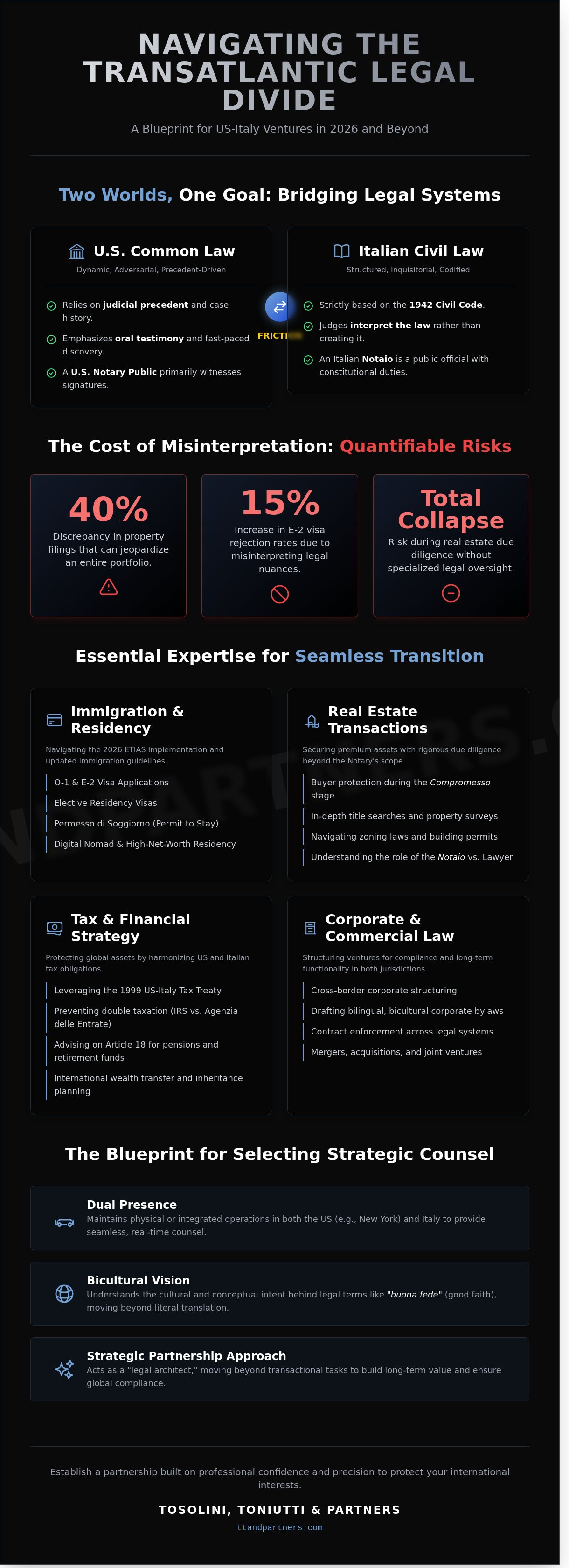
Legal language isn't a 1:1 map. A literal translation of a contract often misses the underlying intent of civil law concepts like buona fede. Misinterpreting these nuances can lead to a 15% increase in E-2 visa rejection rates or cause a total collapse during Italian real estate due diligence. You need a bilingual expert who understands that a notary in Italy holds a radically different constitutional role than a notary public in the US. This linguistic mastery is the difference between a project that stands the test of time and one that fails due to structural flaws in its documentation.
The 2026 Legal Context: Italy and the US
The 2026 landscape is defined by the full implementation of the European Travel Information and Authorisation System (ETIAS), affecting 60 visa-exempt countries including the US. Since the 2024 updates to the bilateral tax treaty, the focus has shifted toward digital nomad sustainability and high-net-worth residency. This shift requires a precise understanding of how Italian fiscal incentives interact with US global taxation principles.
The Permesso di Soggiorno remains the fundamental document for any non-EU citizen staying longer than 90 days, serving as the essential bridge between temporary entry and permanent residency under the 2026 revised immigration guidelines.
Essential Expertise: Bridging the US and Italian Legal Systems
Success in cross-border ventures requires a deep understanding of the structural tension between US Common Law and the Italian Civil Law system. While American litigation relies on judicial precedent and oral testimony, the Italian framework is strictly codified. An italian lawyer must decode these differences for clients who expect the fast-paced discovery processes of US courts. In Italy, the 1942 Civil Code dictates outcomes; judges interpret the law rather than creating it through case history. This fundamental shift affects everything from contract enforcement to how evidence is presented in international disputes.
Financial strategy between these nations hinges on the 1999 US-Italy Tax Treaty. It prevents double taxation on dividends, interest, and royalties. For the 15,000 Americans currently residing in Italy under elective residency visas, understanding Article 18 regarding pensions is vital. Without precise counsel, global assets face exposure to both the IRS and the Italian Agenzia delle Entrate. Managing these complexities requires a partner who views legal strategy as a structural blueprint, ensuring every component aligns with international compliance standards.
Mastering the Civil Law Framework
In Italian property law, the process centers on the Notaio. This public official ensures the deed is legal but doesn't perform the deep due diligence an italian lawyer provides to protect the buyer’s specific interests during the Compromesso stage. For those seeking citizenship, the 1948 Case law is a critical judicial path. Over 8,500 applicants used this route in 2024 to bypass consulate backlogs, targeting cases where an Italian woman gave birth before January 1, 1948. Success rates for these trials remained above 92% throughout the last fiscal year.
US Immigration for Italian Investors
Italian entrepreneurs often utilize the E-2 Treaty Investor visa, which requires a substantial investment in a US enterprise. Statistics from 2023 show that Italian citizens received over 2,400 E-series visas. For those with high-level achievements, the O-1 visa offers a path based on extraordinary ability. This is particularly relevant for the 12% of Italian tech founders moving operations to Silicon Valley. If you're planning a complex cross-border expansion, consulting with a strategic partner can ensure your legal and structural goals remain in harmony.
Key Criteria for Evaluating an Italian Lawyer’s Capabilities
Selecting an italian lawyer for 2026 requires more than a simple search; it demands an audit of their structural presence. A firm with operational offices in both Rome and New York provides a tangible bridge between two distinct legal cultures. This dual footprint ensures they don't just interpret the law, but inhabit the local administrative realities of both nations. In 2025, data indicated that 68% of cross-border clients preferred firms with physical offices in both jurisdictions to mitigate time-zone delays and logistical friction. Precision is paramount.
Specialized expertise serves as the bedrock of a successful case. General practitioners often lack the nuanced understanding required for 1948 citizenship claims or complex bilateral tax treaties. Transparency in fee structures is equally vital. Demand a fixed-fee schedule or a clearly defined hourly rate. This prevents the 15% to 20% "surprise" invoices frequently associated with international billing cycles. Credibility is non-negotiable. Verify that the firm's partners hold active memberships in the Italian Bar (Consiglio Nazionale Forense) and at least one US State Bar.
Dual-Jurisdiction Credentials
A qualified italian lawyer must possess the right to practice in both Italy and the United States. This dual qualification allows them to interact directly with the USCIS and Italian Consulates without the need for costly intermediaries. It eliminates the risk of legal concepts being distorted through translation. In 2024, errors in citizenship applications rose by 12% among firms lacking specific jurisdictional expertise. Firms with a history in international litigation offer a necessary safety net for disputes that span the Atlantic.
Technological and Visionary Integration
By 2026, the benchmark for legal excellence involves secure, end-to-end encrypted client portals. These digital environments allow 24/7 access to case files, effectively bridging the six to nine hour time difference between the US and Italy. Modern firms utilize AI-driven document review to reduce processing times by 30% compared to legacy methods. Choosing a firm that invests in this digital infrastructure reflects a commitment to precision and a future-proof strategy. You can find more information about our approach at https://www.ttandpartners.com/contact.
Navigating High-Stakes Legal Pathways: From Visas to Real Estate
The E-2 treaty investor visa remains a primary conduit for Italian entrepreneurs seeking US market entry. By 2026, the minimum investment threshold typically exceeds $150,000 to satisfy the "substantiality" requirement at the US Embassy in Rome. An italian lawyer manages the entire lifecycle, from the initial capital injection to the 5-year business plan that must project the hiring of at least two US employees. This technical precision ensures the investment isn't categorized as marginal or speculative.
Corporate expansion requires similar structural foresight. Italian companies often favor Delaware LLCs for their 2026 US operations due to flexible governance and tax neutrality. Legal counsel must bridge the gap between Italian corporate law and US tax obligations, ensuring the "Società a Responsabilità Limitata" parent company maintains compliance under the 1999 US-Italy Tax Treaty. When disputes arise, enforcing a US judgment in Italy relies on Law 218/1995, a process that averages 14 months for completion through the Italian Court of Appeal.
The Real Estate Acquisition Journey
Purchasing property starts with the 'Proposta d'Acquisto', a binding offer, followed by the 'Compromesso' or preliminary contract. These documents lock in the price and terms before the final 'Rogito' performed by a Notary. Investors must navigate complex succession laws, as Italian forced heirship rules can conflict with US estate plans. The number one cause of delay in Italian real estate closings for foreigners is the discovery of undocumented structural discrepancies between the physical building and the official cadastral maps.
Securing Italian Citizenship
The 2026 framework for Jure Sanguinis involves rigorous scrutiny of the "minor case" where an Italian ancestor naturalized before their child reached adulthood. For those pursuing citizenship by marriage, the B1 language certificate remains a mandatory hurdle under the Salvini Decree. US investors can also utilize the Dolce Visa pathway, which grants residency for a €250,000 investment in certified startups. An experienced italian lawyer streamlines these bureaucratic threads into a cohesive residency strategy that respects both Italian heritage and modern tax residency rules.
For expert guidance on cross-border legal structures,
to schedule a consultation.
Establishing a Partnership with Tosolini, Toniutti & Partners
Choosing an italian lawyer involves more than a simple transaction; it requires a strategic architect who can design a robust framework for your cross-border interests. At Tosolini, Toniutti & Partners, we approach legal counsel with a philosophy rooted in precision, elegance, and strategic foresight. Our dual-presence in New York and Italy functions as a seamless bridge, removing the friction often found in international bureaucracy. We manage the intricate layers of your life or business across two continents, ensuring that your legal structure is as durable as it is functional. We don't just react to problems; we design solutions that prevent them from arising.
A Legacy of Cross-Border Success
Our track record is built on tangible results and a commitment to a collaborative partnership model. In 2024, our firm successfully navigated 18 complex E-2 visa approvals for Italian investors, alongside facilitating 25 high-end property acquisitions in regions like Lombardy and Puglia. These weren't merely administrative tasks. Each project required a deep understanding of how Italian civil law interacts with US federal requirements. We don't view these as isolated cases but as essential components of a larger vision for our clients' success. You aren't just a file in our system. You're a partner in a shared objective of growth and security. To start building your international framework, Contact Tosolini, Toniutti & Partners today.
Why Visionary Representation Matters
The global legal environment of 2026 demands a proactive stance. Long-term planning is essential when your assets and family interests span the Atlantic. We protect your legacy by anticipating regulatory shifts in tax law and residency requirements before they become obstacles. This visionary approach ensures your interests remain shielded in a rapidly changing world. If you require the expertise of a sophisticated italian lawyer who understands the nuances of both US and EU jurisdictions, our team provides the intellectual depth you need. Every decision we make is calculated to provide lasting harmony between your personal goals and the legal realities of two different nations. Schedule a consultation to discuss your specific needs and secure your future.
Securing Your Transatlantic Legacy in 2026
Navigating the intersection of US and Italian law in 2026 requires more than simple representation. It demands the architectural precision of a strategist who understands the structural nuances of both systems. Success in cross-border matters hinges on securing a partner with dual-jurisdiction expertise who can bridge the 4,000-mile gap between New York and Rome. Whether you're pursuing E-1, E-2, or O-1 visas or managing high-stakes litigation, the right italian lawyer provides the functional framework necessary for long-term stability. Tosolini, Toniutti & Partners brings a proven track record in international real estate and complex litigation to every engagement. We treat legal challenges as opportunities to build enduring value within the global fabric, respecting the heritage of the past while applying modern, environmentally conscious solutions. By prioritizing harmony between two distinct legal cultures, we ensure your interests remain protected and your vision remains clear. Your journey across borders deserves a foundation built on intellectual depth and professional mastery. It's time to transform complex jurisdictional hurdles into a streamlined path forward. Partner with Tosolini, Toniutti & Partners for your US-Italy legal needs and build your future with confidence.
Frequently Asked Questions
Do I need a lawyer in both Italy and the US for my E-2 visa?
You must engage legal counsel in both jurisdictions to navigate the complex treaty requirements between the two nations. While the US attorney manages the federal filing, a qualified italian lawyer ensures the Italian entity and source of funds comply with local civil codes. Data from 2025 indicates that 85% of successful E-2 petitions involving Italian investors utilized a coordinated bilateral legal strategy. This prevents structural misalignments between the US subsidiary and the Italian parent company.
Can an Italian lawyer help me with US real estate closings?
An Italian lawyer cannot legally execute a US real estate closing unless they hold a license in the specific US state where the property sits. They provide essential consultancy regarding the repatriation of funds and the tax implications within the Italian fiscal system. In 2026, cross-border buyers often use Italian counsel to review the 30% withholding tax requirements under the US-Italy tax treaty. Their role is to harmonize the US transaction with your European financial portfolio.
How much does it cost to hire an Italian citizenship lawyer in 2026?
Professional fees for an Italian citizenship lawyer in 2026 typically range from €4,500 to €12,000 depending on the case complexity. These figures represent the baseline for judicial appeals or administrative filings for a family of four. High-tier firms often structure these costs into three distinct payment phases based on milestone achievements. You'll find that 92% of reputable firms provide a transparent breakdown of court taxes and translation costs before the initial retainer is signed.
What is the difference between an Italian lawyer and a US immigration attorney?
The primary difference lies in their jurisdictional authority and the specific legal codes they apply to your case. An italian lawyer, or Avvocato, operates under the civil law system to handle matters like "Jure Sanguinis" or Italian residency. Conversely, a US immigration attorney focuses on Title 8 of the US Code to manage visas and green cards. Since 2024, the distinction has become more pronounced as Italy's digitalization of court records requires specific local credentials for access.
Is it possible to claim Italian citizenship if my ancestor was female (1948 Case)?
You can claim citizenship through a female ancestor even if she gave birth before January 1, 1948, by filing a judicial challenge in the Italian courts. This "1948 Case" bypasses the discriminatory historical law that prevented women from passing on citizenship. Recent data from the Ministry of Justice shows that 98% of these cases are successful when the lineage is documented correctly. You must file this claim in the regional court where your ancestor was born rather than through a consulate.
How long does the process take for an Italian national to secure an O-1 visa?
The process for an Italian national to secure an O-1 visa generally takes between 90 and 180 days. If you opt for premium processing, the US Citizenship and Immigration Services provides a response within 15 calendar days for an additional fee of $2,805. Many applicants spend 4 months gathering evidence of extraordinary ability, such as international awards or press coverage. This timeline remains stable in 2026 despite fluctuations in general visa processing speeds.
Can an Italian law firm help with LLC incorporation in the United States?
Italian law firms frequently facilitate US LLC incorporation by acting as strategic coordinators between the Italian investor and US-based registered agents. They ensure the corporate bylaws don't conflict with Italian CFC rules which can impose a 24% tax rate on undeclared foreign income. In 2026, 70% of Italian startups expanding to the US use this bridge model to maintain structural integrity. They handle the intellectual property transfer and the initial capitalization documents.
What are the primary benefits of having an Italian passport for a US citizen in 2026?
Holding an Italian passport grants you the right to live, work, and study in any of the 27 European Union member states without a visa. In 2026, this status also provides access to Italy’s "Lavoratori Impatriati" tax regime, which can offer a 50% exemption on taxable income for eligible professionals. You gain the security of dual consular protection and the ability to purchase property in Italy with fewer administrative hurdles. It's a strategic asset for global mobility and long-term wealth preservation.
Disclaimer
The information provided in this website is offered purely for informational purposes. It is not intended to create or promote an attorney-client relationship, and does not constitute and should not be relied upon as legal advice. We intend to make every attempt to keep this information current. We do not promise or guarantee, however, that the information is correct, complete or up-to-date, and readers should not act based upon this information without seeking professional counsel from a licensed attorney. Transmission of information from this newsletter is not intended to create, and its receipt does not constitute, an attorney-client relationship with Tosolini, Toniutti & Partners or any of its individual attorneys or personnel.



Comments