

Common Mistakes in Italian Citizenship Applications: A 2026 Strategic Guide
- Gianni Mendes Toniutti, Esq.

- Jul 30
- 12 min read
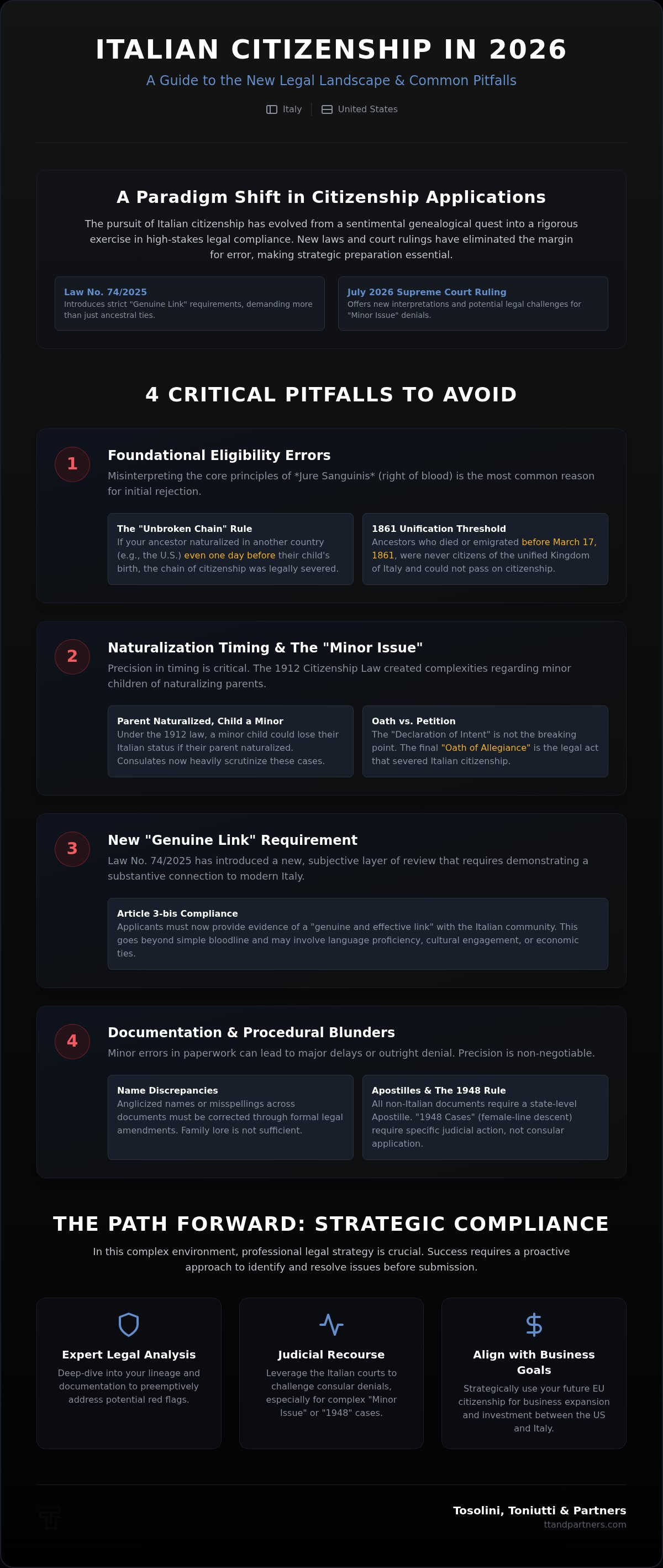
Italian citizenship in 2026 has transitioned from a sentimental genealogical pursuit into a rigorous exercise in high-stakes legal compliance. Following the implementation of Law No. 74/2025, the margin for error has vanished, leaving many applicants to face the devastating reality of a denial after years of anticipation. Identifying the common mistakes Italian citizenship application filers make is no longer optional; it's a prerequisite for success in a landscape defined by generational cutoffs and the recent July 2026 Supreme Court ruling on the "Minor Issue."
We recognize the exhaustion that comes with navigating inconsistent consular requirements and the complexity of sourcing century-old naturalization records. You deserve a strategic path that respects both your heritage and your future business ambitions within the European Union. This guide provides the clarity needed to avoid the documentation pitfalls that lead to rejections under Italy's new legislative framework. We'll examine the nuances of 1948 judicial cases, offer solutions for record discrepancies, and align your dual citizenship goals with your broader international interests.
Table of Contents
Eligibility Pitfalls: Misinterpreting Jure Sanguinis Foundations
The pursuit of an Italian passport is an exercise in historical reconstruction. Many applicants begin their journey with the romantic notion that an Italian-born great-grandfather is a sufficient legal anchor. This is a misconception. One of the most common mistakes Italian citizenship application filers encounter is failing to account for the exact legal status of their ancestor on the date of the next generation's birth. If your ancestor naturalized in the United States even one day before their child was born, the chain of transmission was severed under the laws of that era.
Success requires a deep understanding of Italian nationality law, which prioritizes jure sanguinis (right of blood) over the jure soli (right of soil) principle common in the Americas. The foundational threshold is March 17, 1861. This date marks the official birth of the Kingdom of Italy. If an ancestor died or emigrated before this unification, they were never technically a citizen of the Italian state, but rather a subject of a predecessor entity like the Kingdom of the Two Sicilies or the Grand Duchy of Tuscany. Such individuals cannot transmit a citizenship they never possessed.
The "Unbroken Chain" isn't a suggestion; it's a strict legal requirement. Until the landmark reforms of 1992, Italy didn't generally permit dual citizenship. Voluntary naturalization in another country was viewed as a formal renunciation of Italian identity. For 2026 applicants, this means every link in the family tree must be verified against naturalization records to ensure no "breaks" occurred before the birth of the subsequent descendant.
The Kingdom of Italy and Annexed Territories
Specialized scrutiny is applied to ancestors from "redemption territories" like Trento, Trieste, and Bolzano. These regions remained under Austro-Hungarian rule until after World War I. The 1920 Treaty of Rapallo established the legal framework for residents of these areas to claim Italian status. If your ancestor emigrated from these provinces before the official annexation, proving their "Italianity" requires specific judicial evidence that they were recognized as ethnic Italians during the transition of power.
Automatic vs. Voluntary Naturalization
Legal nuances often hide within the timing of US naturalization. The 1922 Cable Act is a prime example, as it changed how the US viewed the citizenship of married women. It's also vital to distinguish between a "Declaration of Intent" and a final "Petition for Naturalization." A declaration didn't strip an ancestor of their Italian status; only the final oath of allegiance served as the legal break. Understanding these distinctions prevents the common mistakes Italian citizenship application processes often fall victim to during the initial document review.
The 'Minor Issue' and Naturalization Timing Mistakes
Precision in timing is the silent arbiter of citizenship eligibility. While many focus on identifying an Italian ancestor, the legal weight rests on the specific moment that ancestor acquired foreign status. This leads to one of the most frequent common mistakes Italian citizenship application candidates make: miscalculating the "Minor Issue" under the 1912 Citizenship Law. Under Article 12 of this historical statute, the naturalization of a parent could potentially strip a minor child of their Italian status. In 2026, US consulates have intensified their scrutiny of these cases, often issuing blanket denials for lineages where the Italian-born ancestor naturalized while their child was still a minor.
The distinction between a "Petition for Naturalization" and the "Oath of Allegiance" is critical. The petition is merely an intent; the oath is the legal act of renunciation. Records from USCIS and the National Archives (NARA) must be cross-referenced to prove the child was born before the parent took the oath. Even a discrepancy of a few days determines the validity of a bloodline. Relying on family lore rather than certified federal records is a risk that high-net-worth applicants cannot afford.
Challenging Consular Denials in Italian Courts
Administrative rejections at the consulate level aren't final. The July 2026 landmark ruling from the United Sections of Italy's Supreme Court has shifted the landscape, offering new interpretations for cases where minor children were involved. When administrative channels fail, international litigation provides a sophisticated alternative. Filing these cases directly in Italian courts allows for a judicial review that is often more nuanced than the rigid interpretations found in official guidance on Italian citizenship.
The 'Certificate of Non-Existence' (CONE) Error
Proving an ancestor never naturalized is as difficult as proving they did. A common error is submitting a standard "no record found" letter without supporting context. To be accepted in 2026, a CONE must be reinforced with census data and Italian "Atti di Nascita" to ensure name consistency. If "Giovanni" appears as "John" on US records, the consulate may reject the CONE as irrelevant to the individual in question. Resolving these discrepancies before your appointment is essential to avoid years of additional delay. If you've encountered these hurdles, contacting a legal strategist can help align your documentation with current judicial standards.
Post-2025 Regulatory Errors: Article 3-bis and the 'Genuine Link'
The legislative landscape for Italian ancestry underwent a profound transformation on March 27, 2025. Law No. 74/2025, which converted the "Tajani Decree," introduced Article 3-bis to the existing citizenship framework. This isn't a mere procedural update. It represents a fundamental shift in how the Italian state perceives its diaspora. One of the common mistakes Italian citizenship application candidates make in 2026 is underestimating the "Genuine Link" requirement. It's no longer enough to present a clean paper trail of birth and marriage certificates. The state now seeks evidence of a contemporary connection to Italian culture or territory.
Applicants who filed their dossiers after the March 2025 deadline are subject to these stricter evidentiary standards. Even if you secured a consulate appointment years ago, the date of submission is what triggers the new law. The Italian Government Citizenship Requirements now include declarations of residency and language proficiency that were previously reserved for naturalization through marriage or residency. This "generational cutoff" aims to link citizenship to a more active participation in the Italian national identity, making the process more selective than it was in previous decades.
Evidentiary Standards for the 'Genuine Link'
Proving a "genuine tie" requires a holistic approach to your family's history. Consulates are increasingly looking for proof of Italian language study, property ownership, or frequent travel to the ancestral comune. This isn't just about the past; it's about your future intent. Once recognized, maintaining this link through the AIRE (Registry of Italians Residing Abroad) is vital. Failure to update your records can lead to administrative complications that jeopardize the durability of your status. We structure applications to present a narrative of continuity that satisfies these 2026 scrutiny levels, ensuring your connection to Italy is documented with professional precision.
Administrative Scrutiny vs. Judicial Certainty
The subjective nature of "Genuine Link" assessments at consulates has made the judicial path more appealing for many families. While administrative officers now have significant discretion under the 2025 reforms, the Italian courts still operate on established legal precedents. This is particularly relevant for 1948 cases, which remain largely unaffected by the recent legislative shifts. For high-achieving individuals, such as O-1 visa holders, integrating citizenship goals with professional mobility requires a strategic alignment of both US and Italian statutes. Preparing for a citizenship interview in 2026 means being ready to articulate your contribution to the Italian community, moving beyond the simple "right of blood" to a more comprehensive vision of dual identity.
Documentation Blunders: Discrepancies, Apostilles, and the 1948 Rule
The integrity of your application depends on the absolute consistency of your documentary evidence. A single clerical error from 1920 can resonate through a century, creating a legal wall that administrative officials are often unauthorized to bypass. One of the common mistakes Italian citizenship application candidates frequently commit is submitting "Short-Form" or abstract birth certificates. In 2026, Italian authorities strictly require "Long-Form" (vault) copies that include parental ages, birthplaces, and the names of the attending physicians. These details are essential for cross-referencing the "Italianity" of the lineage.
Certification is another area where precision is mandatory. Every US vital record must be accompanied by a state-level Apostille. A common error is assuming a local notary's seal suffices; however, the Hague Convention requires the Secretary of State's certification to validate the document for international use. Name discrepancies, such as "Giovanni" transitioning to "John" or "Giuseppina" to "Josephine," represent a more complex hurdle. While some consulates were previously lenient, the 2026 standard requires these variations to be reconciled through legal amendments or "One and the Same" court orders to ensure the person named on the US death certificate is undeniably the person born in Italy.
Resolving 'One and the Same' Discrepancies
When records contain irreparable errors, a "Positive/Negative" letter from the vital records office serves as a critical tool. This document confirms that no other record exists for that individual, effectively narrowing the legal identity. In some cases, historical LLC incorporation records or professional licenses can provide secondary evidence of identity when primary vital records are missing. Correcting these ancestral records in US courts before your appointment is a strategic necessity that prevents a 365-day "homework" suspension from the consulate.
The 1948 Judicial Path Success Strategy
The 1948 Rule remains a distinct legal category. It applies to descendants of Italian women who gave birth before January 1, 1948, a period when Italian law unfairly restricted women from passing citizenship to their children. These cases cannot be processed at a consulate. They must be litigated in the regional court in Italy where the ancestor was born. Despite the complexity, 1948 cases currently enjoy a high success rate because they are decided by judges based on constitutional equality rather than by administrative officers following rigid consular manuals. If your lineage involves a pre-1948 female ancestor, schedule a strategic consultation to initiate the judicial process in Italy and secure your family's future.
Strategic Compliance: Securing Your EU Future with TT&P
The journey toward an Italian passport is often viewed through the lens of genealogy, yet in 2026, it's more accurately described as a complex cross-border legal project. Many applicants fall into the trap of hiring "citizenship assistance" services that operate without legal licenses. These agencies may help organize folders, but they lack the authority to represent you in the Italian court system. This is a critical distinction. When administrative hurdles like the "Minor Issue" or 1948 Rule arise, only a registered law firm can initiate the necessary international litigation to secure your rights. Understanding the common mistakes Italian citizenship application candidates make by choosing administrative assistance over legal counsel is the first step toward a successful outcome.
For entrepreneurs and high-net-worth individuals, citizenship is a gateway to broader strategic goals. We often work with clients who are moving beyond the initial inquiry of how much is a green card to pursue full EU mobility. This transition allows for a more sophisticated approach to US-Italy business architecture. By integrating citizenship with E-2 Visa strategies, Italian entrepreneurs can establish a robust presence in the US while maintaining the benefits of their European heritage. This holistic view ensures that your dual status works in harmony with tax treaty compliance and real estate investments.
The Attorney-Client Privilege Advantage
Working with a specialized law firm provides a layer of security that generic services cannot offer: attorney-client privilege. Your sensitive financial disclosures and naturalization records remain protected under professional confidentiality. This is particularly vital when handling multi-generational claims that require deep dives into family history. Our firm provides professional liability and the structural certainty of a registered US-Italy practice, ensuring that every document is handled with the precision required by 2026 judicial standards.
Next Steps for Your 2026 Application
The path to recognition begins with a rigorous eligibility assessment. We identify the strongest ancestral line and address potential breaks in the chain before they reach a consulate officer's desk. Our team handles the procurement of "no-record" certifications and state-level Apostilles through established legal channels, eliminating the technical errors that derail so many applications. To ensure your documentation aligns with the latest 2025 reforms and judicial trends, we invite you to contact Tosolini, Toniutti & Partners for a tailored strategic consultation. Secure your EU future with the precision and foresight your legacy deserves.
Architecting Your Italian Legacy
Success in the 2026 citizenship landscape demands a shift from passive document collection to active legal strategy. Navigating the restrictive Article 3-bis reforms and the nuanced interpretations of the 1912 Law requires a level of precision that standard assistance services simply cannot provide. By identifying the common mistakes Italian citizenship application processes often encounter, you can bypass administrative bottlenecks and ensure your lineage is recognized with judicial certainty. Whether resolving a complex 1948 case or aligning your passport with EU real estate investments, the focus must remain on the integrity of the legal path.
Tosolini, Toniutti & Partners offers decades of US-Italy cross-border legal experience. Our specialized expertise in international litigation and 1948 cases provides high-net-worth dual citizens with the comprehensive support needed for a seamless transition. We don't just process papers; we architect your future within the European Union. Secure your Italian birthright. Contact Tosolini, Toniutti & Partners for a professional consultation. Your ancestral connection is a powerful asset. We're here to ensure it remains protected and productive for generations to come.
Frequently Asked Questions
What are the most common reasons for Italian citizenship denial in 2026?
Denials in 2026 often stem from a failure to prove a "Genuine Link" under Article 3-bis or identifying a break in the ancestral chain due to voluntary naturalization. Many applicants overlook name discrepancies between Italian and US records, which consulates now scrutinize with increased rigor. These common mistakes Italian citizenship application filers make can be avoided through a thorough pre-audit of all vital records and naturalization timing.
How does the 'Minor Issue' affect my Italian citizenship application?
The "Minor Issue" refers to the 1912 Citizenship Law, where a parent's naturalization could strip their minor child of Italian status. Consulates increasingly use this to deny applications if the ancestor took a foreign oath before the child reached adulthood. While consulates often reject these lineages, recent 2026 judicial trends in Italian courts offer a path to overcome these administrative denials through specialized litigation.
Do I need to speak Italian to apply for citizenship by descent (Jure Sanguinis)?
Citizenship by descent doesn't strictly require a language certificate like the B1 proficiency exam. However, under Law No. 74/2025, demonstrating a "Genuine Link" to Italy may involve showing cultural or linguistic connection during the review process. While you aren't required to be fluent, possessing basic Italian skills can significantly strengthen an application subjected to the newer, more restrictive 2026 evidentiary standards.
What is Article 3-bis of the 2025 law and how does it impact me?
Article 3-bis of Law No. 74/2025 introduced a "generational cutoff" and the "Genuine Link" requirement for applications submitted after March 27, 2025. This means applicants must now provide more than just vital records; they must prove an active connection to Italian culture or territory. It represents a shift from purely administrative recognition to a more selective process that favors those with contemporary ties to the Italian state.
How long does the Italian citizenship application process take in 2026?
Processing times vary significantly based on the chosen path and jurisdiction. Consular appointments in major US districts often have wait times extending to 2028 or beyond, with an additional 24 months for processing. Conversely, judicial paths through Italian courts generally conclude within 18 to 24 months. These timelines are estimates and depend on the specific Italian municipality or regional court handling the dossier.
Can I apply for Italian citizenship if my ancestor naturalized before 1912?
You can apply if your ancestor naturalized before 1912, provided they didn't lose their Italian status before the next generation was born. However, the 1912 Law codified many of the rules we follow today. If an ancestor naturalized before 1912, they generally lost Italian citizenship immediately. They could only pass it to children born before that naturalization date, making the timing of the birth and oath critical.
What is a 1948 case and why does it require an Italian lawyer?
A 1948 case involves claiming citizenship through a female ancestor whose child was born before January 1, 1948. Because this path challenges the gender discrimination of previous laws, it must be litigated in an Italian court rather than through a consulate. An Italian lawyer is mandatory because this is a formal judicial proceeding that requires representation before a judge in the regional court of the ancestor's birth.
Is it better to apply for Italian citizenship at a US consulate or in Italy?
Applying in Italy is typically faster, often taking months instead of years, but it requires established legal residency in an Italian municipality. Consular applications allow you to remain in the US but involve significant wait times. For many, the judicial path is the superior middle ground. It bypasses consular delays without requiring a physical move to Italy, provided you have a valid legal basis like a 1948 case.


Comments