

Conditional vs. Permanent Green Card for Italians: Key Differences in 2026

Could a two-year Green Card already make you a lawful permanent resident? Yes. The difference in the conditional vs permanent green card for Italians generally concerns the eligibility pathway and the requirement to remove conditions, not Italian nationality. Conditional residence is lawful permanent resident status, not a temporary visa, even though the card is valid for a limited period.
If you are concerned about the card’s expiration date, first identify which process applies to your case. Marriage-based cases generally involve Form I-751, while qualifying investor cases generally involve Form I-829. Their filing windows differ, so one deadline cannot be substituted for the other.
This guide explains what conditional and permanent residence mean, how marriage and investor pathways differ, and which deadlines to verify in 2026. It also distinguishes immigration status from the physical card and explains when case-specific guidance may help. USCIS requirements can change, so check the current instructions for your circumstances. Tosolini, Toniutti & Partners handles Green Card matters involving US-Italy cross-border immigration and can assess individual cases.
Table of Contents
Conditional vs. permanent Green Card for Italians: what the terms mean
Why some Italians receive conditional residence: marriage and EB-5 pathways
Conditional vs. permanent Green Card: compare rights, validity, and obligations
How Italians remove Green Card conditions and avoid filing confusion
Choose the right next step for your conditional or permanent Green Card case
Conditional vs. permanent Green Card for Italians: what the terms mean
Conditional residence is lawful permanent resident status. “Conditional” describes requirements attached to certain categories, not a temporary visa or a separate immigration status for Italian citizens. A conditional resident lives in the United States as a permanent resident while meeting the applicable requirement to file a petition to remove the conditions.
The distinction matters because a Green Card is evidence of status, not the status itself. The card’s expiration date tells you when that document expires, but it does not, by itself, explain your full immigration position or the steps you need to take. Review the card alongside approval notices and other case records. For general background on Lawful Permanent Resident status, see the overview of Green Cards, then verify legal requirements against current USCIS guidance.
What does conditional permanent residence mean?
Conditions apply to certain qualifying categories, not every Green Card holder. Marriage-based and EB-5 investor cases are two examples. In each, conditional residence requires a later filing to request removal of the conditions. The correct petition and timing depend on the basis of the case, so the processes are not interchangeable.
Conditional permanent residence is lawful permanent resident status subject to category-specific conditions that must be addressed through a further immigration filing.
The card’s limited validity and the required follow-up are related, but they are not the same thing. If your card is nearing expiration, check the filing instructions and your case timeline. Do not assume that you were only a visa holder.
Does being Italian change the Green Card rules?
No separate conditional Green Card category applies because someone is Italian. The relevant pathway and individual circumstances determine whether conditions apply. For example, residence may be based on a qualifying marriage or an EB-5 investment. Italian citizenship alone does not determine which process governs.
Keep nationality questions separate from the basis for US residence. Italian citizenship may matter in other cross-border matters, but it does not replace the need to identify the immigration category in your records. For the conditional vs permanent green card for Italians, confirm how residence was granted and whether the case is subject to conditions. Then check current USCIS form instructions and the dates in your personal notices before deciding what to file.
Why some Italians receive conditional residence: marriage and EB-5 pathways
Conditional residence can arise through more than one immigration pathway, but the rules differ. In marriage-based cases, the age of the qualifying marriage when permanent residence is granted may determine whether residence is conditional. In qualifying EB-5 cases, conditional residence is tied to the investor pathway and its requirements. Neither outcome follows from Italian citizenship, and not every applicant in either category receives conditional status.
When comparing the conditional vs permanent green card for Italians, focus on the route to residence and the facts of the case, not nationality. U.S. Citizenship and Immigration Services (USCIS) explains how to remove the conditions on your permanent resident status and provides separate processes for marriage-based and investor cases.
Conditional residence through marriage
For a marriage-based case, the key timing question is whether the marriage was less than two years old when the person became a permanent resident. If so, conditional residence may apply. The marriage must still qualify under the relevant immigration rules. Marriage to a U.S. citizen or permanent resident alone does not guarantee eligibility or approval.
Keep the two stages separate. Evidence for the original family-based case addresses the qualifying relationship and eligibility for residence. The later Form I-751 process addresses removal of the conditions, using the filing basis and evidence required for that stage. If circumstances have changed, such as the marriage ending, available filing options may depend on the facts. Check current USCIS instructions before proceeding.
Conditional residence through EB-5 investment
Qualifying EB-5 investors may receive conditional permanent resident status, as may eligible family members who derive status through the investor. This is separate from marriage-based residence: the conditions relate to the EB-5 case, not proof of a spousal relationship. The investor’s later petition to remove conditions is Form I-829. Do not substitute the marriage-based Form I-751 process.
For either pathway, confirm the category and relevant dates in your records, then consult current USCIS form instructions. The filing basis, evidence, and timing are case-specific; an Italian passport does not resolve those questions. Tosolini, Toniutti & Partners handles Green Card matters and offers case-specific guidance on US-Italy immigration.
Conditional vs. permanent Green Card: compare rights, validity, and obligations
A conditional Green Card holder is a lawful permanent resident, not a temporary visa holder. The distinction is that conditions remain attached to residence until the required process is completed. The card is evidence of immigration status, but its expiration date and the status itself are separate matters. For a general legal overview, see Cornell Law School’s definition of a Lawful Permanent Resident.
Does a conditional Green Card provide permanent-resident status?
Yes. Conditional residents hold lawful permanent resident status subject to conditions. The required filing asks USCIS to remove those conditions; it is not an application to convert a temporary visa into permanent residence. Details such as travel or employment can depend on a person’s documents and circumstances, so verify current guidance before relying on a general description of rights.
Is a permanent Green Card truly permanent?
“Permanent” describes the immigration status, not an endlessly valid card. A card may have an expiration date even when the holder’s status is not conditional. If your card is expiring, confirm the appropriate document-related step through current USCIS instructions. Renewing a card is not the same as filing to remove conditions: one concerns documentation, while the other addresses a conditional-residence requirement.
For the conditional vs permanent green card for Italians, the practical comparison is not simply “temporary versus permanent.” It is conditional permanent residence with a required follow-up process versus permanent residence without those conditions. Italian nationality does not determine which applies. Identify your pathway, review your card and personal notices, and confirm the filing requirements before taking action. If your records do not make the category or next step clear, Tosolini, Toniutti & Partners handles Green Card matters and can provide case-specific guidance.
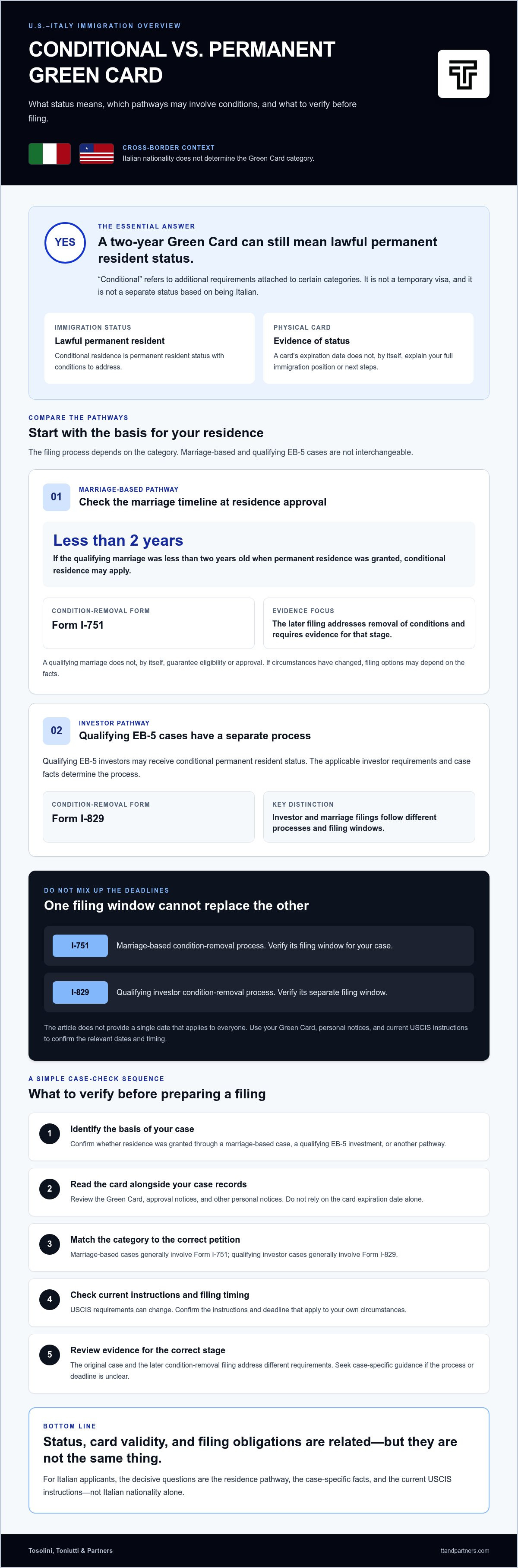
How Italians remove Green Card conditions and avoid filing confusion
Start with the basis for conditional residence, then follow the process for that category. A marriage-based case generally uses Form I-751; a qualifying EB-5 case uses Form I-829. The filing windows differ, so do not rely on a general “two-year card” reminder or use one category’s deadline for the other.
Identify the basis: Review approval records and your Green Card to confirm whether the case is marriage-based or EB-5-based.
Confirm the deadline: Calculate it using the relevant card or status dates, then check current USCIS instructions.
Prepare case-specific evidence: Follow the requirements for the correct petition. Evidence for one pathway does not replace evidence for the other.
File and track: Keep a copy of the submitted petition and monitor USCIS notices for updates or requests.
Marriage-based conditions and Form I-751
Form I-751 asks USCIS to remove conditions on residence in qualifying marriage-based cases. It is generally filed jointly by the conditional resident and their spouse, unless a qualifying basis to request a waiver of the joint-filing requirement applies. A waiver is not automatic; eligibility depends on the circumstances and current instructions.
The usual filing window is the 90 days immediately before the conditional Green Card expires. Confirm the expiration date on your card and calculate the window carefully. If the marriage has ended or circumstances have changed, get advice on the appropriate filing basis rather than assuming the standard joint process applies.
EB-5 conditions and Form I-829
Form I-829 is the petition for a qualifying EB-5 investor to remove conditions on permanent resident status. It has a separate timing rule: the petition is generally filed during the 90 days immediately before the second anniversary of obtaining conditional permanent resident status. Use the relevant status date in your records and verify the filing period and evidence requirements against current USCIS instructions.
Keep the procedures separate. Form I-829 is not a marriage petition, and the relationship evidence or filing logic for Form I-751 should not be carried over to an EB-5 case. The conditional vs permanent green card for Italians question becomes easier to address once the category, dates, and required petition are clear. For an individual assessment of a Green Card matter, contact the firm about your case.
Choose the right next step for your conditional or permanent Green Card case
Begin by identifying the basis for your Green Card. If residence came through a qualifying marriage, check whether your status is conditional and whether Form I-751 may apply. If it came through the EB-5 investor pathway, review whether Form I-829 is relevant. If your Green Card came through another route, do not assume either process applies. Your immigration records, not Italian citizenship alone, determine which requirements to review.
Questions to resolve before filing
Before preparing a petition, gather your Green Card, approval notices, prior filings, and relevant case documents. Use them to confirm how residence was granted and when conditional residence began. Then compare the dates in your records with current USCIS instructions for the applicable form. A date remembered from a prior conversation may not be enough to establish the correct filing window.
Which category and petition were the basis of your residence?
What date do your records show for the start of conditional residence?
Have there been changes to the relationship or investment circumstances that are relevant to your case?
Which filing window, evidence requirements, and eligibility questions should you confirm with USCIS guidance or legal counsel?
Keep the marriage-based and EB-5 processes separate as you work through these questions. If your concern includes broader costs, the 2026 Green Card cost and strategy guide provides additional context.
When to seek case-specific guidance
Consider a legal review if you are unsure which filing basis applies, how to calculate a deadline, what evidence is relevant, or whether changed circumstances may affect your options. This is particularly important if you believe a waiver may be relevant. Eligibility depends on the facts and applicable requirements, so a general article cannot determine whether you qualify.
The conditional vs permanent green card for Italians distinction is a starting point, not an individual eligibility decision. Check current USCIS instructions and the exact dates in your personal notices before acting. Tosolini, Toniutti & Partners handles Green Card matters involving US-Italy cross-border immigration. For an individual assessment, contact the immigration team.
Make your next Green Card step with clarity
The central distinction is straightforward: conditional residence is lawful permanent resident status with an additional requirement, while the route and case facts determine whether conditions apply. Italian citizenship does not create a separate conditional Green Card category. Marriage-based and EB-5 cases also have different petitions and filing timelines, so identifying your category and checking your personal notices are essential first steps.
Understanding the conditional vs permanent green card for Italians can help you frame the right questions, but individual eligibility and deadlines depend on your case. Verify current USCIS instructions before filing, and seek case-specific guidance if your circumstances have changed or the correct process is uncertain.
Tosolini, Toniutti & Partners provides Green Card assistance in US-Italy cross-border immigration matters. Explore US-Italy immigration guidance to consider an individual assessment. With your records reviewed and the applicable process identified, you can plan your next step with greater clarity.
Frequently Asked Questions
Is a conditional Green Card the same as a permanent Green Card?
A conditional Green Card represents lawful permanent resident status, but includes conditions that must be addressed through a later filing. It is not a temporary visa. The main distinction in the conditional vs permanent green card for Italians is whether conditions apply and which process is required to remove them. Check your category and dates in your immigration records rather than relying on the card label alone.
Can Italian citizens receive a conditional Green Card?
Yes. Italian citizens may receive conditional residence if their qualifying immigration category and case facts meet the applicable criteria. Conditional status may arise in certain marriage-based and EB-5 cases, but not every applicant in either pathway receives it. Italian nationality does not create a separate conditional Green Card category. Review the basis of your residence and the notices issued by USCIS to identify the rules that apply.
How long does conditional permanent residence last?
The conditional Green Card is valid for two years. That period describes the card’s validity, not every aspect of a person’s immigration status. Conditional residents must follow the applicable process to request removal of conditions, with timing depending on the category. Marriage-based and EB-5 cases use different petitions and filing windows. Check current USCIS instructions and your status dates to confirm what applies.
What happens if I miss the deadline to remove Green Card conditions?
Missing the applicable filing deadline can have serious consequences. USCIS guidance and the circumstances of the case matter, so do not assume a late filing will be accepted or that the issue will resolve automatically. If the deadline has passed or may be close, promptly review your notices and seek case-specific legal advice. The appropriate response may depend on the filing basis, the reason for the delay, and other facts in your record.
Can a conditional Green Card holder work or travel?
Conditional residents are lawful permanent residents and generally may live and work in the United States. Travel and proof of status can depend on the person’s documents and whether a petition is pending. Before traveling, check current USCIS guidance and confirm what evidence you will need to return, including any receipt notice or extension documentation relevant to your case. Do not assume an expired card makes travel arrangements safe.
Does an expired Green Card mean my permanent resident status has ended?
No. An expired card does not, by itself, establish that permanent resident status has ended. The card is documentation, and its expiration date is distinct from the underlying status. However, conditional residents must address the conditions through the correct filing process, and failing to file can have serious consequences. Review the card alongside USCIS notices and filing history, then get case-specific advice if your status or next step is unclear.
Are Forms I-751 and I-829 interchangeable?
No. Form I-751 is generally used to request removal of conditions in qualifying marriage-based cases, while Form I-829 applies to qualifying EB-5 investor cases. They apply to different categories and have separate instructions, evidence requirements, and filing timelines. Filing the wrong form could create avoidable complications. Confirm the basis of your residence and consult current USCIS instructions before preparing a petition. Do not choose a form based only on the card’s expiration date.


Comments