

Cross-Border Contract Disputes Between the US and Italy: A Strategic Legal Guide
- Gianni Mendes Toniutti, Esq.

- Jun 11
- 12 min read
Imagine a partnership where a visionary American design firm and a precise Italian manufacturer find their collaboration stalled by a single misinterpreted clause. With trade volume between the United States and Italy reaching $150.1 billion in 2025, these high-stakes intersections are more common than ever, yet they often lead to profound uncertainty. You likely feel the weight of jurisdictional ambiguity or the anxiety of facing unfamiliar civil law procedures while managing cross-border contract disputes US Italy. It's a natural concern when the stakes involve both significant capital and long-standing professional reputations.
We're here to transform that uncertainty into a strategic advantage by providing a sophisticated roadmap through the complexities of international litigation. You'll gain a clear framework for resolving conflicts and practical knowledge on how to enforce judgments effectively. This guide explores the essential balance between American Common Law and the Italian Civil Code, including the impact of the 2026 legal reforms, to ensure your international operations remain resilient and your legal risks stay minimized.
Key Takeaways
Distinguish between the precedent-based US Common Law and the statute-driven Italian Civil Law to navigate jurisdictional complexities with intellectual clarity.
Implement sophisticated forum selection and choice of law clauses that go beyond basic templates to secure the integrity of your international agreements.
Leverage alternative dispute resolution and the New York Convention as powerful tools for managing cross-border contract disputes US Italy while preserving commercial harmony.
Navigate the "Delibazione" procedure with technical precision to ensure that foreign judgments are successfully recognized and enforced by Italian courts.
Integrate your litigation profile with broader business goals, including LLC incorporation and visa strategies, for a holistic approach to cross-atlantic operations.
Table of Contents
The Jurisdictional Tug-of-War: US Common Law vs. Italian Civil Law
Critical Contract Clauses to Mitigate US-Italy Litigation Risks
Dispute Resolution Mechanisms: Litigation, Arbitration, and Mediation
Enforcing Judgments: Moving from a Court Order to Actual Recovery
Strategic Legal Counsel for Cross-Atlantic Business Operations
The Jurisdictional Tug-of-War: US Common Law vs. Italian Civil Law
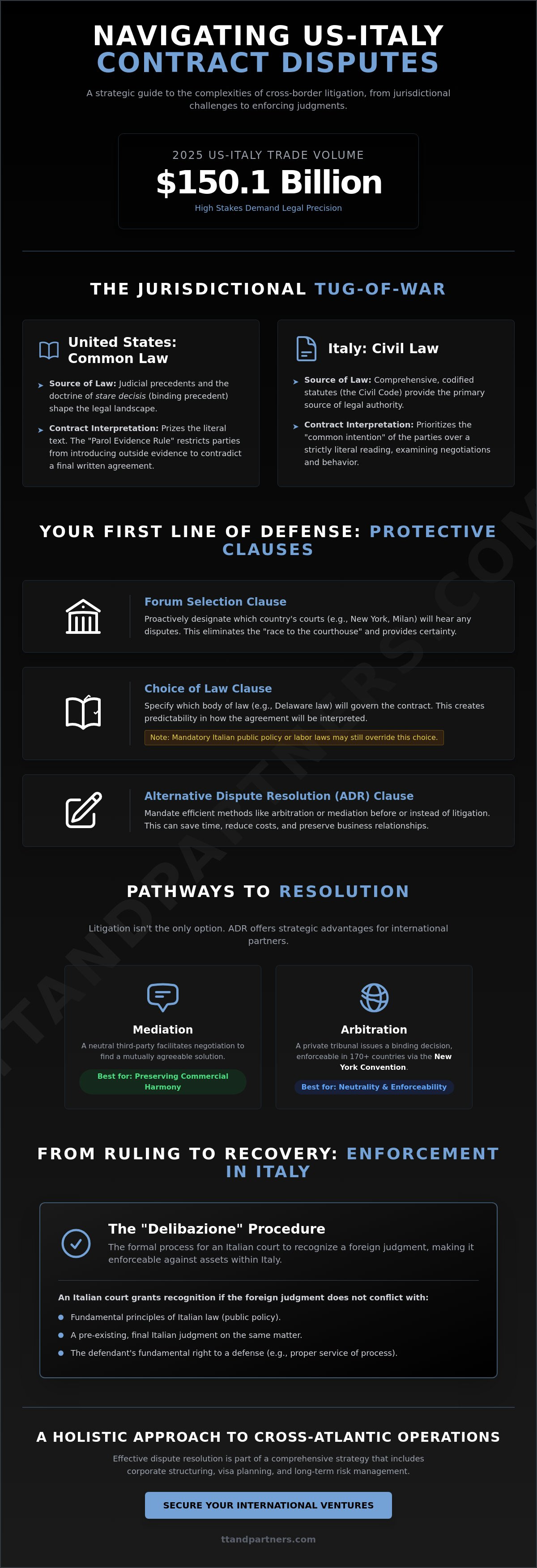
The divide between the United States and Italy isn't just geographical; it's deeply philosophical. The United States operates under a system where judicial precedents and the doctrine of binding precedent shape the legal landscape. In contrast, Italy adheres to a tradition rooted in comprehensive statutes that provide the primary source of authority. Understanding these Conflict of laws principles is essential for any professional managing cross-border contract disputes US Italy. While the 1948 treaty between the two nations facilitates reciprocal legal access and ensures that corporations have most favored nation status, it doesn't bridge the fundamental gap between these two legal methodologies.
When a dispute reaches an American court, judges often apply the doctrine of an inconvenient forum to determine if the case truly belongs there. They weigh private interest factors, such as the ease of access to proof and the availability of witnesses, against public interest factors like the local court's burden. If the contract's center of gravity is in Milan or Rome, a US judge might dismiss the case, forcing the litigation into the Italian system. This strategic pivot requires a deep understanding of how the Italian civil code interprets obligations, as it serves as the ultimate blueprint for contractual duties in the Italian Republic.
Key Differences in Contract Interpretation
American law often relies on the rule that restricts parties from introducing outside evidence to contradict a final written agreement. It's an approach that prizes the literal text. Italian courts take a more holistic path. Under the principle of good faith and specific articles of the civil code, judges prioritize the common intention of the parties over a strictly literal reading. They'll examine negotiations and the parties' behavior after signing to find the true meaning of a deal. Because of these differences, expert witnesses aren't just helpful; they're vital. They educate the court on how foreign legal concepts should be applied, ensuring that a judge in New York or a magistrate in Florence doesn't misinterpret the spirit of the agreement.
Determining the Competent Court
Jurisdiction isn't a given in cross-border contract disputes US Italy. In the US, courts use the minimum contacts doctrine to decide if an Italian firm has enough presence in a state to be sued there. Italy looks to the competent court, usually favoring the defendant's residence or the place where the contractual obligation was performed. If a contract remains silent on jurisdiction, the situation becomes volatile. Parties might find themselves in a race to the courthouse, where the first to file in their preferred country gains a strategic advantage. This uncertainty underscores why precise drafting and early consultation are necessities for maintaining the integrity of cross-atlantic business operations. If you're facing such complexities, you can contact us to discuss your specific jurisdictional standing.
Critical Contract Clauses to Mitigate US-Italy Litigation Risks
A robust contract serves as a protective structure, designed to withstand the inherent tensions between the American and Italian legal spheres. Effectively managing cross-border contract disputes US Italy begins during the drafting phase, where precision in clause selection can prevent years of costly litigation. While many US entities instinctively choose New York or Delaware law for its predictability, this choice isn't an absolute shield. Mandatory legal rules in the Italian system can override contractual choices if they touch upon fundamental public policy, labor protections, or specific consumer rights established in the 2026 reforms.
Forum selection requires a similar strategic balance. A US court offers familiarity, yet an Italian court might be necessary if the counterparty's assets are entirely within Mediterranean borders. In many cases, opting for International arbitration in Italy provides a neutral ground that bypasses the home court advantage while ensuring enforceability under the New York Convention. Language also plays a critical role. In a pathological dispute where the English and Italian versions of a contract conflict, the agreement must explicitly state which version prevails to avoid a judicial interpretation that neither party intended.
The landscape of 2026 demands that Force Majeure and hardship clauses account for digital infrastructure failures and modern supply chain volatility. Simply citing acts of God is no longer sufficient. Contracts must define specific triggers and mitigation steps to reflect the current pace of global trade and the technical specifications of Italian electronic invoicing mandates, which require preservation of records for ten years.
Drafting the Choice of Law Provision
US companies favor New York or Delaware law because of their sophisticated commercial precedents. However, to be enforceable in a US court, these provisions must often be conspicuous, appearing in bold or capital letters to meet notice requirements. In Italy, specific approval in writing is required for unfair or onerous terms under the civil code. Failing to secure a second, separate signature for these clauses can render them void in an Italian court, regardless of the overarching choice of law.
Service of Process Across Borders
Initiating a lawsuit requires strict adherence to the Hague Service Convention. While the US allows various methods of delivery, Italy generally requires service through its designated central authority. US plaintiffs who rely on simple international mail often find their cases dismissed months later for improper service. This technicality is a frequent pitfall that can be avoided by ensuring all procedural steps align with international treaties from the outset, particularly when managing cross-border contract disputes US Italy. If you're navigating these procedural hurdles, you can consult with our team to refine your approach.
Dispute Resolution Mechanisms: Litigation, Arbitration, and Mediation
Choosing the appropriate forum is a strategic decision that defines the entire trajectory of cross-border contract disputes US Italy. While US federal courts offer a rigorous, discovery-heavy environment, the Italian commercial courts operate on a document-centric basis that prizes written evidence over oral testimony. The decision often hinges on where the counterparty's assets are located and the desired speed of resolution. In 2026, US district court filing fees remain at $405, while appellate fees have increased to $665. Conversely, Italian litigation follows the principle that the losing party pays the winner's costs. This rule can deter frivolous claims but adds a layer of financial risk for a claimant who lacks a clear, evidence-backed position.
Mandatory mediation has become a cornerstone of the Italian legal landscape, driven by the desire to avoid the inherent friction of public courtrooms. For specific sectors like real estate, banking, or insurance, mediation is a required procedural step before a judge will hear the case. Statistics from 2025 indicate that nearly 90% of civil disputes in Italy are resolved outside the courtroom. These alternative methods are estimated to be 50 to 70% less expensive than traditional litigation. Using mediation within the context of cross-border contract disputes US Italy allows parties to reach a resolution that preserves their commercial relationship while respecting technical requirements like the ten-year record preservation mandate for electronic invoices.
The Advantages of International Arbitration
Arbitration awards are generally easier to enforce across borders than court judgments because of the New York Convention. Under the 2026 rules of the International Chamber of Commerce, which entered into force on June 1, the claimant's filing fee is $5,000. While the emergency arbitrator fee has risen to $50,000, institutional fees have been reduced for disputes under $10 million. Specialized venues like the Milan Chamber of Arbitration provide a sophisticated, confidential environment where industry experts decide the outcome. This privacy is a significant benefit for businesses protecting sensitive intellectual property or trade secrets.
Navigating the Italian Court System
The perception that Italian courts are perpetually slow is a narrative that modern commercial divisions are actively dismantling through digitalization. A typical case moves through the trial court, followed by the appellate stage, and potentially the Supreme Court for a final legal review. Unlike the US system, where each party usually bears its own costs, Italy's fee-shifting rule means the prevailing party can recover a significant portion of their legal expenses. This structure creates a high-stakes environment that rewards technical precision and a deep understanding of the 2026 amendments to the civil code.
Enforcing Judgments: Moving from a Court Order to Actual Recovery
Securing a favorable verdict provides a sense of closure, but the true measure of success is the actual recovery of assets. In cross-border contract disputes US Italy, a favorable verdict in a US court is merely a blueprint, not a guarantee of payment. Because no bilateral treaty exists for the reciprocal recognition of judgments, a US order must undergo a specific validation process in Italy. This procedure, traditionally called delibazione, involves the Italian Court of Appeal granting an "Exequatur." The Italian magistrate won't re-litigate the facts; instead, they verify that the US court held proper jurisdiction and that the defendant's right to due process was respected.
Recovery requires a sophisticated approach to asset tracing. Identifying bank accounts or holdings in the US or Italy demands technical precision and a deep understanding of local privacy laws. While the United States signed the Hague Convention on Choice of Court Agreements, it hasn't ratified the treaty as of June 2026. This means enforcement remains a matter of domestic law in both territories. Strategic coordination is essential to ensure that a victory in one jurisdiction doesn't become a hollow triumph in another.
Enforcing a US Money Judgment in Italy
To secure an Italian Exequatur, the judgment must be final and non-appealable. Italian courts scrutinize whether the award aligns with "public policy." A significant hurdle often arises with punitive damages. While the Italian Supreme Court opened the door to enforcing such awards in 2017, they remain under strict review. The court must ensure the award isn't purely disproportionate or retaliatory. Typically, the timeline for recognition ranges from six to eighteen months, depending on the complexity of the original proceedings and the specific court's docket.
Enforcing Italian Judgments in the US
Italian businesses seeking to recover debts in America rely on the Uniform Foreign-Country Money Judgments Recognition Act (UFCMJRA), which most US states have adopted. US courts will recognize an Italian judgment if the proceedings were compatible with the requirements of due process. Once recognized, the judgment can be used to initiate an asset seizure or influence a real estate closing to satisfy the debt. If your strategy involves multi-jurisdictional recovery, you should contact our legal experts to coordinate your enforcement efforts with precision.
Strategic Legal Counsel for Cross-Atlantic Business Operations
A business's resilience in the face of cross-border contract disputes US Italy is often decided long before a summons is served. The initial LLC incorporation strategy isn't merely a tax or administrative choice; it's the foundation of your litigation profile. By selecting a specific corporate structure, you define the boundaries of liability and determine which jurisdictional rules apply when friction arises. Preventative law, centered on rigorous audits of existing agreements and operational workflows, allows companies to identify "pathological" clauses before they trigger a crisis. It's about building architectural integrity into every commercial relationship.
True success in international litigation requires a holistic vision that bridges the gap between the static text of a contract and the dynamic reality of global trade. In 2026, where Italian electronic invoicing is mandatory and US federal filing fees have evolved, legal counsel must act as strategic thinkers. We understand the environmental and technological context of every transaction, ensuring that your legal strategy supports your long-term growth rather than just solving a temporary problem.
Litigation Risks for E-1 and E-2 Visa Holders
For investors operating under an E-2 Visa, a significant contract dispute is more than a financial burden; it's a threat to their legal status in the United States. A major loss in court can undermine the "substantiality" of the investment or lead to a finding of "marginality" if the business can no longer support the investor and their family. Maintaining strict corporate formalities is essential to prevent creditors from "piercing the corporate veil," which would expose personal assets to business liabilities. This intersection of immigration and litigation requires a delicate, expert touch.
Ensure all inter-company agreements between US and Italian entities are documented with the same precision as third-party contracts.
Conduct bi-annual legal audits to ensure compliance with the 2026 amendments to the Italian Civil Code regarding digital signatures.
Review litigation profiles to protect the "substantial trade" requirements for E-1 visa holders during market volatility.
The Tosolini, Toniutti & Partners Approach
Our firm specializes in the delicate art of bridging the gap between New York's case law and Italy's statutory Codice. We don't just react to disputes; we build structures that endure them. By maintaining a dual-qualified team, we provide the intellectual content and technical precision needed to navigate cross-border contract disputes US Italy with confidence. Whether you're refining a forum selection clause or defending a complex commercial claim, our vision remains human-centered and result-oriented. We believe in a dialogue between the past's values and the future's technological solutions.
If you're ready to secure your cross-atlantic operations and minimize your legal exposure, contact our cross-border litigation team for a strategy session.
Securing Your Cross-Atlantic Commercial Legacy
Success in the international arena depends on a harmony between visionary ambition and technical legal precision. We've explored how the friction between American Common Law and the Italian Civil Code can be managed through meticulous contract drafting and the strategic use of arbitration. Successfully resolving cross-border contract disputes US Italy isn't just about winning a single case; it's about protecting the structural integrity of your global operations. By understanding the nuances of judgment enforcement and the 2026 regulatory updates, you can transform legal uncertainty into a competitive advantage.
Our dual-qualified legal expertise across both US and Italian jurisdictions ensures that your interests are represented with a deep understanding of both legal philosophies. With decades of experience in international litigation and strategic offices positioned to facilitate seamless representation, we provide the intellectual depth your business requires. Secure your cross-border interests with a strategic legal consultation. Your cross-atlantic journey deserves a foundation built on professional excellence and a clear, future-oriented vision.
Frequently Asked Questions
Which court has jurisdiction if our US-Italy contract doesn’t specify one?
Jurisdiction is generally determined by the place where the primary contractual obligation was performed or by the defendant's domicile. In the absence of a specific clause, US courts apply the "Minimum Contacts" doctrine to establish authority, while Italian judges look to the Foro Competente principles under the Civil Code. This ambiguity often creates a race to the courthouse to secure a venue that aligns with a party's strategic interests.
Can I enforce a US "Punitive Damages" award in an Italian court?
Italian courts can recognize US punitive damages provided they aren't purely retaliatory or disproportionate to the actual harm. Since a landmark 2017 Supreme Court ruling, these awards are no longer considered automatically contrary to public policy. However, the Italian judge will carefully verify that the award serves a compensatory or deterrent function that's recognized within the broader Italian legal framework and the 2026 civil reforms.
How long does the average cross-border contract dispute take to resolve in Italy?
Resolution times depend on the specific commercial division, but the digitalization of the Italian system has notably improved efficiency for cross-border contract disputes US Italy. A case typically moves through the Tribunale and may proceed to the Appello stage for review. While complex litigation can span several years, the 2026 reforms aim to streamline these proceedings through mandatory electronic filing and much stricter procedural deadlines.
Does the UN Convention on Contracts for the International Sale of Goods (CISG) apply to US-Italy trade?
The CISG applies automatically to contracts for the sale of goods between US and Italian parties unless the agreement explicitly excludes it. This international treaty provides a uniform set of rules for contract formation and remedies across different legal systems. Many practitioners choose to opt out of the CISG in favor of a specific state law, such as New York or Delaware, to ensure greater predictability.
What is the "delibazione" process for foreign judgments in Italy?
The delibazione process is the formal recognition of a foreign judgment by the Italian Court of Appeal to grant it legal force. The court verifies that the foreign judge held proper jurisdiction and that the defendant received notice according to international standards. Once an "Exequatur" is issued, the US judgment becomes an enforceable title, allowing for asset seizure or debt recovery within Italian borders.
Is arbitration always better than litigation for US-Italy business contracts?
Arbitration offers superior enforceability under the New York Convention but isn't a universal solution for every commercial friction. It provides confidentiality and specialized expertise, which are vital for complex cross-border contract disputes US Italy involving intellectual property. However, litigation might be more cost-effective for straightforward debt collection where the "Loser Pays" principle in Italian courts helps the prevailing party recover their legal expenses.
How much does it typically cost to serve an Italian company with a US lawsuit?
Serving an Italian entity requires strict adherence to the Hague Service Convention through the Italian Central Authority. Costs vary based on the volume of translation required and the specific fees of the Ufficiale Giudiziario involved in the delivery. You shouldn't rely on simple international mail, as US courts often dismiss cases months later when they find that service didn't meet the treaty's technical standards.
Can a contract dispute in the US affect my E-2 or E-1 visa status?
A significant contract dispute can jeopardize your visa status by draining the capital required to meet "substantial trade" or "marginality" tests. For E-2 investors, legal liabilities that threaten the entity's solvency can lead to the loss of treaty investor status. Maintaining strict corporate formalities is a critical defense to ensure that business litigation doesn't lead to personal liability or the revocation of your right to remain.


Comments