

Cross-Border Litigation Attorney US Italy: Strategic Legal Resolution in 2026
- Gianni Mendes Toniutti, Esq.

- Apr 27
- 12 min read
Can a legal strategy truly be considered global if it fails to account for the 4,000 miles of jurisdictional friction between New York and Rome? You likely understand that managing a dispute across two continents is less about winning an argument and more about mastering the architecture of two conflicting legal systems. The tension between expansive US discovery and strict EU privacy mandates often creates a deadlock that stalls progress for months. In 2026, the complexity of international commerce demands a more integrated approach to conflict resolution.
This guide provides a blueprint for resolving these complexities with the precision of a master architect. By engaging a specialized cross-border litigation attorney US Italy, you can transform fragmented legal efforts into a singular, cohesive movement. We'll show you how to secure enforceable judgments while minimizing the high costs associated with dual representation. We'll examine how to synchronize the Hague Service Convention timelines, which often span six to nine months for Italian service, with the immediate needs of your case. You'll gain a clear perspective on aligning US procedural requirements with Italian civil law to ensure your strategy remains resilient on both sides of the Atlantic.
Key Takeaways
Understand the intricate jurisdictional architecture and legal complexities that define high-stakes disputes between the United States and Italy in 2026.
Master the procedural nuances of the Hague Service Convention and navigate the friction between American discovery and Italian civil law limitations.
Evaluate whether international commercial arbitration or strategic litigation offers the most resilient path for resolving your specific cross-border conflict.
Identify why engaging a specialized cross-border litigation attorney US Italy is essential for maintaining a unified strategy across diverse legal landscapes.
Discover how an intellectually rigorous, dual-jurisdictional approach prevents conflicting legal advice and eliminates the inefficiencies of redundant billing.
Table of Contents The Complexity of US-Italy Cross-Border Legal Disputes Key Procedural Hurdles in US-Italy International Litigation Strategic Options: Litigation, Arbitration, and Mediation Selecting a Cross-Border Litigation Attorney: Critical Criteria Strategic Legal Partnership: The Tosolini, Toniutti & Partners Approach
The Complexity of US-Italy Cross-Border Legal Disputes
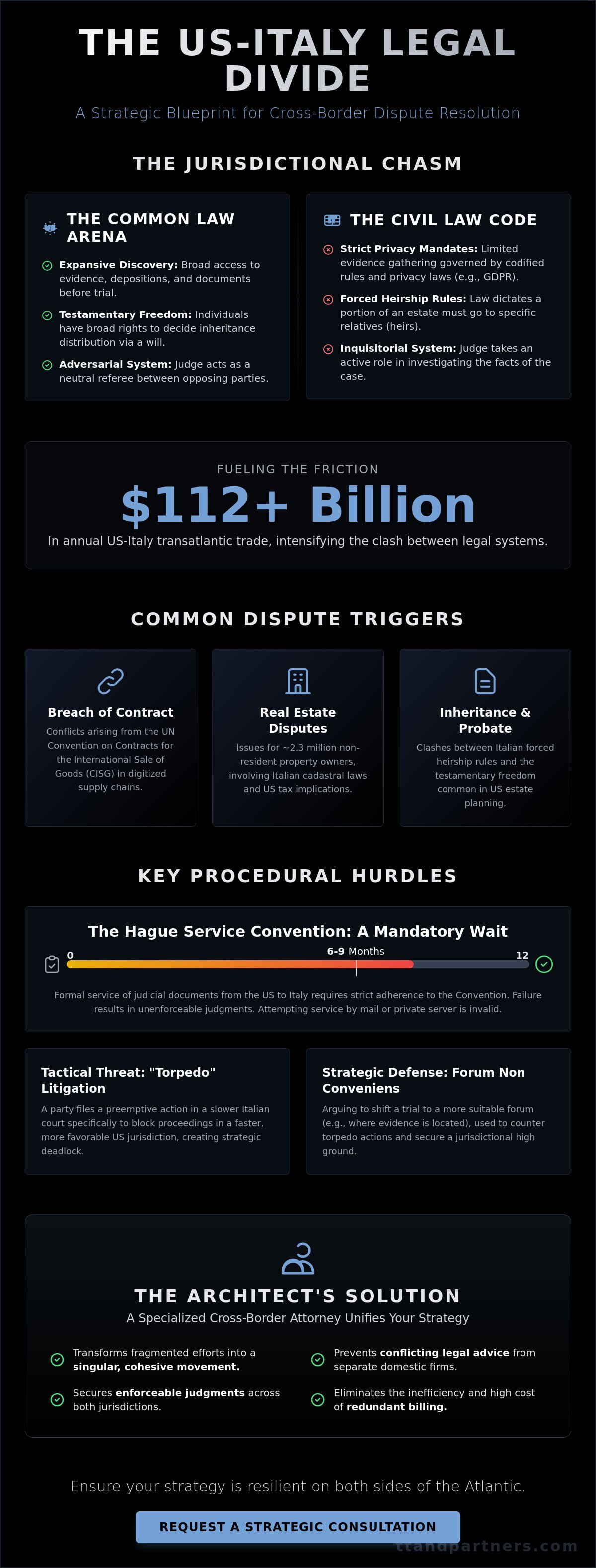
The legal landscape of 2026 demands a shift from reactive defense to architectural precision in dispute resolution. As transatlantic trade between the United States and Italy exceeded 112 billion dollars in late 2025, the friction between Common Law and Civil Law systems has intensified. A Complexity of US-Italy Cross-Border Legal Disputes emerges when parties ignore the structural differences between the US federal court system and the Italian Tribunale. Standard domestic firms often falter here. They treat international overlaps as secondary concerns rather than the foundation of the case. They don't possess the bilingual procedural fluency required to bridge the gap between discovery processes in New York and the evidence-gathering phases in Milan.
Success requires identifying the "center of gravity" of the conflict. This involves analyzing where the contractual performance occurred or where the tortious act had its primary impact. Modern litigation relies on the 2023 Hague Judgments Convention and long-standing bilateral treaties to ensure that a victory in Rome isn't hollow in New York. A specialized cross-border litigation attorney US Italy constructs a strategy that accounts for these jurisdictional layers from the first filing. They view the case as a holistic structure where the choice of law and the choice of forum must harmonize to produce a durable outcome.
Common Triggers for International Litigation
Disputes in 2026 frequently arise from three specific catalysts that bridge the two continents:
Breach of contract: Conflicts often stem from the United Nations Convention on Contracts for the International Sale of Goods (CISG), especially as supply chains become more digitized and automated.
Real estate: Disputes involving the estimated 2.3 million non-resident property owners in Italy require a deep understanding of Italian cadastral laws and US tax implications.
Inheritance and probate: Conflicts occur when Italian forced heirship rules collide with the testamentary freedom typical of US estate planning, creating complex validity issues.
The Importance of Jurisdictional Strategy
The choice of forum dictates the procedural rhythm of the entire case. Utilizing forum non-conveniens arguments can effectively shift a trial to a more favorable environment where the evidence is more accessible. In European jurisdictions, the risk of "torpedo" litigation remains a tactical threat. This occurs when a party files a preemptive action in a slower court to block proceedings in a faster jurisdiction. A seasoned cross-border litigation attorney US Italy prevents these maneuvers by securing the jurisdictional high ground early. For those facing these intricate challenges, seeking a strategic legal consultation is the first step toward a resolute outcome. This foresight ensures that the legal process remains a tool for resolution rather than an endless cycle of procedural delays.
Key Procedural Hurdles in US-Italy International Litigation
Success in transatlantic disputes requires more than just legal knowledge; it demands a structural understanding of how two distinct judicial systems intersect. A cross-border litigation attorney US Italy must navigate a landscape where US procedural flexibility meets the rigid, codified requirements of the Italian civil law system. In 2026, this intersection is increasingly defined by digital integration and stricter data sovereignty. Procedural errors at the start of a case don't just cause delays; they often lead to the irreversible collapse of a claim.
Service of Process and the Hague Convention
The Hague Service Convention remains the exclusive mechanism for serving judicial documents from the US to Italy. Attempting service via prohibited methods, such as direct mail or private process servers without official intervention, often results in the Italian courts refusing to recognize a subsequent US judgment. Practitioners must coordinate with the Italian Central Authority for the Hague Service Convention to ensure compliance. In 2026, the typical timeline for formal service in Italy remains between four and seven months. Common mistakes that lead to dismissal include failing to provide certified Italian translations or neglecting the specific requirements of the Italian Ministry of Justice.
Discovery and Data Privacy (GDPR vs. US Rules)
The clash between the broad US discovery phase and Italian privacy protections creates a significant friction point. Italian law doesn't recognize the wide-ranging pretrial document production common in US courts. Instead, evidence gathering must often utilize the Hague Evidence Convention to remain enforceable. Letters Rogatory are formal requests from a US court to an Italian judicial authority seeking assistance in obtaining evidence or testimony from a party located within Italy.
Managing document production requires a delicate balance with the General Data Protection Regulation (GDPR). Since January 2025, Italian courts have intensified their scrutiny of data transfers to non-EU jurisdictions. A cross-border litigation attorney US Italy utilizes strategic protective orders to bridge this gap; this ensures that evidence is produced without triggering heavy fines for privacy violations. Jurisdictional discovery plays a vital role here; it establishes the court's authority before the merits of the case are even debated. If you're managing a complex dispute, it's wise to consult with a specialist who understands these architectural legal nuances.
Strategic Options: Litigation, Arbitration, and Mediation
Selecting the right forum isn't just a procedural choice; it's a foundational architectural decision for any legal strategy. By 2026, the complexity of US-Italy trade, which reached approximately $117 billion in 2023, requires a sophisticated lens to resolve inevitable friction. A cross-border litigation attorney US Italy must weigh the rigidity of traditional courtrooms against the modularity of alternative dispute resolution. While Italian courts have seen efficiency gains from the 2023 Cartabia Reform, the average duration for a first-instance civil case still hovers around 500 days. This timeline often clashes with the faster pace of US commercial interests.
Enforceability remains the primary metric for success in these disputes. The 1958 New York Convention, ratified by 172 countries including the US and Italy, provides a streamlined framework for recognizing arbitral awards. It's the gold standard for global enforcement. In contrast, enforcing a US court judgment in Italy relies on Law 218/1995, which requires a "delibazione" process. This extra layer of judicial review checks for "ordine pubblico" (public policy) compliance, creating a potential bottleneck that arbitration avoids entirely. Strategic selection of the dispute resolution method includes:
Legal Context: Assessing whether the contract's governing law aligns better with a civil law or common law forum.
Asset Location: Identifying where the counterparty's assets are held to ensure the final judgment has immediate utility.
Procedural Speed: Choosing between the structured pace of Italian courts and the accelerated timelines of private tribunals.
When to Choose International Arbitration
Arbitration provides a private sanctuary for corporate entities. In 2026, International Chamber of Commerce (ICC) data shows that 40% of trans-Atlantic disputes now utilize expedited arbitration rules to maintain business continuity. Neutrality stays at the center of this choice. By selecting a neutral seat like Paris or Geneva, parties eliminate the "home court advantage" often feared in US jury trials or Italian civil proceedings. The process is fast and flexible. Most 2026 arbitral panels use integrated digital platforms to resolve disputes within 12 to 14 months, ensuring that legal hurdles don't stall long-term innovation.
The Mediation Alternative
Mediation acts as a bridge between the adversarial US style and the relationship-focused Italian business culture. It's a collaborative exercise in legal architecture. Statistics from the Milan Chamber of Arbitration indicate that 65% of mediated disputes reach a settlement within three sessions. This preserves partnerships that litigation usually destroys. If you're managing a high-stakes conflict, reaching out to a cross-border litigation attorney US Italy helps determine if mediation's lower costs, often 50% less than a full trial, fit your specific context. It's a pragmatic path for those who value both precision and human connection in their professional dealings.
Selecting a Cross-Border Litigation Attorney: Critical Criteria
Selecting the right cross-border litigation attorney US Italy requires an eye for structural integrity and jurisdictional alignment. In 2026, the complexity of global trade demands more than just a passing familiarity with foreign codes; it requires a professional who understands how a motion filed in a New York District Court will echo through the halls of the Tribunale di Roma. Dual-qualification is the non-negotiable foundation of a viable defense. Without deep knowledge of both civil and common law systems, you risk a fragmented strategy that collapses under the weight of conflicting procedural rules. A single firm managing both ends of the Atlantic prevents the "double-billing" trap where two separate legal teams charge for the same research and coordination.
A strategic partnership in legal representation is a collaborative framework where the attorney functions as a co-architect of the client's long-term commercial stability. This model ensures that every legal maneuver serves a broader business objective. By adopting this approach, firms provide a unified strategy that eliminates the friction of conflicting advice. When one entity manages the entire lifecycle of a dispute, the client receives a cohesive narrative that remains resilient under the scrutiny of multiple judges.
Communication and Cultural Fluency
Success in international law exists beyond the limits of literal translation. It lives in the nuance of legal mentalities. The Italian system's focus on civil law formalities contrasts sharply with the American emphasis on discovery and jury persuasion. The right cross-border litigation attorney US Italy acts as a bridge between New York and Italy, ensuring that no intent is lost in the Atlantic crossing. Transparency in international billing is equally vital. Recent data from the 2024 Legal Trends Report indicates that 38% of multinational clients cite billing opacity as a primary source of friction. We address this through rigorous, data-driven reporting and clear, consolidated fee structures.
Enforcement of Foreign Judgments
The value of a court victory is zero if the judgment can't be enforced. Enforcing a US judgment in Italy is a technical process that requires the Italian Court of Appeal to verify the foreign ruling's compatibility with local public policy. Conversely, the process of "Exequatur" for Italian judgments in the United States typically follows the Uniform Foreign-Country Money Judgments Recognition Act, which has been adopted by over 30 states. Our firm evaluates the enforceability of a claim before the first document is even filed. You can read our guide on international litigation for detailed enforcement strategies. To discuss your specific jurisdictional needs, contact our legal strategists today.
Strategic Legal Partnership: The Tosolini, Toniutti & Partners Approach
Resolving disputes between the United States and Italy requires more than mere legal knowledge; it demands a structural understanding of how two distinct legal civilizations interact. Our firm approaches each case as an architectural challenge. We design a jurisdictional framework that spans the Atlantic, ensuring that every legal maneuver is grounded in precision. A skilled cross-border litigation attorney US Italy doesn't just react to filings. They anticipate the friction between Common Law and Civil Law systems. This intellectual rigor ensures that every motion serves a long-term strategic purpose. We view litigation as a tool for restoration, seeking to return balance to our clients' commercial and personal lives.
Transatlantic legal battles carry a heavy weight. The financial cost is often matched by significant emotional strain. We prioritize a client-centric model that emphasizes clarity and predictability throughout the process. Our team manages the technical complexity so you can focus on your core operations. By 2026, the speed of global commerce has increased the frequency of these conflicts. We provide the stability needed to endure them. Our approach facilitates seamless transatlantic operations by removing the legal debris that clogs the wheels of international business.
Integrated Corporate and Litigation Support
Effective legal defense begins long before a summons is issued. We emphasize preventative law as a foundation for sustainable growth. Utilizing LLC incorporation serves as a primary layer of protection for Italian entities entering the US market. This strategic positioning minimizes future litigation risk by clearly defining liability. When disputes arise, our representation remains cohesive. We handle everything from the first filing to the final enforcement of judgments, providing the value of a visionary partner who understands the globalized landscape of 2026.
Contact Our Cross-Border Team
Initiating a resolution for your US-Italy legal matter is a straightforward process. You can contact Tosolini, Toniutti & Partners for a strategic evaluation of your cross-border case. To ensure a productive initial consultation, please prepare all relevant contracts, correspondence, and previous court filings. Our team will analyze these elements to provide a clear roadmap for your defense or claim. We believe in visionary partnerships that turn legal obstacles into opportunities for structural improvement. Don't let jurisdictional gaps compromise your interests; seek a cross-border litigation attorney US Italy who understands the intricate architecture of international law.
Securing Your Transatlantic Interests in 2026
Navigating a dispute across the Atlantic isn't just about law; it's about the precision of a well-designed partnership. Success in 2026 requires a deep understanding of the 1951 Treaty of Friendship, Commerce and Navigation and the specific Hague Convention protocols that govern service and evidence. A skilled cross-border litigation attorney US Italy doesn't just react to filings. They build a structural framework that anticipates jurisdictional conflicts before they arise. This proactive approach ensures that your business objectives aren't lost in procedural delays.
Tosolini, Toniutti & Partners leverages over 25 years of experience to bridge the gap between US common law and the Italian civil system. We focus on seamless integration, ensuring that every legal move respects the cultural and procedural context of both nations. Whether you're navigating arbitration in Milan or federal court in New York, the right strategy ensures your interests remain protected and your vision remains clear. We're ready to help you turn complex legal hurdles into a stable foundation for future growth.
We look forward to building a resilient legal path forward together.
Frequently Asked Questions
How long does cross-border litigation between the US and Italy typically take?
Cross-border litigation between the US and Italy typically spans 24 to 60 months. This timeline accounts for the initial filing, international service of process, and the complex discovery phase. Italian civil proceedings alone averaged 527 days for the first instance in 2023 according to European Commission data. Complex commercial disputes involving US discovery protocols often extend this duration toward the five-year mark.
Can an Italian citizen be sued in a US court?
You can sue an Italian citizen in a US court if the court establishes personal jurisdiction through minimum contacts under the Due Process Clause. This requires the defendant to have conducted business, caused injury, or owned property within the specific US state. A cross-border litigation attorney US Italy ensures the complaint follows the 1965 Hague Service Convention to maintain the case's validity during these initial stages.
What is the Hague Service Convention and why does it matter?
The Hague Service Convention is a multilateral treaty that standardizes the process for serving judicial documents across international borders. It matters because improper service leads to the immediate dismissal of a case or the refusal of Italian courts to recognize a future judgment. In 2024, Italy processed service requests through its Central Authority, typically requiring three to six months for completion.
Are US court judgments automatically enforceable in Italy?
US court judgments aren't automatically enforceable in Italy because no bilateral treaty exists between the two nations for mutual recognition. Enforcement relies on Law No. 218/1995, the Italian Private International Law Act. To succeed, the judgment must meet seven specific criteria, including the defendant's right to defense and the ruling's compatibility with Italian public policy.
How much does a cross-border litigation attorney cost?
Fees for a cross-border litigation attorney US Italy vary based on the complexity of the international dispute and the chosen billing model. Most specialized firms utilize hourly rates or staged flat fees for specific phases like the initial filing or discovery. While we don't provide fixed estimates here, the 2024 Legal Trends Report indicates that specialized international counsel rates reflect the high level of technical expertise required.
Can I use mediation to solve a US-Italy business dispute?
You can use mediation to resolve US-Italy business disputes, and it's often a mandatory step under Italian Legislative Decree 28/2010. This law requires mediation for specific commercial matters before a trial can proceed in Italy. Mediation successfully resolves approximately 45 percent of commercial cases in European jurisdictions, providing a faster, private alternative to the public court system.
What is the role of the "Exequatur" process in international law?
The Exequatur process is the formal judicial procedure where an Italian Court of Appeal reviews a foreign judgment to grant it legal force within Italy. It doesn't involve a retrial of the case's merits. Instead, the court verifies the foreign ruling's compliance with Italian procedural standards. Without a successful Exequatur decree, you can't seize assets or freeze bank accounts located on Italian soil.
Does US discovery apply to documents located in Italy?
US discovery applies to documents in Italy, but it must often follow the 1970 Hague Evidence Convention procedures. While US courts may order the production of documents, Italian law frequently restricts broad fishing expeditions common in American litigation. Parties typically use Letters of Request to obtain evidence, a process that requires approval from the Italian Ministry of Justice and can take six months.


Comments