

How to Get an Italian Passport from the USA: The 2026 Legal Strategy Guide
- Gianni Mendes Toniutti, Esq.

- Apr 28
- 14 min read
The traditional route to European residency through an Italian consulate has become an exercise in architectural patience; current wait times in major US hubs like New York or Los Angeles now stretch past 800 days. You've likely realized that the standard application process feels like a structure without a foundation, especially when dealing with complex 1948 maternal line restrictions or missing 19th-century vital records. This 2026 legal strategy guide offers a precise roadmap on how to get an Italian passport from USA by utilizing judicial paths that bypass the consular bottleneck entirely.
We understand that your time is a finite resource and your legacy deserves a more efficient framework. You'll learn how to navigate the Italian court system to secure recognition in as little as 12 to 18 months, even if your lineage was previously deemed ineligible. We'll examine the technical requirements for sourcing historical documents and analyze how dual status impacts your current US business holdings and tax obligations. This isn't just about a travel document; it's about building a multi-generational bridge between your American reality and your European heritage.
Key Takeaways
Distinguish between the recognition of citizenship and the administrative issuance of a travel document to navigate the two-phase legal process effectively.
Identify the most viable pathway for your heritage, focusing on the specific legal requirements of Jure Sanguinis or Jure Matrimonii.
Discover the judicial strategy to bypass extensive consular backlogs by leveraging the Italian court system to address "denial of justice" delays.
Master the technical logistics of how to get an Italian passport from USA, from maintaining active AIRE status to securing Prenot@mi appointments.
Evaluate the strategic advantages of dual citizenship for professionals seeking to expand their business architecture into the European Union Single Market.
Table of Contents Understanding the Distinction Between Italian Citizenship and Passport Issuance The Three Primary Pathways to Qualifying for an Italian Passport Navigating Consular Delays: The Judicial Path to Your Passport The Step-by-Step Logistics of Passport Issuance via US Consulates Strategic Benefits for US Investors and Professionals
Understanding the Distinction Between Italian Citizenship and Passport Issuance
The process of learning how to get an Italian passport from USA begins with a fundamental distinction between legal status and physical documentation. A passport serves as a tangible manifestation of citizenship; it's the final architectural detail of a complex legal structure. You don't apply for the document in isolation. Instead, you first secure formal recognition of your status as a citizen. The Italian Ministry of Foreign Affairs coordinates this recognition through a network of 10 primary consular jurisdictions across the United States, ensuring each application aligns with national standards.
Holding an Italian passport doesn't require you to renounce your American nationality. Since the enactment of Law no. 91 on February 5, 1992, Italy has explicitly permitted dual citizenship. This legal framework allows you to maintain your US rights while accessing the benefits of the European Union. Understanding Italian nationality law is the first step in mapping your lineage. It provides the structural basis for your claim, moving beyond family stories into the realm of verifiable legal facts.
Phase One: Establishing Your Legal Right to Citizenship
Before you engage with a consulate, you must prove an unbroken chain of descent from an Italian ancestor. This requires a meticulous assembly of birth, marriage, and death certificates, alongside federal proof that your ancestor didn't naturalize as a US citizen before the birth of the next person in your line. Italian citizenship is an inherent right by birth (jure sanguinis) that requires formal administrative recognition. You must identify the specific legal basis for your claim, such as the 1912 or 1992 statutes, to ensure your documentation package meets the current requirements of the Ministry of the Interior.
Phase Two: Consular Registration and Document Issuance
Once the state recognizes your citizenship, the focus shifts to administrative logistics. Every Italian living outside of Italy must register with the Anagrafe degli Italiani Residenti all'Estero (AIRE). This database is the foundational requirement for all consular services. Your residency in a specific US state dictates which consulate has jurisdiction over your file. For example, a resident of Florida cannot utilize the New York consulate. The final step involves a physical visit for biometric data collection, including digital fingerprints and high-resolution photography. This transition from historical proof to modern biometrics completes the cycle of how to get an Italian passport from USA.
The Three Primary Pathways to Qualifying for an Italian Passport
Understanding how to get an Italian passport from USA requires a structural analysis of the three distinct legal foundations that govern Italian nationality. Unlike many nations that prioritize the place of birth, Italy emphasizes the continuity of bloodlines and the integrity of the family unit. This architectural approach to citizenship ensures that even those several generations removed from the peninsula can reclaim their status through precise legal channels. While naturalization through ten years of residency remains an option for those living in Italy, most US citizens will find their path through descent, marriage, or judicial intervention.
Citizenship by Descent (Jure Sanguinis)
Italy maintains a "no limit" rule regarding the number of generations one can look back to find an Italian ancestor. The primary requirement is that the ancestor was alive and an Italian citizen on or after the unification of Italy on March 17, 1861. This pathway relies on the principle that citizenship is passed automatically from parent to child. However, the Law of June 13, 1912, created a significant hurdle; if an ancestor naturalized as a US citizen before the birth of the next person in the line, the chain was broken.
The Law of February 5, 1992, modernized these requirements, but the 1912 restrictions still dictate the eligibility of historical lines. Applicants must produce a comprehensive portfolio of vital records, including birth, marriage, and death certificates, alongside proof of the ancestor's non-naturalization status. When preparing your dossier, the Italian Consulate in New York provides the specific logistical framework for those residing in its jurisdiction, including the mandatory appointment systems and document verification protocols.
The 1948 Case: Overcoming Gender Discrimination
Before the Italian Constitution took effect on January 1, 1948, women did not have the legal right to pass citizenship to their children. This historical gender bias created a "1948 Rule" that effectively blocked thousands of descendants from claiming their heritage through a maternal line. Modern legal strategy has shifted this landscape. Since a landmark 2009 ruling by the Supreme Court of Cassation, these cases are now successfully challenged in Italian civil courts.
These judicial challenges do not go through the consulate system. Instead, they require a legal representative to file a claim in the regional court where the ancestor was born. In 2026, the success rate for these 1948 cases remains exceptionally high, often exceeding 95% for well-documented claims. This route is essential for anyone whose line involves an Italian mother or grandmother whose child was born before 1948. For those requiring a structural analysis of their specific lineage, reaching out for a professional contact can clarify the technical viability of a claim.
Citizenship through Marriage (Jure Matrimonii)
Obtaining an Italian passport through marriage is a streamlined process, yet it carries specific linguistic and temporal requirements. If the couple resides in the United States, the applicant must wait three years from the date of the marriage or civil union before applying. This period is reduced to 1.5 years if the couple has biological or adopted children under the age of 18.
The applicant must pass a B1 level Italian language certification, a requirement established by the Salvini Decree on December 4, 2018.
Applications are submitted digitally via the Ministero dell’Interno portal.
The Italian spouse must be correctly registered in the Registry of Italians Residing Abroad (AIRE).
Determining how to get an Italian passport from USA via marriage involves coordinating with the Ministry of the Interior rather than just the local consulate. The process is rigorous, requiring a clean criminal record from every state where the applicant has lived since age 14. This path emphasizes the cultural integration of the spouse into the Italian national fabric.
Navigating Consular Delays: The Judicial Path to Your Passport
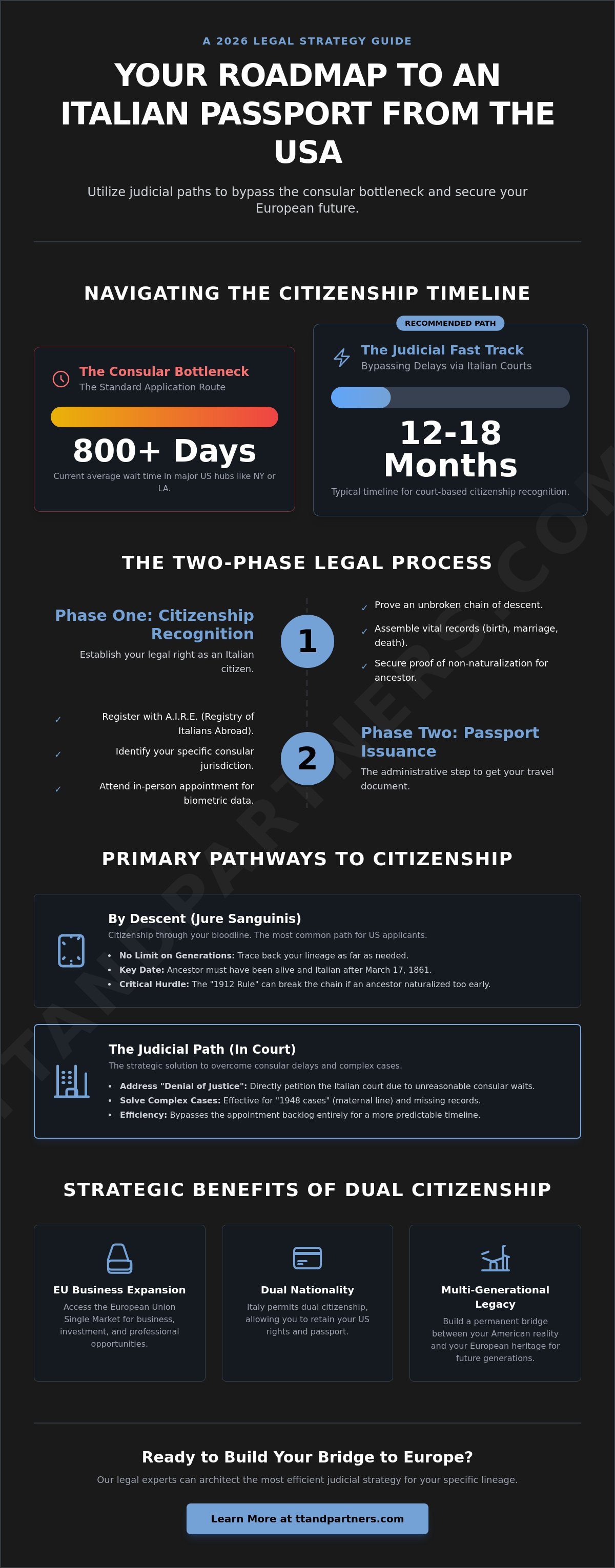
The traditional route of scheduling an appointment at an Italian consulate has reached a point of structural failure. In major urban hubs like Los Angeles, New York, or Miami, the wait times for a citizenship interview frequently exceed 10 years; in many cases, the online booking systems show no availability at all. This systemic gridlock isn't merely an inconvenience. It represents a "denial of justice" under the Italian legal framework. When the state fails to provide a required administrative service within a reasonable timeframe, the judicial system offers a necessary bypass. For those researching how to get an Italian passport from USA, understanding this shift from administrative queues to courtroom filings is essential for a successful 2026 strategy.
The "Against the Queue" Lawsuit Strategy
The "Against the Queue" lawsuit is a precise legal instrument designed to challenge the inefficiency of the consular network. Since the landmark reform in June 2022, these cases are no longer centralized in Rome. Instead, they're heard in the regional courts where your Italian ancestor was born. This decentralization has improved the flow of cases, though it requires a deep understanding of local court preferences. A specialized legal team handles the entire process in Italy, meaning you don't need to travel for hearings. By proving that the consulate hasn't provided an appointment within the statutory 730-day limit, you move your application into the hands of a judge. This judicial route typically concludes in 12 to 24 months, a timeline that vastly outperforms the decade-long consular wait. If you're ready to evaluate your eligibility for this path, you can reach out via our contact page for a structural review of your lineage.
Document Preparation for Judicial Filings
Success in the courtroom depends on the architectural integrity of your document portfolio. Judges require "certified long-form" versions of every birth, marriage, and death certificate in your direct line of descent. These documents must be immaculate; any discrepancy in names or dates can stall a case. Once gathered, every US-issued document must receive an Apostille, a form of international legalization that verifies the signature of the issuing official. Before your file is submitted, you must also ensure all records are translated into Italian by certified professionals who understand legal terminology. It's also vital to remember that even with a court victory, you must eventually register with the AIRE system. This step is a prerequisite for the final issuance of the booklet, as noted by the Italian Consulate in San Francisco.
To ensure your portfolio meets the high standards of the regional courts, focus on these technical requirements:
Consistency: Ensure names like "Giuseppe" don't fluctuate to "Joseph" across different decades without a formal "One and the Same" affidavit.
Longevity: Use only multi-generational long-form certificates that include parental information.
Precision: Translations must be "sworn" or "certified" to be accepted by an Italian judge.
When you understand how to get an Italian passport from USA through the courts, you're no longer at the mercy of a broken booking system. You're following a structured, legal blueprint toward citizenship.
The Step-by-Step Logistics of Passport Issuance via US Consulates
Understanding how to get an Italian passport from USA requires a shift from legal theory to administrative precision. The process functions like a final structural inspection; every detail must align with the established AIRE registry before the physical document is issued. This phase isn't about proving your lineage, but about verifying your current status within the Italian state's digital architecture. Success depends on a methodical approach to five distinct logistical milestones.
Step 1: Confirming AIRE Status. Your registration in the Registry of Italians Residing Abroad (AIRE) must be active and up to date. Consulates like those in Los Angeles or Chicago often require 180 days to process address changes before they'll accept a passport application.
Step 2: Portal Registration. You must secure a digital slot through the Prenot@mi online booking system. These appointments are the only gateway to the biometric phase.
Step 3: Document Synthesis. You'll assemble the "Modulo A" application and two biometric photographs that meet the 35x45mm international standard.
Step 4: Biometric Enrollment. You'll attend an in-person appointment for fingerprinting. This physical touchpoint is mandatory for all applicants over the age of 12.
Step 5: Final Issuance. Once the administrative review is complete, the passport is delivered via secure mail or held for in-person pickup, a process that typically takes 4 to 8 weeks depending on the specific consulate's volume.
Mastering the Prenot@mi System
The Prenot@mi portal is the primary digital interface for all Italian consulates in the United States. Its high traffic demands a strategic approach to how to get an Italian passport from USA. Most slots refresh at midnight Central European Time, which translates to 6:00 PM Eastern Standard Time. You must confirm your appointment in the portal between 3 and 10 days before the scheduled date; failure to do so results in automatic cancellation. If your local consulate shows no availability, check the "Cancellations" tab daily at 4:00 PM local time, as this is when most slots are released back into the system for immediate booking.
Required Documentation for the Passport Appointment
Accuracy in your submission prevents costly delays. For adults, the "Modulo A" application form serves as the definitive record of your intent. You'll need to provide proof of US residency within the consulate's specific jurisdiction, such as a utility bill or a valid Driver’s License issued within the last 90 days. Payment is strictly controlled. Most US locations, including New York and San Francisco, only accept USPS Money Orders. Credit cards and personal checks are generally rejected. Ensure your Money Order matches the exact Euro-to-USD conversion rate published by the consulate for the current fiscal quarter.
The logistics of identity require the same foresight as a complex building project. If you're ready to finalize your dual citizenship journey, contact our legal strategists to ensure your documentation meets every rigorous standard.
Strategic Benefits for US Investors and Professionals
Acquiring dual citizenship isn't just a nod to heritage; it's a strategic architectural move for your global portfolio. Understanding how to get an Italian passport from USA allows professionals to unlock the European Union Single Market, a region with a GDP exceeding $16 trillion in 2023. This legal status transforms the way investors approach cross-border operations. It streamlines LLC incorporation by removing the bureaucratic friction often faced by non-EU entities. While the technical process of how to get an Italian passport from USA involves rigorous documentation, the resulting access to the Eurozone's financial infrastructure is unparalleled.
Mobility and Business Expansion
Holding an Italian passport grants the immediate right to live, work, and study across all 27 EU member states without restriction. This mobility serves as a hedge against domestic market volatility. For those managing complex assets, dual citizenship provides a tactical advantage in international litigation or property disputes within the European court system. Crucially, an Italian passport eliminates the need for residency permits, known as the Permesso di Soggiorno, for long-term stays in Italy. This status also creates a powerful synergy with the E-2 Visa framework, allowing treaty investors to move fluidly between the US and European markets.
Real estate acquisition becomes significantly more efficient for citizens. Italian nationals can access lower mortgage rates and benefit from the "prima casa" (first home) tax exemptions. These incentives can reduce registration taxes from 9% to 2% for qualifying properties. By bypassing the reciprocity requirements that often delay foreign buyers, citizens can secure prime Mediterranean assets with the same speed as local residents.
Tax and Estate Planning Considerations
The 1984 US-Italy Tax Treaty remains the cornerstone for avoiding double taxation on income and capital gains. Strategic planning ensures that your global footprint doesn't lead to redundant fiscal obligations. Citizenship also alters the landscape of inheritance. Italian law follows the principle of forced heirship, which can conflict with US testamentary freedom. Aligning these two legal frameworks requires a precise understanding of the EU Succession Regulation No. 650/2012. For personalized assistance with your application, contact our cross-border legal team to ensure your estate remains protected across both jurisdictions.
Unrestricted EU Access: Full residency rights in 27 countries.
Fiscal Efficiency: Application of the 1984 bilateral tax treaty.
Asset Protection: Strategic advantages in European real estate markets.
Building Your Architectural Bridge to Europe
Securing dual citizenship requires a structural understanding of international law that goes beyond simple forms. Navigating the logistics of how to get an Italian passport from USA demands a clear strategy, particularly when addressing the complexities of 1948 judicial cases or bypassing the systemic delays currently affecting US consulates. Our methodology integrates decades of experience in US-Italy cross-border law to ensure your application stands on a firm legal foundation. With dedicated offices in New York and Italy, we facilitate seamless document sourcing directly from municipal archives to ensure every detail is accounted for.
Success in 2026 depends on precise execution and a visionary approach to your professional mobility. We don't just process papers; we design the legal framework that allows US investors and professionals to thrive within the European landscape. This dual-track presence ensures that your transition is handled with the same precision as a complex architectural project. Your future as a global citizen is within reach when you align with experts who understand the intricate fabric of both legal systems.
Take the definitive step toward your Italian heritage today.
Frequently Asked Questions
How long does it take to get an Italian passport from the USA in 2026?
The timeline for how to get an Italian passport from USA in 2026 typically spans 24 to 36 months from the date of your initial consular appointment. This duration reflects the complex administrative framework of the Italian Ministry of Foreign Affairs and the high volume of applications in major hubs like New York or Los Angeles. You'll likely spend an additional 8 to 12 months in the preparatory phase, gathering vital records and securing apostilles before the formal review begins.
Do I have to speak Italian to get an Italian passport?
You don't need to demonstrate Italian language proficiency if you're applying through Jure Sanguinis, which is citizenship by descent. The legal structure of bloodline citizenship focuses on the continuity of your lineage rather than linguistic skills. However, if you're applying through marriage, Law 132/2018 mandates a certified B1 level of proficiency. This requirement ensures that spouses can integrate into the cultural and social fabric of the Italian community.
Can I get an Italian passport if my great-grandfather was Italian?
You can claim citizenship through a great-grandfather if he didn't naturalize as a US citizen before the birth of the next person in your direct line. This rule stems from the 1912 law that preserved Italian status for children born to Italian fathers abroad. If your ancestor became a US citizen after June 14, 1912, and after his child's birth, the transmission remains intact. We view this lineage as a historical foundation that supports your modern right to a European identity.
What is the cost of obtaining an Italian passport in the US?
The administrative fee for an adult citizenship application is €300, which is approximately 325 dollars depending on the quarterly exchange rate set by the consulate. Once your citizenship is recognized, the physical passport booklet requires a separate payment of €116. These figures don't include external costs for document procurement, which often range from 50 to 150 dollars per certificate for professional translations and state-level authentication services.
Can my spouse get an Italian passport if I am a citizen?
Your spouse can apply for citizenship after three years of marriage if you reside outside of Italy, a period that's reduced to 18 months if you have minor children. The application process requires the spouse to pass a B1 language exam and provide a clean criminal record from every state where they've lived since age 14. This path creates a shared legal context for your family, allowing both partners to hold European Union status simultaneously.
What happens if I cannot find my ancestor’s naturalization records?
If naturalization records are missing, you must secure a "Certified Statement of No Record" from both USCIS and the National Archives to prove the ancestor remained an Italian citizen. You'll also need to provide a census record from a specific year, such as 1930 or 1940, to establish their residency status at that time. These documents function as secondary evidence to bridge gaps in the historical record, ensuring the integrity of your application folder.
Is the 1948 Case still a valid way to get citizenship?
The 1948 Case is a highly successful legal strategy for descendants of Italian women who gave birth before January 1, 1948. While consulates don't have the authority to process these files, Italian courts consistently grant citizenship based on a landmark 1975 ruling regarding gender equality. Statistics from 2024 and 2025 show that these judicial challenges maintain a success rate above 95 percent when the documentation clearly proves the maternal bloodline.
Do I need a lawyer to apply for an Italian passport?
Navigating how to get an Italian passport from USA doesn't require a lawyer for standard administrative applications at a consulate. Many applicants manage their own document collection and appointment scheduling through the Prenot@Mi portal. However, a specialized attorney is a legal necessity if your path involves a 1948 Case or a lawsuit against the 730-day processing limit in the Italian court system. These judicial routes require a professional to represent your interests within the Italian legal framework.


Comments