

Cross-Border Litigation Between US and Italy: A 2026 Strategic Guide
- Gianni Mendes Toniutti, Esq.

- Apr 21
- 13 min read
In June 2024, a Milanese manufacturing firm found itself entangled in a three-year dispute after a New York court asserted jurisdiction over a contract originally signed in Lombardy. This scenario isn't a rare anomaly; it represents the primary risk for entities engaged in cross-border litigation between US and Italy. You're likely aware that the friction between Italy's civil law traditions and the American adversarial system creates a landscape where a single procedural misstep can derail an entire commercial strategy. It’s a reality that demands the same precision as a complex architectural project.
This guide provides a comprehensive roadmap for 2026, offering the clarity you need to handle jurisdictional hurdles and the often overwhelming costs of US discovery. We’ll move beyond the theoretical to provide actionable insights on evidence gathering under the Hague Convention and the specific requirements for judgment enforcement. You'll gain a clear understanding of how to align these two distinct legal frameworks to protect your interests and ensure a stable, enforceable outcome across the Atlantic.
Key Takeaways
Identify the structural tensions between US Common Law and Italian Civil Law to better anticipate the procedural trajectory of multi-jurisdictional conflicts.
Master the strategic implementation of forum selection clauses to ensure commercial agreements remain enforceable within the most competent legal environment.
Navigate the intricate landscape of cross-border litigation between US and Italy by leveraging the Hague Evidence Convention and emerging AI-driven discovery tools.
Develop a comprehensive framework for the recognition of foreign judgments, bridging the enforcement gap where global treaties are currently absent.
Ensure operational continuity by partnering with a strategic bridge that integrates litigation, corporate, and immigration expertise into a singular transatlantic vision.
Table of Contents The Architecture of US-Italy Cross-Border Litigation in 2026 Navigating Jurisdictional Challenges and Forum Selection Procedural Divergence: Evidence, Discovery, and AI Enforcing Foreign Judgments: Bridging the Gap TT and Partners: Your Strategic Transatlantic Bridge
The Architecture of US-Italy Cross-Border Litigation in 2026
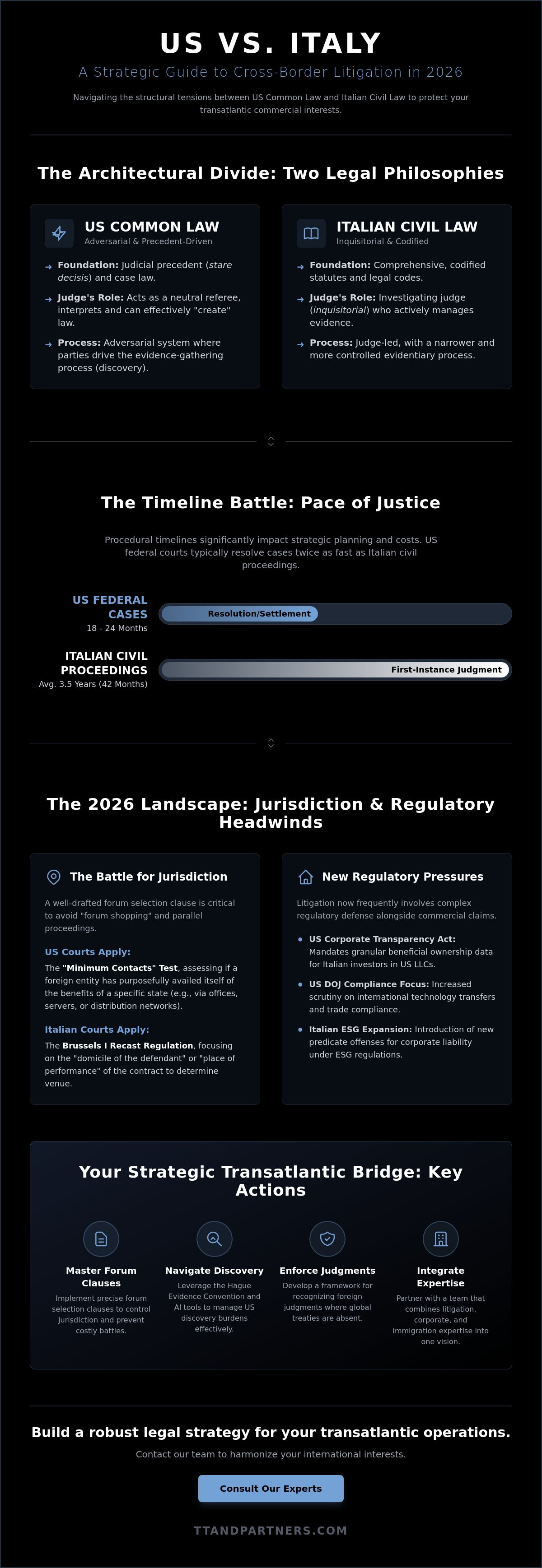
Cross-border litigation between US and Italy isn't merely a clash of rules; it's a structural collision between two distinct legal philosophies. This multi-jurisdictional conflict requires a deep understanding of the context where US Common Law meets the Italian Civil Law tradition. As globalized supply chains tightened in 2025, the frequency of these disputes increased by 12 percent compared to the previous decade. These conflicts often arise from high-value real estate investments and complex industrial partnerships that demand a visionary approach to resolution. Bilateral treaties and international conventions, like the Hague Service Convention, provide the necessary stability to manage these transatlantic tensions effectively. Without these frameworks, the legal fabric of international commerce would lack the durability required for long-term investment.
Common Law vs. Civil Law: A Structural Comparison
The US system builds its foundation on judicial precedent and the principle of stare decisis. In contrast, the Italian system operates through codified statutes where the judge's role is to apply the law rather than create it. The adversarial nature of US courts places the burden of truth-seeking on the parties; however, the Italian inquisitorial style grants the judge more control over the evidentiary process. Clients must manage their expectations regarding the timeline. Italian civil proceedings in 2026 still average 3.5 years for a first-instance judgment, whereas US federal cases often reach resolution or settlement within 18 to 24 months. This difference in pace requires a strategic, long-term view of any legal action to ensure the functionality of the client's broader business goals.
The 2026 Landscape: New Regulatory Pressures
New regulatory frameworks have added layers of complexity to the legal fabric of 2026. The US Corporate Transparency Act now mandates that Italian investors holding interests in US LLCs provide granular data on beneficial ownership to FinCEN. Simultaneously, the Department of Justice (DOJ) announced in late 2025 a renewed focus on international trade compliance, specifically targeting technology transfers. In Italy, the expansion of ESG (Environmental, Social, and Governance) regulations has introduced new predicate offenses for corporate liability. These shifts mean that cross-border litigation between US and Italy now frequently involves regulatory defense alongside traditional commercial claims. Professionals must treat these cases with the same precision as a complex architectural project, ensuring every element aligns with current international standards.
For those seeking to build a robust legal strategy in this evolving environment, professional consultation is essential. You can reach out to our team at https://www.ttandpartners.com/contact to discuss your specific jurisdictional needs and how to harmonize your international interests.
Navigating Jurisdictional Challenges and Forum Selection
The jurisdictional landscape of cross-border litigation between US and Italy functions like a complex urban grid. Every international commercial agreement must define its center of gravity through a robust forum selection clause. Without this clarity, parties often find themselves trapped in "forum shopping" battles where the stakes include higher discovery costs in New York or lengthy procedural delays in Rome. A well-drafted clause acts as the structural foundation, ensuring that disputes don't collapse into chaotic parallel proceedings.
US courts determine competence through the "minimum contacts" test, a standard established in the 1945 International Shoe Co. v. Washington decision. For an Italian entity, this might mean maintaining a recurring distribution network, a dedicated server, or a physical office in a specific state. Conversely, Italian courts apply the Brussels I Recast Regulation (EU 1215/2012) to determine if the "domicile of the defendant" or the "place of performance" dictates the venue. When these two systems overlap, the risk of conflicting judgments increases, potentially freezing international assets for years.
The Battle for Jurisdiction: Where to File?
The choice of forum dictates the rhythm and cost of the entire dispute. Strategic factors often include:
Speed of Resolution: The Southern District of New York averaged 10.7 months for civil case dispositions in 2023. In contrast, Italian civil proceedings can exceed 36 months in some jurisdictions before a first-instance decision is reached.
Available Remedies: US courts allow for punitive damages and jury trials. These are generally unenforceable in Italy due to public policy constraints and the nature of civil law systems.
Discovery Scope: The broad nature of US discovery, including depositions and "Section 1782" applications, allows parties to obtain evidence that doesn't exist under the more restrictive Italian Civil Code.
Anti-Suit Injunctions and Protective Measures
To maintain order, US judges sometimes issue anti-suit injunctions. These orders prohibit a party from continuing a parallel case in an Italian court. While effective in common law systems, these injunctions face significant resistance in the EU. The European Court of Justice has historically viewed them as incompatible with the principle of mutual trust between member states. This creates a friction point in cross-border litigation between US and Italy that requires sophisticated maneuvering.
Effective litigation also relies on the 1965 Hague Service Convention. Failure to follow these specific transmission channels can lead to the immediate dismissal of a US lawsuit. It can also cause an Italian court to refuse the recognition of a foreign default judgment. If your organization faces these structural complexities, a consultation with a strategic partner can help align your legal framework with your commercial goals.
The doctrine of Forum Non Conveniens remains a vital pressure valve. A US court may dismiss a case if it determines that Italy is a more "convenient" forum for the parties. Judges weigh private interests, such as the location of physical evidence and witnesses, against public interests like the burden on local juries. In 2024, US federal courts dismissed approximately 12% of international commercial cases on these grounds when the underlying events occurred primarily in European territories. This makes the initial selection of a forum not just a legal choice, but a decisive strategic move.
Procedural Divergence: Evidence, Discovery, and AI
The structural tension in cross-border litigation between US and Italy often centers on the collection of evidence. US litigants operate within a framework of broad discovery, seeking a wide array of documents to build their case. Italian civil procedure, rooted in a more restrictive tradition, views these expansive requests as intrusive "fishing expeditions." In Italy, the judge controls the evidentiary process, and parties can't simply demand documents without specific judicial authorization. This cultural and legal gap requires a disciplined approach to bridge the two systems.
It's vital to understand that "attorney-client privilege" doesn't translate perfectly into the Italian concept of segreto professionale. While US law protects communications to encourage full disclosure, Italian professional secrecy focuses on the lawyer's duty of confidentiality. A critical distinction in 2026 remains that Italian in-house counsel often don't enjoy the same privilege protections as external advocates. This creates a vulnerability during the evidentiary phase that US firms must account for when designing their communication protocols.
The Hague Evidence Convention in Practice
Italy ratified the Hague Evidence Convention on June 22, 1982, providing a formal channel for obtaining evidence through Letters of Request. However, Italy maintains a reservation under Article 23, refusing to execute requests for "pre-trial discovery of documents" as understood in common law systems. To succeed, requests must be narrow, specific, and clearly linked to the issues at trial. Italian blocking statutes also protect sensitive corporate data, making it difficult to transfer information without adhering to strict local procedures. Depositions of Italian witnesses for US trials typically require a commission or a formal request to the Italian Ministry of Justice, a process that can take six to nine months to complete.
E-Discovery and Data Privacy (GDPR)
In the context of US-Italy disputes, discovery is the formal pre-trial process where parties are required to exchange documents and information relevant to the legal claims at hand. Balancing these US obligations with the European General Data Protection Regulation (GDPR) is a primary challenge in cross-border litigation between US and Italy. By 2026, AI-driven e-discovery tools have become the standard for managing this complexity. These systems use natural language processing to identify privileged content across multilingual document sets, reducing manual review hours by 40% compared to 2024 benchmarks. These tools allow legal teams to redact sensitive personal data automatically, ensuring compliance with EU privacy standards while meeting US court deadlines. Strategic planning ensures that data remains secure within the proper jurisdictional boundaries; for expert coordination of these technical requirements, contact the team at TT and Partners.
Enforcing Foreign Judgments: Bridging the Gap
Securing a favorable verdict is a milestone, not the finish line. A judgment obtained in a New York court doesn't automatically grant the right to seize assets in Milan. This reality stems from the absence of a comprehensive global treaty for the recognition of civil judgments between the two nations. Without a bilateral agreement, legal teams must rely on domestic statutes and the diplomatic principle of comity.
Comity serves as the foundation for cross-border litigation between US and Italy. It's a practice where US federal courts recognize the legislative, executive, or judicial acts of another nation, provided they're consistent with American constitutional values. In Italy, the process is more structured, revolving around the "exequatur" procedure. This formal recognition transforms a foreign ruling into an enforceable domestic title.
Enforcing Italian Judgments in the United States
Most US states, including commercial hubs like New York and California, have adopted the Uniform Foreign-Country Money Judgments Recognition Act (UFCMJRA). This act simplifies the process for recognizing Italian money judgments. The court's role isn't to relitigate the case but to ensure the Italian proceeding met basic standards of fairness.
Due Process: Recognition is denied if the Italian court lacked jurisdiction or if the defendant wasn't given proper notice.
Public Policy: US courts won't enforce a judgment that's "repugnant" to local public policy, though this bar is high.
Finality: The judgment must be final and conclusive in Italy.
Understanding these procedural requirements is vital for effective recovery. For a broader perspective on these mechanics, consult our guide on International Litigation 2026.
Enforcing US Judgments in Italy
Italy's Law 218/1995 provides the framework for recognizing foreign sentences. The Court of Appeal in the district where enforcement is sought must verify that the US court had jurisdiction according to Italian principles. It's also necessary to prove that the defendant was properly served and that the ruling doesn't conflict with any existing Italian judgments.
The "ordine pubblico" (public policy) exception remains a critical gatekeeper. Historically, Italian courts refused to enforce US punitive damages because they aren't compensatory in nature. This changed slightly after the 2017 Court of Cassation ruling No. 16601. The court decided that punitive damages aren't inherently against public policy, as long as they're not disproportionate to the harm suffered. Despite this opening, enforcing high-value US awards in Italy still requires meticulous preparation.
Success in
cross-border litigation between US and Italy
depends on anticipating these enforcement hurdles before the first motion is filed. If you require strategic counsel on asset recovery or judgment enforcement,
.
TT and Partners: Your Strategic Transatlantic Bridge
Success in the complex arena of cross-border litigation between US and Italy depends on a legal partner who views law through the lens of structural integrity. At Tosolini, Toniutti & Partners, we don't just react to disputes; we design systems that prevent them. Our firm functions as a transatlantic bridge, translating not just languages, but the distinct procedural philosophies of the American and Italian legal systems. By 2026, the volume of trade between these two nations reached record levels, with Italian exports to the US exceeding 72 billion dollars in recent cycles. This scale of interaction demands a holistic strategy that integrates immigration, corporate governance, and litigation into a single, cohesive framework.
We facilitate business expansion by ensuring that every legal component is balanced. Our vision for 2026 focuses on proactive legal architecture. We believe that a well-constructed corporate presence is the best defense against the unpredictable nature of international disputes. Instead of waiting for a summons, we help our clients build resilient operations that respect the nuances of both the Italian Civil Code and US Common Law. This dual-system fluency allows us to anticipate friction points before they escalate into costly court battles.
Beyond Litigation: Strategic Business Architecture
Risk management begins with the foundation of your enterprise. Proper LLC Incorporation serves as a primary defense, creating a robust shell that isolates liability and defines jurisdictional boundaries before a conflict ever arises. We manage the legal fabric of your transatlantic real estate and corporate holdings with the same precision an architect applies to a master plan. Our dual-qualified counsel understands that a contract signed in Milan must withstand the scrutiny of a New York courtroom. This bilingual expertise ensures that every clause is durable and every strategy is functional. We prioritize proactive legal architecture over the high costs of reactive litigation, ensuring your expansion remains stable and focused on growth.
Consultation and Next Steps
Preparing for the challenges of 2026 requires a meticulous cross-border legal audit. This process evaluates your current contracts, employment agreements, and intellectual property protections against the latest regulatory shifts in both the EU and the US. If you're currently facing a dispute or planning a significant expansion, our team provides the strategic clarity needed to navigate these waters. You can reach our team for a dedicated strategy session on cross-border litigation between US and Italy through our Contact Us page. We'll work together to build a legal structure that supports your vision and protects your transatlantic interests with engineering-grade precision.
Review of existing transatlantic contracts for jurisdictional clarity.
Assessment of corporate structures to mitigate litigation exposure.
Direct coordination between Italian and US legal teams.
Strategic planning for 2026 market entry and expansion.
Mastering the Transatlantic Legal Architecture
The 2026 legal landscape demands a synthesis of technical precision and visionary strategy. Navigating jurisdictional hurdles and the integration of AI into evidence discovery requires a framework that's both durable and adaptable. Successful cross-border litigation between US and Italy depends on bridging the procedural gap between common law and civil law systems before the first filing occurs. We've spent over 20 years refining this process, ensuring that forum selection and judgment enforcement aren't just hurdles but strategic advantages.
TT and Partners operates from established offices in New York and Milan. Our dual-qualified legal professionals provide the intellectual depth and local context necessary for complex disputes. We don't just manage cases; we design pathways to resolution that respect the integrity of both legal cultures. It's time to secure your interests with a partner who understands the intricate fabric of international law.
Your path to a successful resolution starts with a foundation built on expertise and clarity.
Frequently Asked Questions
Can an Italian court judgment be enforced in the US?
Yes, Italian court judgments are enforceable in the US under state laws like the Uniform Foreign-Country Money Judgments Recognition Act. Since no federal treaty exists, 38 US states apply this statute to recognize final, conclusive, and enforceable foreign money judgments. You'll need to file a recognition action in a US court, where the judge verifies the Italian proceedings followed due process standards before issuing an enforcement order.
What is the Hague Evidence Convention and how does it apply to US-Italy cases?
The Hague Evidence Convention is a multilateral treaty that streamlines the transmission of judicial documents and evidence requests between member states like the US and Italy. Italy ratified the convention on June 22, 1982, providing a structured framework for Letters of Request. This process allows US litigants to obtain witness testimony or physical evidence located on Italian soil while respecting Italian sovereignty and civil law procedures.
How long does cross-border litigation between the US and Italy typically take?
Cross-border litigation between the US and Italy typically spans 3 to 5 years from the initial filing to a final judgment. This timeline accounts for international service of process via the Hague Service Convention, which adds 6 to 12 months to the early stages. Procedural differences between the US discovery phase and the Italian istruttoria phase often create bottlenecks that extend the lifecycle of the dispute.
Do US-Italy tax treaties affect the outcome of litigation?
The 1999 US-Italy Income Tax Treaty influences the net recovery of litigation awards by preventing double taxation on settlement proceeds or court-ordered damages. Article 22 of the treaty governs how specific types of income are taxed, ensuring that litigants don't face redundant obligations in both jurisdictions. Understanding these fiscal rules is vital for structuring settlements that preserve the financial integrity and the intended value of the court's decision.
Is it possible to sue an Italian company in a US federal court?
You can sue an Italian company in a US federal court if the court establishes personal jurisdiction based on the company's minimum contacts with the US. Under the Federal Rules of Civil Procedure, a plaintiff must prove the Italian entity conducts business or caused injury within the specific US district. This path is a common strategy in cross-border litigation between the US and Italy when the dispute involves US-based assets.
What are the costs associated with transatlantic discovery?
Transatlantic discovery costs often exceed $50,000 due to specialized requirements like certified translations and international depositions. Legal teams must account for the 1970 Hague Convention protocols and the fees of expert witnesses who understand both legal systems. These expenses reflect the complexity of managing evidence across different time zones and regulatory frameworks, requiring a precise and transparent budget for effective case management and strategic planning.
How does the GDPR affect evidence gathering for US lawsuits?
Regulation (EU) 2016/679, known as GDPR, restricts the transfer of personal data from Italy to the US during the discovery process. US litigants must find a legal basis under Article 49 of the GDPR to move sensitive information across borders without facing fines of up to 4% of global annual turnover. This creates a tension between US broad discovery rules and European privacy protections that requires careful, expert navigation.
Can I use an E-2 visa while involved in US litigation?
An E-2 treaty investor visa remains valid during litigation as long as you continue to direct and develop your qualifying US enterprise. While the litigation itself doesn't grant legal status, the visa allows you to remain in the US to manage your business and participate in court proceedings. You must maintain the investment's operational requirements to ensure your stay isn't compromised while the legal dispute moves through the court system.


Comments