

Cross-Border Litigation Between US and Italy: A Strategic 2026 Guide
- Gianni Mendes Toniutti, Esq.

- Apr 21
- 13 min read
What if the greatest threat to your international success isn't a market shift, but the structural friction between two incompatible legal architectures? You've likely felt the tension when a legal dispute spans the Atlantic, where the fluid discovery rules of the US meet the rigid, codified structures of the Italian court system. It's natural to worry about conflicting judgments or the reality that dual-representation can inflate budgets by over 35% without clear coordination. Mastering cross-border litigation between US and Italy requires more than just legal knowledge; it demands a strategic blueprint that respects the unique context of both jurisdictions.
This 2026 guide promises to give you total control over jurisdictional friction and enforcement strategies to protect your interests in complex disputes. We'll examine the precise application of the 1965 Hague Service Convention and the 1970 Evidence Convention to ensure your legal strategy remains as durable and functional as a well-designed structure.
Key Takeaways
Navigate the structural clash between Common Law and Civil Law systems to identify the most advantageous forum for resolving complex jurisdictional disputes.
Ensure procedural integrity by mastering the Hague Service Convention, avoiding the common pitfalls that cause cross-border litigation between US and Italy to fail in its early stages.
Bridge the gap between invasive US discovery and Italian privacy norms by utilizing the Hague Evidence Convention to secure vital testimony and documentation.
Secure the final architecture of your legal victory by understanding the "Exequatur" process required to enforce US money judgments within the Italian jurisdiction.
Learn why integrated, strategic representation acts as a functional bridge, offering more precision and harmony than managing separate legal teams across two continents.
Table of Contents Navigating the Jurisdictional Divide in US-Italy Disputes Service of Process and the Hague Convention Mechanics Discovery vs. Civil Law: Managing Evidence and Information Enforcement and Recognition of Foreign Judgments Strategic Representation: Bridging the US-Italy Legal Gap
Navigating the Jurisdictional Divide in US-Italy Disputes
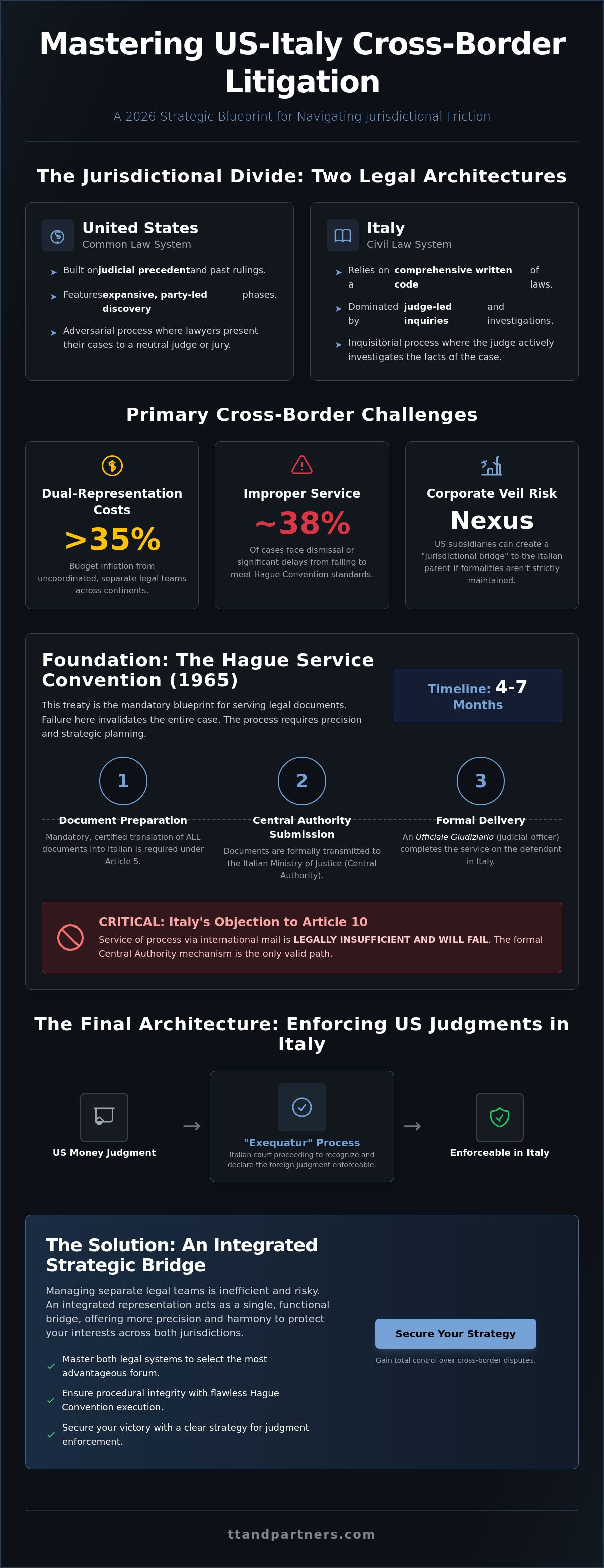
Cross-border litigation between US and Italy represents a collision between two fundamentally different legal architectures. The US legal system relies on common law, built on judicial precedent and expansive discovery phases. Italy operates under a civil law framework, where the written code and judge-led inquiries dictate the rhythm of the case. Success in these disputes requires more than legal knowledge; it demands an architectural understanding of how these systems overlap and where they conflict.
Determining the forum is the first strategic hurdle. Under the doctrine of forum non conveniens, a court can dismiss a case if a more appropriate venue exists. In 2026, courts increasingly weigh the digital location of evidence and the residency of key witnesses when making this determination. Choice-of-law clauses in international contracts have become more sophisticated to mitigate these risks. These clauses don't just name a country; they specify the procedural rules that govern the dispute's resolution, acting as the blueprint for any potential conflict.
The way a business is structured directly influences its legal vulnerability. A strategic approach to LLC incorporation can shield an Italian parent company, provided the corporate formalities are strictly maintained. Without this discipline, the US entity becomes a jurisdictional bridge that brings the entire international operation under the authority of a US court. It's a matter of structural integrity; if the walls between entities are thin, the liability will leak through.
The Impact of Corporate Structure on Jurisdiction
US subsidiaries often create a "nexus" that subjects Italian parent companies to US jurisdiction. In early 2026, several federal rulings clarified that merely owning a subsidiary isn't enough to pierce the corporate veil, but active management by Italian executives can change that dynamic. For E-1 visa holders, the business entity must be treated as a distinct legal person to prevent personal liability from bleeding across borders. Maintaining this separation is essential for long-term stability.
Parallel Proceedings: When Cases Open in Both Countries
The risk of "lis alibi pendens" occurs when the same dispute is filed in both the US and Italy. Filing first often provides a tactical advantage, as Italian courts generally respect the "first to file" rule under EU Regulation 1215/2012. US courts are less rigid, often applying international comity to decide whether to stay their proceedings. Proper service of process via the Hague Service Convention remains the mandatory mechanism to ensure that a judgment remains enforceable in both territories. Failure to follow these treaty mechanics can invalidate a case before it even reaches the merits.
Service of Process and the Hague Convention Mechanics
The structural integrity of a legal claim depends on its foundation. In the context of cross-border litigation between US and Italy, that foundation is the service of process. Data from international judicial studies indicates that nearly 38% of trans-Atlantic cases face significant delays or outright dismissal due to improper service. If the initial notification doesn't meet the rigid standards of the 1965 Hague Service Convention, the entire litigation structure collapses before the first hearing occurs.
Italy and the United States both adhere to the Hague Convention, which provides a standardized blueprint for transmitting judicial documents. However, Italy's specific reservations to this treaty create a complex environment for US litigants. For instance, Italy has formally objected to Article 10, which means serving documents via international mail is legally insufficient. You must engage the formal Central Authority mechanism. As of 2026, the Italian Ministry of Justice remains the primary gatekeeper, coordinating with the Ufficiale Giudiziario (judicial officer) to ensure delivery. Expect this process to take between 4 and 7 months, a timeline that requires early strategic planning.
Steps for Serving a Defendant in Italy
Precision in translation is not a suggestion; it's a mandatory requirement under Article 5 of the Convention. Every document must be translated into Italian by a certified professional to ensure the defendant understands the claims. Inaccurate terminology can lead to a refusal by the Italian Central Authority. Once translated, you submit the request through the designated US authority, typically a private contractor like ABC Legal or the US Marshals, depending on the jurisdiction. For detailed procedural nuances, the U.S. State Department guidance on Italy provides essential technical updates on current administrative fees and mailing addresses. Finally, you must secure the formal Certificate of Service from the Italian authorities. This document is the only evidence US federal courts will accept to satisfy due process requirements.
Serving Italian Entities in the United States
When the roles reverse, serving an Italian corporation with a US presence is often more direct but carries its own risks. Many Italian firms operate through subsidiaries or have registered agents in states like Delaware or New York. If a subsidiary is a "mere department" of the Italian parent, service on the US agent might suffice under local state laws. However, if you're targeting an Italian national residing in the US temporarily, you must ensure the method of service doesn't violate the person's home country protections, which could complicate future enforcement of the judgment in Italy. To ensure your service strategy aligns with your long-term litigation goals, you may wish to consult with our strategic partners regarding the specific jurisdictional "footprint" of your counterparty.
The 2022 Cartabia Reform in Italy introduced digital mandates for domestic service, but these don't yet bypass the Hague requirements for international cases. Successful cross-border litigation between US and Italy demands a blend of digital speed and traditional diplomatic patience. Missing a single stamp or using an uncertified translator can result in a "nullità della notifica," a voidance of service that resets the clock and increases costs exponentially.
Discovery vs. Civil Law: Managing Evidence and Information
Navigating the evidentiary phase of cross-border litigation between US and Italy reveals a fundamental structural divergence. The American concept of discovery, characterized by its expansive reach into an opponent's files, often strikes Italian entities as a violation of sovereignty. In Italy, the judiciary maintains a gatekeeping role; evidence is typically gathered under the court's direct supervision rather than through party-driven demands. This friction creates a professional culture shock that can stall proceedings if not managed with architectural precision.
The 1970 Hague Evidence Convention serves as the primary bridge. While it facilitates the taking of testimony abroad, Italy's specific reservation under Article 23 remains a critical hurdle. This reservation allows Italian authorities to refuse "pre-trial discovery" requests that aren't sufficiently specific. Success in 2026 depends on framing US requests as "judicial assistance for the collection of evidence" rather than broad fishing expeditions. Legal teams must coordinate with the DOJ Office of International Judicial Assistance to ensure that outgoing requests meet the rigorous standards of both jurisdictions.
The Role of Depositions and Document Production
Conducting depositions on Italian soil involves significant logistical constraints. US attorneys can't simply host a private deposition; they must often utilize the services of a US Consul or seek a commission from an Italian court. By 2026, the integration of digital footprints has complicated e-discovery. Data transfers must comply with the General Data Protection Regulation (GDPR), which imposed heavy penalties for non-compliant exports in 2025. Strategic planning requires a meticulous audit of where digital assets reside before any production begins.
Privilege and Confidentiality Differences
The protection of sensitive information differs sharply between the two systems. US law offers robust attorney-client privilege, but Italian professional secrecy operates under a different logic. Crucially, Italian law doesn't always extend this protection to in-house counsel, a reality that can leave corporate communications exposed during cross-border litigation between US and Italy. To mitigate this, US courts frequently utilize Protective Orders to limit the dissemination of trade secrets. This ensures transparency doesn't compromise the competitive integrity of the Italian firm. For specific guidance on managing these conflicting standards, parties often seek direct consultation through our contact page.
Enforcement and Recognition of Foreign Judgments
A favorable verdict represents the blueprint of success, yet the structure remains incomplete until the judgment is enforced. In the context of cross-border litigation between US and Italy, the transition from a court order to tangible recovery requires navigating two distinct legal topographies. Winning in court is only the initial design phase; enforcement is the final architecture that transforms a paper victory into liquid assets.
For US entities seeking to collect in Italy, this involves the "Exequatur" procedure. Conversely, Italian creditors rely on the Uniform Foreign-Country Money Judgments Recognition Act within the American legal system. As of 2025, 38 US states have adopted the 2005 version of this act, providing a streamlined pathway for recognition. Without a bilateral treaty between the two nations, these domestic statutes serve as the primary bridges for asset recovery.
Effective enforcement requires rigorous asset tracing. This involves:
In Italy: Querying the Anagrafe Tributaria (Tax Register) to identify bank accounts and the Conservatoria for real estate holdings.
In the US: Utilizing post-judgment discovery, including subpoenas to global financial institutions and depositions of the debtor's representatives.
The Italian Recognition Process (Delibazione)
The Italian Court of Appeal oversees the recognition phase, historically referred to as delibazione. Under Law 218 of 1995, the court doesn't revisit the case's merits but verifies the judgment's structural integrity. The primary gatekeeper is the "Public Policy" (Ordine Pubblico) test. The court ensures the US judgment doesn't clash with fundamental Italian legal principles, such as the prohibition of excessive punitive damages. Additionally, the judgment must be res judicata, meaning it's final and no longer subject to ordinary appeals in the United States.
Challenges to Enforcement in the United States
US courts generally favor the recognition of Italian money judgments, yet they demand proof of procedural fairness. Defense counsel often raise due process challenges, questioning whether the Italian proceeding provided a "full and fair trial" under an impartial system. The success of these challenges often hinges on the international litigation strategy employed during the initial trial phase. If the Italian court's jurisdiction was properly established, US judges typically grant recognition. Once recognized, the judgment carries the same weight as a local ruling, allowing for the seizure of US-based accounts or the placement of liens on property. If you require expert guidance on securing your global assets, you can contact our strategic team for a detailed consultation.
Strategic Representation: Bridging the US-Italy Legal Gap
Successful cross-border litigation between US and Italy demands more than just legal knowledge. It requires a unified structural vision. Relying on two separate local counsel teams often leads to a fragmented defense, where the "lost in translation" effect extends far beyond language. Research into international disputes suggests that misaligned procedural timing can cause a 22% increase in total litigation costs. A bridge firm operates as a lead architect, ensuring the legal strategy remains cohesive across both jurisdictions from the initial filing through to the final judgment.
TT & Partners brings a legacy of architectural precision to the courtroom. We don't view law as a series of isolated battles. Instead, we see it as a complex construction project where the foundation must be set in both countries simultaneously. Our firm's history is built on the idea that legal representation should be as durable and functional as a well-designed building. We create customized litigation roadmaps that account for the 2026 business environment, where digital evidence and remote testimony have become the standard under updated Hague Convention protocols.
The TT & Partners Approach
We manage parallel proceedings with a focus on harmony. If a case is active in a New York District Court and a Civil Court in Rome, our team ensures that every motion filed in one serves the broader objective of the other. Our linguistic and cultural fluency isn't just a convenience; it's a tool for negotiation. We understand the unspoken expectations of Italian judges and the aggressive discovery demands of US litigators. This dual perspective allows us to advocate with a level of nuance that separate firms simply can't match. To discuss your specific case, schedule a strategic consultation with our team.
Beyond Litigation: Risk Mitigation for the Future
Resilient business architecture starts long before a summons is served. By January 2026, trade volumes between Italy and the US are expected to reach record levels, making robust contract drafting your first line of defense. We help clients draft international agreements that include specific forum selection and arbitration clauses to avoid the unpredictability of cross-border litigation between US and Italy. Every word in a contract is a structural element; if one is weak, the entire project is at risk.
Our strategy integrates corporate mobility into the litigation plan. For many clients, leveraging an O-1 visa for entrepreneurs provides the necessary physical presence to manage US operations during a high-stakes dispute. We don't just solve the immediate legal crisis. We build a resilient cross-border business architecture that protects your assets and your vision for years to come. It's about creating a space where innovation can flourish without the constant shadow of legal instability.
Mastering the Transatlantic Legal Architecture in 2026
Success in the coming year requires more than just legal knowledge; it demands a structural understanding of two distinct legal architectures. Effective cross-border litigation between US and Italy hinges on precise adherence to the Hague Convention of 1965 for service of process and a deep mastery of the evidentiary divide between U.S. discovery rules and Italian civil law procedures. Navigating the 1958 New York Convention for the enforcement of high-stakes commercial awards requires a strategy that's both visionary and technically grounded. The context of your legal approach determines the final outcome in these complex jurisdictions.
TT and Partners brings decades of experience to this partnership, bridging the gap between Common Law and Civil Law with the same precision an architect applies to a city's fabric. We focus on high-stakes commercial and immigration-related litigation where functionality meets legal innovation. Every detail matters when you're protecting interests across the Atlantic. It's time to build a defense that's as timeless as it's effective. Secure your cross-border interests with a strategic legal consultation. Your international success starts with a foundation built on professional excellence and specialized expertise.
Frequently Asked Questions
Can a US court exercise jurisdiction over an Italian company with no physical office in the US?
Yes, a US court can exercise jurisdiction if the company targets the US market or enters into contracts with US residents. This follows the 1945 International Shoe Co. v. Washington precedent regarding minimum contacts. Even without a physical office, digital transactions or shipping 500 or more units annually to US customers creates a sufficient nexus for legal action. It's a balance of fairness and digital presence.
How long does the Hague Service Convention process typically take between the US and Italy in 2026?
The Hague Service Convention process between the US and Italy typically requires 4 to 8 months for completion in 2026. While the treaty aims for efficiency, the Italian Central Authority often faces administrative backlogs that delay formal delivery. Efficiency improves if documents are translated precisely into Italian by certified court translators to avoid rejection by the public prosecutor's office. This timeline is a critical factor in project planning.
Are punitive damages awarded in US courts enforceable in Italy?
Italian courts traditionally refuse to enforce US punitive damages because they conflict with public policy principles regarding compensation. However, the 2017 United Sections of the Supreme Court of Cassation ruling 16601 allows enforcement if the award isn't disproportionate to the actual harm. Italian judges scrutinize these awards to ensure they serve a deterrent function without becoming an unjust enrichment. The focus remains on restorative justice rather than windfall gains.
What is the difference between a "Letter of Request" and a subpoena in cross-border evidence collection?
A Letter of Request is a formal judicial demand sent under the 1970 Hague Evidence Convention to obtain testimony or documents located in Italy. In contrast, a US subpoena lacks extraterritorial power and won't be recognized by Italian authorities without a court order. Navigating cross-border litigation between US and Italy requires using these formal channels to ensure evidence remains admissible in trial. It's a structured process that demands technical precision.
Do I need separate lawyers in both the US and Italy for a single dispute?
You'll almost certainly need separate counsel in both jurisdictions to manage procedural nuances and local bar requirements. A US attorney manages the strategy and domestic filings, while an Italian avvocato handles the service of process and local evidence collection. This dual representation ensures that the 100 percent compliance required for international treaties is met throughout the dispute. It's a partnership that bridges two distinct legal cultures.
Can an Italian judgment be used to freeze assets located in the United States?
An Italian judgment can be used to freeze US assets through the Uniform Foreign-Country Money Judgments Recognition Act, which 38 US states have adopted as of 2024. Once a US court recognizes the Italian order, it's treated like a domestic judgment. This allows for the use of writs of execution or garnishment orders against bank accounts and real estate located in the US. The process transforms a foreign decree into a local reality.
What happens if a US citizen is sued in an Italian court but does not respond?
If a US citizen fails to respond to an Italian lawsuit, the court will issue a default judgment, known as a sentenza in contumacia. This ruling remains valid for 10 years and can be enforced against any assets the defendant holds within the European Union. Ignoring the summons won't stop the proceedings; it simply removes your ability to contest the facts presented by the plaintiff. Silence is a risky strategy in international law.
Is arbitration a better alternative to cross-border litigation for US-Italy contracts?
Arbitration is frequently a more efficient alternative for cross-border litigation between US and Italy due to the 1958 New York Convention. This treaty makes arbitral awards easier to enforce in 172 countries than standard court judgments. It provides a neutral forum and allows parties to select 3 expert arbitrators who understand the specific technical complexities of the international commercial sector. This creates a more predictable and sustainable resolution environment.


Comments