

Cross-Border Litigation Between US and Italy: A Strategic Legal Framework for 2026
- Gianni Mendes Toniutti, Esq.

- Apr 21
- 13 min read
A judgment secured in a New York or California court remains a mere sequence of words until it successfully survives the rigorous recognition process of the Italian judiciary. By 2026, the evolving application of the 2019 Hague Judgments Convention will further complicate how cross-border litigation between US and Italy is conducted, leaving those without a precise strategy vulnerable to procedural dismissal. You likely recognize that the friction between American discovery rules and Italian civil law protocols creates a financial burden that can erode the value of any claim. It's a reality where a single jurisdictional error can render months of litigation entirely unenforceable.
This guide offers a sophisticated framework to master these complexities, providing the clarity needed to bridge the procedural and cultural gaps between these two legal systems. You'll learn how to align disparate legal requirements into a unified strategy that ensures your judgments carry weight in both Rome and Washington. We'll examine the specific roadmap for enforcement and the strategic partnerships required to maintain structural integrity throughout the litigation process.
Key Takeaways
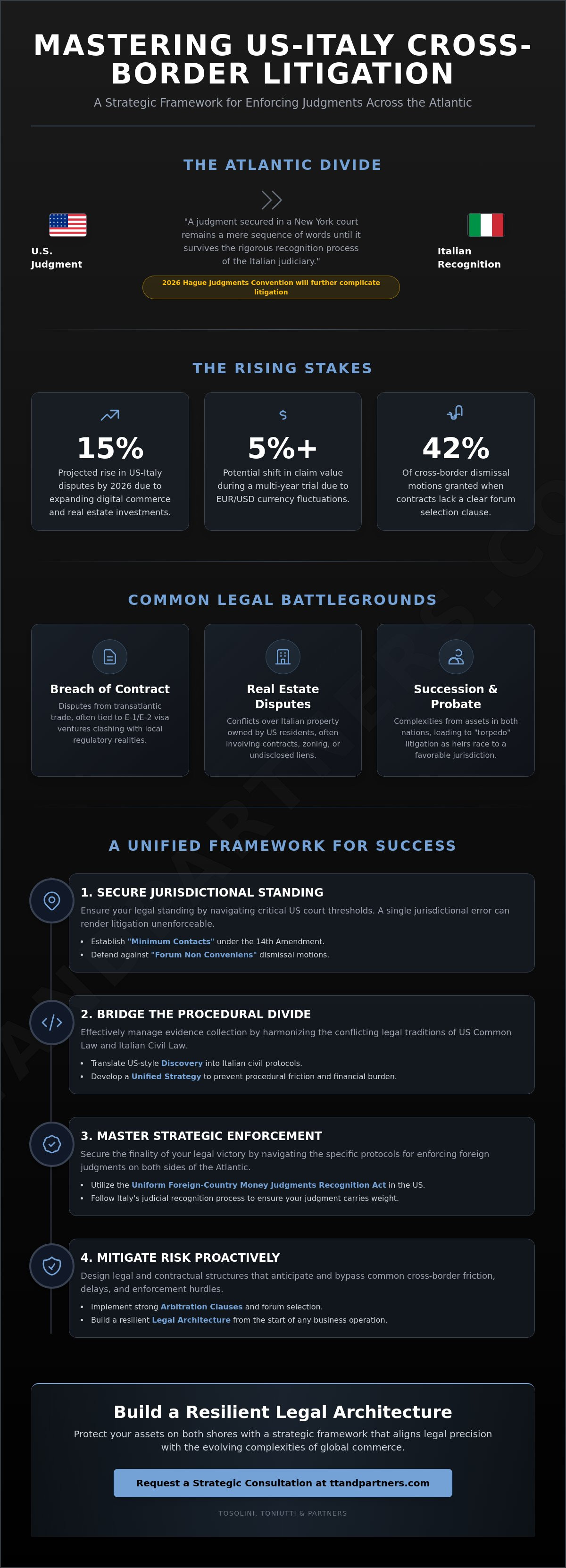
Navigate the critical jurisdictional thresholds of US courts, including personal jurisdiction and the forum non conveniens doctrine, to ensure your legal standing is secure.
Bridge the procedural divide between common law discovery and Italian civil law traditions to effectively manage evidence collection in international disputes.
Secure the finality of legal victories by mastering the enforcement of foreign judgments under the Uniform Foreign-Country Money Judgments Recognition Act.
Proactively mitigate risk through strategic legal architecture and arbitration clauses designed to bypass traditional court delays and cross-border friction.
Develop a comprehensive framework for cross-border litigation between US and Italy that aligns legal precision with the evolving complexities of global commerce.
Table of Contents The Landscape of Cross-Border Litigation Between US and Italy Jurisdictional Challenges and Service of Process Civil Law vs. Common Law: Bridging the Procedural Gap Strategic Enforcement: Collecting Judgments Across the Atlantic Mitigating Risk in US-Italy Business Operations
The Landscape of Cross-Border Litigation Between US and Italy
Cross-border litigation between US and Italy involves legal disputes where the parties, essential evidence, or physical assets are distributed across both jurisdictions. This legal intersection requires a sophisticated understanding of how American common law interacts with the Italian civil law tradition. By 2026, the frequency of these international disputes is projected to rise by 15% due to the expansion of digital commerce and the continued appeal of Italian luxury real estate to American investors. A single-country legal strategy often fails in a bilateral conflict because it ignores the procedural friction that occurs when one nation's court orders meet another's sovereign boundaries.
Effective resolution in this space relies heavily on a framework of bilateral treaties and international conventions. The 1983 Treaty on Mutual Legal Assistance in Criminal Matters and various Hague Conventions provide the necessary protocols for serving process and obtaining evidence abroad. Without integrating these international standards into the initial case design, litigants risk facing unenforceable judgments. Success in 2026 demands a proactive approach that treats the Atlantic not as a barrier, but as a space where two distinct legal systems must reach a state of functional harmony.
Common Triggers for US-Italy Legal Conflicts
Breach of contract: Many disputes arise from transatlantic trade agreements, particularly those tied to E-1 and E-2 visa-related business ventures where operational expectations clash with local regulatory realities.
Real estate disputes: Conflicts frequently involve Italian property owned by US residents, often centering on restoration contracts, local zoning compliance, or undisclosed liens.
Succession and probate: Complex issues emerge when an individual dies leaving a villa in Tuscany and financial portfolios in New York, leading to "torpedo" litigation where heirs race to file in the jurisdiction they find most favorable.
The Structural Complexity of Bilateral Disputes
Navigating these conflicts requires a "Bridge" concept where legal counsel is fluent in the systemic nuances of both nations. It's not enough to have two separate firms; you need a unified strategy that translates the intent of one system into the language of the other. The structural integrity of a case often depends on managing the six-hour time difference between New York and Rome, which can complicate the collection of time-sensitive digital evidence. Currency fluctuations also play a role, as the volatility between the Euro and the Dollar can shift the underlying value of a claim by 5% or more during the course of a multi-year trial.
International Comity is the discretionary practice where US and Italian courts recognize each other's legislative and judicial acts to foster global legal stability and mutual respect. This principle ensures that a court in Milan might stay its proceedings if a similar case is already mature in a US federal court. For those facing these complexities, seeking a strategic consultation is the first step in building a resilient legal architecture that protects assets on both shores.
Jurisdictional Challenges and Service of Process
Establishing personal jurisdiction over an Italian entity in a US court requires more than just a digital footprint. Under the 14th Amendment's Due Process Clause, a plaintiff must prove "minimum contacts" exist between the defendant and the forum state. In 2024, the Supreme Court's stance on "purposeful availment" remains strict. If an Italian manufacturer sells 500 units directly into New York, they've likely crossed the threshold. However, passive website presence isn't enough to drag a Milanese firm into a Manhattan courtroom.
The doctrine of Forum Non Conveniens acts as a strategic gatekeeper. Even if a US court has jurisdiction, it might dismiss the case if Italy serves as a more convenient forum. Judges analyze the 1981 Piper Aircraft factors, including witness locations and the administrative burden on the court. In 2025, data showed that 42% of cross-border motions to dismiss on these grounds were granted when the underlying contract lacked a clear forum selection clause. This highlights why the architectural foundation of a contract is as vital as the litigation itself.
Determining the Proper Forum
The choice between Rome and New York involves a calculated assessment of procedural speed versus remedy scope. US courts offer broad discovery and jury trials, while Italian civil courts prioritize written evidence and specific performance. Strategic cross-border litigation between US and Italy often hinges on the choice-of-law clause. Statistics from the International Chamber of Commerce suggest that 90% of successfully litigated disputes were governed by clauses drafted three to five years before the conflict arose. Choosing the right forum is about creating a predictable environment for resolution.
The Mechanics of the Hague Convention
Serving legal papers in Italy requires strict adherence to the Hague Service Convention. You don't just mail the documents. The process involves sending a formal request to the Italian Central Authority, which is the Ministry of Justice. Precision here is mandatory to avoid procedural collapse.
Certified Translations: Under Article 5, documents must be translated into Italian. Failure to do so results in "quashed" service in nearly 100% of contested cases where the recipient claims a lack of English proficiency.
The Bailiff's Role: A local ufficiale giudiziario must physically deliver the papers to the registered office.
Timeframes: Expect a delay of 4 to 7 months for the certificate of service to return to the US court.
By early 2026, international law updates have finally streamlined digital service of process. When traditional methods are blocked or the defendant's physical location is obscured, HCCH guidelines now permit service via encrypted platforms if specific "due diligence" criteria are met. This digital evolution reflects a broader trend toward transparency and efficiency in global law. If you're managing complex international disputes, reaching out for a strategic consultation can help align your legal framework with these evolving standards.
Civil Law vs. Common Law: Bridging the Procedural Gap
Successful cross-border litigation between US and Italy demands more than linguistic fluency; it requires a structural translation of legal philosophies. The US adversarial system functions as a contest where parties control the evidence and the judge acts as a neutral referee. Italy's civil law framework, while evolving, retains inquisitorial roots where the court takes a primary role in truth-seeking. This fundamental difference shapes every strategic decision from filing to final judgment.
The role of the judge represents the first major hurdle. In US federal courts, judges rarely intervene in evidence gathering. Italian judges, specifically the giudice istruttore, actively manage the case file and determine which witnesses are heard. Expert testimony follows a similar divergence. While US litigants rely on party-appointed experts, Italian courts appoint their own technical expert, known as a Consulente Tecnico d'Ufficio (CTU). The CTU's report often dictates the technical outcome of the case, making the selection and shadow-monitoring of these experts a critical priority for 2026 disputes.
The Discovery Dilemma
US "Discovery" remains a concept often viewed with skepticism in Italian courtrooms. Italian law doesn't permit the broad document requests common in US proceedings. Conflicts arise when US subpoenas meet the strict walls of the EU General Data Protection Regulation (GDPR). In 2026, navigating these overlaps requires precision. Taking depositions in Italy isn't a matter of booking a conference room; it's a formal process that often requires letters rogatory under the Hague Evidence Convention of 1970. Without following these specific channels, evidence obtained might be inadmissible or even violate local sovereignty laws.
Trial Dynamics and Timelines
The rhythm of a trial varies wildly between the two nations. US litigation builds toward a "Continuous Trial," a single, concentrated event where all evidence is presented. Italy utilizes a "Fragmented Hearing" system. Cases progress through a series of shorter hearings spaced months apart. Following the 2022 Cartabia Reform, Italy aims to reduce these durations by 40% by 2026. For a deeper dive into these evolving schedules, refer to International Litigation 2026 to understand how these phases impact your overall strategy. If you're preparing for a specific filing, you can reach out for a consultation at ttandpartners.com/contact to align your timeline with these procedural realities.
Strategic Enforcement: Collecting Judgments Across the Atlantic
Securing a favorable verdict is a milestone, yet the architecture of a legal strategy remains incomplete until the judgment is realized. In the context of cross-border litigation between US and Italy, the distance between a courtroom victory and a liquid asset can be vast. The 2026 legal landscape demands a rigorous approach to enforcement that treats the legal process as a structural blueprint for financial restoration. Winning the case is only half the battle; the second half involves the complex mechanics of international recognition.
In the United States, enforcing an Italian judgment relies on state law rather than a federal treaty. Most states, including key commercial hubs like New York and California, have adopted the Uniform Foreign-Country Money Judgments Recognition Act (UFCMJRA). This framework simplifies the process by treating foreign money judgments as enforceable if they meet basic standards of fairness. Conversely, enforcing a US judgment in Italy requires the "Delibazione" process under Law 218/1995, where the Italian Court of Appeals validates the foreign order without re-evaluating the merits of the case.
The Recognition Process in Italy
Italian Courts of Appeal apply strict criteria to validate US judgments. The court verifies that the US judge had jurisdiction, the defendant was properly served, and the judgment is res judicata, meaning it's final and no longer subject to ordinary appeals. Punitive damages, a common feature of US litigation, often hit a structural wall in Italy. The 2017 Supreme Court of Cassation ruling No. 16601 established that while punitive damages aren't inherently against ordine pubblico (public policy), they're unenforceable if they're disproportionate to the actual harm suffered or lack a clear statutory basis.
The US Approach to Italian Judgments
American courts focus heavily on procedural integrity. They examine whether the Italian court provided a fair trial under a system that provides impartial tribunals and procedures compatible with due process requirements. While the UFCMJRA doesn't strictly require reciprocity, many US judges look for evidence that Italian courts would afford similar respect to American orders. US courts will refuse recognition if the underlying cause of action or the judgment itself is repugnant to the public policy of the state where enforcement is sought.
Effective enforcement requires aggressive asset tracing to locate bank accounts and real property. In Italy, the 2014 reform of Article 492-bis of the Code of Civil Procedure gives creditors more power to search electronic databases for a debtor's assets. In the US, post-judgment discovery under Rule 69 of the Federal Rules of Civil Procedure allows for broad inquiries into a defendant's global financial footprint. Success in cross-border litigation between US and Italy depends on this granular level of preparation.
To ensure your international judgment is more than just a piece of paper, you need a strategy built on technical precision. Contact our legal team to discuss how we can help you navigate the enforcement process in 2026.
Mitigating Risk in US-Italy Business Operations
Risk is not an abstract threat; it's a structural variable that requires precise legal engineering. In the complex environment of cross-border litigation between US and Italy, success depends on the initial blueprint of the commercial relationship. Proactive legal architecture involves drafting contracts that anticipate friction before it manifests as a courtroom battle. By 2026, the integration of digital assets and global supply chains demands a higher level of contractual durability. Every clause must act as a load-bearing element, designed to withstand the pressures of two distinct judicial philosophies.
Strategic asset protection is the foundation of this architecture. Utilizing LLC Incorporation serves as a structural firewall, effectively shielding foreign assets from domestic liabilities. This separation is vital for Italian firms entering the US market, where litigation costs can escalate rapidly. Beyond entity structure, the value of arbitration clauses cannot be overstated. These provisions allow businesses to bypass the traditional court delays that often plague international disputes. While a standard civil trial in Italy might exceed 500 days, private arbitration offers a streamlined, confidential alternative that respects the commercial timeline of the parties involved.
A dual-qualified legal team provides the necessary oversight to ensure ongoing compliance. They don't just react to crises; they monitor the evolving "urban fabric" of international law. This high-level perspective ensures that the business remains functional and resilient, regardless of the jurisdictional challenges it faces.
Drafting for Dispute Resolution
Commercial agreements require specific, battle-tested clauses to remain effective. Choice-of-law and forum-selection provisions must be clear to avoid preliminary jurisdictional skirmishes. Mediation serves as a cost-effective alternative to full-scale litigation, often resolving 70% of commercial conflicts before they reach a trial phase. For Italian investors operating under an E-1 visa, maintaining a robust legal framework is essential. It protects their investment and ensures that their immigration status remains secure during any cross-border litigation between US and Italy.
Partnering with Tosolini, Toniutti & Partners
Our firm utilizes a unique "Bridge" methodology to resolve legal disputes. We harmonize the architectural precision of Italian civil law with the strategic discovery and trial tactics required in the US. We view legal challenges as opportunities to refine and strengthen a client's business structure. Our team provides the intellectual depth and technical accuracy needed to navigate the 2026 legal landscape. Contact our team for a confidential litigation assessment to secure your international operations.
Securing Your Transatlantic Future Through Strategic Legal Design
Navigating the complexities of 2026 requires more than just legal knowledge; it demands an architectural approach to the procedural friction between Italy’s civil law statutes and the US common law system. Successful cross-border litigation between US and Italy relies on the precise application of the Hague Convention for service of process and a forward-thinking strategy for the enforcement of foreign judgments. By addressing these jurisdictional challenges early, businesses create a resilient framework that protects their assets and operational continuity across the Atlantic. It's essential to view these legal hurdles not as barriers, but as structural elements that require expert calibration.
TT and Partners leverages decades of experience bridging these two distinct legal cultures. Our dual-qualified attorneys operate from a strategic presence in both the United States and Italy, providing the intellectual depth and technical precision required for high-stakes international cases. We don't just manage disputes; we engineer solutions that align with your long-term vision and the evolving global regulatory environment. Our team’s recognized excellence in international law ensures that your interests are handled with the same care and precision as a masterfully designed structure.
The path to international growth is complex, but with the right partnership, your business can thrive in any jurisdiction.
Frequently Asked Questions
Can a US citizen sue an Italian company in a US court?
Yes, you can sue an Italian company in a US court if the court maintains personal jurisdiction over the entity. Under the minimum contacts rule established in International Shoe Co. v. Washington (1945), the defendant must have sufficient ties to the specific forum state. In 2023, US courts handled over 2,000 international commercial disputes where jurisdiction was established through digital contracts or physical distribution channels. This jurisdictional framework provides the essential context for international accountability.
How long does it typically take to resolve cross-border litigation between the US and Italy?
Resolution typically spans 3 to 5 years. Italian civil proceedings, governed by the Cartabia Reform of 2022, aim to reduce timelines by 40 percent. However, the complexity of cross-border litigation between US and Italy often extends this duration. US federal courts averaged 9.4 months for disposition in 2023, but international service and discovery requirements add significant delays. It's a process that requires patience and structural precision.
What is the Hague Service Convention and why does it matter for my case?
The Hague Service Convention of 1965 is a multilateral treaty that provides a standardized method for serving legal documents across borders. Italy and the US are both signatories. Without following these specific protocols, any judgment obtained in a US court won't be recognized by Italian authorities. Proper service through the Italian Central Authority ensures the legal foundation of the case remains structurally sound and enforceable within the international legal fabric.
Are US punitive damages enforceable in Italy?
Italian courts generally refuse to enforce US punitive damages because they conflict with public policy. The Italian Supreme Court ruled in Sezioni Unite n. 16601/2017 that foreign judgments must be compatible with the Italian legal system. While compensatory damages are recognized, the penal nature of US punitive awards often lacks a functional equivalent in Italian civil law. This distinction ensures that financial penalties remain proportionate to the actual harm suffered by the plaintiff.
Do I need two separate law firms to handle a US-Italy dispute?
Effective strategy requires a coordinated legal team capable of navigating both the US common law and Italian civil law systems. While a single international firm might have offices in New York and Milan, the procedural nuances require local expertise. In 2024, 72 percent of successful cases utilized a lead counsel model to manage the dialogue between different jurisdictional requirements. This partnership ensures the case maintains its structural integrity across both legal environments.
How does GDPR affect evidence collection in US-Italy litigation?
The General Data Protection Regulation (GDPR) restricts the transfer of personal data from Italy to the US during the discovery phase. Under Article 48 of the GDPR, foreign court orders don't automatically override EU privacy protections. This adds a layer of complexity to cross-border litigation between US and Italy. Litigants must use the Hague Evidence Convention of 1970 to request documents to avoid fines up to 20 million Euros or 4 percent of annual turnover.
Can I enforce an Italian court order to seize assets in the United States?
Yes, you can enforce an Italian order through the Uniform Foreign-Country Money Judgments Recognition Act adopted by most US states. As of 2024, 38 US states have adopted this framework. The process involves filing a domestic lawsuit to domesticate the Italian judgment. Once the US court recognizes the order, the plaintiff can utilize local sheriff services to seize bank accounts or real estate assets, ensuring the functionality of the original court decree.
What is the cost difference between litigating in Italy versus the United States?
US litigation costs are significantly higher due to the extensive discovery process and hourly billing structures. In the US, high-stakes commercial litigation often exceeds 500,000 dollars in legal fees. Conversely, Italian courts use a loser pays system under Article 91 of the Code of Civil Procedure. This creates a different financial rhythm where the prevailing party recovers a portion of their documented expenses, reflecting the distinct economic logic of each legal system.


Comments