

Do American Citizens Need a Visa for Europe? The 2026 ETIAS and EES Guide
- Gianni Mendes Toniutti, Esq.

- Apr 1
- 12 min read
What if your next arrival in the Schengen Zone is halted not by a lost passport, but by the absence of a digital authorization you didn't realize was mandatory? For decades, the question do american citizens need a visa for europe had a simple "no" for short stays, but the introduction of the EES and ETIAS systems in 2026 changes the very architecture of international travel. You've likely felt the growing anxiety surrounding these new digital borders, wondering if your next trip will be met with a frustrating denial at the boarding gate. It's a valid concern as the European Union transitions from manual stamps to a sophisticated biometric framework.
We promise to provide the structural clarity you need to move through these new systems with confidence. By understanding the 7 euro ETIAS application and the strict mechanics of the 90/180-day rule, you can ensure your travel plans remain as seamless as a well-designed urban space. This guide examines the legal distinction between a visa and travel authorization, outlines the specific data required for the EES entry-exit system, and defines the exact boundaries of your visa-free stay.
Key Takeaways
Identify the critical distinction between the 2026 ETIAS security pre-screening and a traditional visa to ensure seamless entry into the evolving European travel landscape.
Master the complexities of the 90/180-day rule to determine if and when do american citizens need a visa for europe for extended stays or professional consultations.
Navigate the shift toward a digital border infrastructure by understanding how the biometric Entry/Exit System (EES) replaces traditional manual passport stamping.
Differentiate between permitted business negotiations and gainful employment to maintain legal compliance during short-term European engagements.
Explore the strategic transition from a temporary visitor to a legal resident through the framework of the Italian Permesso di Soggiorno for long-term stays.
Table of Contents Navigating the 2026 European Entry Requirements for U.S. Citizens ETIAS vs. Schengen Visas: Understanding the 90-Day Threshold Permitted Activities: Business Meetings vs. Gainful Employment The EES and ETIAS Compliance Framework for Travelers Strategic Residency: When a Travel Authorization is Not Enough
Navigating the 2026 European Entry Requirements for U.S. Citizens
The landscape of international mobility is shifting toward a more data-driven architecture. In 2026, the European Union will activate a new protocol for arrivals from visa-exempt nations. If you're wondering do american citizens need a visa for europe, the distinction lies in the nomenclature. While it's not a visa in the traditional sense, the European Travel Information and Authorisation System (ETIAS) represents a mandatory pre-screening process. This evolution reflects a global trend toward digitizing border functionality; it ensures that security and efficiency coexist within the complex urban fabric of the continent. For decades, Americans crossed these borders with just a passport stamp, but the new system introduces a layer of digital verification to address modern security challenges.
The Launch of ETIAS in 2026
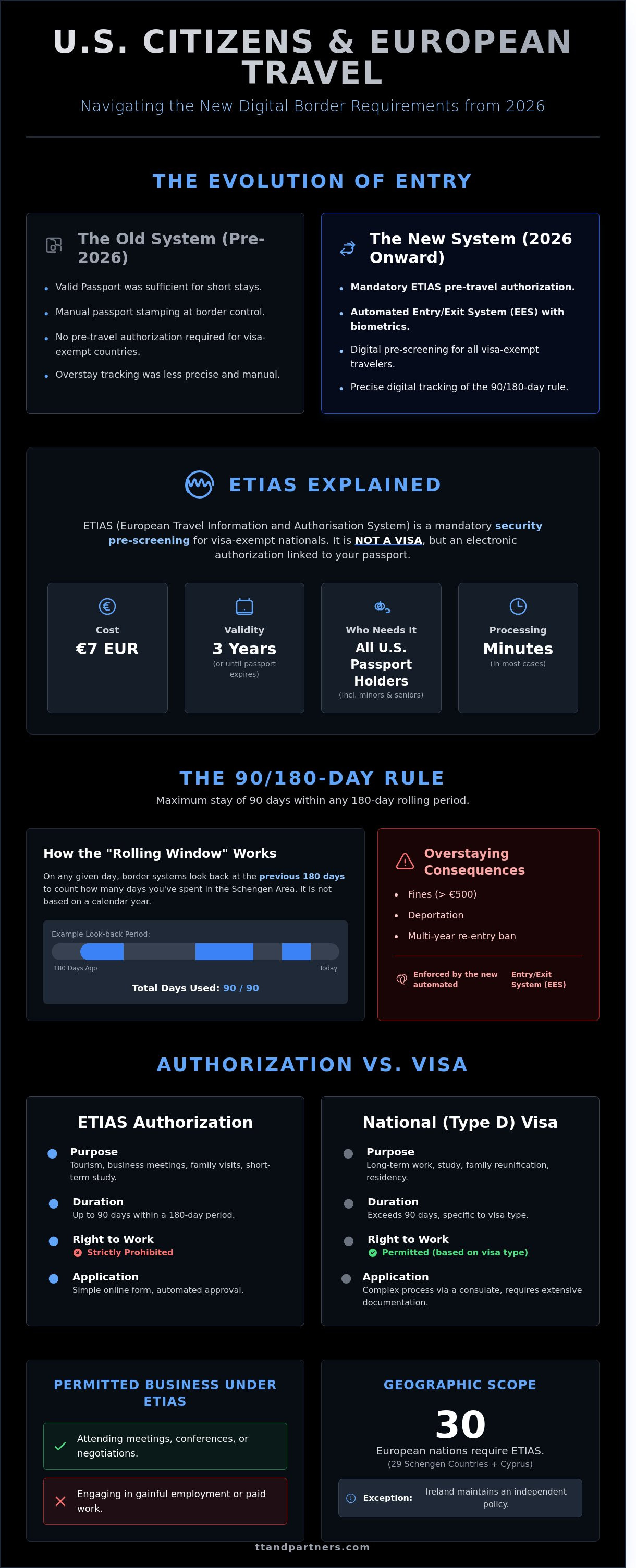
The 2026 rollout marks a definitive change in travel logistics. Every US passport holder must obtain this authorization before departure. It's a universal rule; it applies to minors and travelers over age 70 without exception. The authorization's lifespan is tied to your document's integrity. It's valid for 3 years or until your passport expires. Travelers can utilize the ETIAS for multiple entries, provided the total stay doesn't exceed the 90-day limit within a rolling 180-day window. This system prioritizes speed, with most applications processed in minutes through an automated database check.
The Schengen Area vs. The European Union
Navigating the map requires an understanding of political and functional boundaries. The ETIAS mandate extends across 30 European nations. This list includes the 29 Schengen countries and Cyprus, which is currently in the process of joining the borderless zone. It's essential to distinguish between the European Union and the Schengen Area to avoid legal complications. Ireland remains an outlier; it maintains an independent visa policy and doesn't require ETIAS. American citizens must respect these zones to avoid overstaying. When planning extended itineraries, travelers often ask do american citizens need a visa for europe for stays longer than 90 days, as the digital tracking of the Entry/Exit System (EES) will make enforcement of these boundaries much more precise from 2026 onward.
ETIAS vs. Schengen Visas: Understanding the 90-Day Threshold
The distinction between a travel authorization and a traditional visa is vital for maintaining compliance within the European landscape. While the official ETIAS website provides clarity on the digital process, the underlying logic remains the 90/180-day rule. This framework defines the boundaries of visa-exempt travel. For US passport holders, the ETIAS acts as a pre-screening tool for short-term visits. These include tourism, attending business conferences, or visiting family. It doesn't grant the right to work or reside indefinitely. The central question of whether do american citizens need a visa for europe depends entirely on the duration and purpose of the stay. When the planned stay exceeds the 90-day limit, or the nature of the visit shifts to gainful employment, the ETIAS is no longer sufficient. At this juncture, the traveler must transition from a simple authorization to a formal National (Type D) Visa. This shift requires a rigorous application process at a consulate, mirroring the structural precision required in complex architectural planning.
Calculating the 180-Day Rolling Window
The rolling window isn't based on a calendar year starting January 1st. It operates on a look-back principle. On any day of travel, border officials examine the preceding 180-day period. If a traveler spent 60 days in the Schengen Area during May and June, then returned for 30 days in September, they've reached their limit. They can't re-enter until the earliest days of their first trip drop off the 180-day window. With the 2025 implementation of the Entry/Exit System (EES), these calculations are automated. Digital records replace manual passport stamps. Overstaying by even 24 hours can result in fines exceeding 500 Euros or a multi-year re-entry ban.
When the Travel Authorization is Not Enough
Certain life transitions require more than a short-term entry permit. If you're planning to relocate to Italy for retirement or long-term project management, the Elective Residency Visa is the appropriate legal instrument. Similarly, US citizens seeking to join the European workforce must secure a Work Visa before departure. These documents provide a foundation for residency that the ETIAS cannot offer. Understanding the nuance between these legal paths ensures that your stay remains within the bounds of international law. For those seeking to establish a more permanent presence in the Italian urban fabric, our team provides guidance on the necessary administrative steps to secure long-term status. Decisions regarding do american citizens need a visa for europe are ultimately determined by the 90-day threshold; crossing it demands a shift from automated authorization to formal diplomatic application.
Permitted Activities: Business Meetings vs. Gainful Employment
The ETIAS system functions as a digital framework, not a work authorization. When asking "do american citizens need a visa for europe," it's vital to recognize that this travel authorization supports the mobility of ideas, not the sale of labor. The legal definition of business under the 2026 regulations is limited to non-productive activities. You're permitted to participate in consultations, attend industry trade fairs, or engage in high-level negotiations. It's a tool for professional synchronization, not a gateway to European payrolls. The European Union External Action Service provides detailed information for U.S. citizens to help distinguish these boundaries clearly.
Business Travel Architecture
Permitted corporate activities focus on the exchange of intellectual capital rather than the execution of physical or technical labor. Under the 90-day allowance, you can lead a board meeting in Berlin or attend a design symposium in Milan without a work permit. However, productive work for a European entity is strictly prohibited. If you're a developer writing code for a Paris-based startup, you've exceeded the scope of ETIAS. Border officials in 2026 will likely request invitation letters or event registrations to verify your intent. Having these documents ready ensures your entry remains as seamless as a well-designed floor plan. Always carry a digital or physical copy of your return itinerary to prove you don't intend to overstay.
Investment and Real Estate Inspections
For those looking to expand their professional footprint, ETIAS allows for the inspection of commercial assets or finalizing an LLC incorporation. These visits often serve as the structural foundation for long-term residency strategies, providing the necessary context for future E-2 or O-1 visa applications. Digital nomads working remotely for a U.S. employer generally fit within this scope, provided they don't seek local clients or contracts within the Schengen Area. Complex transactions involving multi-million dollar acquisitions require a deeper level of legal foresight. If your goals involve intricate business transitions, reaching out through our contact page for a strategic referral is a prudent step to ensure your travel remains compliant with evolving EU standards.
The 2026 landscape demands a high level of precision from travelers. While "do american citizens need a visa for europe" is a common query, the real challenge lies in understanding the functional limits of your stay. Misinterpreting the line between a consultation and employment can lead to entry denials or future travel bans. By maintaining clear documentation and a defined itinerary, you preserve the integrity of your professional journey across the European urban fabric.
The EES and ETIAS Compliance Framework for Travelers
The Entry/Exit System (EES) serves as the digital architecture for 2026 European borders. It functions as a biometric backbone, shifting the paradigm from manual passport stamping to a sophisticated digital record. By capturing facial images and four fingerprint scans, the EES creates a precise chronological map of every traveler’s movements. This transition eliminates the ambiguity of ink-based logs, replacing them with a centralized database that calculates stay durations with mathematical accuracy. When travelers ask do american citizens need a visa for europe, the answer lies in understanding that while a traditional visa isn't required for short stays, compliance with this digital framework is mandatory.
The system's software automatically flags individuals who exceed the 90-day limit within a 180-day period. This increased efficiency allows authorities to identify overstayers with 100% accuracy, leading to immediate entry bans. These bans typically last between 3 to 5 years, depending on the severity of the violation. The precision of this digital oversight ensures that the structural integrity of the Schengen Area remains intact through transparent, data-driven enforcement. Understanding the nuances of the EES helps clarify why do american citizens need a visa for europe remains a common question even as the process becomes fully automated.
The Biometric Entry Process
At the first port of entry into the Schengen Area, travelers interact with self-service kiosks designed for high-efficiency processing. The system records biometric data and stores it for a standard period of three years. This longevity allows the EU to track compliance across multiple trips over several years. If a traveler arrives without a valid ETIAS or carries a record of prior overstays, the refusal of entry protocol activates instantly. This automated decision-making process leaves no room for border-side negotiation, emphasizing the need for prior preparation.
Data Privacy and Legal Recourse
Personal data resides within the EU’s Central System, governed by strict GDPR standards to ensure privacy. Travelers have the legal right to access their stored information and request the correction of any factual errors in their EES profile. If an ETIAS application is denied or an entry ban is issued, an appeal process is available through the member state that made the decision. Complex entry disputes often require specialized legal counsel to navigate the nuances of European administrative law. For those seeking clarity on how these regulations impact their specific travel plans, professional consultation provides the necessary foresight.
Strategic Residency: When a Travel Authorization is Not Enough
While ETIAS serves the transient visitor, it doesn't support a life built across two continents. We view immigration as a structural design challenge where the goal is permanence and fluidity. For those asking do american citizens need a visa for europe for stays exceeding 90 days, the answer is complex. The focus must shift toward the Italian residency permit. This document transforms a visitor into a legal inhabitant. It provides the necessary foundation to live, work, and integrate into the Italian social fabric without the anxiety of a ticking clock. Relying on short-term waivers is a fragile strategy for those who seek a genuine connection to the continent.
Pathways to Permanent European Access
Italian citizenship by descent represents a restoration of ancestral lineage. It's a permanent solution that removes the need for ETIAS entirely. An EU passport grants the right to live and work anywhere in the 27 member states. This removes the 90-day limitation that restricts American travelers. For those planning a reciprocal life, we provide insights into the cost and strategy of obtaining a Green Card to ensure your US access remains as robust as your European one. This dual-sided approach ensures that your global footprint is legally sound and professionally managed.
Securing Your Cross-Border Future
The 2026 transition to the Entry-Exit System and ETIAS makes professional legal guidance a necessity. Digital border enforcement will track every entry and exit with 100 percent accuracy. This leaves no room for administrative errors or overstays. Our firm specializes in creating stable, long-term frameworks for international mobility. We invite you to contact our firm for a comprehensive immigration audit. We help you move beyond the basic question: do american citizens need a visa for europe, and guide you toward a future of unlimited access. Our role is to bridge the legal gap between the United States and Italy through precise, human-centered planning.
Architecting Your Permanent Presence in Europe
The 2026 implementation of ETIAS and the Entry/Exit System (EES) introduces a new era of digital border management. While the technical answer to do american citizens need a visa for europe remains tied to the 90 day short-stay exemption, the margin for error has disappeared. Automated tracking under the EES begins in November 2024, followed by mandatory ETIAS registration by May 2025. These systems ensure that every entry is recorded with mathematical precision; this makes compliance a prerequisite for future mobility. If your goals involve more than a brief visit, it's essential to look beyond temporary authorizations.
Our team provides the structural foundation needed for complex cross-border transitions. We specialize in US-Italy immigration law, focusing on E-1, E-2, and O-1 visa strategies that serve as catalysts for international growth. Whether you're pursuing Italian residency or full citizenship, we offer the intellectual depth and technical expertise to navigate these frameworks. Schedule a consultation with our cross-border legal experts to begin designing your path forward. Your future in Europe deserves a plan that's as ambitious as your vision.
Frequently Asked Questions
Is ETIAS a visa for US citizens?
No, ETIAS isn't a visa; it's a digital travel authorization designed for pre-travel security screening. US citizens traveling for tourism or business don't need a traditional visa for stays under 90 days. The system functions similarly to the US ESTA, linking your biometric data to your passport. This screening ensures the integrity of European borders while maintaining the ease of travel for low-risk visitors.
How much does the ETIAS application cost in 2026?
The ETIAS application fee is 7 Euros for adults between 18 and 70 years old. Applicants outside this specific age range are exempt from the payment, though they must still complete the registration. You'll pay this fee online using a debit or credit card during the final step of the application. Once issued, your authorization remains valid for 3 years or until your passport expires, whichever comes first.
Can I be denied entry to Europe if I have an approved ETIAS?
Yes, an approved ETIAS doesn't guarantee automatic entry into the Schengen Area. Border guards at the point of entry possess the final authority to grant or deny admission based on security protocols. They'll verify your travel documents and entry requirements under the new Entry/Exit System (EES). If you can't justify your stay or lack sufficient financial means, officials may refuse entry regardless of your digital authorization status.
What happens if I stay in the Schengen Area longer than 90 days?
Overstaying the 90-day limit within a 180-day period results in immediate legal consequences, including heavy fines and potential deportation. The EES digital system tracks your movements precisely, recording every entry and exit across the 29 Schengen member states. If you exceed this timeframe, you'll likely face an entry ban for future travel. You must apply for a long-stay national visa if you plan to remain longer than the allowed period.
Do I need ETIAS if I have a valid European visa or residency permit?
You don't need ETIAS if you hold a valid national visa or a residency permit issued by a Schengen member state. These documents already grant you the legal right to reside and move within the region under specific conditions. When travelers ask, do american citizens need a visa for europe, they're usually referring to short-term tourism. Your residency status supersedes the requirement for a standard travel authorization for the duration of its validity.
How long does it take to get ETIAS approval?
Most ETIAS applications receive approval within minutes of submission via email. However, if the system flags your file for manual review, the process can extend to 4 days or even 30 days in complex cases involving additional documentation. You should apply at least 96 hours before your departure to account for potential delays. The automated system sends a confirmation once the European authorities finalize your status and link it to your passport.
Is ETIAS required for transit through a European airport?
You'll need an ETIAS if your transit involves passing through border control to enter the Schengen Area. This applies if you're switching terminals that require clearing customs or staying in a hotel outside the airport's international transit zone. If you remain strictly within the international transit area without crossing the border, the authorization isn't required. Always check your specific flight connection details to determine if your path crosses a border checkpoint.
Can I work remotely from Europe for a US company using ETIAS?
ETIAS allows for short-term business activities, but it isn't a substitute for a work permit or a digital nomad visa. While you can answer emails or attend virtual meetings for your US employer, you can't seek local employment. When considering do american citizens need a visa for europe for remote work, remember that stays are limited to 90 days. For long-term stays or tax residency, you'll need a specific national visa from the country where you reside.


Comments