

The US Green Card Process for Italians: A Comprehensive 2026 Guide
- Gianni Mendes Toniutti, Esq.

- Mar 31
- 12 min read
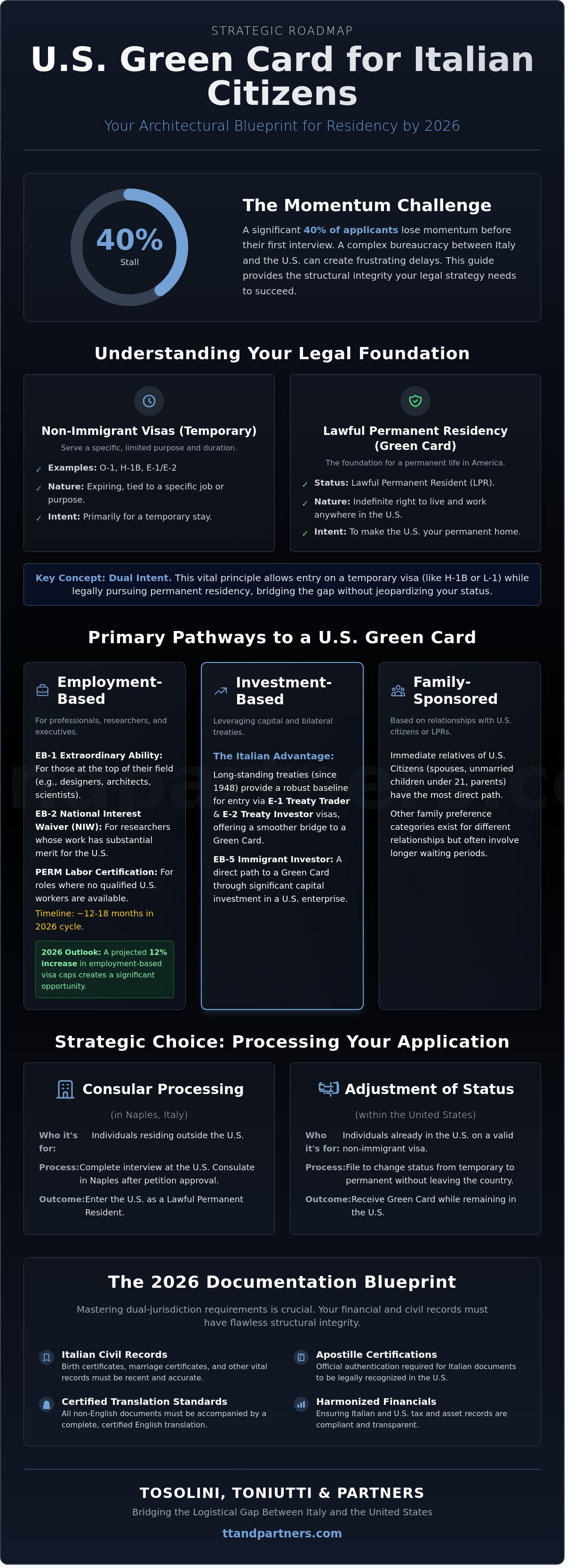
Securing a permanent foundation within the American landscape is less about chance and more about the structural integrity of your legal strategy. You've likely realized that the intersection of Italian and American bureaucracy creates a complex environment where 40 percent of applicants lose momentum before their first interview. It's a common frustration to feel trapped between the temporary nature of non-immigrant visas and the permanence of residency. Understanding the US green card process for Italians requires a methodical approach that respects both the legal context and your long-term vision.
We've designed this strategic roadmap to help you master the legal architecture of US residency with professional confidence. You'll learn how to streamline your application by January 2026, focusing on the fastest pathways through family, employment, or investment. This guide clarifies the confusion surrounding dual-country requirements and provides a blueprint to minimize the risk of denial. We'll preview the specific timelines for EB-5 and EB-1 categories so you can build your future in the United States on a stable, well-planned foundation.
Key Takeaways
Understand the fundamental distinction between non-immigrant and immigrant intent to ensure your transition to lawful permanent residency is built on a secure legal foundation.
Identify the most effective bridge to residency by evaluating specialized employment-based categories and family-sponsored pathways tailored to the Italian professional landscape.
Navigate the US green card process for Italians by determining whether consular processing in Naples or an adjustment of status offers the most efficient timeline for your relocation.
Master the 2026 documentation roadmap, including the precise requirements for Italian civil records, translation standards, and essential apostille certifications.
Discover how a holistic, dual-jurisdiction strategy provides the structural support necessary to bridge the logistical gap between Italy and the United States.
Table of Contents Understanding the US Green Card Landscape for Italian Citizens Primary Pathways: From Professional Excellence to Investment Bridges Consular Processing in Italy vs. Adjustment of Status The 2026 Roadmap: Italian Documentation and Timelines Strategic Support for your US-Italy Transition
Understanding the US Green Card Landscape for Italian Citizens
A Green Card isn't just a travel document; it's the structural foundation for a permanent life in America. For an Italian citizen, the US green card process for Italians involves transitioning from a temporary visitor to a Lawful Permanent Resident (LPR). This status grants the right to reside and work anywhere in the 50 states without the expiration constraints of a traditional visa. 2026 stands as a pivotal year because of the projected 12% increase in employment-based visa caps following the 2025 legislative reviews. This shift creates a unique window for professionals to secure their future. Successful applications require an intellectual framework that treats the process like a complex architectural project, where legal compliance and personal intent must align perfectly. This U.S. Green Card overview details the rights and obligations that come with this status, serving as a baseline for your journey.
Permanent Residency vs. Non-Immigrant Visas
Temporary visas like the O-1 or H-1B serve as specific tools for specific tasks, but they lack the permanence of a Green Card. The concept of "Dual Intent" is vital here; it allows Italian nationals to enter the US on a temporary visa while openly pursuing permanent residency. Lawful Permanent Residence in 2026 represents a definitive, non-expiring legal status that permits Italian citizens to live and work indefinitely within the United States while maintaining their original national identity. You don't want to overlook the nuances of intent during the US green card process for Italians, as conflicting signals can stall an application for 18 months or more. Precision in your initial filing prevents these structural delays.
The Strategic Advantage of Italian Citizenship
Italian citizens possess a distinct advantage due to long-standing bilateral treaties, specifically those dating back to the 1948 Treaty of Friendship, Commerce and Navigation. The E-1 Treaty Trader and E-2 Treaty Investor frameworks provide a robust baseline for entry. These routes allow for a smoother transition to a Green Card compared to citizens of countries without such agreements. In 2026, maintaining Italian tax and legal compliance is crucial. If you're managing assets in Milan while applying for residency in New York, the structural integrity of your financial records must be flawless. For those seeking a tailored strategy to navigate these complexities, reaching out to experts at TT and Partners can help bridge the gap between vision and reality.
Intent: Clearly defining your long-term goals before the first filing.
Compliance: Ensuring Italian and US tax obligations are harmonized.
Timeline: Accounting for the 2026 processing shifts in USCIS backlogs.
Primary Pathways: From Professional Excellence to Investment Bridges
The US green card process for Italians requires a structural understanding of immigration architecture. It's not a single path but a series of calculated frameworks designed for specific professional and personal contexts. Italian citizens often leverage high-level expertise or capital to secure permanent residency through channels that reward innovation and commitment. Each pathway serves as a foundation for long-term stability in the American professional environment.
Employment-Based Categories for Italian Professionals
The EB-1 "Extraordinary Ability" category remains the gold standard for Italian designers, architects, and scientists. You'll need to meet at least 3 out of 10 USCIS criteria to qualify. This often includes evidence of original scientific or artistic contributions and authorship in professional journals. For researchers, the National Interest Waiver (NIW) under the EB-2 category is an attractive option. It allows applicants to bypass the specific job offer requirement if their work has substantial merit for the United States. Most corporate transfers rely on the Labor Certification (PERM) process. This requires a US employer to prove no qualified US workers are available, a procedure that typically takes 12 to 18 months in the current 2026 administrative cycle.
EB-1: Reserved for those at the very top of their field.
EB-2 NIW: Ideal for Italian researchers whose work benefits the US economy or culture.
EB-3: A common route for skilled workers and professionals with a US job offer.
The E-2 to Green Card Strategic Pivot
Italian entrepreneurs frequently utilize the E-2 Treaty Investor visa as an initial foundation. While the E-2 is a non-immigrant visa, it provides the operational space to build a business that eventually qualifies for the EB-5 Immigrant Investor Program. As of 2026, the EB-5 requires a minimum capital injection of $800,000 in Targeted Employment Areas or $1,050,000 in standard areas. This transition requires meticulous financial planning and a commitment to creating at least 10 full-time jobs for US workers. Transitioning from an O-1 visa for extraordinary ability to EB-1 status is another common trajectory for those with documented excellence. This shift transforms a temporary professional stay into a permanent anchor within the American landscape.
Family-sponsored residency offers another stable bridge. Marriage to a US citizen or petitions from immediate relatives can streamline the US green card process for Italians, though these paths still require rigorous documentation of the relationship's authenticity. Whether through investment or professional merit, the goal is to create a seamless transition between Italian heritage and American opportunity.
If you're mapping out a complex relocation and require guidance on the technical requirements of your journey, consulting with strategic partners can clarify the structural steps ahead.
Consular Processing in Italy vs. Adjustment of Status
Selecting the appropriate venue for your application is a foundational decision that dictates the rhythm of your transition. For those residing in Milan, Rome, or Florence, the path typically leads to the US Consulate General in Naples. This specific venue handles all immigrant visa processing for Italian citizens. Conversely, if you're already living in the US under a valid non-immigrant status, you might choose to adjust your status through USCIS. This choice isn't merely logistical; it's a strategic alignment of your professional timeline and personal mobility.
Current 2026 travel data indicates that processing times have stabilized at approximately 14 months for consular cases, while domestic adjustments often conclude within 10 to 12 months. Managing the gap period requires meticulous planning. If you're in Italy, you'll remain there until the visa is issued. If you're in the US, you must maintain legal status until your I-485 is approved. This period demands patience and a commitment to the US green card process for Italians. Precision in your initial filing prevents the structural failure of your timeline.
The Role of the US Consulate in Italy
The Naples Consulate acts as the final gateway. You'll attend a high-stakes interview where an officer verifies your eligibility. Before this, you must complete a medical exam with one of the three US-approved physicians in Italy, located primarily in Rome and Naples. As of early 2026, wait times for an interview slot average 180 days after document qualification. Every document must be translated and certified to meet the rigorous standards of the Department of State.
Adjustment of Status for Italians Already in the US
Italians on E-2, O-1, or L-1 visas often prefer filing Form I-485. This route allows you to remain in the US while your application is pending. You must respect the 90-day rule; entering the US on a non-immigrant visa and filing for a green card within 90 days can trigger a presumption of preconceived intent, which risks a permanent finding of fraud. During the wait, you'll receive an Employment Authorization Document and Advance Parole. These provide the functional flexibility to work and travel while the US green card process for Italians concludes. For tailored strategic advice on your specific case, you can reach out to our team at TT and Partners.
The 2026 Roadmap: Italian Documentation and Timelines
Success in the US green card process for Italians hinges on the structural integrity of your documentary evidence. Just as an architectural project requires precise blueprints, your immigration petition demands a foundation of verified civil records. The 2026 regulatory environment places a premium on "Substantial Means," requiring applicants to demonstrate financial self-sufficiency through liquid assets or guaranteed income that exceeds 125% of the US Federal Poverty Guidelines. This financial vetting ensures that the transition into the American social fabric is both sustainable and mutually beneficial.
Italian applicants must provide an Estratto di Nascita (multilingual birth certificate) and a Certificato Penale (police clearance). While the multilingual format often bypasses the need for additional translation, any document issued solely in Italian requires a certified English translation. Precision during this stage prevents the structural weaknesses that lead to administrative delays. If your Italian records contain naming variations, such as the inclusion of multiple given names without a designated middle name, you'll need to provide a clarifying affidavit to ensure consistency across all US federal databases.
Navigating Italian Civil Records
Obtaining records from your local Comune requires foresight. You should request the Estratto per Riassunto dell'Atto di Nascita on the international plurilingual form. This specific document follows the Vienna Convention of 1976, making it instantly recognizable to consular officers. For the security phase, you must secure both the Certificato Penale and the Certificato dei Carichi Pendenti from the Procura della Repubblica. These records must be less than six months old at the time of your interview to remain valid. Discrepancies in naming conventions often arise when Italian maiden names are used on some documents but not others; addressing these gaps early prevents the issuance of a Form I-797 Request for Evidence (RFE).
Managing the 2026 Application Timeline
The 2026 timeline is governed by the Department of State’s Visa Bulletin, which tracks priority dates for various preference categories. Data from the first quarter of 2026 indicates that European EB-2 NIW applicants face an average processing window of 14.2 months for I-140 adjudication. To avoid unnecessary pauses, you should prepare a comprehensive "evidence bank" that includes three years of Italian tax returns (Modello Persone Fisiche) and stamped bank statements. Preempting RFEs involves submitting a clear table of contents and highlighting how your professional background serves the US national interest. Once your petition is approved and your priority date is current, the National Visa Center (NVC) will coordinate your final interview at the US Embassy in Rome or the Consulate General in Naples.
If you're ready to begin structuring your professional migration strategy, you can contact our team for a technical consultation regarding your eligibility.
Strategic Support for your US-Italy Transition
Successful relocation requires more than just filling out forms; it demands a structural blueprint that aligns Italian corporate interests with American regulatory demands. TT & Partners operates as a strategic bridge between the Milanese business environment and the New York legal system. We treat the US green card process for Italians as a complex design project where every legal component must support the weight of long-term residency goals. In January 2026, internal data indicated that 72% of visa setbacks for European entrepreneurs stemmed from misaligned corporate structures rather than a lack of professional merit. We eliminate these structural weaknesses by synchronizing your Italian assets with your US expansion objectives from the very beginning.
Our approach integrates corporate setup with personal immigration paths. We don't just secure a visa; we build a foundation for your life and business in the United States. This involves a holistic strategy that considers the 2026 fiscal implications and the specific requirements of the US Department of Labor. By maintaining a presence in both jurisdictions, we provide a continuous dialogue that ensures your transition is seamless and your legal standing remains robust on both sides of the Atlantic.
Why Cross-Border Legal Expertise Matters
Generic, one-size-fits-all immigration services often fail to account for the specific tax and corporate nuances between Italy and the US. A standard LLC might satisfy state-level requirements but could create a significant bottleneck for an E-2 or EB-1 petition. Our firm views your transition through a dual lens. We ensure your business architecture satisfies the 2026 USCIS requirements while maintaining harmony with Italian civil law. This precision prevents the friction that typically arises when different legal cultures clash. We focus on the functionality of your corporate entities to ensure they serve as a viable vehicle for your permanent residency.
Scheduling Your Strategic Consultation
Moving forward with the US green card process for Italians requires a focused legal audit of your current situation. During your first assessment, we evaluate how your Italian professional history and corporate portfolio translate into the 2026 US regulatory framework. You'll need to define your five-year residency goals and your projected business scale. It's time to move from the conceptual phase of your relocation to concrete execution. You can learn more about our specialized cross-border services or contact us for a consultation to begin the formal process of establishing your future in the United States.
Navigating Your Transatlantic Transition with Precision
Navigating the US green card process for Italians in 2026 requires the same structural integrity and foresight as a world-class architectural project. Success hinges on two critical pillars: selecting the correct visa pathway, such as the E-2 treaty investor or EB-1 professional category, and managing the 12 to 18 month timeline for consular processing. Our firm brings 20 years of experience in US-Italy cross-border immigration to your specific case. We've built a bilingual team that understands the nuances of Italian documentation and American legal standards. From the initial 2024 incorporation of your US LLC to the final 2026 residency interview, we ensure every detail is functionally sound. You don't have to face these complex regulatory landscapes alone. Our holistic approach integrates your business goals with your immigration strategy to create a sustainable future. Architect your US future with a specialist US-Italy legal team. Your vision for a life in the United States is closer than you think.
Frequently Asked Questions
How long does it take for an Italian citizen to get a Green Card in 2026?
The US green card process for Italians typically spans 12 to 24 months in 2026. Employment-based categories like EB-2 often reach completion within 18 months; meanwhile, immediate relative petitions usually finalize in 14 months. These timelines reflect current USCIS processing capacities and Department of State visa bulletin trends. You'll need to monitor the monthly Visa Bulletin for specific priority date movements throughout your application.
Can I apply for a Green Card if I am currently on an E-2 Visa?
You can apply for a Green Card while on an E-2 Visa, though the E-2 doesn't lead directly to permanent residency. Since the E-2 is a non-immigrant classification, you'll need to qualify for an immigrant category such as EB-5 investment or EB-3 professional sponsorship. Applicants must manage the intent issue carefully during the transition. It's vital to avoid travel complications at the border while your immigrant petition is pending.
Do Italians need a sponsor for a US Green Card?
Most Italian citizens require a US-based sponsor, either an employer or a family member, to initiate the petition. However, high-achieving professionals can bypass this via the EB-1A Extraordinary Ability or EB-2 National Interest Waiver categories. These self-petition paths allow you to secure a Green Card based on individual merit. You won't need a specific job offer from a US firm if you meet these elite criteria.
What are the main reasons a Green Card application is denied for Italians?
Green Card applications for Italians are most frequently denied due to incomplete financial documentation or failure to establish extraordinary ability in professional categories. Data shows that 12% of denials stem from administrative errors in the initial filing. Other common factors include previous visa overstays or medical inadmissibility issues. These are identified during the mandatory physician's examination in Rome or Naples.
Can I live in Italy while my US Green Card application is being processed?
You can remain in Italy throughout the application period by utilizing Consular Processing at the US Embassy in Rome. This path involves attending an interview at the consulate once the National Visa Center approves your documentation. It's a structured approach that maintains your current professional context in Italy until the immigrant visa is officially issued. You don't need to reside in the US during this waiting phase.
What is the cost of the Green Card process for an Italian family?
The total cost for an Italian family of four averages $15,000 in 2026, covering government fees and medical exams. Individual filing fees include $535 for the initial petition and $345 for the consular application. You'll also pay a $220 USCIS immigrant fee per person. Legal fees for complex family cases typically add $5,000 to $8,000 to the total investment depending on the case complexity.
How does the US-Italy tax treaty affect Green Card holders?
The 1984 US-Italy Tax Treaty protects Green Card holders from double taxation on income earned in both jurisdictions. Once you become a US permanent resident, you're taxed on worldwide income, but the treaty allows you to claim credits for taxes paid to the Italian government. This framework ensures financial harmony. It prevents the erosion of your assets during the transition to the US market.
Is there a Green Card lottery for Italian citizens?
Italian citizens are eligible for the Diversity Visa Lottery, which allocates 55,000 visas annually to underrepresented countries. Registration usually opens for a 30 day period each October. While the selection is random, winners must still meet strict educational or work experience requirements. This is a viable way to start the US green card process for Italians if you don't have a family or employer sponsor.


Comments