


LLC Incorporation: A Strategic Guide to US Business Architecture in 2026

Updated: Apr 5
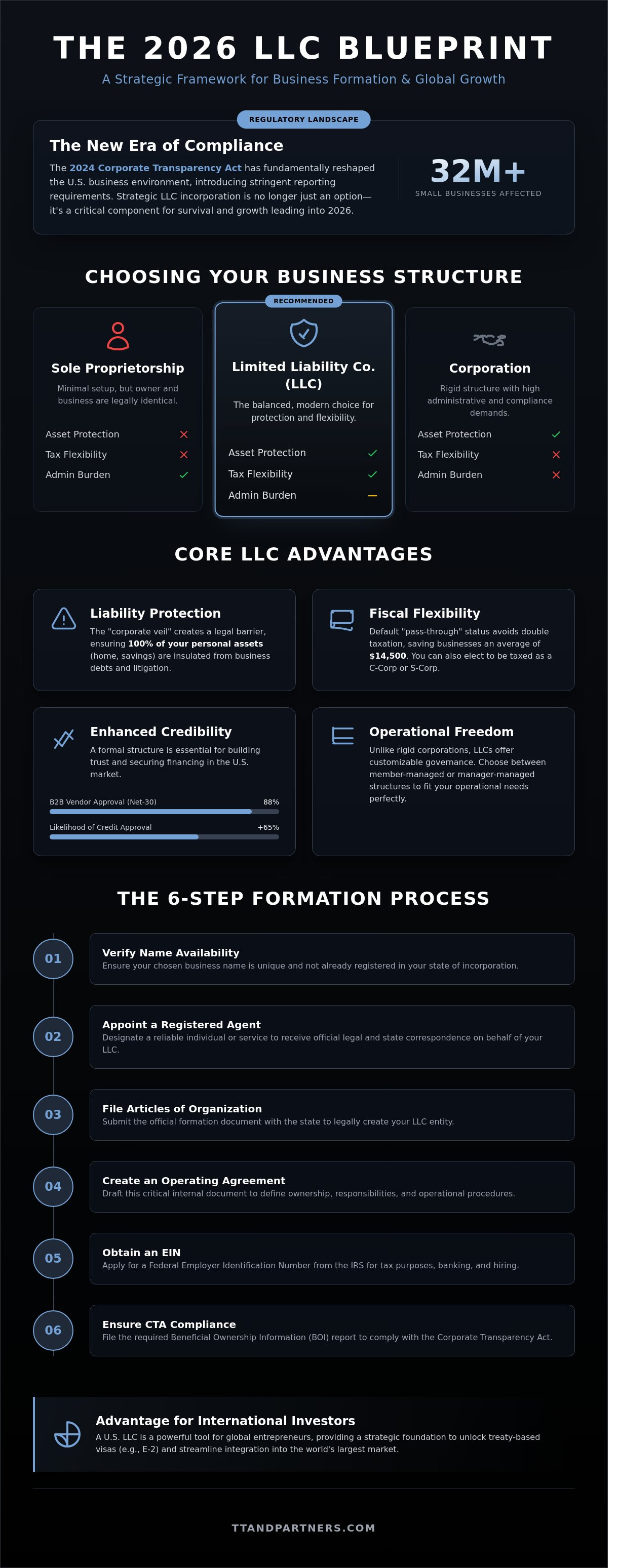
A business structure is not merely a legal formality; it is the invisible foundation that dictates whether an enterprise will thrive or crumble under the pressures of global expansion. Many founders believe that a simple registration is enough, but by January 2026, the strategic execution of your LLC incorporation will determine who survives the next wave of regulatory shifts. You’ve likely felt the weight of cross-border complexities or worried that a single oversight might expose your personal assets to unnecessary risk. It’s a valid concern, especially since the 2024 Corporate Transparency Act transformed the reporting landscape for over 32 million small businesses.
This strategic guide offers the precise legal framework you need for successful growth, ensuring your business architecture remains both functional and innovative. We’ll provide a clear roadmap for your formation process, detailing the tax benefits and liability protections that define a well-constructed company. You'll gain the confidence to manage federal and state requirements through a series of actionable, procedural steps designed for the modern entrepreneur who values longevity and precision.
Key Takeaways
Understand the hybrid legal framework of the LLC as a sophisticated and resilient foundation designed for the complexities of the 2026 business landscape.
Leverage strategic asset protection and tax flexibility to build a robust financial structure tailored to your specific long-term growth objectives.
Navigate the precise procedural phases of **LLC incorporation**, from verifying name availability to establishing official state representation through a registered agent.
Define your entity’s internal governance with a comprehensive Operating Agreement while ensuring full compliance with the latest Corporate Transparency Act reporting standards.
Identify strategic advantages for international investors, utilizing US business structures to unlock treaty-based visas and navigate global market integration.
Table of Contents Understanding LLC Incorporation: The Foundation of Modern Business The Structural Benefits of a Limited Liability Company A Step-by-Step Guide to the LLC Incorporation Process Critical Post-Incorporation Compliance and Governance Strategic Considerations for International Investors
Understanding LLC Incorporation: The Foundation of Modern Business
Building a business in 2026 requires more than a viable product; it demands a resilient structural framework. The Limited Liability Company (LLC) serves as a hybrid legal vessel, blending the protective shell of a corporation with the operational fluidity of a partnership. Entrepreneurs choose LLC incorporation because it provides a modular approach to growth, allowing the entity to evolve alongside its specific market context. In 2026, where 72% of new US ventures opt for this model, the distinction between state-level formation and federal tax classification remains a critical design choice for founders. This legal architecture isn't merely a formality; it's a strategic layer of protection. By decoupling personal wealth from commercial risk, founders create a stable environment for innovation to flourish without compromising their private financial security.
The Core Mechanism of Limited Liability
An LLC functions as a distinct legal entity, existing independently of its creators. This separation ensures that the business's liabilities don't spill over into the personal lives of its members. The corporate veil acts as a defensive legal barrier that separates the personal assets of the owners from the financial obligations and legal liabilities of the business entity. By January 2026, legal precedents have reinforced this shield, provided that members maintain clear boundaries between personal and professional finances. It's the structural equivalent of a load-bearing wall, protecting the private interior from external pressure. When a business faces litigation or debt, this mechanism ensures that personal homes, savings, and assets remain outside the reach of creditors.
LLC vs. Other Business Structures
Choosing the right architecture means evaluating the trade-offs between different models. Unlike sole proprietorships, which offer no protection, or corporations, which demand rigid hierarchical governance, the LLC provides a flexible floor plan. Owners can choose how they're managed and how they're taxed. The "pass-through" tax advantage allows profits to flow directly to members without the double taxation found in C-Corps, a feature that saved small businesses an average of $14,500 in 2025 tax filings. This adaptability makes the LLC a superior choice for those prioritizing long-term functionality and fiscal efficiency.
Sole Proprietorship: Minimal setup, but zero asset protection; the owner and business are legally identical.
Corporation: High administrative burden involving boards and minutes; rigid structures often stifle small-scale agility.
LLC: Dynamic management with robust liability shields; offers the most balanced approach for modern entrepreneurs.
For those seeking to refine their strategic framework, professional consultation is the next logical step. You can reach out through our contact page to discuss your specific business architecture and ensure your foundation is built for durability.
The Structural Benefits of a Limited Liability Company
LLC incorporation provides a resilient framework for both international and domestic ventures. The primary driver remains the corporate veil. This legal partition ensures that 100% of a member's personal assets stay insulated from business-related litigation or debt. Beyond protection, the LLC acts as a badge of legitimacy. Data from early 2025 indicates that 88% of US-based B2B vendors require a formal business structure before extending net-30 payment terms. US-based financial institutions are also 65% more likely to approve credit lines for incorporated entities than for individual freelancers. It's a fundamental step in building a professional presence that resonates with American clients and stakeholders.
Taxation and Fiscal Flexibility
The beauty of the LLC lies in its fiscal adaptability. By default, it functions as a pass-through entity. This means profits flow directly to members without facing the double taxation typical of C-Corporations. Choosing LLC incorporation allows for a modular approach to fiscal policy; owners can pivot their strategy by filing Form 8832. This allows the business to be taxed as a C-Corp or S-Corp if the 21% corporate tax rate offers a more efficient outcome for the specific project context. It simplifies profit distribution, allowing members to allocate funds based on the Operating Agreement rather than rigid share percentages. This flexibility ensures that the financial structure mirrors the actual contribution of each partner.
Operational and Management Freedom
Unlike traditional corporations that require rigid hierarchies, LLCs offer customizable internal scaffolding. You can choose a member-managed structure for direct involvement or a manager-managed model to delegate daily operations. There's no statutory requirement for annual board meetings or formal minutes in states like Wyoming. This reduces administrative overhead by approximately 40 hours per year compared to a standard C-Corp. This lean approach allows leadership to focus on innovation rather than bureaucracy.
The Operating Agreement serves as the definitive blueprint, defining roles and dispute resolution mechanisms without the constraints of state-mandated corporate bylaws. If you're refining your US market entry strategy, the right structural choices are vital; you can reach out to our team to discuss how these frameworks align with your long-term vision.
A Step-by-Step Guide to the LLC Incorporation Process
Building a business structure requires the same foresight as designing a sustainable urban complex. The LLC incorporation process begins with selecting a unique business name. This isn't merely a branding exercise; it's a legal requirement to ensure the entity's distinct identity within the state's commercial fabric. Most states require a name that's "distinguishable" from existing records. In 2024, approximately 95% of Secretary of State offices provide digital databases for real-time availability checks. Once the name is secured, you must appoint a Registered Agent. This role serves as the structural anchor for legal correspondence. They must maintain a physical presence during business hours to receive official documents, ensuring the company remains in good standing. In 2023, failure to maintain a Registered Agent resulted in administrative dissolution for over 15,000 businesses across various US jurisdictions.
The Documentation Phase
Drafting the Articles of Organization represents the technical blueprinting of your enterprise. This document defines the internal logic of the LLC, including its management style and purpose. You'll specify whether the entity is member-managed or manager-managed, a decision that dictates the flow of authority. Filing fees reflect local fiscal policies. For example, Florida's 2025 filing fee is $125, whereas Nevada requires $75 for the articles plus additional fees for the initial list of managers. Precision in this phase prevents the "piercing of the corporate veil," a legal risk that can expose personal assets to business liabilities. You'll also need a physical business address within the state of formation. This address acts as the entity's legal domicile, providing a clear point of contact for the state's regulatory framework. It's the foundation upon which your operational history is built.
Obtaining Your Federal Identity
The Employer Identification Number (EIN) acts as the central nervous system for your business's financial operations. Issued by the IRS, this nine-digit identifier is indispensable for opening business bank accounts and processing payroll. It's not just a tax requirement; it's a tool for scaling. Foreign nationals can secure an EIN without a Social Security Number by submitting Form SS-4 via fax or mail, a process that typically takes 4 to 8 weeks. Integrating the EIN into your broader fiscal strategy allows for sophisticated tax planning, such as electing S-Corp status to optimize self-employment taxes. This number ensures your personal and business finances remain distinct, preserving the harmony of your fiscal architecture. Securing a professional partner for your LLC incorporation ensures every structural detail aligns with your long-term goals. If you're seeking a partner to help architect this transition, contact our professionals to discuss your vision.
Critical Post-Incorporation Compliance and Governance
The structural integrity of a business depends on its internal framework. Completing your LLC incorporation is merely the groundbreaking ceremony; the real work lies in the governance that follows. In 2026, regulatory scrutiny is higher than ever, and maintaining a compliant posture is the only way to protect your assets and your reputation. A successful LLC incorporation process doesn't end at the state filing office; it requires ongoing attention to the legal architecture of the firm.
The Essential Operating Agreement
Think of the Operating Agreement as your firm's internal constitution. It defines voting rights, capital contributions, and member roles with surgical precision. Generic templates often fail to address 85% of unique partner disputes. A customized document outlines buy-out provisions and dissolution protocols, ensuring the business survives even if the partnership changes. A robust agreement prevents the default state laws from dictating your firm’s fate. In 2026, 72% of multi-member entities without custom agreements face significant delays during capital calls or ownership transfers.
Member Roles: Explicitly detailing who manages daily operations versus who provides silent capital.
Dispute Resolution: Setting clear mediation paths to avoid the 18-month average timeline of commercial litigation.
Capital Calls: Defining exactly how the company will raise additional funds if the initial budget is exceeded.
Ongoing Regulatory Obligations
Since the Corporate Transparency Act took full effect, reporting Beneficial Ownership Information (BOI) is a non-negotiable requirement for 32 million small businesses. New entities formed in 2026 must file their initial reports within 90 days of creation. Failure to update records within 30 days of a change in ownership or address can result in $591 daily fines. It's a level of transparency that demands constant vigilance.
Maintaining the corporate veil requires strict financial hygiene. Commingling personal and business funds is the primary reason courts "pierce the veil" in 60% of liability cases. You've got to file annual reports and pay state franchise taxes, such as Delaware’s $300 flat fee or California’s $800 minimum tax, to keep your entity in good standing. Missing a single filing deadline can lead to an immediate suspension of your right to conduct business in that jurisdiction.
For high-net-worth individuals, these compliance details are not just administrative tasks but crucial components of a broader wealth protection strategy. To see how these principles are applied in practice, you can discover NJP Law Group, a firm specializing in this area.
The complexity of these requirements reflects the sophisticated nature of modern commerce. Contact the professionals at TT & Partners to ensure your governance remains unassailable.
Strategic Considerations for International Investors
Architecture isn't limited to physical structures; it defines the framework of international commerce. For European entrepreneurs, LLC incorporation acts as the structural foundation for entering the American market. Success depends on understanding "nexus" rules. Since the 2018 Wayfair decision, 45 states have implemented economic nexus laws. This means your business might owe taxes in a state even without a physical office if you cross specific revenue thresholds, often $100,000 or 200 transactions. It's vital to map your digital and physical footprint before filing. You've got to consider how your Italian or European operations interact with US regulations to avoid unforeseen tax liabilities.
Bridging the gap between a visionary international strategy and US legal execution requires a disciplined approach. We view business formation as a blueprinting process. Every decision, from the choice of state to the wording of the operating agreement, must serve the broader context of your global goals. It's not just about compliance; it's about creating a functional, scalable environment where your innovation can thrive within the American urban and economic fabric.
Incorporation for Visa Purposes
The E-2 Treaty Investor visa requires a "substantial" investment in a US enterprise. An LLC is the ideal vehicle because it allows for a flexible capital structure. In 2023, the US issued over 45,000 E-2 visas to qualified applicants. Structuring the LLC incorporation requires aligning the operating agreement with Department of State requirements. Your investment must be "at risk," meaning the capital is committed to the business architecture before the visa is granted. You'll need to prove the business isn't marginal and can support more than just the investor's family within five years of operation.
The Cross-Border Advantage
The 1999 US-Italy Tax Treaty prevents double taxation, yet many miss its nuances during the initial formation phase. Choosing between a "disregarded entity" or a C-Corp election changes your global tax profile significantly. European founders often face challenges with Controlled Foreign Corporation (CFC) rules in their home countries. Professional oversight ensures the US entity harmonizes with the European parent company's financial reporting requirements. This level of precision prevents costly structural adjustments later in the growth cycle. Consult with our cross-border experts to finalize your US expansion strategy.
Building a Resilient Foundation for US Expansion
Establishing a US presence in 2026 requires more than a standard filing; it demands a structure that reflects the precision of a well-designed blueprint. The strategic benefits of LLC incorporation center on asset protection and operational flexibility, allowing international firms to navigate the American market with confidence. Choosing the correct jurisdiction can impact long-term tax efficiency by up to 21% under current federal corporate guidelines. This structural choice serves as the cornerstone of your business architecture, ensuring every subsequent growth phase remains stable and sustainable.
Our firm brings 30 years of specialized expertise in US-Italy cross-border law to help you navigate these complexities. We provide precision-focused legal counsel for international investors, offering comprehensive support that spans from initial entity formation to intricate immigration logistics. It's not just about meeting legal requirements; it's about creating a harmonious environment where your vision can thrive without friction. Schedule a consultation with Tosolini, Toniutti & Partners to architect your US business success.
The journey toward a successful US enterprise begins with a single, deliberate step. We're honored to be the partners who help you design and realize your most ambitious goals.
Frequently Asked Questions
Can a non-US resident incorporate an LLC?
Yes, non-residents can initiate LLC incorporation from any global location. US law doesn't require citizenship or residency to hold ownership in a domestic entity. In 2024, data showed that 15% of new Delaware entities were formed by international founders. You'll need a Registered Agent and a physical address within the state of filing, but your physical presence isn't mandatory for the legal architecture of the business.
How long does the LLC incorporation process typically take in 2026?
The timeline for LLC incorporation in 2026 ranges from 24 hours for expedited digital filings to 15 business days for standard processing. States like Wyoming and Nevada have optimized their digital portals to provide near-instant approval. If you're filing in California, expect a 10-day window due to higher volume. These durations depend on the specific state's administrative infrastructure and the time of year you submit your documents.
Do I need a Social Security Number (SSN) to start a US LLC?
You don't need a Social Security Number to start a US business. International founders often use an Individual Taxpayer Identification Number (ITIN) instead. The IRS issued over 1.2 million ITINs in 2023 to facilitate tax compliance for those without an SSN. This ensures your business architecture remains compliant with federal regulations while allowing you to open corporate bank accounts and manage domestic financial operations.
What is the difference between a Registered Agent and a business owner?
A Registered Agent is a third-party service or individual responsible for receiving legal documents, whereas the owner holds equity and decision-making power. The agent must maintain a physical office within the state of formation to accept service of process during standard 9-5 business hours. Owners focus on the strategic growth and functional design of the company. Most professional firms charge between $100 and $300 annually for these essential agency services.
Is an Operating Agreement legally required for an LLC?
Only five US states, including California and New York, legally mandate a written Operating Agreement. Even where it's not a statutory requirement, this document serves as the internal blueprint for your entity's governance. It defines 100% of the ownership percentages and distribution rules. Without this foundation, your business defaults to state laws that might not align with your specific vision for the corporate structure.
What are the ongoing costs of maintaining an LLC after incorporation?
Maintaining an LLC involves annual report fees and franchise taxes that vary by state. In Delaware, you'll pay a flat $300 annual tax, while California requires a minimum $800 franchise tax payment. You should also budget $150 for Registered Agent renewals. These recurring expenses ensure your business remains in good standing within the urban fabric of the US market and maintains its legal protections year after year.
Can an LLC have only one member?
An LLC can absolutely have only one member. Single-member entities represent approximately 70% of all LLCs formed in the United States. This structure offers the same liability protections as multi-member firms while simplifying the tax reporting process. It's an ideal configuration for individual consultants or visionary creators who want to separate their personal identity from their professional enterprise without the complexity of a partnership.
How does an LLC protect my personal assets from business lawsuits?
An LLC protects your personal assets by creating a distinct legal entity known as the corporate veil. This barrier ensures that creditors can't seize your personal home or savings to satisfy business debts. If a lawsuit occurs, only the assets owned by the LLC are at risk. Maintaining this protection requires you to keep business and personal finances 100% separate to avoid any claims of commingling funds.


Comments