


How Much Is a Green Card? The 2026 Cost and Strategy Guide

What if the most significant cost of your US residency isn't the fee itself, but the price of a structural failure in your application? You've likely felt the impact of the April 1, 2024, USCIS fee restructuring, where understanding how much is a green card became a complex calculation involving hikes of over 200%. It's natural to feel anxious about a system where a single missing signature results in a forfeited $1,440 filing fee.
We believe that a permanent residency path requires the same precision as a complex architectural blueprint. This guide provides a definitive 2026 budget, offering a transparent breakdown of the $675 family preference fees and the $1,000 in hidden medical or travel expenses. You'll gain a predictable financial map and a clear strategy to protect your investment from technical errors. We'll explore the mandatory government tariffs, the optional administrative layers, and why professional oversight acts as the essential scaffolding for your American future.
Key Takeaways
Navigate the multi-layered financial structure of U.S. residency by distinguishing between mandatory government fees and the essential auxiliary costs of a successful transition.
Gain clarity on how much is a green card in 2026 through a comparative analysis of family, employment, and investment-based financial trajectories.
Identify "hidden" administrative expenses to construct a resilient budget that accounts for the full spectrum of the permanent residency process.
Understand how a precision-led application strategy protects your investment by avoiding the compounding costs of errors, RFEs, or potential denials.
Explore the value of professional legal integration in managing cross-border complexities with the same technical rigor applied to high-end architectural design.
Table of Contents Understanding the Total Investment: USCIS Fees vs. Real-World Costs Cost Breakdown by Category: Family, Employment, and Investment The "Hidden" Expenses of U.S. Permanent Residency Strategic Budgeting: Avoiding the High Price of Application Errors Navigating Cross-Border Complexity with TT and Partners
Understanding the Total Investment: USCIS Fees vs. Real-World Costs
Securing permanent residency is a structural undertaking that requires more than a simple filing. It's a multi-layered financial commitment where the initial government fees represent only the foundation of a much larger project. To understand what a green card is and its true price, one must look beyond the surface. The April 1, 2024, USCIS fee hike marked the most significant restructuring in nearly a decade, creating a new baseline for 2026 applicants. This change shifted the burden of funding the immigration system onto specific categories, ensuring that the sticker price of a single form no longer reflects the total capital required for a successful outcome.
When asking how much is a green card, it's vital to distinguish between mandatory government tolls and the auxiliary expenses that ensure the integrity of the application. Much like an architectural blueprint, the process demands precision. Small errors in document preparation or missed medical requirements don't just delay the timeline; they lead to costly re-filings and lost opportunities. The total expenditure is a reflection of the case's complexity and the specific path chosen, whether through family ties or professional achievement.
The 2026 USCIS Fee Landscape
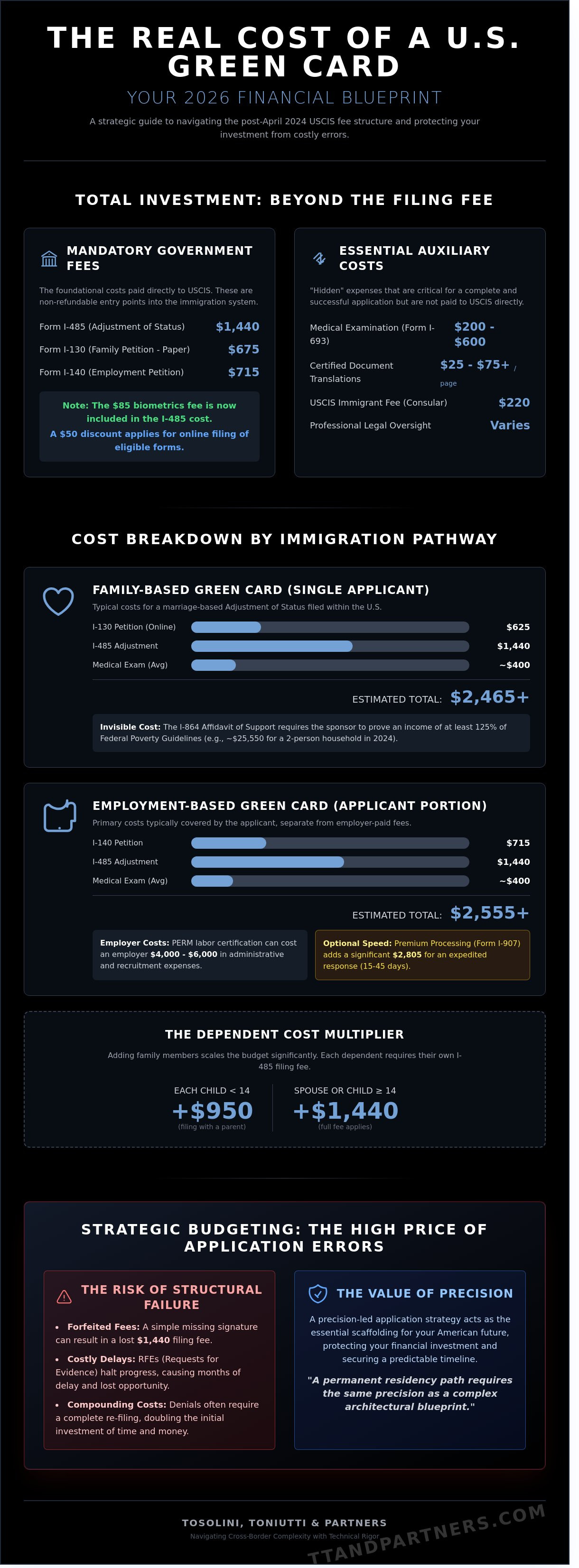
The current fee structure favors digital interaction and consolidated pricing models. Form I-130, used for family petitions, currently costs $675 for paper submissions. Form I-140, the standard for employment-based petitions, is set at $715. For those seeking to adjust status within the United States, Form I-485 carries a $1,440 price tag. Applicants save $50 by choosing online filing for eligible forms like the I-130. A notable change in this cycle is the integration of biometrics; the previous $85 standalone fee is now wrapped into the primary application cost for most categories, simplifying the initial accounting process.
Filing Fee vs. Professional Value
The government fee is merely the entry point to the immigration system, not the final budget. Real-world costs include the mandatory medical examination, which typically ranges from $200 to $600 based on the civil surgeon's rates. For individuals processing their applications at a U.S. consulate abroad, the USCIS Immigrant Fee is a mandatory $220 charge for producing the physical card. When calculating how much is a green card, applicants must also budget for certified translations, which often cost $25 to $75 per page, and professional legal guidance. If you need a detailed breakdown of how these costs apply to your specific vision, you can reach out via our contact page to explore the strategic requirements of your case.
Cost Breakdown by Category: Family, Employment, and Investment
Building a life in the United States requires a financial blueprint as precise as a structural plan. The total expenditure depends on the chosen foundation, whether it's family ties, professional expertise, or capital investment. Calculating how much is a green card involves more than just a single fee; it's a sum of filing costs, biometric services, and administrative overhead. For an accurate assessment based on the April 2024 fee schedules, applicants should utilize the official USCIS Fee Calculator to ensure their budget aligns with the latest federal requirements.
Adding dependents doesn't just add a linear cost; it scales the budget exponentially. Each child under 14 filing an I-485 with a parent costs $950, while those 14 and older require the full $1,440 fee. Concurrent filing, which is submitting the petition and adjustment application together, can save months of waiting but requires a larger upfront capital injection. This often exceeds $3,000 for a single applicant when including required medical exams and travel documentation.
Family-Based Green Card Costs
A marriage-based petition serves as the most common entry point into the American social fabric. The I-130 petition costs $625 for online filers or $675 for paper submissions, followed by the $1,440 Adjustment of Status fee. The I-864 Affidavit of Support is technically free to file, yet it carries the invisible cost of meeting the 125% Federal Poverty Guidelines. For a household of two in 2024, this means proving an annual income of at least $25,550 to qualify as a sponsor.
Employment and Investment Pathways
Employer-sponsored routes often shift the financial burden, yet they remain complex. While the PERM labor certification costs the employer roughly $4,000 to $6,000 in recruitment expenses, the employee may still face personal filing fees for their portion of the process. For those seeking speed, the $2,805 Premium Processing fee guarantees a response within 15 to 45 days. In the EB-5 investment sector, the stakes are significantly higher. Beyond the $800,000 or $1,050,000 capital requirement, the I-526E petition alone carries a $11,160 filing fee. Understanding how much is a green card in this context requires looking at the total lifecycle of the investment.
If you're designing a long-term strategy for your residency, consulting with a strategic partner can help refine your financial timeline and project milestones.
The "Hidden" Expenses of U.S. Permanent Residency
The structural integrity of an immigration budget relies on more than just the government filing fees. While the USCIS official fee schedule dictates the primary costs, secondary expenses often create friction in the application process. In 2026, third-party service providers have adjusted their rates by approximately 8% to mirror global labor trends and increased operational overhead. A strategic applicant views these costs as essential infrastructure. Planning for a 20% financial buffer ensures the project doesn't stall due to unforeseen administrative requirements. Geographic location plays a decisive role here. Applicants processing through consulates in high-cost cities like London or Tokyo face higher local service fees than those in lower-density regions.
Medical Exams and Vaccinations
The I-693 medical exam represents a significant variable in the total cost. Civil surgeons operate as independent contractors; therefore, prices fluctuate based on local market demand. In 2026, a standard exam in major metropolitan areas costs between $350 and $700. If your immunization records are incomplete, expect to pay $100 to $200 per required vaccination. These results remain valid for two years. If your priority date isn't current or processing experiences a bottleneck, you might face a second round of fees to replace an expired exam. Precision is paramount. Missing a single shot can lead to a Request for Evidence, which adds time and further expense to the calculation of how much is a green card.
Administrative and Documentation Fees
Documentation requires meticulous attention to detail and often carries a heavy price tag. Certified translations for non-English birth or marriage certificates now average $35 per page. If you've resided in multiple jurisdictions for more than six months, obtaining official police certificates involves fees ranging from $20 to $150 per country. Travel remains the most volatile expense. Consular processing requires physical attendance at a U.S. embassy, which often involves international flights and multi-day hotel stays. These logistical realities significantly impact how much is a green card in the final accounting. For those seeking a structured, professional approach to their residency goals, reaching out through our contact page provides a pathway to clarity. Every document must be handled with the same care as a blueprint, as errors here lead to costly structural failures in your application.
Strategic Budgeting: Avoiding the High Price of Application Errors
Precision in documentation functions much like a structural blueprint; a single miscalculation in the early phases can compromise the entire project's integrity. When applicants calculate how much is a green card, they often overlook the fiscal impact of administrative friction. A Request for Evidence (RFE) or a Notice of Intent to Deny (NOID) represents more than a temporary pause. These hurdles introduce compounding costs that far exceed the initial filing fees. A rejected application isn't just a lost opportunity, it's a total loss of the original investment, requiring a complete restart with new fees and updated evidence.
The Cost of Procedural Delays
The financial architecture of an immigration journey relies on the timely issuance of an Employment Authorization Document (EAD). For a professional earning a median salary of $92,000, a four month delay in work authorization results in a $30,666 loss in gross income. An RFE can delay a Green Card by 6-12 months, resulting in significant indirect costs. If USCIS denies an application without prejudice, the petitioner must pay the $1,440 filing fee again, effectively doubling the primary investment. These delays don't just stall careers; they drain the capital reserves meant for a new life in the United States.
Ensuring Long-Term Compliance
Maintaining legal status while a petition is pending requires rigorous oversight and constant vigilance. Applicants must navigate a landscape where predatory "consultant" sites often charge $300 to $600 for government forms that are actually free. This deceptive pricing distorts the true understanding of how much is a green card in the current 2026 fiscal environment. Initial accuracy ensures a seamless transition to naturalization five years later. Errors caught during the citizenship phase can trigger retroactive audits, costing upwards of $5,000 in specialized legal defense fees. Professional oversight acts as financial insurance, protecting the applicant's long term vision from avoidable structural failures.
Building a secure future requires the same strategic planning as a complex architectural project. To ensure your application stands on a solid foundation, contact our strategic partners today.
Navigating Cross-Border Complexity with TT and Partners
Relocating between the United States and Italy requires more than a simple filing. It demands a structural understanding of two distinct legal landscapes that often operate on conflicting logic. At TT and Partners, we view the law through the lens of architectural discipline. We don't just process applications; we design the framework for your international life. This approach ensures that every technical detail aligns with the aesthetic and professional vision you have for your future. The friction between USCIS requirements and Italian civil law can be significant. Success depends on a partner who speaks both languages, literally and figuratively.
By 2026, the question of how much is a green card has evolved beyond a simple sum of government fees. Following the massive USCIS fee hikes that took effect on April 1, 2024, where some employment-based categories saw increases of over 100%, the true cost is now measured in the precision of your strategy. A single error in documentation doesn't just cost money; it costs time, which is the most expensive resource for any global professional. We close the gap between your vision of U.S. residency and the dense legal reality of federal regulations.
Tailored Legal Architecture for Global Clients
Our firm moves beyond the traditional "form-filling" model. We treat your relocation as a holistic project, much like a master-planned development. This means managing your Italian corporate interests and real estate holdings in tandem with your immigration status. We ensure that your tax residency and asset structures remain functional across borders. Every client receives a blueprint that accounts for these variables. If you're ready to build a secure foundation, contact our team for a strategic consultation on your specific case.
Why Precision Matters in 2026
The 2026 regulatory environment is defined by increased scrutiny and digitized processing. Precision is the only way to avoid the delays that have plagued the system over the last 24 months. We provide the technical rigor needed to bridge the divide for international professionals. Our commitment to excellence mirrors the way a well-designed building integrates into the urban fabric. We don't settle for "functional" when "exceptional" is required. When calculating how much is a green card, remember that professional guidance is an investment in your long-term stability. Plan your U.S. future with expert guidance today.
Architecting Your Permanent Residency Strategy
Building a life in the United States requires the same meticulous planning as a complex architectural project. When you're calculating how much is a green card, it's vital to look beyond the $1,440 base fee for Form I-485. Total investments for 2026 often exceed $5,000 when you factor in medical exams, biometrics, and the specialized legal support required for complex categories. We provide the structural framework for these transitions, focusing on the unique intersection of US-Italy immigration law and international corporate integration. Our experts manage the precise 18 month timeline required for E-2 to Green Card shifts, ensuring your real estate portfolios and business assets align perfectly with federal requirements. Precision during the initial filing phase prevents the high cost of structural application failure later. You can't afford to leave your global mobility to chance when the stakes involve your family's future and your professional legacy. It's time to design a path that reflects your long term vision with absolute clarity.
Consult with our cross-border experts regarding your Green Card strategy to ensure your transition is handled with professional excellence. Your American journey deserves a foundation built on expertise and foresight.
Frequently Asked Questions
How much is the total cost for a marriage-based Green Card in 2026?
The total cost for a marriage-based Green Card in 2026 is $2,115 for applicants living within the United States. This figure includes the $675 fee for Form I-130 and the $1,440 fee for Form I-485. You'll also need to budget approximately $200 to $500 for the required medical examination performed by a civil surgeon. These costs represent the structural foundation of your legal residency process. Precise financial planning ensures your application remains on solid ground.
Can I pay the USCIS filing fees in installments?
You can't pay USCIS filing fees in installments as the agency requires full payment at the time of submission. Applications sent without the complete fee are rejected immediately. However, you can use a credit card to pay via Form G-1450, which allows you to manage the debt through your bank's monthly billing cycle. This financial strategy provides a way to distribute the impact over several months without compromising the process or the timeline.
Is there a fee waiver available for the Green Card application?
Fee waivers are available for specific Green Card categories, though they're rarely granted for marriage-based or employment-based applications. You must file Form I-912 to demonstrate that your household income is at or below 150% of the Federal Poverty Guidelines. For a family of four in 2024, this threshold is $46,800. The agency examines your financial documents with the same precision used in architectural site surveys to determine your eligibility for this benefit.
How much does it cost to renew or replace a lost Green Card (Form I-90)?
It costs $415 to renew or replace a lost Green Card when filing Form I-90 online. If you choose to submit a paper application, the fee increases to $465. These rates have been standard since April 1, 2024. Maintaining a valid document is essential for your legal standing, much like keeping a building's permits up to date to ensure long-term functionality and compliance with federal regulations. Always keep digital copies of your documents.
Does the lawyer fee include the USCIS filing fees?
Lawyer fees don't include the USCIS filing fees in standard legal contracts. Most immigration firms charge a flat professional fee ranging from $3,000 to $7,000 for a marriage case, which covers their expertise and document preparation. You'll pay the government fees separately via check or credit card. Understanding how much is a green card requires looking at these two distinct financial components as separate line items in your overall project budget.
What happens to my fees if my Green Card application is denied?
USCIS doesn't refund any filing fees if your Green Card application is denied. The payment covers the cost of processing and adjudicating your file regardless of the final decision. If you choose to re-apply, you'll have to pay the full $2,115 again. This policy emphasizes the need for technical accuracy in your initial submission to avoid costly structural failures in your immigration strategy. Every detail must be verified before the final filing occurs.
Are there extra costs if I apply from outside the United States?
Applying from outside the United States involves different costs, totaling $1,355 in government fees. You'll pay $675 for the I-130 petition, $325 for the DS-260 processing, and $120 for the Affidavit of Support review. After your visa is approved, a final $235 USCIS Immigrant Fee is required to produce the physical card. These layers of costs ensure the integrity of the international immigration framework and its security protocols throughout the entire process.
How much is the biometrics fee in 2026?
The biometrics fee in 2026 is $30 for most applicants. This amount is now bundled into the $1,440 fee for Form I-485, so you don't need to write a separate check for it. Knowing how much is a green card helps you prepare for these specific technical requirements. The fee covers the digital capture of your fingerprints and photograph at an Application Support Center. It's a vital step in the identification process for residency.
Disclaimer
The information provided in this website is offered purely for informational purposes. It is not intended to create or promote an attorney-client relationship, and does not constitute and should not be relied upon as legal advice. We intend to make every attempt to keep this information current. We do not promise or guarantee, however, that the information is correct, complete or up-to-date, and readers should not act based upon this information without seeking professional counsel from a licensed attorney. Transmission of information from this newsletter is not intended to create, and its receipt does not constitute, an attorney-client relationship with Tosolini, Toniutti & Partners or any of its individual attorneys or personnel.


Comments