

Dual US Italian Citizenship Benefits: A Strategic Mobility Guide for 2026
- Gianni Mendes Toniutti, Esq.

- May 29
- 13 min read
In an era defined by shifting borders and legislative tightening, your heritage is no longer just a family story; it's a structural asset for a volatile age. While many view a second passport as a luxury, the reality is that it functions as a sophisticated legal instrument for global mobility and generational security. You likely feel the increasing friction of travel restrictions or the weight of global political instability, making the search for a permanent solution more urgent than ever.
This guide explores the profound dual US Italian citizenship benefits, detailing how this status serves as a bridge to unrestricted EU access and expanded business horizons. You'll learn exactly how to leverage your lineage under the 2026 regulations, including the specific two-generation eligibility limits established by Law 74/2025. We'll also preview the structural advantages of holding an EU passport ahead of the 2026 ETIAS rollout, from simplified real estate closing to the creation of a lasting legacy for your children. By the end of this analysis, you'll understand why securing Italian citizenship is the most strategic move you can make for your family's future and your professional expansion.
Key Takeaways
Understand how dual US Italian citizenship benefits extend beyond travel, providing a permanent legal anchor in both the United States and the European Union.
Master the legal frameworks that allow you to live, work, and study across all 27 EU member states with the same rights as local citizens.
Explore the economic advantages of Italian status, including streamlined real estate closing and potential tax benefits for your primary residence.
Discover why Jure Sanguinis remains the most powerful tool for establishing a legacy of global mobility for your children and future generations.
Learn to distinguish between consular applications and judicial paths to navigate Italian bureaucracy and secure your status with professional precision.
Table of Contents
The Strategic Value of Global Mobility in 2026
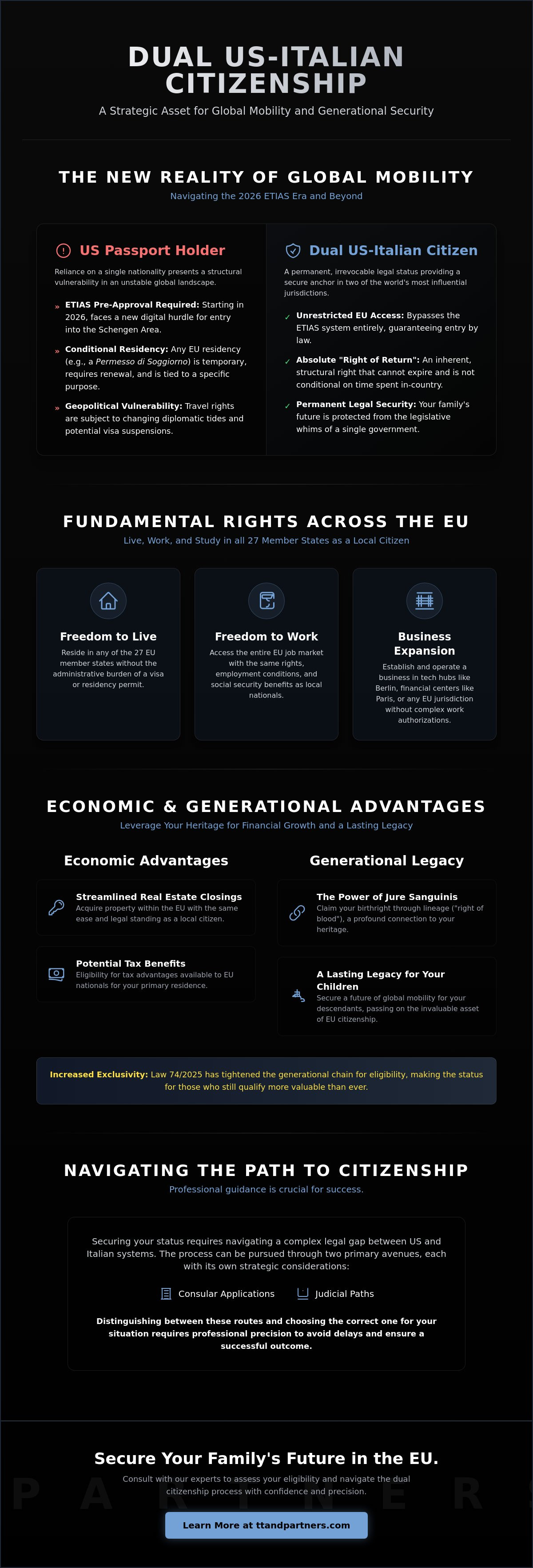
In 2026, global mobility has transformed from a simple travel convenience into a vital risk management strategy for the modern professional. Holding dual US-Italian citizenship provides a permanent, irrevocable legal status within two of the world's most influential jurisdictions. It's not just about a second passport. It's about the intellectual and strategic freedom to pivot when geopolitical conditions shift. While a US passport offers significant global reach, it remains subject to the changing diplomatic tides of the European Union. Reliance on a single nationality is increasingly seen as a structural vulnerability in a diversified portfolio.
The "Plan B" philosophy has matured. High-net-worth individuals and families no longer view citizenship through the narrow lens of commercial programs that require massive capital outlays. They're turning to Italian nationality law to reclaim their heritage. This principle of Jure Sanguinis, or right of blood, offers a more profound connection to the EU than any temporary visa. The primary dual US Italian citizenship benefits lie in this permanence. You aren't a guest in Italy. You're a returning citizen with a seat at the table in one of the world's largest economies. While Law 74/2025 has recently tightened the generational chain, for those who still qualify, the status is more exclusive and valuable than ever.
Navigating the ETIAS Era as a Dual National
The European Travel Information and Authorization System (ETIAS) is set to become fully operational in late 2026. This digital hurdle requires US citizens to obtain pre-approval before entering the Schengen Area. For the frequent traveler or business owner, this adds a layer of administrative friction that didn't exist in previous years. An Italian passport bypasses this system entirely. As an EU national, your entry is guaranteed by law. This provides absolute peace of mind during global health crises or political shifts that might trigger sudden visa suspensions for non-EU travelers. You simply walk through the EU citizen lane, avoiding the scrutiny and delays of the general queue.
The "Right of Return" and Permanent Residency
It's vital to distinguish between a temporary permit and the absolute "Right of Return." A Permesso di Soggiorno is a functional tool for residency, but it's conditional. It requires periodic renewal and often ties your status to a specific purpose, like work or study. Citizenship is an inherent, structural right. It can't expire. It doesn't require you to maintain a specific number of days in the country to remain valid. This legal security creates a genuine second home. It allows you to move between the US and the EU with total autonomy. Having this status ensures that your family's future isn't tied to the legislative whims of a single government, offering a layer of protection that a standard residency permit can't match.
Fundamental Rights: Living, Working, and Studying in the EU
Securing an Italian passport is not merely a symbolic gesture toward one's ancestry. It is the acquisition of a powerful legal status that grants you the same fundamental rights as any individual born in the European Union. One of the most significant dual US Italian citizenship benefits is the inherent right to reside in any of the 27 EU member states without the administrative burden of a visa or residency permit. This freedom is governed by the principle of equal treatment, ensuring that you're entitled to the same employment conditions, social security benefits, and tax advantages as local nationals. This legal parity transforms the entire continent into a domestic market for your talents and lifestyle choices.
For entrepreneurs and digital nomads, this mobility represents a competitive edge in a globalized economy. You aren't restricted to the borders of Italy; you can establish your base in the tech hubs of Berlin, the financial centers of Paris, or the creative districts of Madrid. By understanding your rights to work in the EU, you can navigate these markets with the confidence of a domestic player. This status eliminates the need for complex work authorizations, allowing you to pivot between jurisdictions as your business interests evolve. It creates a seamless bridge between the American and European markets, fostering a unique professional duality.
Employment Freedom Beyond Italian Borders
The transition from a foreign professional to an EU citizen removes the prohibitive costs and delays of employer sponsorship. In many European markets, companies hesitate to hire non-EU talent due to the bureaucratic hurdles involved. As a dual national, you bypass these obstacles entirely. You can accept a position in Dublin or Amsterdam on Friday and start on Monday. This agility is a cornerstone of the modern professional's toolkit, offering a level of career autonomy that a standard US passport cannot provide. You're no longer tied to a specific employer's visa support, giving you total leverage in salary negotiations and career pivots.
Access to World-Class Healthcare and Education
Beyond the professional sphere, the structural benefits extend to your family's well-being and intellectual development. Italian citizens have access to the Italian National Health Service (Servizio Sanitario Nazionale), which is consistently ranked among the best in the world for its comprehensive coverage. Your children can also benefit from "EU rate" university tuition. While international students often face exorbitant fees, EU citizens pay significantly lower rates, often saving tens of thousands of dollars over a four-year degree. These long-term dual US Italian citizenship benefits are fully transferable to your spouse and descendants, creating a legacy of opportunity. If you're ready to explore how these rights apply to your specific lineage, you can reach out for a professional evaluation to begin the verification process.
Economic Advantages: Real Estate and Business Expansion
Dual status isn't merely a cultural connection; it's a tool for capital efficiency and asset protection. The U.S. government on dual nationality confirms that Americans can maintain their original status while acquiring another, opening a door to sophisticated investment structures. One of the primary dual US Italian citizenship benefits is the removal of reciprocity hurdles that often complicate property acquisitions for non-residents. By holding an Italian passport, you're no longer viewed as a foreign investor, but as a domestic stakeholder with full access to the Italian market's structural advantages.
Business expansion follows a similar logic of integration. For those looking to establish a bridgehead in the European Union, LLC incorporation becomes a more streamlined process when backed by the legal standing of a citizen. This status also grants access to Italian and EU business grants specifically reserved for domestic entrepreneurs, providing non-dilutive capital for innovation and growth. It's a shift from being a guest participant to a primary actor in the Eurozone's economic landscape.
Strategic Real Estate Investments
Acquiring property as a citizen unlocks significant fiscal advantages. The "Prima Casa" (First Home) tax regime allows citizens to benefit from a reduced "imposta di registro" or registration tax of 2%, compared to the standard 9% rate typically applied to non-residents. Beyond tax, citizens enjoy robust legal protections in international litigation involving property disputes. Financing also becomes more accessible. Local banks are far more inclined to offer competitive mortgage rates to citizens than to foreign investors, viewing them as long-term participants in the local economy.
Entrepreneurial Synergy and Trade
The synergy between US and Italian status is particularly evident in international trade. Dual citizenship perfectly complements the E-1 Treaty Trader Visa, allowing corporate entities to facilitate substantial trade between the two nations with reduced friction. Certain European industries, such as specific sectors of defense or telecommunications, may have ownership restrictions that favor EU nationals. Holding an Italian passport allows you to maintain majority stakes in these sensitive sectors without the need for local proxies. Navigating these complex cross-border structures requires the precision of a seasoned Italian immigration lawyer to ensure that every entity is compliant with both jurisdictions. This holistic approach ensures your dual US Italian citizenship benefits translate into measurable wealth preservation and business scalability.
Legacy and Generational Wealth: The Power of Jure Sanguinis
Italian citizenship operates on the principle of Jure Sanguinis, or the right of blood. Unlike the American concept of birthright citizenship based on geography, the Italian framework recognizes your lineage as a continuous legal thread. One of the most enduring dual US Italian citizenship benefits is its capacity to be passed down through generations, effectively functioning as a sovereign inheritance. This status ensures that your children and their descendants aren't merely observers of European culture, but recognized members of the Italian state with all the structural advantages that entails. It's a permanent asset that appreciates in value as global borders become less permeable.
The transmission of this status is often automatic for minor children, provided the parent has already established their own citizenship. As of January 1, 2026, parents have a three-year window to register the birth of their foreign-born minor child to claim their citizenship status. Notably, the previously required €250 registration fee has been dropped for applications submitted after this date. This legislative change underscores the importance of timely administrative action. By securing this status now, you're providing your family with a permanent "Plan B" that remains immune to the shifting sands of global immigration policies. It's a strategic foundation for a life lived across two continents.
Securing the Future for Your Descendants
Maintaining your family's status requires consistent interaction with the AIRE (Anagrafe degli Italiani Residenti all'Estero) system. Registering life events like births or marriages ensures the generational chain remains unbroken. This administrative diligence protects your children from future legislative tightening, such as the restrictions introduced by Law 74/2025, which limited eligibility for many to the second generation. Beyond legal security, dual nationality provides a significant professional head start. Your children will have the freedom to pursue internships in Milan, master's degrees in Paris, or research positions in Berlin without the barrier of visa sponsorship. It's a gift of absolute optionality.
The 1948 Case: Overcoming Historical Gender Discrimination
The path to citizenship isn't always administrative. Historically, the "1948 Rule" prevented Italian women from passing citizenship to children born before January 1, 1948. While this discriminatory practice was ended for future births, those with lineages through maternal ancestors born before this date must seek a judicial remedy. Modern legal precedents allow these families to claim their rights through the Italian court system. These cases require a filing fee of €600 per petitioner and demand a high level of technical precision. Because these claims are argued before a judge rather than processed at a consulate, success depends on the quality of your legal representation. If your lineage follows a maternal path, you should consult with our specialists to evaluate your eligibility for a judicial appeal.
Professional Guidance: Navigating the US-Italy Legal Gap
The bridge between two legal systems requires more than just document collection; it demands a sophisticated understanding of how US administrative records interact with Italian civil law. Discrepancies in names or dates on century-old birth certificates can derail an application at the consular level. While some attempt a DIY approach, the primary dual US Italian citizenship benefits are best secured through professional oversight that anticipates these hurdles before they become formal rejections. This process isn't merely about gathering papers. It's about building a defensible legal argument for your right to a second nationality.
Applicants generally face three paths. Consular applications are the standard but often involve wait times that stretch toward the statutory 36-month maximum established by Law 11/2026. Applying directly in Italy requires establishing physical residency, a move that carries its own tax and logistical implications. For many, judicial appeals offer a strategic alternative, particularly for 1948 cases or when consular delays become unreasonable. When you analyze the long-term ROI, the contrast is clear. Unlike the recurring fees and residency requirements associated with the cost of a Green Card, Italian citizenship is a one-time investment that yields permanent, generational returns.
Why Professional Representation is Essential
The technical precision required for Apostilles and certified translations cannot be overstated. An Apostille is a specific form of international legalization that many US state offices handle differently. A single error in the chain of authentication can lead to a "preavviso di rigetto," or notice of intent to reject. A specialized lawyer doesn't just fill out forms. They curate a legal portfolio that meets the exacting standards of the Italian Ministry of Foreign Affairs. This expertise allows for a strategic consultation to determine if your lineage is best served by a consular filing or a court-based petition.
Your Next Steps Toward Dual Citizenship
Your journey begins with a rigorous assessment of your lineage to ensure compliance with the 2025 legislative changes. Once eligibility is confirmed, the document collection phase involves gathering records from both sides of the Atlantic and subjecting them to formal legalization. This is where precision meets strategy. To navigate this transition and maximize your dual US Italian citizenship benefits, you should contact Tosolini, Toniutti & Partners for a comprehensive evaluation. Our firm serves as a dedicated bridge, ensuring your transition to dual nationality is handled with the professional gravity it deserves.
Architecting a Borderless Future
Securing an Italian passport is more than a cultural tribute; it's a sophisticated risk management strategy for an unpredictable age. We've examined how this status functions as a permanent legal anchor, providing unrestricted access to the European Union's economic and educational landscape while establishing a generational legacy for your descendants. The primary dual US Italian citizenship benefits lie in this absolute optionality, allowing you to move between jurisdictions with the confidence of a domestic stakeholder rather than a temporary guest.
Success in this complex legal landscape requires a partner with deep cross-border expertise. Our bilingual legal team, based in the United States, possesses decades of experience navigating the specific nuances of Jure Sanguinis and 1948 cases. We provide the intellectual rigor and technical precision necessary to bridge the gap between US records and Italian requirements. Your lineage is a powerful asset that deserves a strategic approach to verification and filing. Schedule a Strategic Consultation with Our US-Italy Legal Experts to begin architecting your family's global future. Your path to a more mobile and secure lifestyle starts with a single, decisive step.
Frequently Asked Questions
Will obtaining Italian citizenship cause me to lose my US citizenship?
You won't lose your US citizenship by acquiring an Italian passport. The United States government permits dual nationality, allowing you to maintain your American status while enjoying dual US Italian citizenship benefits. You'll continue to hold your US passport and fulfill all obligations to the United States. This duality provides a structural safety net, allowing you to move between jurisdictions without compromising your original legal standing.
Do I have to pay taxes in Italy if I become a dual citizen?
Citizenship alone doesn't trigger Italian tax obligations unless you establish legal residency in Italy. US citizens are taxed on their worldwide income regardless of where they live, a requirement that remains unchanged by a second passport. If you choose to reside in Italy, you must manage the IVAFE tax of 0.20% on foreign financial assets and the IVIE tax of 0.40% on foreign real estate. Strategic planning is essential to manage these cross-border obligations.
Do I need to speak Italian to qualify for citizenship by descent?
There is no language requirement for those applying through Jure Sanguinis. Unlike naturalization or citizenship by marriage, which require a B1 level of Italian proficiency, descent-based applicants are exempt from language testing. This allows you to secure your status based solely on your lineage and proven ancestral links. While speaking the language enhances your experience in Italy, your legal right to citizenship remains independent of your linguistic skills.
How long does the dual citizenship process typically take in 2026?
The statutory maximum processing time for adult applications is 36 months as established by Law 11/2026. Actual timelines vary significantly depending on whether you apply through a consulate or an Italian court. Some consulates process applications in 18 months, while others utilize the full three-year window. Judicial paths can sometimes offer a more predictable timeline for those facing administrative backlogs or complex lineage issues that require court intervention.
Can my spouse also become an Italian citizen if I qualify?
Your spouse can apply for citizenship through marriage once you've been a citizen for three years, or 18 months if you have children together. This process requires the spouse to pass a B1 level Italian language exam and provide a clean criminal record. While your spouse doesn't qualify automatically through your descent, the path to naturalization is significantly clearer once your own status is legally established and registered with the appropriate authorities.
Are there any military service requirements for dual US-Italian citizens?
There are currently no mandatory military service requirements for Italian citizens. Italy abolished compulsory military service in 2005, moving to a fully professional volunteer force. As a dual national, you aren't required to serve in the Italian armed forces or register for the draft. This ensures that your status doesn't come with unexpected defense obligations, allowing you to enjoy the dual US Italian citizenship benefits with total peace of mind.
What is the "1948 Case" and does it apply to my family lineage?
The 1948 Case refers to a legal path for descendants of Italian women who had children before January 1, 1948. Historically, these women couldn't pass citizenship to their offspring due to discriminatory laws. Modern court rulings have corrected this, allowing descendants to claim their rights through a judicial petition in Italy. If your lineage involves an Italian female ancestor whose child was born before 1948, this court-based route is your primary legal solution.
Can I pass Italian citizenship to my children if they are already adults?
You can pass citizenship to adult children, but they must submit their own individual applications to be recognized. While minor children are registered automatically through their parents, adult descendants must prove their lineage through the standard application process. Each adult applicant must pay the €600 consular fee. Your successful application provides the necessary legal foundation, making their subsequent filings significantly more straightforward by establishing the recognized ancestral link in the Italian system.


Comments