

E-1 Treaty Trader Visa: Complete Eligibility Guide

A steady U.S. trade relationship alone doesn’t qualify a business or trader for an E-1 visa. According to U.S. Citizenship and Immigration Services, more than 50% of a treaty trader’s international trade volume must be between the United States and the treaty country of the trader’s nationality. The E-1 analysis also considers employee eligibility, including the employer’s treaty-country ownership and the employee’s role.
The criteria can seem straightforward until nationality, trade flows, and job duties are considered together. This guide explains how treaty-country eligibility and substantial trade apply to E-1 applicants, which employees may qualify, and how long an initial stay and later extensions can last.
You’ll find the key E-1 rules organized for quick reference, with attention to the distinctions that matter when assessing a U.S. trade operation or a prospective employee.
Table of Contents
Substantial and principal trade requirements
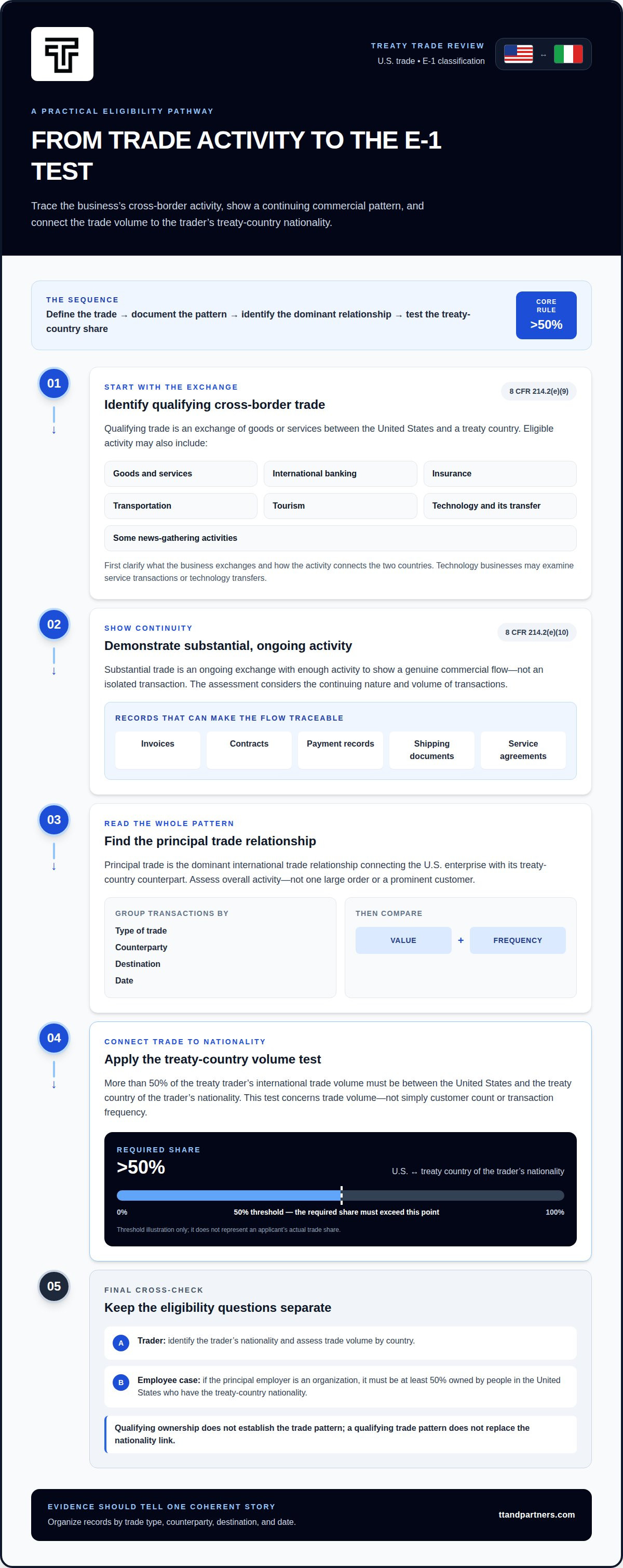
Qualifying trade is the cross-border exchange of goods or services between the United States and a treaty country. Under 8 CFR 214.2(e)(9), eligible trade may also involve international banking, insurance, transportation, tourism, technology and its transfer, or some news-gathering activities. To assess an E-1 case, identify what the business exchanges and how the activity connects the two countries. A technology company, for example, may examine transactions involving services or technology transfers.
Substantial trade is an ongoing exchange with enough activity to demonstrate a genuine commercial flow, rather than an isolated transaction. The requirement is addressed in 8 CFR 214.2(e)(10). The assessment considers the continuing nature and volume of transactions, so organize records that show business activity over time. In an E-1 application, invoices, contracts, payment records, shipping documents, and service agreements can help make the commercial pattern clear and traceable.
Principal trade describes the dominant international trade relationship connecting the U.S. enterprise with its treaty-country counterpart. The overall pattern matters, not merely one large order or a prominent customer. Review transactions by destination and trading partner, then compare their value and frequency across the business’s international activity. This helps distinguish sustained E-1 trade from incidental sales or services. Treaty-country nationality and ownership rules are separate eligibility questions.
For a practical review, group transactions by type, counterparty, destination, and date. Then check that the records present a consistent picture of the business’s trade. Orders and shipping records can document goods; contracts and payment records can support services. The evidence should show a coherent pattern, not isolated examples.
The application process centers on documenting qualifying trade and the treaty relationship. A person lawfully in the United States may request a change to E-1 status by filing Form I-129. Total costs depend on the filing route and case scope; professional fees are provided after a quote request, with required work and record complexity shaping the quote.
Treaty-country eligibility
Treaty-country eligibility links the trader’s nationality to a country with a qualifying treaty relationship with the United States. According to U.S. Citizenship and Immigration Services, a treaty trader qualifies for E-1 classification when more than 50% of their international trade volume is between the United States and the treaty country of their nationality. This E-1 test concerns trade volume, not simply customer count or transaction frequency.
Nationality identifies the country whose treaty relationship supports the application. First, identify the trader’s nationality, then organize international trade by country and counterparty. For example, a trader of Italian nationality should distinguish U.S.-Italy business from transactions involving other countries. This helps assess the relevant trade relationship within the broader international activity.
A treaty enterprise is the business connected to qualifying trade and employee eligibility. According to U.S. Citizenship and Immigration Services, when the principal employer is an organization rather than an individual, it must be at least 50% owned by people in the United States who have the treaty-country nationality. This ownership rule applies to employee cases and is distinct from the trader’s trade-volume test. Identify the owners, their nationalities, and their ownership interests.
For an employee application, trace the relationship from the employer to its owners. Compare ownership records with nationality evidence, and make the organization’s structure clear. For a trader application, sort international trade by destination and assess whether the U.S. and treaty-country volume meets the required share. Keeping these checks separate helps clarify which E-1 eligibility criteria each document supports.
Countries with treaty relationships can support this classification, but the trader’s nationality remains central. A business connection to a treaty country does not replace that nationality link. Likewise, qualifying ownership alone does not establish the required trade pattern. Keep distinct records for nationality, ownership, and trade volume, then assess each against its own E-1 criterion.
Work-stoppage strikes or labor disputes may affect Canadian or Mexican treaty traders’ or employees’ E-1 status under 8 CFR 214.2(e)(22). E1 lines are used in many countries; United States, Canada, and Japan are exceptions.
E-1 employee qualifications
An E-1 employee is a worker whose role connects to a qualifying treaty trader or enterprise. The assessment focuses on the employee’s duties or special qualifications, alongside the employer’s treaty relationship. A job title alone does not explain the work. Describe the position through its responsibilities, authority, and relationship to the enterprise’s operations.
Executive or supervisory duties are responsibilities that involve directing an organization, a major component, or other employees. The definition appears in 8 CFR 214.2(e)(17). Explain the role’s decision-making authority, supervision, and organizational scope. For example, an application describing a manager should distinguish strategic oversight from routine task completion. An organizational chart and a clear job description can show how the position fits within the business.
Special qualifications are skills that make an employee’s services essential to the efficient operation of the treaty enterprise. Their definition appears in 8 CFR 214.2(e)(18). The relevant question is how the employee’s expertise relates to the company’s specific work. A useful explanation connects the person’s experience or technical knowledge to actual business needs, rather than relying on a broad claim of expertise. Supporting materials should make that connection understandable.
Parent-company or subsidiary employment is a separate relationship considered under 8 CFR 214.2(e)(8)(ii). This provision addresses employment by a treaty organization’s parent company or subsidiary. If the worker’s employment involves an affiliated entity, clarify the corporate relationship and identify which organization directs the role. Corporate records and a description of reporting lines can help distinguish an affiliate arrangement from employment by an unrelated business.
Build the employee’s case around evidence that supports the chosen qualification route. For an executive or supervisor, describe authority, reporting structure, and oversight. For a specially qualified employee, explain the relevant expertise and how it relates to the enterprise’s operations. Include consistent job descriptions and organizational records, then check that the proposed duties match the employer’s actual business. This focused presentation helps reviewers assess the position’s substance rather than infer it from a title.
Initial stay and extensions
An initial stay is the period a qualifying trader or employee may remain in the United States. According to U.S. Citizenship and Immigration Services, an initial stay may last up to two years. An extension is additional authorized stay requested before the current period ends. USCIS says extensions or changes of status may be granted in increments of up to two years each.
There is no limit on the number of extensions an E-1 nonimmigrant may receive. Each extension still concerns the person’s continued stay in the relevant classification. Keep the business and employment records aligned with the role and trade relationship supporting the stay. A clear record helps explain how the underlying activity continues across each requested period.
A change of status is a request to move to E-1 status while lawfully present in the United States. The trader or employee must maintain an intention to depart when their status expires or is terminated. International travel also affects planning: an admissible E-1 nonimmigrant returning from abroad may generally receive an automatic readmission period of two years. Readmission is not a substitute for maintaining qualifying status.
Dependent status has separate considerations for spouses and children. E-1 dependent children must be unmarried and under 21 years of age. Spouses in valid E-1 or E-1S status are generally employment authorized incident to status, except spouses of employees of TECRO and TECO. Beginning January 30, 2022, USCIS and CBP began issuing Forms I-94 with an E-1S admission code for certain spouses of E-1 workers. Dependents in the United States may apply together for a change or extension of dependent status using one Form I-539.
Build a timeline around your current status period, planned travel, and any dependent filings. For guidance on coordinating these immigration timing considerations, discuss your status timeline with the firm.
Tosolini, Toniutti & Partners: E-2 VISA
Tosolini, Toniutti & Partners assists individuals and businesses assessing E-1 eligibility and pursuing an appropriate U.S. immigration strategy. Its E-1 visa support can help organize the treaty, trade, ownership, and employee-role questions covered in this guide. The firm also handles E-2 and O-1 visas, as well as Green Cards, for different immigration objectives.
Consider legal assistance when trade records, company ownership, employee duties, or status timing need to be assessed together. If your plans extend beyond treaty-trader status, discuss whether a Green Card fits your broader circumstances. The next step is to outline your business activity and immigration goals with Tosolini, Toniutti & Partners.
Contact Tosolini, Toniutti & Partners to discuss your situation, or visit ttandpartners.com.
Shape Your Next Immigration Step
The next step is to turn your business plans and personal objectives into a clear immigration strategy. Consider how your role, company structure, and longer-term plans fit together before choosing a path. A focused review can help distinguish between an E-1 visa strategy and other options that may better reflect your goals.
Tosolini, Toniutti & Partners assists with E-1, E-2, and O-1 visas. If your priorities extend beyond a temporary visa, the firm also handles Green Card matters. The right starting point is a clear account of your intended U.S. activity and the outcome you are seeking.
Share your circumstances and objectives with Tosolini, Toniutti & Partners to discuss the next step. A considered plan can make a complex decision more manageable and help you move forward with greater clarity.
Frequently Asked Questions
What does E1 mean?
In U.S. immigration, E-1 refers to the treaty trader visa classification. It is a category for qualifying international trade connected to the United States and a treaty country. The term can also appear in unrelated technical contexts, so the surrounding subject matters. In this guide, it refers to immigration status for traders and certain employees.
What is the E1 visa and who qualifies?
The E-1 visa allows eligible treaty traders and certain employees to live and work in the United States in connection with qualifying trade. A trader needs the required treaty-country nationality and trade relationship. An employee may qualify through executive or supervisory duties, or special qualifications. For an organizational employer, U.S. Citizenship and Immigration Services requires qualifying treaty-country nationals to own at least half of the enterprise.
What is the E1 visa application process and cost in the United States?
The application focuses on documenting qualifying trade and the treaty relationship. A person lawfully in the United States may request a change to E-1 status by filing Form I-129. Total costs depend on the filing route and case scope; professional fees are provided after a quote request, with required work and record complexity shaping the quote.



Comments