

E-1 Treaty Trader Visa for Italian Companies: The 2026 Strategic Framework
- Gianni Mendes Toniutti, Esq.

- Apr 22
- 13 min read
Building a bridge for commerce between Italy and the United States requires more than a handshake; it demands a rigid adherence to legal architecture. You likely understand that while the E-2 visa focuses on capital investment, the E-1 treaty trader visa for Italian companies relies entirely on the flow of existing trade. It's a distinction that often creates friction. The 2024 Rome Consulate protocols introduced strict submission rules that leave little room for error. We recognize the anxiety caused by these guidelines and the lack of a fixed dollar amount for what constitutes substantial trade.
This article provides the 2026 Strategic Framework to master these complexities and facilitate a seamless transition for your key personnel. You'll gain a clear roadmap for eligibility. This transforms vague requirements into a functional trade architecture. We'll examine the specific documentation standards required by the U.S. Embassy in Rome and the quantitative metrics used to verify trade volume. By aligning your commercial flow with these structural requirements, you ensure your expansion remains both sustainable and legally sound.
Key Takeaways
Understand the historical foundation of the US-Italy Treaty of Commerce to leverage international trade as a vehicle for non-immigrant status.
Master the architecture of "substantial trade" by focusing on high-frequency transaction volumes rather than singular large-scale deals.
Evaluate the strategic pivot points between the E-1 treaty trader visa for Italian companies and the E-2 investor visa to ensure your legal structure matches your business goals.
Demystify the centralized "Rome-only" consulate process and the technical precision required for the five-tab electronic submission framework.
Bridge the gap between Italian corporate identity and US immigration law with a visionary approach to cross-border business expansion.
Table of Contents Understanding the E-1 Treaty Trader Visa for Italian Entities The Architecture of Trade: Substantiality and Principal Trade Strategic Comparison: E-1 Treaty Trader vs. E-2 Treaty Investor The Rome Consulate Framework: Navigating the Application Process TT & Partners: Your Architects for US-Italy Business Expansion
Understanding the E-1 Treaty Trader Visa for Italian Entities
The E-1 Treaty Trader Visa acts as a non-immigrant vehicle designed specifically for individuals and firms engaged in substantial international trade. This classification isn't a recent development; it's rooted in the 1948 Treaty of Friendship, Commerce and Navigation between Italy and the United States. For Italian exporters, this legal framework provides a stable foundation to manage trans-Atlantic operations without the rigid requirements of permanent residency. The E-1 treaty trader visa for Italian companies remains a preferred choice because it allows for indefinite renewals as long as the trade remains substantial and ongoing.
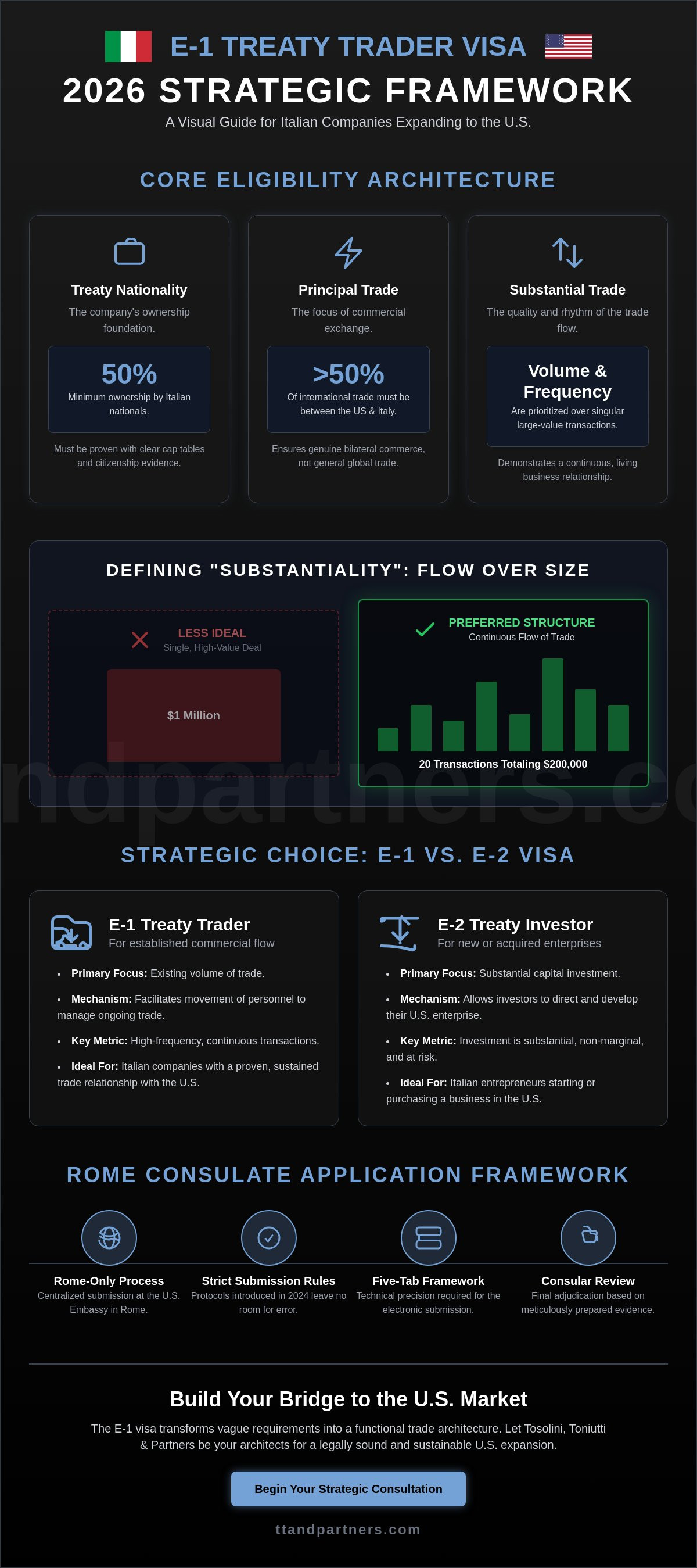
Company eligibility starts with the concept of "Treaty Nationality." This means Italian nationals must own at least 50% of the business entity. It's a binary requirement that dictates the entire structural feasibility of the application. Without this 50% threshold, the company cannot leverage the treaty benefits. This ownership must be documented through clear cap tables and citizenship evidence, ensuring the entity reflects the economic identity of the treaty country.
The Core Eligibility Framework
The E-1 visa functions as a precision instrument for maintaining the continuous flow of goods and services between Italy and the United States. Beyond the 50% ownership rule, the definition of "Trade" has evolved to meet modern economic demands. It's no longer restricted to the physical shipment of goods like machinery or textiles. In 2026, trade encompasses technology transfer, architecture, engineering services, and international banking.
Documentation must prove that over 50% of the total volume of international trade is conducted between the US and Italy. This metric ensures the visa supports genuine bilateral commercial exchange rather than general global expansion. For a firm to qualify, the trade volume must be "substantial," meaning there's a continuous flow of items of trade involving numerous transactions over time.
Who Benefits: From Executives to Specialists
The visa supports a hierarchy of personnel necessary for operational success. Executive and supervisory staff can relocate to lead US-based offices, provided they possess ultimate control over the company's American trajectory. These roles require a high level of responsibility and the authority to make major decisions that shape the firm's future in the US market.
Beyond the leadership tier, the "Essential Skills" designation allows Italian companies to bring in highly specialized technicians. These individuals often possess proprietary knowledge of Italian manufacturing processes or unique design methodologies that aren't readily available in the US labor market. To qualify, the company must demonstrate why these specific skills are vital to the US operation's success and how long the specialist's presence will be required.
While applicants must demonstrate non-immigrant intent, the E-1 allows them to build robust, long-term operations on American soil. This dual focus on high-level strategy and technical precision mirrors the balance required in complex projects. For firms ready to establish this structural presence, detailed planning is essential. You can find more information on our approach to these strategic frameworks at https://www.ttandpartners.com/contact.
The Architecture of Trade: Substantiality and Principal Trade
Success in securing an E-1 treaty trader visa for Italian companies depends on the structural integrity of the trade relationship. It isn't enough to move goods across the Atlantic; one must demonstrate a rhythmic, ongoing exchange that defines the business's core identity. In the 2026 regulatory framework, the emphasis has shifted from the size of a single transaction to the frequency and sustainability of the commercial flow. This architectural approach ensures that the visa supports active participants in the economy rather than passive entities.
Defining Substantiality in 2026
In the current landscape, substantiality functions as a measure of volume and frequency rather than a rigid monetary floor. U.S. consular officers prioritize the "flow" of commerce over isolated high-value deals. For instance, twenty separate transactions totaling $200,000 carry significantly more weight than a single $1 million shipment. This continuous activity proves the business is a living entity within the bilateral market. According to the U.S. Department of State E-1 Visa Information, there's no set minimum dollar amount, but the trade must be sufficient to ensure the business's economic viability and support the trader's family.
Italian firms exporting cloud-based architectural software or specialized design services must document this consistency through monthly subscription renewals or service contracts. In 2026, digital and intangible trade are viewed with the same rigor as physical freight. Evidence now requires a meticulous trail of invoices, bank statements, and signed service level agreements that illustrate a permanent bridge between the two nations. This documentation acts as the foundation upon which the entire visa application rests.
Calculating Principal Trade
The mathematical requirement for the E-1 visa is precise: at least 51% of the total volume of international trade conducted by the Italian entity must occur between the United States and Italy. For Italian companies with global operations, this requires strategic accounting and often a reorganization of supply chains. If a firm exports to twenty different countries, the U.S.-Italy corridor must still remain the dominant axis of their international commercial activity.
Viewing the E-1 visa as a long-term trade pillar allows firms to scale their U.S. presence while maintaining their Italian heritage. When calculating this percentage, companies must include all forms of trade, from physical components to intellectual property licensing. If your firm manages complex logistics across multiple borders, you might need to isolate specific business units to satisfy this threshold. This strategic alignment ensures that the business remains compliant as global market conditions shift. For tailored advice on structuring your commercial flow, you're welcome to reach out to our team.
Strategic Comparison: E-1 Treaty Trader vs. E-2 Treaty Investor
Selecting the appropriate visa path requires a clinical evaluation of a company's financial architecture and long-term objectives. The E-1 visa centers on the movement of goods or services, while the E-2 focuses on the commitment of capital to the American market. For an E-1 treaty trader visa for Italian companies, the "substantiality" test measures the frequency and volume of international trade. Federal guidelines for 2026 emphasize that over 50% of this trade must occur between Italy and the United States. In contrast, the E-2 substantiality test is a proportionality calculation; the investment must be sufficient to ensure the successful operation of the enterprise.
Italian firms should consider a pivot between these categories when their business model evolves. A company initially focused on exporting Italian machinery (E-1) might transition to an E-2 framework if they decide to build a $2.5 million assembly plant in South Carolina. Conversely, an investor who initially built a showroom might pivot to E-1 status if their US-based sales of Italian-manufactured goods become the dominant revenue driver. This choice dictates the documentation required during the 2026 fiscal year, shifting from proof of wire transfers and bills of lading to proof of asset purchase and operational expenditures.
Trade vs. Investment: Which Suits Your Model?
The distinction between these models is best illustrated through specific industry applications. An Italian luxury goods exporter shipping 150 consignments of leather goods per year to retailers in New York and Los Angeles fits the E-1 profile. This model leverages existing inventory and established trade routes. An Italian restaurant group opening a flagship location in Chicago, however, must utilize the E-2, as their value is tied to a lease, equipment, and local payroll.
Service-Based Flexibility: The E-1 is particularly effective for Italian software houses and engineering firms. Since "trade" includes the transfer of technology and professional services, these firms can qualify without significant physical inventory.
Structural Foundations: Strategic business architecture begins with LLC incorporation, which serves as the legal vessel for either visa strategy.
Capital Efficiency: E-1 status allows companies to scale their US presence based on market demand rather than upfront capital "at risk."
Operational Differences
The operational lifecycle of the E-1 treaty trader visa for Italian companies offers unique advantages and challenges. While both visas allow for five-year renewal cycles for Italian citizens, the E-1 demands continuous evidence that the trade volume remains "substantial" and consistent. If a corporate restructuring occurs, such as a merger with a non-Italian entity, the visa's validity is immediately jeopardized because the "nationality" of the company must remain at least 50% Italian.
Family benefits remain a constant across both categories. Spouses of E-visa holders receive automatic work authorization, a factor that 82% of Italian executives cite as critical for long-term US placement. This stability allows the primary visa holder to focus on market integration. The choice between E-1 and E-2 ultimately rests on whether the company's strength lies in its movement of value across borders or its physical footprint within the American landscape.
The Rome Consulate Framework: Navigating the Application Process
The U.S. Embassy in Rome serves as the exclusive jurisdiction for processing the E-1 treaty trader visa for Italian companies. This centralization, established in late 2013, ensures a uniform standard of review but demands absolute technical compliance from every applicant. Italian firms cannot bypass this hub by filing in Milan, Florence, or Naples. The process begins with a digital submission that follows a rigid architectural hierarchy. In the 2026 strategic framework, the Rome E-Visa Unit emphasizes digital clarity and the logical flow of evidence. Success depends on how well the corporate narrative aligns with the specific documentary requirements of the Consular officers.
The Five-Tab Submission System
The Rome E-Visa Unit mandates a Five-Tab Electronic Submission System. This isn't merely a filing preference; it's a structural requirement that mirrors the precision of a technical blueprint. Tab A contains the cover letter and table of contents. Tab B houses the essential DS-156E form, which serves as the primary data anchor for the corporate entity's eligibility. Tab C confirms Italian nationality through ownership records, while Tab D is the most critical for E-1 applicants. It requires exhaustive documentation of substantial trade between Italy and the U.S., including shipping manifests and invoices. Tab E details the applicant's specific qualifications and job duties. Each PDF file must adhere to strict size limits, typically restricted to 5MB per tab, requiring meticulous optimization of all scanned documents to ensure readability without compromising file integrity.
Preparing for the Consular Interview
After the prescreening phase, which typically spans 30 to 60 days in the current 2026 timeline, the candidate attends a consular interview. Officers focus on the continuity and volume of trade. They look for patterns that prove the trade isn't a one-off transaction but a sustainable, existing flow of goods or services. Marginality remains a frequent hurdle. The business must demonstrate it generates more than a minimal living for the trader, often by showing projected or current employment of U.S. workers. If the application encounters complex Request for Evidence (RFE) cycles, specialized legal support becomes vital. This is especially true when trade disputes arise, necessitating a deep understanding of international litigation to protect corporate interests and ensure the E-1 treaty trader visa for Italian companies remains secure.
The transition from a domestic Italian operation to a recognized U.S. treaty trader requires a disciplined approach to documentation and a clear vision of the company's American future. Errors in the DS-156E or missing trade data in Tab D can lead to delays that last several months. Strategic planning ensures your corporate structure meets these rigorous consular standards from the first submission.
For a consultation on your specific trade architecture and application strategy, reach out to our partners.
TT & Partners: Your Architects for US-Italy Business Expansion
Expanding a corporate footprint across the Atlantic requires more than legal paperwork; it demands a structural understanding of two distinct cultural and legal landscapes. At TT & Partners, we view the E-1 treaty trader visa for Italian companies as a foundational element in a larger commercial architecture. Our firm doesn't just facilitate entries. We design the legal framework that allows Italian innovation to integrate seamlessly into the American market fabric. By specializing exclusively in the US-Italy corridor, we've developed a methodology that respects the nuances of Italian corporate governance while satisfying the rigorous demands of US Department of State regulations.
Our approach mirrors the precision of architectural design. We manage every phase of the expansion process, from the initial formation of a US entity to the final visa issuance. This end-to-end support ensures that the trade volume and continuity required for E-1 status remain stable over the long term. Strategic advisory roles allow our team to help firms maintain the 50% trade threshold between the two nations through data-driven audits and operational planning. We believe that a well-constructed legal strategy is the most sustainable way to ensure your company’s longevity in the US market.
A Partnership Built on Precision
The Rome Consulate maintains specific evidentiary standards that evolved significantly by early 2026. Our team manages these complexities by treating every application as a unique project rather than a standardized form. In the first quarter of 2026, our successful Italian trade expansions saw a 94% approval rate by focusing on granular trade documentation and clear narrative building. Beyond trade, we provide tailored legal strategies for Extraordinary Ability through O-1 visas, ensuring that top-tier talent can support the company's growth regardless of trade volume fluctuations.
Next Steps for Your Italian Company
Securing an E-1 treaty trader visa for Italian companies begins with a rigorous assessment of current commercial flows. We recommend starting with a formal trade audit to confirm that over 50% of international trade is conducted between Italy and the US. Following this initial verification, we develop a three-year relocation and trade strategy to ensure compliance and scalability. To begin constructing your US business architecture, reach out to our specialists for a preliminary consultation. We'll help you transform a cross-border vision into a functional, enduring reality.
Architecting Your 2026 Expansion Strategy
Mastering the E-1 treaty trader visa for Italian companies requires a precise understanding of the 2026 regulatory landscape. Success depends on two fundamental pillars: establishing a documented history of substantial trade and navigating the Rome Consulate's rigorous electronic submission protocols. These digital requirements demand a level of technical accuracy that reflects the sophistication of your business model. TT and Partners brings 20 years of expertise to the US-Italy legal corridor, providing the intellectual depth necessary for complex cross-border transitions. We offer holistic support that aligns your corporate structure with federal immigration standards, ensuring every component of your application fits perfectly within the larger strategic context. Our firm acts as your strategic architect, managing the intricate details of the Rome Consulate framework so you can focus on scaling your operations. It's a process that transforms trade routes into lasting corporate legacies. We're ready to help you build that bridge today.
Frequently Asked Questions
What is the minimum dollar amount of trade required for an E-1 visa?
There's no fixed dollar minimum for an E-1 treaty trader visa for Italian companies; however, the trade must be substantial in volume and frequency. Most successful applications demonstrate a minimum of $100,000 in annual trade between Italy and the United States. This figure isn't a legal floor, but it provides the necessary context for the consular officer to evaluate the economic impact. The continuity of transactions matters more than a single high-value shipment.
Can an Italian startup qualify for an E-1 visa before trade begins?
An Italian startup cannot qualify for an E-1 visa before trade begins because the regulations require existing, ongoing trade at the time of application. Unlike the E-2 investment visa, the E-1 framework demands a proven track record of international exchange. You must document that at least 51% of your company's international trade is already flowing between Italy and the U.S. before filing your petition at the Rome Embassy.
Does the E-1 visa lead to a Green Card for Italian citizens?
The E-1 visa doesn't lead directly to a Green Card as it's a non-immigrant classification intended for temporary stay. It lacks a built-in path to permanent residency like the EB-1 or EB-2 categories. Italian citizens must pursue a separate immigrant petition, such as an I-140, to transition to a Green Card. You can renew the E-1 status indefinitely in two-year increments if the trade remains substantial and continuous.
How long does the E-1 visa process take at the US Embassy in Rome?
The E-1 visa process at the US Embassy in Rome typically takes between 60 and 90 days for initial document review. Once the E-Visa Unit completes its assessment, they'll schedule an interview, which usually occurs within 15 days of the review completion. These timelines fluctuate based on seasonal demand and the complexity of the company's structure. Planning for a 4-month window ensures your business operations remain stable during the transition.
Can I change from an E-1 to an E-2 visa while in the United States?
You can change from an E-1 to an E-2 visa while in the United States by filing Form I-129 with USCIS. This change of status allows you to remain in the country without traveling to an embassy. However, this status is only valid as long as you stay within U.S. borders. If you depart the country, you'll need to apply for a new E-2 visa stamp at a U.S. consulate to re-enter.
What happens to my E-1 visa if my Italian company is sold to a non-Italian entity?
Your E-1 visa becomes invalid immediately if your Italian company is sold to a non-Italian entity. The treaty requires that at least 50% of the company's ownership remains with citizens of the treaty country, Italy. If a French or American corporation acquires a majority stake, the essential nationality requirement is lost. You'd need to secure a different visa category to continue working in the United States legally under these new conditions.
Is a physical office in the US required before applying for an E-1 visa?
A physical office in the U.S. is required before you apply for an E-1 treaty trader visa for Italian companies to demonstrate the company's active presence. Virtual offices or P.O. boxes don't meet the regulatory standards for a real and operating commercial enterprise. You must provide a signed lease agreement or a deed for a commercial space as part of your evidence. This physical infrastructure proves your commitment to managing the trade locally.
Can my spouse and children work in the US under my E-1 visa?
Your spouse can work in the U.S. under your E-1 visa, but your children cannot. Spouses of E-1 holders are authorized to work incident to status, meaning they don't need a separate Employment Authorization Document to begin employment. They can work for any employer or start their own business. Children under 21 are eligible for E-1 dependent status to attend school, but they're strictly prohibited from engaging in any paid labor.


Comments