

E-1 Treaty Trader Visa for Italian Companies: The 2026 Strategic Guide
- Gianni Mendes Toniutti, Esq.

- Apr 22
- 13 min read
If your international expansion relies on the sheer size of a single transaction, you're likely building on a foundation of sand. Most Italian entrepreneurs recognize that the US market represents the ultimate canvas for growth, yet the technical architecture of immigration often feels like an impenetrable blueprint. Securing an E-1 treaty trader visa for Italian companies requires more than just high-value exports; it demands a rhythmic consistency in trade that many firms overlook. You already know that the complexity of cross-border regulations can stall even the most ambitious projects.
This guide provides a sophisticated roadmap to master these requirements, offering clarity on the 50% trade volume threshold and the specific protocols mandated by the US Embassy in Rome for the 2026 fiscal year. We'll examine the structural requirements for substantial trade, detail a strategic application plan, and outline a vision for scaling your presence across the American landscape. By aligning your operational reality with these regulatory frameworks, you can transform a complex legal process into a sustainable engine for international growth.
Key Takeaways
Navigate the historical context of the US-Italy Treaty of Commerce to build a sophisticated legal foundation for your firm's international expansion.
Master the technical nuances of quantifying "substantial trade" by prioritizing transaction frequency and operational continuity over arbitrary dollar amounts.
Strategically design your personnel architecture to secure an E-1 treaty trader visa for Italian companies by distinguishing between executive leadership and essential specialized talent.
Streamline your path through the Rome Embassy’s E-Visa unit by meticulously preparing the corporate profile and required documentation with professional precision.
Transform a renewable trade classification into a long-term vision for US market dominance and potential pathways to permanent residency for key stakeholders.
Table of Contents Understanding the E-1 Treaty Trader Framework for Italian Entities Quantifying "Substantial Trade" in the US-Italy Corridor Personnel Architecture: Who Qualifies for the E-1 Visa? Navigating the Rome Embassy Application Process Long-Term Vision: From E-1 Trader to US Market Dominance
Understanding the E-1 Treaty Trader Framework for Italian Entities
The E-1 classification remains a cornerstone of the transatlantic economic architecture, facilitating the fluid movement of specialized personnel and executives between Italy and the United States. This legal pathway originates from the Treaty of Commerce and Navigation, a bilateral agreement signed on February 2, 1948. In the 2026 commercial landscape, this treaty provides a stable foundation for Italian exporters who seek to scale their operations without the restrictive quotas of the H-1B lottery or the rigid corporate hierarchies required by L-1 transfers. The E-1 visa serves as a bridge for companies where 50% of trade is international. By prioritizing the consistent volume of exchange over the size of a upfront financial deposit, it rewards active market participation and long-term commercial commitment. For a deeper dive into the historical and technical foundations of this status, Understanding the E-1 Treaty Trader Visa offers a detailed perspective on how these regulations evolved to support global commerce.
The Core Eligibility Pillars
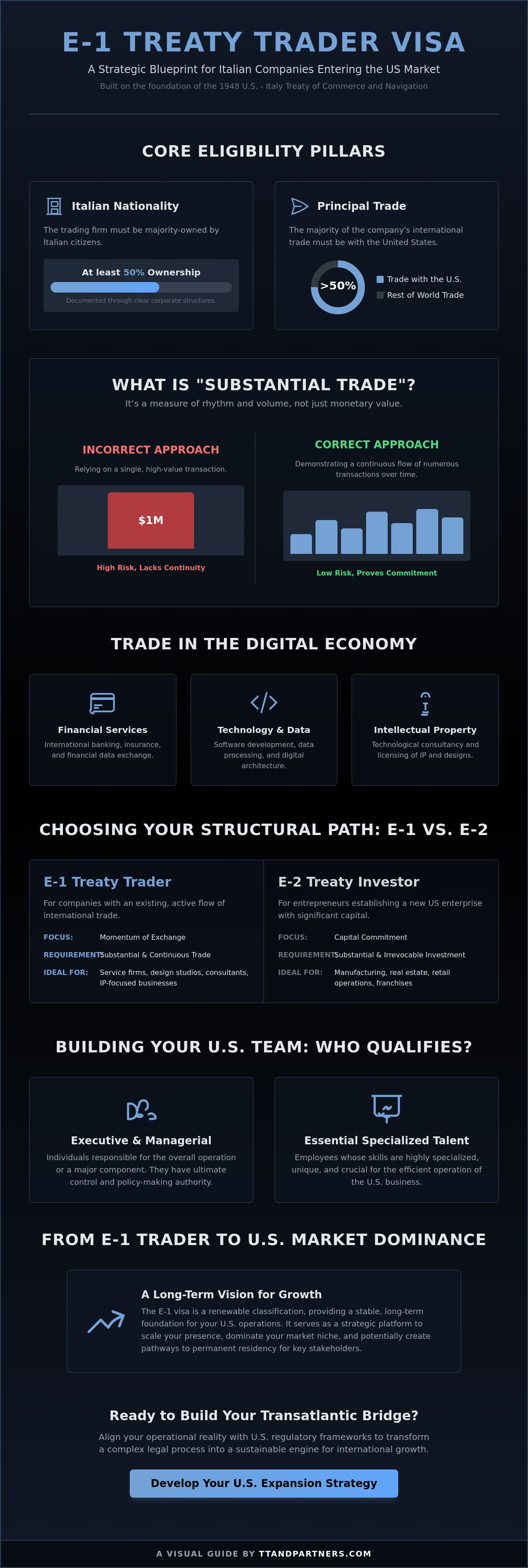
To qualify for the E-1 treaty trader visa for Italian companies, the enterprise must demonstrate that at least 50% of its ownership is held by Italian citizens. This ownership must be documented through clear corporate structures, whether the entity is a boutique studio or a large industrial firm. By 2026, the definition of trade has expanded to reflect the digital economy. It doesn't refer solely to the shipment of physical goods; it encompasses a broad spectrum of modern commerce:
International banking, insurance, and financial services.
Data processing, software development, and digital architecture.
Technological consultancy and intellectual property licensing.
The "Treaty Country" nexus requires that the Italian parent organization maintains its operational heart in Italy. This ensures the trade flow remains truly bilateral, supporting the economic health of both nations while allowing the US branch to thrive as a functional extension of the Italian headquarters.
E-1 vs. E-2: Selecting the Correct Structural Path
Choosing between trade and investment is a strategic decision that defines a company's US trajectory. While the E-2 visa requires a substantial capital commitment, the E-1 focuses on the momentum of existing exchange. Italian design firms frequently favor the E-1 model because their primary value lies in specialized services and intellectual output rather than heavy equipment or real estate. If a firm manages a consistent flow of design contracts between Milan and New York, the E-1 provides a more agile framework for growth. It's a structure that values the intellectual content of the work over the physical assets of the office. You can explore the technical nuances of these options in our E-1 vs E-2 comparison. This choice ensures that the legal structure supports the architectural integrity of the business plan. For personalized guidance on your firm's specific needs, you may reach out to our team at TT and Partners.
Quantifying "Substantial Trade" in the US-Italy Corridor
The architecture of the E-1 treaty trader visa for Italian companies rests on the concept of "substantial trade." This isn't defined by a rigid minimum dollar amount; instead, it's a measure of the rhythm and volume of commercial activity. For an Italian firm to qualify in 2026, the focus must shift from the total value of a single transaction to the frequency and continuity of the trade flow. Substantial trade is measured by the continuous flow of individual items and transactions rather than the weight of a single large invoice. Adjudicators look for a pattern of trade that demonstrates a committed, ongoing relationship between the Italian parent and the U.S. market.
The regulatory environment, as detailed in the E-1 Treaty Trader Framework, emphasizes that the volume of trade must be sufficient to ensure a continuous flow of international trade between the two nations. While a small boutique exporting high-value artisanal furniture might qualify with twelve shipments a year, a high-volume textile manufacturer might need weekly transactions to prove the same level of substantiality. The core requirement is that the trade exists independently of the visa application; it's a living commercial artery, not a temporary project.
The Principal Trade Requirement
To secure an E-1 treaty trader visa for Italian companies, the enterprise must prove that at least 51% of its total international trade volume is conducted specifically between the U.S. and Italy. This "50% Rule" becomes complex for multi-national Italian corporations with decentralized supply chains. Documentation must be meticulous. We rely on a structured assembly of bills of lading, customs clearances, and digital ledgers to map the commercial flow. If an Italian firm trades globally, the U.S. corridor must remain the primary focus of its international operations, verified through precise accounting of every shipment crossing the Atlantic.
Sector-Specific Trade Nuances
Different industries require tailored evidentiary strategies to meet the substantiality test. In the Italian fashion and design sector, trade often follows a seasonal pulse. Evidence must show how high-volume shipments in February and September create a sustainable annual average. Conversely, the industrial machinery sector often deals with low-frequency, high-value units. Here, the trade definition expands to include service contracts, software updates, and spare part deliveries that maintain the "continuity" requirement between major sales.
Many Italian firms find that a strategic LLC incorporation serves as the necessary foundation for organizing these trade documents under a U.S. entity. This structural clarity allows for a more transparent presentation of invoices and contracts to consular officers. If your company is currently evaluating its trade volume for the upcoming fiscal year, you may wish to consult with our strategic advisors to ensure your documentation aligns with 2026 standards.
Personnel Architecture: Who Qualifies for the E-1 Visa?
Success with the E-1 treaty trader visa for Italian companies depends on a precise alignment of human capital with US regulatory standards. It's not just about the volume of trade; it's about the individuals who execute the vision. The framework divides candidates into two primary groups: the individual Treaty Trader and the specialized employees. Every applicant must share the Italian nationality of the firm's majority owners. This requirement is a foundational pillar of the treaty. If the entity is a corporation, at least 50% of the stock must be held by Italian citizens. This ownership structure must be documented with surgical precision to satisfy 2026 evidentiary standards.
Executive and Managerial Roles
Executives must demonstrate they hold primary responsibility for the company's policy and strategic direction. In the current 2026 application landscape, a simple job title isn't enough to secure approval. The US government requires a detailed organizational chart showing that the manager oversees a professional team. We've observed that applications are frequently scrutinized if the manager is involved in day to day clerical tasks. The focus must remain on high level operations and US market expansion. A successful filing clearly distinguishes between a true executive and a mid level supervisor who lacks discretionary authority over the firm's trajectory.
Specialized Knowledge and Essential Skills
The "Essential Employee" category is designed for technical experts whose skills are unique to the Italian firm's heritage or proprietary technology. This is where the concept of "Italian Craftsmanship" becomes a legal asset. You must document why a US worker can't fulfill the role. This often involves highlighting specialized training, unique architectural software, or proprietary manufacturing processes. Key requirements include:
Proven Expertise: The employee needs at least two years of experience with the specific systems used by the Italian parent company.
Brand Integrity: Proving the role is vital for maintaining the aesthetic or functional standards of the Italian brand.
Transfer of Skills: A clear plan for the E-1 employee to train US staff, typically outlined over a three year period.
Strategic planning for these transfers ensures that technical experts can move between Milan and New York without administrative friction. For firms looking to map out their US personnel structure, contacting our strategy team can provide the necessary clarity for a successful 2026 submission. The goal is to build a personnel architecture that reflects the sophistication of the Italian parent company while meeting the rigorous demands of US immigration law.
Navigating the Rome Embassy Application Process
Securing an E-1 treaty trader visa for Italian companies requires the same structural integrity as a complex architectural restoration. The process at the U.S. Embassy in Rome is rigorous; it demands a digital foundation that aligns perfectly with Department of State protocols. The first phase involves establishing a corporate profile within the Rome E-Visa unit system. This isn't a mere administrative hurdle. It's a strategic registration that validates the Italian entity's eligibility before any individual applicant steps into the consulate.
The digital submission phase is where most applications encounter friction. Rome enforces a strict 5MB limit for the initial PDF package. Managing this constraint requires more than just file compression; it involves a curated selection of evidence where every kilobyte must earn its place. You've got to prioritize high-impact documents like the DS-156E and recent tax returns while ensuring that trade logs remain legible. If the file exceeds this threshold, the E-Visa Unit frequently returns the package without review, causing delays that can stretch for several months.
Technical precision extends to the preparation of executives. The transition from paper to the podium happens at the Via Vittorio Veneto entrance. Consular officers in Rome are known for their deep understanding of the Italian-American commercial corridor. They don't just look for signatures. They look for an articulate defense of the company's trade volume and a clear vision for US expansion. Preempting a Request for Evidence (RFE) starts by identifying gaps in the trade history, such as inconsistent shipping dates or missing invoices from the previous fiscal year.
Documentary Precision and Tab Structure
Organizing the E-1 package is a matter of logical flow and visual clarity. The Rome Embassy prefers a specific "Tab" structure. Tab A must contain the table of contents and cover letter, while Tab D focuses on the "Substantial Trade" requirement. Italian corporate documents, including the Visura Camerale and financial statements, require certified English translations. Even though the E-1 is a trade visa, a visionary business plan is essential. It proves that the trade isn't just a historical fluke but a sustainable pillar of the company's future US presence.
The Consular Interview Experience
The interview at the US Embassy in Rome is a focused dialogue about commercial intent. Expect questions about the percentage of international trade conducted with the US; it must constitute more than 50% of the company's total international volume. Officers often probe the "substantiality" of the trade, looking for a continuous flow of transactions rather than a single large shipment. You'll need to demonstrate a long-term commitment to the American market that goes beyond temporary sales. For those seeking to refine their delivery, our team provides personalized interview preparation to ensure your narrative matches your documentation.
Success in the E-1 treaty trader visa for Italian companies depends on this balance of engineering-grade data and human persuasion. If you're ready to build your US bridge, contact our experts to begin your application strategy.
Long-Term Vision: From E-1 Trader to US Market Dominance
The E-1 treaty trader visa for Italian companies functions as a foundational structure rather than a temporary fix. It provides a renewable bridge that allows for an indefinite stay in the United States, provided the underlying trade relationship remains robust. For Italian firms, this means the ability to plan for 10 or 20 years of growth without the constant anxiety of visa expiration. The five-year reciprocity period for Italian nationals offers a stable framework, allowing executives to focus on market penetration and operational harmony rather than administrative hurdles.
Market dominance requires more than just physical presence; it demands a legal architecture that evolves with the business. As trade volume grows, the E-1 serves as a launchpad for deeper integration into the American economy. This transition is not merely about staying in the country; it involves refining the corporate presence to reflect the sophistication of Italian innovation within the US urban fabric.
Evolution to Permanent Residency
For key executives and managers, the transition from an E-1 status to a Green Card is a logical progression in the corporate lifecycle. The EB-1C Multinational Manager category stands as the most efficient path for this evolution. It allows high-level personnel to secure permanent residency without the lengthy labor certification process, provided they served in a managerial capacity for the Italian parent company for at least one year within the preceding three years. Precise timing is essential to avoid status gaps or travel restrictions that can disrupt global operations. Organizations should consult the 2026 Green Card strategy guide to align their filing schedules with the current USCIS processing benchmarks, which often fluctuate by several months.
Integrated Legal Support for the Italian Expatriate
Securing an E-1 treaty trader visa for Italian companies is only the first step in a broader strategic deployment. Protecting corporate assets in a foreign jurisdiction requires sophisticated international litigation support to manage disputes that span multiple legal systems. Our approach treats legal challenges as structural elements to be resolved with engineering precision, ensuring that US-Italy trade remains uninterrupted by local conflicts.
The needs of the Italian executive extend beyond the boardroom. A successful expansion integrates private legal matters, including:
Acquisition and management of premium US real estate assets.
Cross-border estate planning to protect family wealth across two continents.
Compliance with the 2026 tax transparency standards for foreign entities.
Tosolini, Toniutti & Partners acts as a strategic architect for these complex transitions. We move beyond simple visa processing to provide total legal harmony, ensuring every component of the expansion is durable and functional. To discuss the long-term blueprint for your US operations, connect with our team for a professional consultation.
Designing Your Transatlantic Commercial Blueprint
Securing a foothold in the American market requires more than just capital; it demands a structural understanding of the US-Italy trade corridor. The 2026 landscape emphasizes that substantial trade isn't a static figure but a continuous flow where over 50% of international volume must link the two nations. Successfully navigating the Rome Embassy's rigorous standards for the E-1 treaty trader visa for Italian companies hinges on a precise personnel architecture. Your executive and specialist roles must serve as the functional pillars of this expansion.
At TT and Partners, we approach legal representation with the same rigor an architect applies to a master plan. Our decades of US-Italy cross-border legal expertise provide the necessary context for high-net-worth Italian corporate clients to scale with confidence. Through our bilingual presence in New York and Italy, we ensure your vision remains coherent across both jurisdictions. It's time to transform your commercial objectives into a permanent transatlantic structure.
The horizon for Italian innovation in the United States has never been clearer.
Frequently Asked Questions
Does an Italian company need a physical office in the US for an E-1 visa?
An Italian company must secure a physical office space in the United States to qualify for the E-1 treaty trader visa for Italian companies. The US Department of State requires evidence of a leased or owned premise where business operations occur. Virtual offices or P.O. boxes don't meet this threshold. You'll need a signed lease agreement showing the square footage and address to demonstrate the company's active presence.
How much trade is considered substantial for an Italian exporter in 2026?
Substantial trade is defined by the volume and frequency of transactions rather than a specific monetary floor. The E-1 treaty trader visa for Italian companies requires that over 50% of the international trade volume involves the exchange of goods or services between the US and Italy. Most successful applicants demonstrate at least 12 distinct trade transactions over the preceding fiscal year. This continuous flow proves the trade isn't a single event.
Can an E-1 visa holder eventually apply for a Green Card?
An E-1 visa holder can apply for a Green Card, though the E-1 is technically a non-immigrant classification. You'll need to navigate the transition through paths like the EB-1C for multinational managers or EB-2 for advanced professionals. Since the E-1 doesn't offer dual intent as clearly as an L-1 visa, timing's critical. Many executives initiate the permanent residency process after establishing their US operations for 18 months.
What is the 50% rule for Italian ownership of the US entity?
The 50% rule dictates that Italian nationals must own at least 50% of the US entity to maintain treaty eligibility. These owners must reside in Italy or hold E-1 status in the United States. If ownership drops below this 50% threshold, the company loses its treaty status immediately. This requirement ensures the business remains a direct extension of the Italian economic framework within the American market.
How long does the E-1 visa application take at the Rome Embassy?
Processing times at the US Embassy in Rome typically range from 8 to 16 weeks for initial company registration. Once the company's status is established, individual employee interviews are usually scheduled within 15 business days. These timelines fluctuate based on seasonal demand and embassy staffing levels. It's best to submit your documentation at least 5 months before your intended travel date to account for administrative reviews.
Can my Italian employees bring their families to the US on an E-1 visa?
Spouses and unmarried children under 21 years of age can accompany E-1 visa holders to the United States. Spouses receive automatic work authorization incident to their status, so they don't need to apply for a separate Employment Authorization Document. Children can attend public or private schools but can't work. This family inclusion provides the stability needed for long term strategic assignments in the US market.
Is the E-1 visa better than the E-2 visa for a startup?
The E-1 visa is superior for startups with high transaction volumes but limited initial capital for investment. While the E-2 requires a substantial capital outlay, the E-1 focuses on the existing flow of goods or services. If your Italian firm already exports significant volume to the US, the E-1 provides a faster route without the need for large bank transfers. It prioritizes the movement of value.
What happens if the volume of trade between Italy and the US decreases?
If trade volume between Italy and the US falls below the 50% threshold, the entity risks losing its E-1 eligibility. The US government monitors these levels during visa renewal applications, which occur every 2 to 5 years. You'll need to provide tax returns and shipping logs to prove the trade remains substantial. A temporary dip isn't always fatal, but a consistent decline suggests the company doesn't meet the treaty's intent.


Comments