

E-1 Treaty Trader Visa for Italian Companies: The 2026 Strategic Guide
- Gianni Mendes Toniutti, Esq.

- Apr 22
- 13 min read
For an ambitious Italian enterprise, the Atlantic isn't a barrier; it's a structural joint in a global trade architecture that demands more than just vision. Securing an E-1 treaty trader visa for Italian companies remains the most elegant way to establish a permanent presence on American soil without the massive capital outlays required by other classifications. You've likely felt the friction of defining "substantial trade" under the rigorous scrutiny of the Rome Consulate, where a single technical ambiguity can stall years of strategic momentum. It's a common anxiety that often shadows the excitement of international expansion.
This 2026 guide provides the precise roadmap your firm needs to master these complexities and secure multi-year visas for your key personnel. We've distilled the latest regulatory nuances into a functional blueprint that prioritizes business continuity and professional precision. We'll explore the specific 2026 requirements for Italian entities and show you how to transform the application process from a bureaucratic hurdle into a strategic advantage.
Key Takeaways
Discover how the historical Treaty of Commerce and Navigation provides a foundational architecture for Italian enterprises seeking a privileged bridge to the US market.
Learn to optimize the E-1 treaty trader visa for Italian companies by balancing transaction volume and value within the context of the 2026 global economy.
Streamline your application through the Rome Consulate by mastering the technical intricacies of the DS-156E and centralized processing requirements.
Analyze the scalability of trade-based classifications versus capital-intensive investments to identify the most sustainable entry strategy for your business model.
Execute a precise corporate structuring plan that aligns your US branch and essential personnel with international compliance and operational excellence.
Table of Contents The Legal Architecture of the E-1 Treaty Trader Visa for Italian Entities Defining Substantial and Principal Trade in the 2026 Economy Navigating the Rome Consulate: A Strategic Application Roadmap Strategic Comparison: Choosing Between E-1 Trade and E-2 Investment Implementation: Bridging the US-Italy Legal Gap
The Legal Architecture of the E-1 Treaty Trader Visa for Italian Entities
The E-1 classification functions as a structural bridge, facilitating the flow of commerce between two distinct economic landscapes through a framework of reciprocity. It's not merely a permit but a strategic instrument designed for entities that maintain a continuous volume of trade between Italy and the United States. For firms operating within the 2026 global market, the E-1 Treaty Trader Visa for Italian companies represents a sophisticated tool for expansion, allowing for the movement of essential personnel without the rigid constraints of quota-based categories. This visa relies on the existence of a specific bilateral agreement that elevates the Italian enterprise to a privileged status within the American regulatory environment.
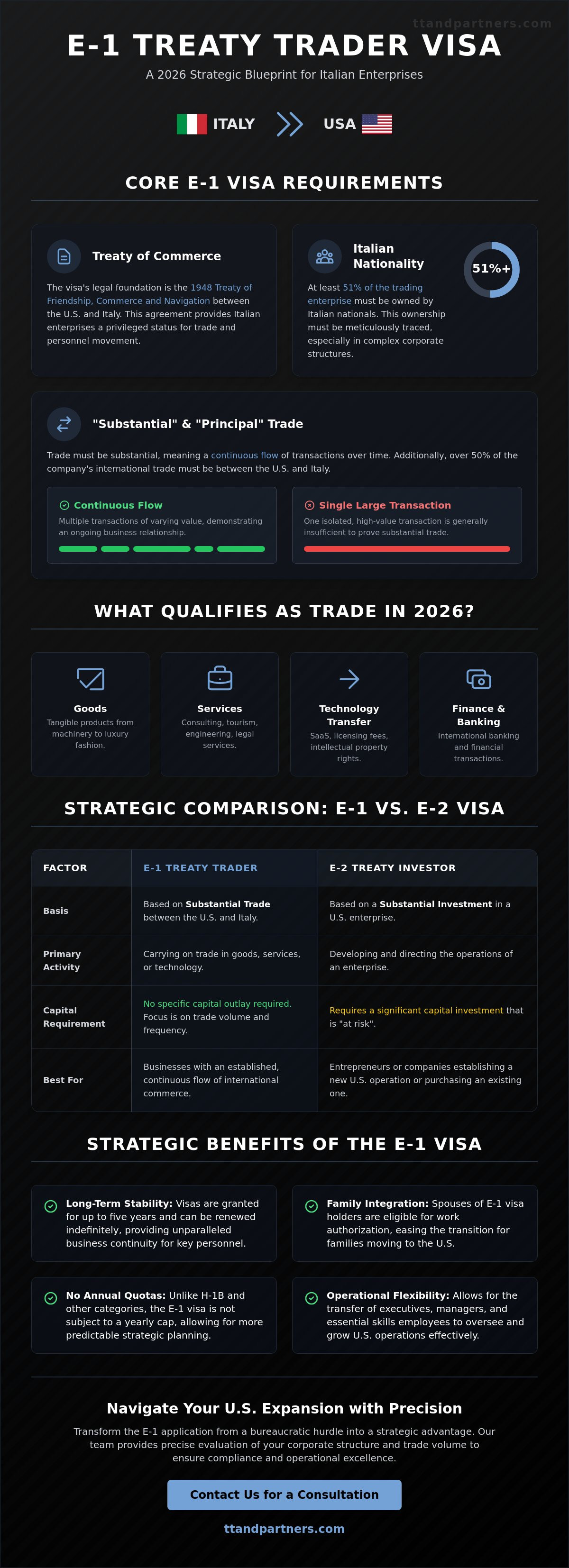
Success in this category requires a meticulous composition of ownership and activity. The 51% rule dictates that at least 51% of the trading enterprise must be owned by Italian nationals who aren't lawful permanent residents of the U.S. This requirement ensures that the entity retains its national identity, preserving the integrity of the bilateral trade intent. Beyond the administrative setup, the E-1 offers profound strategic benefits, including the potential for unlimited renewals in five-year increments and work authorization for spouses. These features provide a level of stability and family integration that's rarely found in other non-immigrant classifications.
The Italian Nationality Requirement
Verifying the chain of ownership is a process of intellectual precision, especially for complex corporate structures involving holding companies or subsidiaries. Each tier of the organization must be traced back to individual Italian citizens to satisfy the nationality mandate. Treaty Country status for Italian nationals is defined by the 1948 bilateral agreement between the United States and the Republic of Italy. If the ultimate owners hold dual citizenship, their choice of "treaty nationality" must be clearly documented to maintain the E-1 treaty trader visa for Italian companies' eligibility throughout the 2026 fiscal year.
The Role of the Treaty of Commerce and Navigation
The 1948 Treaty of Friendship, Commerce and Navigation serves as the foundational blueprint for all modern US-Italy trade relations. This historical document provides the legal protections that allow a boutique design firm in Milan to establish a functional presence in New York with minimal friction. Under the 2026 framework, the treaty ensures that Italian traders receive treatment no less favorable than that accorded to domestic entities in similar contexts. It facilitates a seamless personnel movement, treating the transatlantic corridor as a unified space for innovation and professional exchange. This partnership-driven approach allows businesses to focus on the quality of their trade rather than the hurdles of immigration.
Establishing this legal foundation is the first step in a broader expansion strategy. If your organization requires a precise evaluation of its corporate structure or trade volume, you can reach out to our team at TT and Partners for a detailed consultation on these requirements.
Defining Substantial and Principal Trade in the 2026 Economy
Success in securing an E-1 treaty trader visa for Italian companies depends on moving past the myth of a fixed dollar minimum. Consular officers in 2026 prioritize the "continuous flow" of trade over a single high-value invoice. This means a boutique furniture manufacturer in Milan shipping ten containers annually holds a stronger position than a firm with one massive, isolated transaction. The focus remains on the frequency and the systematic nature of the commercial exchange rather than just the bottom line.
Trade items are no longer restricted to physical crates on ships. The modern definition encompasses services, technology transfer, and international banking. According to the Official E-1 Treaty Trader Qualifications, trade must be in existence at the time of application. You can't base a petition on future contracts or intended business. Italian innovation in fintech and sustainable energy systems provides a robust foundation for eligibility. These sectors often rely on recurring licensing fees or software-as-a-service (SaaS) models, which perfectly satisfy the requirement for high-frequency transactions.
Goods: Tangible products ranging from industrial machinery to luxury fashion.
Services: Architectural design, engineering, legal consulting, and data processing.
Technology: Software licensing, patent transfers, and specialized technical know-how.
Banking: International financial services and insurance brokerage.
The Mechanics of Substantial Trade
Analyzing trade patterns requires a rigorous 12-month look-back period to establish a baseline of activity. For service-based Italian firms, such as IT consultancies or architectural studios, trade volume is documented through cross-border wire transfers and signed service level agreements. The continuous flow of trade items between the United States and Italy represents the essential heartbeat of a successful E-1 petition, proving that the commercial relationship is active and enduring rather than speculative.
Principal Trade: The US-Italy Connection
The 50% rule is a non-negotiable metric. Specifically, more than 50.1% of the Italian company's total international trade volume must be conducted between the United States and Italy. This calculation excludes domestic trade within Italy. For global Italian brands with distribution hubs in multiple nations, documenting the precise origin of goods is vital. Precision in record-keeping ensures the Italian identity of the trade remains undisputed. If you're structuring a complex multi-national trade operation, it's often helpful to discuss the specific architectural framework of your business to ensure compliance.
Navigating the Rome Consulate: A Strategic Application Roadmap
The U.S. Embassy in Rome serves as the exclusive hub for E-visa processing in Italy. This centralization means that whether a company is based in the industrial corridors of Milan or the artisan districts of Florence, every E-1 treaty trader visa for Italian companies converges on the capital. This singular focus allows consular officers to develop deep expertise in Italian trade patterns, but it also demands a higher standard of technical precision from applicants. The process isn't merely administrative; it's a presentation of a company's commercial integrity within the global market.
Success depends on the DS-156E, the technical heart of the application. This form acts as the structural blueprint for your trade history. It documents the continuity and volume of transactions that justify the visa. If the data on this form doesn't align perfectly with the corporate tax returns and shipping manifests provided in the supporting package, the officer will likely issue a refusal for additional information. In 2024, administrative processing delays often stemmed from these small, avoidable discrepancies between the application forms and the supporting evidence.
The Electronic Submission Protocol
Rome follows a strict digital architecture for submissions. You must compile the entire petition into a single PDF file divided into exactly five tabs. This file cannot exceed 5MB. This constraint forces a "less is more" philosophy where you have to select only the most high-impact evidence of trade. Common errors often occur when the biographical data in the DS-160 doesn't sync with the enterprise data in the DS-156E. For a deeper dive into these technical requirements, consult our E-1 Treaty Trader Visa: The 2026 Strategic Guide.
Tab A: Table of Contents and a concise Cover Letter.
Tab B: Administrative forms including the DS-156E and DS-160 confirmation.
Tab C: Proof of Italian nationality and corporate ownership structure.
Tab D: Evidence of substantial and continuous trade between Italy and the U.S.
Tab E: Applicant qualifications, including a CV and a detailed job description.
The Consular Interview Strategy
The interview is where your business vision meets the officer's scrutiny. Officers in Rome focus heavily on the "substantial trade" requirement. They want to see that the trade is existing and ongoing, not just speculative. Executive applicants must articulate how their presence in the U.S. will facilitate these trade flows. They also need to address the "intent to depart." While the E-1 is a non-immigrant visa, you must prove you'll leave the U.S. when the status ends. This is often established through ties to Italy, such as property ownership or family connections. If you're ready to refine your application's narrative, you can reach out to our team at ttandpartners.com/contact.
The officer might also probe the corporate hierarchy. They check if the applicant's role is truly executive or supervisory. If the organizational chart looks thin or the job description seems too operational, the visa might be denied. Clarity and professional composure are your best tools during this final phase of the journey.
Strategic Comparison: Choosing Between E-1 Trade and E-2 Investment
Selecting the appropriate vehicle for U.S. expansion requires a precise analysis of an Italian company's existing assets. The decision hinges on whether the firm will lead with its balance sheet or its order book. The E-1 treaty trader visa for Italian companies is specifically designed for the latter, rewarding established trade flows rather than idle capital. While the E-2 visa demands a substantial investment that must be "at risk" before approval, the E-1 leverages the momentum of existing operations. This makes it a structurally sounder choice for businesses that have already cultivated a robust American client base.
Scalability is where the E-1 model demonstrates its true architectural strength. For high-volume exporters, the E-1 doesn't require the continuous injection of new capital to support additional visas for essential staff. Instead, it relies on the consistency of trade. If more than 50% of your international trade volume is conducted between Italy and the U.S., the E-1 provides a stable foundation. This is particularly advantageous for companies that prefer to keep their liquid reserves flexible. Many firms eventually integrate their operations through LLC Incorporation to manage local liabilities, creating a hybrid strategy that combines trade-based status with a formal U.S. corporate structure.
Risk profiles differ significantly between these two paths. The E-2 requires you to commit funds to a lease, equipment, or inventory before the visa is granted. If the application fails, that capital is often trapped or lost. The E-1 relies on historical data and signed contracts. It's a lower-risk entry point for companies whose primary value lies in their intellectual property or specialized goods. It transforms existing success into a legal right to operate within the U.S. market.
The E-1 Advantage for Service Providers
Italian software firms and design studios often find the E-1 model fits their lean operational style. These businesses don't need to purchase heavy machinery or large warehouses to prove their value. By focusing on the "trade in services," they bypass the substantial investment hurdle. This path is often more accessible than the O-1 Visa for Entrepreneurs, as it doesn't require proving "extraordinary ability," but simply a consistent flow of billable expertise across the Atlantic.
The E-2 Path for New Market Entrants
When an Italian startup lacks a prior trade history, the E-2 becomes the necessary alternative. This route is essential for those building a U.S. presence from zero. The primary challenge here is the "marginality" test; the U.S. government requires proof that the business will generate more than a minimal living for the owner within five years. Success in this category depends on a clear understanding of E-2 Visa Investment Amounts and a rigorous five-year business plan.
Ready to determine which visa structure aligns with your corporate vision? Contact our strategic advisors to begin your U.S. expansion.
Implementation: Bridging the US-Italy Legal Gap
Establishing a US presence requires more than administrative registration; it demands a structural alignment that mirrors the Italian parent company’s DNA. For the E-1 treaty trader visa for Italian companies, the US entity must maintain at least 50% Italian ownership to satisfy nationality requirements. This architectural foundation ensures that the business remains eligible for treaty benefits while operating within the complex US regulatory environment. We view this setup as a blueprint for long-term stability rather than a mere filing requirement.
Structuring the US Enterprise
Compliance goes beyond ownership. By January 2026, transparency standards require rigorous tax reporting and adherence to local labor laws. Missteps here often lead to friction. Proper alignment reduces the risk of International Litigation 2026, where cross-border disputes can stall growth. We treat the corporate structure as a living system, designed for both immediate functionality and resilience within the urban and legal fabric of the US market.
Sustainability in the US market involves planning for personnel. Identifying essential employees isn't just about current needs; it's about future leadership. The E-1 visa allows for executive transfers and specialized knowledge roles, but these positions must be clearly defined. You'll need to document that at least 51% of the US entity's international trade volume is conducted between the United States and Italy. This data-driven approach keeps the visa status secure through every renewal cycle.
Securing Your US Future
Strategic growth often leads to permanent residency. Integrating your current status into a broader Green Card strategy allows for a seamless transition for key talent. We don't view the E-1 treaty trader visa for Italian companies as a temporary fix; it's a foundational element of a global expansion. Our approach combines legal precision with a vision for your brand's future. We act as strategic thinkers who understand that every document is an element in a larger design.
Maintain rigorous trade logs to prove the 51% bilateral trade threshold.
Rotate key personnel to balance local expertise with Italian corporate culture.
Update corporate bylaws to reflect 2026 US labor law amendments.
Our methodology focuses on the harmony between Italian heritage and American opportunity. We provide the intellectual framework necessary for your business to thrive across borders, ensuring that your expansion is both aesthetically and legally sound. When you're ready to build your legacy in the United States, we're here to facilitate the process with professional magistery.
Mastering Your Transatlantic Expansion
The architecture of international trade in 2026 demands more than just capital; it requires a precise alignment of bilateral commerce and legal structure. Success hinges on demonstrating that over 50 percent of your international trade flows directly between Italy and the United States. Navigating the specific procedural nuances of the U.S. Embassy in Rome is the final, critical step in this blueprint. It's about ensuring your business model fits the rigorous criteria of substantial and continuous trade.
Securing an E-1 treaty trader visa for Italian companies involves a complex journey from LLC incorporation to the final interview. TT & Partners brings 20 years of cross-border expertise to this process, ensuring every document fits perfectly into a larger strategic vision. Our team provides end-to-end support, bridging the gap between Italian business traditions and American regulatory standards. We've built a reputation for excellence through hundreds of successful applications at the Rome Consulate. Every detail is handled with the same precision we bring to a structural design.
Your growth in the American market deserves a foundation built on precision and professional integrity. We're ready to help you design that future today.
Frequently Asked Questions
What is the minimum dollar amount of trade required for an E-1 visa for an Italian company?
There is no fixed minimum dollar amount defined by US immigration law for the E-1 treaty trader visa for Italian companies. Instead, the trade must be substantial in terms of volume and frequency. Most successful applications demonstrate at least $100,000 in annual trade volume consisting of numerous individual transactions. This ensures the trade isn't a single large purchase but a continuous commercial relationship between the two nations.
Can an Italian citizen apply for an E-1 visa if they live outside of Italy?
Italian citizens can apply for an E-1 visa regardless of their current country of residence. Eligibility is determined by nationality rather than physical location. If a trader holds a valid Italian passport and manages a business where 50% of the international trade occurs between the US and Italy, they qualify. This allows global entrepreneurs to leverage their citizenship while operating from international hubs like London or Dubai.
How long is the E-1 visa valid for Italian treaty traders in 2026?
The E-1 visa for Italian treaty traders is typically valid for five years according to the reciprocity schedule updated in 2024. While the visa allows for a five-year entry period, the actual period of stay granted upon entry is usually two years. You can renew this status indefinitely as long as the business maintains its trade volume and eligibility requirements. This longevity provides the stability needed for long-term strategic planning.
Does a service-based company (like a design studio) qualify for the E-1 Treaty Trader visa?
Service-based organizations like architectural firms or design studios definitely qualify for the E-1 visa. The definition of trade encompasses the international exchange of services, technology, and intellectual property. For an Italian design studio, the goods are the billable hours and digital deliverables transferred to US clients. You must document these services through contracts and invoices to prove a consistent flow of international trade.
What happens if my trade volume drops below 50% between Italy and the US?
If the volume of trade between the US and Italy falls below the 50% threshold, the E-1 status becomes invalid. The law requires that more than 50% of the company's total international trade volume must be between the US and the treaty country. If a company shifts its focus to French or German markets, it risks losing its visa during the next renewal or inspection. This ratio must be maintained throughout the entire visa duration.
Can my spouse and children work in the US if I hold an E-1 visa?
Spouses of E-1 visa holders are authorized to work in the US immediately upon entry. Their status is considered employment authorized incident to status, meaning they don't need to apply for a separate Employment Authorization Document. Children under 21 can attend school but aren't permitted to work. This benefit makes the E-1 treaty trader visa for Italian companies a practical choice for families relocating for business purposes.
Is it possible to change from an E-2 visa to an E-1 visa without leaving the US?
You can change your status from an E-2 to an E-1 visa without leaving the US by filing Form I-129 with USCIS. This process allows business owners to pivot their strategy if their operations shift from investment-heavy to trade-heavy. While this changes your legal status within the country, you'll still need to visit a US Embassy to obtain a physical visa stamp if you plan to travel internationally.
How long does the E-1 visa processing take at the US Embassy in Rome?
Processing times at the US Embassy in Rome generally range from six to ten weeks for the initial file review. Once the E-Visa Unit completes its assessment, they'll schedule an interview, which usually happens within 15 days of the review completion. These timelines fluctuate based on seasonal demand and staffing levels. It's best to submit your application at least three months before your planned departure to avoid disruptions.


Comments