

E-2 Visa Guide 2026: The Strategic Framework for Treaty Investors

Can a business venture truly stand the test of time if its foundation is built on legal ambiguity? For many international entrepreneurs, the prospect of committing capital before securing a legal right to operate feels like designing a skyscraper on shifting sand. You understand that the E-2 Visa requires more than just a bank transfer; it demands a visionary alignment between your commercial goals and the rigid standards of U.S. immigration law. The fear of denial after capital is already committed is a rational response to a complex system where the definition of a substantial investment often lacks a fixed numerical value.
This article provides the professional roadmap you need to master the complexities of the treaty investor process with the precision of a master architect. You'll gain a clear understanding of the 2026 investment thresholds and a step-by-step application framework designed specifically for Italian citizens and global innovators. We'll examine how to structure your U.S. entity for maximum success, ensuring every legal component serves a functional and strategic purpose in your international expansion.
Key Takeaways
Identify the essential eligibility criteria for treaty country nationals, focusing on the 50% ownership threshold required to establish a secure investment foundation.
Master the "substantial investment" test to determine the capital commitment necessary for your specific commercial context without relying on fixed dollar amounts.
Structure a "bona fide" enterprise that transcends the marginality rule by demonstrating a real, active economic impact beyond the investor’s immediate needs.
Navigate the comprehensive E-2 Visa application roadmap, moving strategically from U.S. entity formation to the final consular interview preparation.
Secure the future of your U.S. operations by understanding the nuances of visa renewals and the strategic integration of essential specialized staff.
Table of Contents Understanding the E-2 Treaty Investor Visa in 2026 Treaty Investor Eligibility: Nationality and the Substantiality Test The Strategic Architecture of a "Bona Fide" Enterprise The E-2 Application Roadmap: From Preparation to Consular Interview Life After Approval: Renewals and the Path to Permanent Residency
Understanding the E-2 Treaty Investor Visa in 2026
The E-2 Investor Visa operates as a strategic bridge for entrepreneurs from treaty nations seeking to establish a physical presence in the United States. It isn't a path to a Green Card by design. Instead, it's a non-immigrant classification that demands a clear intent to depart once the business concludes or the visa expires. By 2026, this tool has become the primary choice for founders who value speed and control over permanent residency. The framework allows for a visionary approach to business, where the investor's presence is tied directly to the project's lifecycle.
Within the US-Italy economic corridor, the 1948 Treaty of Friendship, Commerce and Navigation provides the legal foundation for this exchange. Italian investors contribute nearly $30 billion in annual foreign direct investment to the U.S. economy. This E-2 Visa pathway enables architects, designers, and innovators to integrate their specific aesthetic and technical expertise into the American urban fabric with minimal bureaucratic friction. It functions as a tool for those who prioritize functionality and innovation over administrative complexity.
The Core Purpose of the E-2 Program
Capital infusion serves as the program's primary objective. While the investment must be substantial, the creation of jobs for U.S. workers acts as a critical metric for renewal. Success isn't measured solely by the balance sheet but by the tangible impact on the local community. The E-2 visa serves as a mechanism for the active management of a commercial enterprise rather than a vehicle for passive capital placement. This distinction ensures that the investor remains the driving force behind the innovation, maintaining the integrity of the original vision.
E-2 Visa vs. EB-5: Choosing the Right Path
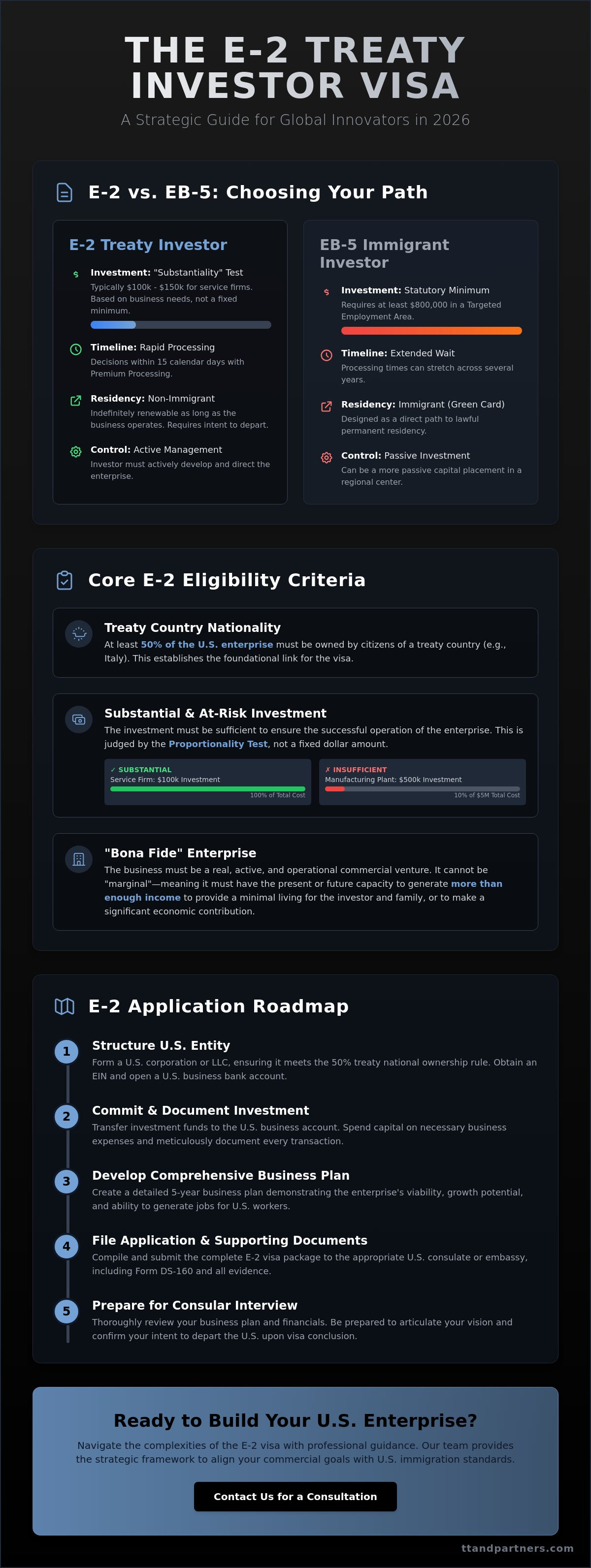
Choosing between an E-2 and an EB-5 depends on the investor's capital structure and timeline. The EB-5 requires a statutory minimum of $800,000 in targeted employment areas. In contrast, the E-2 relies on a "substantiality" test, which often allows for successful applications with investments between $100,000 and $150,000 for service-based firms. Speed is another differentiator. With the 2026 Premium Processing standards, applicants receive a decision within 15 calendar days, whereas EB-5 timelines often stretch across several years. The E-2 status offers indefinite renewability, providing a stable foundation for long-term strategic planning. For those seeking to design their professional future in the U.S., you can reach out through our contact page to discuss the structural requirements of your project.
Treaty Investor Eligibility: Nationality and the Substantiality Test
The E-2 Visa framework operates on a foundation of national identity and financial commitment. At its core, the Nationality Test requires that at least 50% of the enterprise is owned by individuals who possess the citizenship of a treaty country. This isn't a mere administrative hurdle; it's the structural anchor of the application. In 2026, adjudicators look beyond simple cap tables to ensure the treaty national maintains operational control and a high level of managerial influence over the entity's future.
Defining a "substantial investment" remains a nuanced exercise in proportionality rather than a race to a fixed dollar threshold. The USCIS E-2 Visa Eligibility guidelines emphasize that the capital must be sufficient to ensure the successful operation of the enterprise. This is measured through the Proportionality Test, which weighs the investment against the total cost of either purchasing an existing business or establishing a new one from the ground up. For a service-based consulting firm, a $100,000 investment might represent 100% of the setup cost, meeting the requirement. Conversely, a manufacturing plant requiring $5 million in equipment might see a $500,000 injection as insufficient.
The US-Italy Treaty of Commerce and Navigation
The relationship between the United States and Italy is governed by the 1851 Treaty of Commerce and Navigation, a document that continues to shape modern business architecture. For those seeking an E-2 visa for Italian citizens, eligibility is often influenced by residency permits and the nuances of dual citizenship. Consular officers at the U.S. Embassy in Rome or the Consulate General in Milan prioritize applicants who demonstrate a deep connection to the Italian economy. Historical treaty ties provide a layer of stability, yet the adjudication process requires a contemporary vision that aligns with 2026 market demands.
Proving Your Investment is "At Risk"
Capital must be irrevocably committed to the venture to qualify. Funds sitting in a personal savings account are considered "idle" and don't meet the standard. To bridge the gap between financial safety and regulatory compliance, many investors utilize escrow agreements. These mechanisms allow funds to be released only upon visa approval, protecting the investor's principal while satisfying the requirement that the money is already in the "at risk" phase of the business cycle. The legal origin of these funds must be documented through a clear trail of evidence:
Certified tax returns from the previous five years to prove wealth accumulation.
Documented records of property divestment, including closing statements and bank transfers.
Signed gift affidavits accompanied by the donor's financial history and proof of their own legal source of funds.
A mere intent to invest is insufficient for E-2 approval. Building a cross-border enterprise requires the same meticulous planning as a complex urban project. If you're ready to design your professional future in the United States, you can reach out to our team for a strategic consultation.
The Strategic Architecture of a "Bona Fide" Enterprise
The foundation of a successful E-2 Visa application rests on the "bona fide" nature of the investment. This isn't a theoretical exercise; the U.S. government requires evidence of a real, active, and operating commercial undertaking. A passive investment, like owning a single residential property or holding stock, doesn't qualify for this category. The business must exist to produce a service or commodity for profit. For investors from E-2 Treaty Countries, the enterprise serves as the structural vessel for their professional vision in the American market. It's the difference between a static asset and a dynamic economic engine.
Strategic planning involves more than just selecting a site. It requires a 5-year comprehensive business plan that acts as a blueprint for growth. This document must prove the venture isn't "marginal." Under current standards, a marginal business is one that lacks the capacity to generate more than enough income to provide a minimal living for the investor and their family. To bypass this threshold, the enterprise must demonstrate a clear path toward significant economic contribution. Every element of the plan, from market analysis to cash flow projections, must align with this growth-oriented narrative.
Entity Selection: LLC vs. C-Corp for E-2 Investors
Choosing a corporate structure is a decision of both legal protection and fiscal efficiency. Many investors opt for LLC incorporation because it offers a flexible management framework that supports the "develop and direct" requirement of the E-2 Visa. For Italian nationals, the 1984 US-Italy tax treaty provides specific frameworks to avoid double taxation, making the choice of entity even more critical. While an LLC offers pass-through taxation, a C-Corp might be preferable for ventures seeking venture capital or those with complex international ownership tiers. The structure must reflect the long-term operational goals of the investor.
Job Creation and the Marginality Threshold
A robust business architecture prioritizes human capital. The marginality rule is often the most difficult hurdle for small enterprises. To succeed, the business plan should project the hiring of at least three to five U.S. workers within the first five years of operation. This demonstrates that the business has a purpose beyond self-employment.
Year 1: Focus on core management and essential operational staff to establish the brand.
Year 3: Expansion into specialized technical roles as the business scales its service delivery.
Year 5: Achieving full-scale operational maturity with a diverse domestic workforce and measurable community impact.
Lifestyle businesses that only support the owner's immediate needs face high rejection rates. In 2026, adjudicators look for ventures that integrate into the local economic fabric. They want to see projects that create tangible value beyond the investor's personal bank account. Proving this economic viability requires precise data and a vision that extends far beyond the initial visa approval date.
The E-2 Application Roadmap: From Preparation to Consular Interview
The path to securing an E-2 Visa demands the same structural integrity as a high-end architectural project. It's not merely a sequence of administrative filings; it's a strategic deployment of capital and vision. The process begins with the establishment of a U.S. entity, typically an LLC or Corporation, followed by the execution of the investment. You must place your funds "at risk" before the application. This means signing leases, purchasing equipment, or transferring capital into a corporate account dedicated to the enterprise's operations.
Compiling the "Visa Package" is the most labor-intensive phase. This dossier includes Form DS-160 and a comprehensive business plan that serves as the project's blueprint. You'll need to provide a clear audit trail of your source of funds to prove they were earned through legitimate means. Once the package is submitted, the focus shifts to Consular Processing at the U.S. Embassy in Rome or the Consulate in Milan. These hubs handle the specific nuances of Italian treaty investors with professional rigour.
The interview is the final stress test. You'll need to articulate your business vision to the Consular Officer, demonstrating how the enterprise will contribute to the U.S. economy beyond just providing a living for your family. After approval, you'll enter the U.S. with your visa foil. While the visa might be valid for five years, your initial period of stay is typically granted in two-year increments. Maintaining status requires the business to remain operational and compliant with the original vision presented during the interview.
Consular Processing vs. Change of Status
Choosing to file a Change of Status with USCIS via Form I-129 is often a trap for international travelers. While it allows you to remain in the U.S., it doesn't provide a travel document. If you leave the country, your status terminates, and you'll still need to visit a consulate to re-enter. Obtaining a visa foil through the embassy ensures cross-border mobility, which is vital for managing a transatlantic business. You should review the current E-2 visa requirements for 2026 to ensure your investment meets the latest reciprocity standards.
Avoiding the RFE (Request for Evidence)
An RFE can delay your project by months. Common triggers include a weak source of funds, marginality concerns, or vague job descriptions that don't justify the need for the investor's presence. You must document "possession and control" of the investment through bank statements, wire transfers, and executed contracts. The structural integrity of your application depends on the precision of your documentation; securing professional Italian lawyer oversight during the package assembly ensures every legal nuance aligns with both U.S. and Italian jurisdictional expectations.
Ready to build your U.S. presence with professional precision? Connect with our strategic advisors to begin your application roadmap.
Life After Approval: Renewals and the Path to Permanent Residency
Securing the E-2 Visa marks the beginning of a sophisticated operational phase rather than the end of a legal process. For Italian investors, the reciprocity schedule generally allows for a five-year visa validity, yet the actual period of authorized stay is granted in two-year increments upon each entry. Managing these dates requires the same precision an architect applies to a structural blueprint. You must carefully track the distinction between the visa stamp in your passport and the I-94 record issued by Customs and Border Protection. Discrepancies here can lead to unintended status violations that jeopardize future renewals.
The E-2 framework functions as a scalable ecosystem. It allows you to bring essential Italian staff to the U.S. to fill executive, managerial, or highly specialized roles. These employees must possess the same nationality as the treaty investor. This capability ensures that the core philosophy and technical standards of your original enterprise remain intact during international expansion. Beyond the business staff, the E-2 Visa offers a significant open-market employment benefit for spouses. Since the 2021 USCIS policy update, spouses are authorized to work for any employer in the U.S. immediately upon arrival, providing a secondary layer of financial stability for the household.
Maintaining Compliance and Renewing Status
Renewal cycles demand a rigorous audit of your business performance. The U.S. government evaluates whether the enterprise has moved beyond "marginality," which means the business must generate more than enough profit to support the investor's family. You'll need to present five years of tax returns and payroll records that document job creation for U.S. workers. If the business undergoes a pivot, such as shifting from physical consulting to a digital-first service model, you must assess if these structural changes require a formal amendment to your status. Filing for an extension of stay through USCIS is a viable domestic option, but obtaining a new visa at a consulate remains the standard for maintaining international travel flexibility.
The E-2 to Permanent Residency Bridge
While the E-2 is technically a non-immigrant category, it frequently serves as a strategic testing ground for long-term residency. Many investors eventually transition from an E-2 visa to a Green Card by leveraging the EB-1C pathway for multinational managers. This route is particularly effective if the Italian parent company continues to thrive. Another option is the EB-2 National Interest Waiver, which rewards individuals whose work in fields like sustainable architecture or urban innovation provides substantial merit to the U.S. economy. For a tailored roadmap that aligns with your specific professional vision, contact TT and Partners for a strategic consultation on your cross-border goals.
Architecting Your American Business Legacy
Establishing a presence in the United States is about more than capital. It demands a blueprint built on legal foresight and strategic precision. Navigating the treaty investor framework in 2026 involves balancing investment substantiality with the long-term viability of a bona fide enterprise. Success depends on a roadmap that anticipates consular scrutiny while aligning with the latest regulatory shifts. TT and Partners offers over 20 years of experience in US-Italy cross-border immigration to every case. Our team integrates specialized expertise in corporate law with a deep understanding of treaty requirements to ensure your transition is seamless. We provide dual-jurisdiction support that bridges the gap between European origins and American opportunities. Each application is treated with the same rigor as a structural design, ensuring your business stands on a foundation of compliance. Your vision for a global future deserves a partner who understands the complexity of international expansion. We're ready to help you build that foundation.
Frequently Asked Questions
Is there a minimum investment amount for the E-2 Visa in 2026?
There's no fixed statutory minimum dollar amount for the treaty investor investment in 2026. Instead, the U.S. Citizenship and Immigration Services (USCIS) applies a proportionality test to ensure the capital is substantial relative to the total cost of creating the enterprise. While service-based startups often succeed with $100,000, capital-intensive projects like manufacturing facilities require higher allocations to demonstrate viability.
Can I buy a franchise to qualify for an E-2 Visa?
You can certainly purchase a franchise to qualify for an E-2 Visa as it offers a proven operational blueprint. This model is often preferred by adjudicators because it provides established financial projections and a recognized brand structure. Investors must still demonstrate they'll direct the business. In 2024, franchise investments accounted for a significant portion of successful applications due to their structured business plans.
Does the E-2 visa lead directly to a Green Card?
The E-2 Visa doesn't lead directly to a Green Card because it's a non-immigrant classification based on treaty agreements. It lacks a dual-intent provision, meaning holders must eventually transition to other categories like EB-1 or EB-3 for permanent residency. Unlike the EB-5 program, which requires a minimum investment of $800,000, this remains a temporary status that requires renewal every two to five years.
How long can I stay in the U.S. on an E-2 visa?
You can stay in the United States for an initial period of up to two years under this status. There's no limit to the number of extensions you can request, provided you maintain eligibility and the business remains operational. Each extension typically grants another two-year increment. This allows for long-term strategic planning, provided the investor continues to meet the treaty requirements and the enterprise contributes to the economy.
Can my spouse and children work in the U.S. under my E-2 status?
Your spouse is authorized to work anywhere in the U.S. incident to their status, but your children under 21 cannot hold employment. Since the 2021 USCIS policy update, dependent spouses no longer need to apply for a separate Employment Authorization Document. They receive an I-94 with an "S" designation, allowing immediate entry into the labor market. Children may attend school but must change status to work later.
What happens if my business fails while I am on an E-2 visa?
You lose your legal status if your business fails or ceases operations because your authorization is tied directly to that specific enterprise. Investors typically have a 60-day grace period to leave the country, change to a different category, or find a new qualifying investment. This timeframe is critical for restructuring your professional presence. Without an active, marginality-exempt business, the underlying requirements are no longer met.
Do I need to have a physical office in the U.S. for E-2 approval?
You must secure a physical office or commercial space before filing your application to prove the business is real and active. Adjudicators rarely approve cases based solely on virtual offices or residential addresses, as they look for "at-risk" capital spent on tangible infrastructure. Lease agreements and site photographs serve as essential evidence. This physical footprint demonstrates your intent to contribute to the urban fabric.
Can I apply for an E-2 visa if I am already in the United States?
You can apply for a change of status if you're already in the U.S. on a valid non-immigrant visa. This process involves filing Form I-129 with USCIS, though it doesn't provide a travel visa stamp for international re-entry. If you leave the country, you'll need to attend a consular interview abroad to obtain the actual visa foil. Most investors choose this path for speed, utilizing premium processing for a 15-day response.


Comments