

E-2 vs L-1 Visa: A Strategic Comparison for US Business Expansion in 2026
- Gianni Mendes Toniutti, Esq.

- Apr 24
- 13 min read
The structural integrity of a US business expansion depends less on the initial capital and more on the precise legal framework established at the outset. Choosing between the E-2 vs L-1 visas is a decision of architectural significance, where the right choice secures your investment and the wrong one risks total collapse. You've likely felt the weight of this complexity, knowing that the 2026 market presents a unique window for growth but also carries the threat of significant capital loss if the foundation is weak. It's natural to feel uncertain when the future of your family's work authorization and your long term residency hangs in the balance.
I'll help you navigate these regulatory layers to find the most effective legal architecture for your entry. You'll discover the exact structural differences between these categories so you can secure work authorization for both yourself and your spouse while building a viable path to permanent residency. We'll examine the specific requirements for each visa, providing a clear roadmap that transforms legal uncertainty into a master plan for your American operations. This comparison ensures your US presence is as enduring and functional as a well designed building, grounded in the context of current 2026 immigration standards.
Key Takeaways
Define the architectural intent of your US expansion by distinguishing between capital-first entrepreneurial agility and the structural scaling of established institutions.
Analyze the fundamental prerequisites of the E-2 vs L-1 comparison to align your specific nationality and investment profile with the most effective legal architecture.
Navigate the nuanced landscape of "Dual Intent" to design a clear and sustainable path toward permanent residency and a long-term US presence.
Utilize a strategic decision matrix to select the framework that best supports your 2026 business vision, ensuring functional harmony between your personnel and capital.
Learn how precision-engineered legal design replaces generic templates to provide a resilient and sophisticated foundation for your cross-border enterprise.
Table of Contents The Architecture of US Entry: Defining the E-2 and L-1 Frameworks Structural Requirements: Nationality, Investment, and Corporate Ties The Path to Permanent Residency: Mapping the Green Card Trajectory Decision Matrix: Which Visa Supports Your 2026 Business Vision? Strategic Implementation: How TT and Partners Engineers Your US Entry
The Architecture of US Entry: Defining the E-2 and L-1 Frameworks
Entering the US market in 2026 requires a rigorous structural blueprint that aligns with an organization's core DNA. Business visas aren't mere administrative tasks; they're the load-bearing walls of international expansion. The strategic choice between the E-2 vs L-1 pathways depends on whether an entity prioritizes the fluidity of capital or the strength of existing corporate infrastructure. A successful entry demands a vision that looks beyond the initial petition to the long-term sustainability of the American operation. It's about ensuring the legal framework can support the weight of the business's future growth.
E-2 Treaty Investor: The Fluidity of Capital
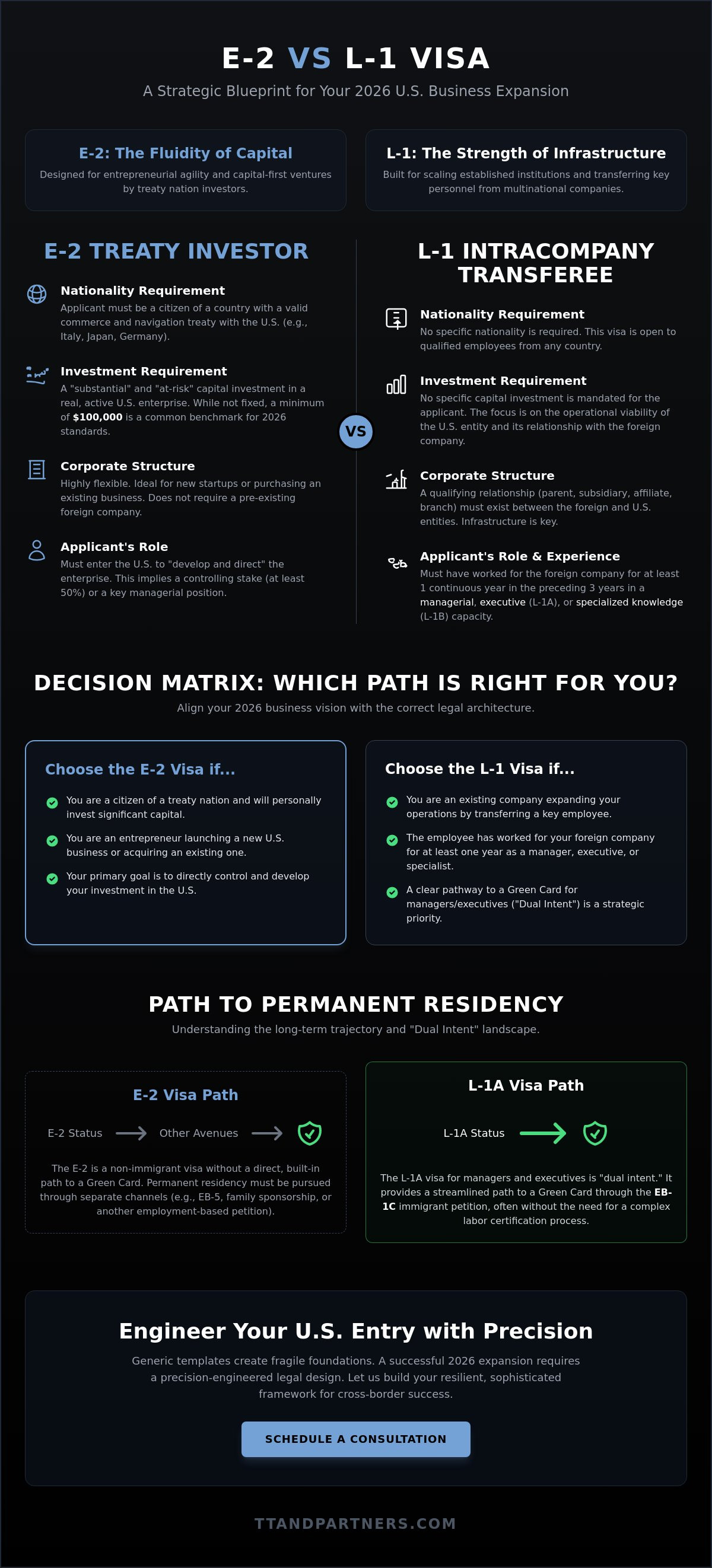
The E-2 visa functions as a capital-first mechanism designed for entrepreneurs from specific treaty-holding nations, such as Italy or Japan. It doesn't require a pre-existing US office, making it an agile choice for lean startups or individual investors. The applicant must demonstrate a substantial investment in an active US enterprise. While the law avoids a fixed dollar amount, practitioners in 2026 typically look for a minimum of $100,000 to ensure the business isn't marginal. The investor's primary role is to direct and develop the enterprise, ensuring the capital creates a tangible impact on the local economic fabric. It's a high-control model for those who lead with their own resources.
L-1 Intracompany Transferee: The Strength of Infrastructure
Large organizations often prefer the L-1 visa framework because it rewards established corporate ecosystems. This pathway requires a qualifying relationship between a foreign entity and a US office, such as a parent-subsidiary or affiliate structure. To qualify, the transferee must've worked for the foreign company for at least one continuous year within the preceding three years in a managerial, executive, or specialized knowledge capacity. This mechanism facilitates the transfer of human capital and proprietary intellectual assets. It's an infrastructure-heavy approach that suits companies scaling their proven international models into new territories. Unlike the E-2, the L-1 doesn't rely on the applicant's nationality, focusing instead on the integrity of the corporate bond.
Selecting the right path is a strategic decision that mirrors architectural planning. The E-2 provides the flexibility for individual visionaries to build from the ground up. The L-1 offers the stability of a bridge, connecting two established entities across borders. Deciding on the E-2 vs L-1 route involves analyzing your current organizational depth and your 2026 expansion goals. Aligning this choice with your vision ensures the legal foundation is as robust as the business itself. For those seeking a tailored strategy for their US presence, reaching out for a professional consultation through our contact page provides the necessary clarity to move forward with confidence.
Structural Requirements: Nationality, Investment, and Corporate Ties
The architectural foundation of a US expansion depends on the legal structure you choose. Deciding between the E-2 vs L-1 visa isn't just a matter of paperwork; it's a strategic choice that dictates how your business will breathe and grow within the American market. While the E-2 offers a path for individual agility, the L-1 is built for institutional scaling. Both require a solid legal vessel, often starting with LLC incorporation to establish a clear separation between personal assets and corporate liabilities. This structural clarity is essential for meeting the 2026 evidentiary standards, where USCIS officers look for a "substantial" commitment rather than a "marginal" enterprise that merely supports the investor's family.
By 2026, the definition of a marginal business has sharpened. To succeed, your business plan must demonstrate the capacity to contribute significantly to the local economy through job creation and tax revenue. It's no longer enough to show a viable bank balance; you must show a functional, living entity. If you're ready to design your corporate presence, you can contact our team for a detailed consultation on these structural nuances.
The Nationality Constraint and the Treaty Advantage
The E-2 visa operates on a principle of reciprocity. It's strictly limited to nationals of countries that maintain a treaty of commerce and navigation with the United States. For an Italian citizen or a Japanese entrepreneur, this creates a streamlined entry point. However, the L-1 is "nationality-blind." It focuses on the relationship between a foreign parent company and its US subsidiary. This makes the L-1 the preferred route for multinational corporations based in non-treaty countries like Brazil or India. In dual-citizenship scenarios, applicants often leverage their treaty-eligible passport to access the E-2, even if their primary business operations are currently located in a non-treaty nation. This flexibility allows for a more personalized expansion strategy that aligns with global mobility trends.
Investment vs. Employment History
The core requirements for these visas target different assets: capital versus tenure. For the E-2, the focus is on "at-risk" capital. The funds must be irrevocably committed to the business before the application is filed. You can't just keep the money in a savings account; it must be spent on equipment, leases, or professional services. For the L-1, the primary "investment" is your professional history. Under the "one-in-three" rule, an L-1A intracompany transferee must prove they worked for the foreign office for at least one continuous year within the preceding three years. Documentation precision is vital here. You'll need to provide a clear audit trail showing the source and path of funds for an E-2, while the L-1 requires detailed organizational charts and payroll records to prove your executive or managerial role. These requirements ensure that the expansion is rooted in genuine commercial activity rather than a temporary arrangement.
The Path to Permanent Residency: Mapping the Green Card Trajectory
The choice between E-2 vs L-1 isn't merely a matter of current tax status or investment capital. It's a decision about the long-term structural integrity of your stay in the United States. Most founders view a visa as a temporary scaffold, yet they desire a permanent foundation. The concept of "dual intent" defines this boundary. L-1 visa holders enjoy a clear legal path to residency. E-2 investors must navigate a more complex landscape because their visa is technically non-immigrant in nature. This doesn't mean the door is closed. It means the architectural plan for your Green Card must be more nuanced and deliberate from the first day of operations.
The Direct Bridge: L-1A to EB-1C
The L-1A visa is the preferred precursor for the EB-1C Green Card. This category is designed for multinational managers and executives. It's a direct bridge. You skip the labor certification process, which can save 12 to 18 months of processing time. However, pitfalls exist for those starting from scratch. "New Office" L-1A petitions are only valid for one year initially. If the business doesn't employ a sufficient number of professional staff by the end of that year, the Green Card path may be blocked. In 2026, USCIS expects to see a clear hierarchy that proves the petitioner isn't just managing day-to-day tasks but is overseeing essential functions or departments.
The Indirect Route: E-2 to Residency
Navigating the E-2 vs L-1 landscape requires a strategic pivot for those on the E-2 path. Since there's no direct bridge, you must find an alternative immigrant category. The National Interest Waiver (NIW) has become a popular choice for E-2 investors in 2026. It allows you to self-petition if your business venture has substantial merit and national importance. Statistics from recent fiscal years show an increase in NIW approvals for entrepreneurs in tech and sustainable design. While your I-140 petition is pending, you must maintain your E-2 status diligently. This involves renewing your visa or status at the appropriate intervals to ensure continuity.
You should also be mindful of travel. Leaving the country with a pending adjustment of status can lead to complications if you don't have the right travel documents. For a comprehensive breakdown of the financial commitment and the steps involved in this transition, see the 2026 Green Card cost and strategy guide. If you need a tailored roadmap for your specific expansion, you can reach out through our contact page to discuss your project's unique requirements.
Decision Matrix: Which Visa Supports Your 2026 Business Vision?
Selecting the right path for a 2026 U.S. expansion requires more than a simple checklist; it demands a structural alignment with your long-term corporate architecture. The choice between E-2 vs L-1 often hinges on whether your primary asset is liquid capital or an existing human infrastructure. While both paths facilitate growth, their technical requirements create different operational constraints that affect how you'll manage your firm's evolution over the next decade.
Evaluating Capital vs. Personnel Assets
The E-2 category rewards high capital commitment and entrepreneurial agility. If you're a startup founder with significant personal or corporate savings but a lean team, this visa provides the necessary flexibility. It doesn't require a pre-existing foreign parent company to remain active after the U.S. branch is established, provided the investor is a national of a treaty country. This makes it ideal for independent ventures that don't want their U.S. success tied to the performance of a foreign entity.
The L-1 path suits established organizations moving mobile talent across borders. You must prove a qualifying relationship between the foreign and U.S. offices, such as a parent-subsidiary structure. For firms where the primary value is the volume of international trade rather than physical investment in a U.S. facility, the E-1 Treaty Trader serves as a vital third alternative. This is particularly relevant for 2026 logistics and service firms that rely on constant cross-border exchange.
Operational Flexibility and Renewal Limits
The temporal design of these visas dictates your scaling strategy. An L-1A executive visa carries a hard 7-year cap. If you're opening a "New Office," USCIS typically grants just one year initially. This 12-month window forces a rapid hiring and revenue cycle, as you must prove the business can support an executive or manager by the first renewal. The pressure to scale quickly under L-1 scrutiny is intense, as failure to meet business plan projections can result in a denial of extension.
The E-2 visa offers a more sustainable, long-term rhythm. While individual visas are often issued in 5-year increments depending on reciprocity schedules, they're renewable indefinitely as long as the business remains active and non-marginal. This "indefinite" nature provides a level of permanence that the L-1 lacks, though it doesn't lead directly to a Green Card. Family integration is equally robust; since the 2022 USCIS policy update, spouses of both E-2 and L-1 holders receive automatic work authorization incident to their status. This allows partners to contribute to the household economy immediately upon arrival.
Success in 2026 relies on matching your visa to your business’s structural load. For a detailed analysis of your expansion framework, contact our strategic advisors.
Strategic Implementation: How TT and Partners Engineers Your US Entry
Business expansion requires more than a visa application; it demands a structural integrity that generic templates cannot provide. At TT and Partners, we approach cross-border legal design with the same precision an architect applies to a skyscraper's foundation. The 2026 regulatory environment has shifted, making the distinction in an E-2 vs L-1 strategy more than a choice of category. It's a choice of long-term viability. We don't rely on loud marketing tactics. We rely on the intellectual depth of our legal frameworks and the measurable success of the enterprises we help build.
Precision in Cross-Border Documentation
Success depends on meeting the "Substantiality" test with documented financial commitment. For an E-2, this means proving the investment isn't marginal through a five-year economic projection that demonstrates a clear impact on the US job market. For L-1 transfers, corporate transparency is non-negotiable. USCIS data from 2024 showed RFE (Request for Evidence) rates exceeding 30% for multinational manager petitions. We eliminate this risk by crafting business plans that function as technical specifications. We don't just fill forms. We build the evidentiary bridge that connects your international entity to its US future, ensuring every document reflects the January 2026 updated scrutiny standards.
Holistic Legal Support for US Expansion
Moving a CEO or an investor is only the first phase of a successful entry. Sustainable growth requires managing international litigation risks and securing commercial real estate that aligns with your operational goals. Our firm bridges the gap between US and Italian legal frameworks, ensuring that your corporate legacy remains protected across jurisdictions. We focus on the context of your expansion, whether it involves securing long-term residency or navigating the 2026 tax transparency requirements. This dual-market expertise allows us to synchronize your US entry with your global objectives. We speak the language of both the engineer and the strategist, providing a vision that is both inspired and grounded in technical reality.
The choice between an E-2 vs L-1 pathway defines the architecture of your American operations. A single error in the initial design can lead to structural failure during the adjudication process. Our partners work directly with you to ensure your expansion is built on a foundation of precision and foresight. We invite you to move beyond standardized solutions and embrace a bespoke legal strategy.
Contact our team for a structural consultation
Architecting Your 2026 US Market Entry
Choosing between the E-2 vs L-1 framework requires a deep understanding of your business's structural DNA and your long-term vision for the American market. The E-2 pathway demands a treaty-based nationality connection and a substantial capital commitment, while the L-1 route hinges on established corporate ties between international entities. Both options serve as the functional foundation for your 2026 expansion, but their impact on your eventual Green Card trajectory varies significantly based on current USCIS adjudication trends. Successful entry isn't just about filing forms; it's about engineering a legal structure that balances immediate operational needs with future residency goals.
Tosolini, Toniutti & Partners brings decades of specialized experience in US-Italy cross-border immigration to every project. We provide comprehensive support that spans from initial LLC incorporation to the final stages of Green Card residency. Our team understands the complexity of business structures and treats your US entry with the precision of a master-planned architectural project. We'll help you navigate these regulatory requirements with clarity and foresight.
Schedule a strategic visa consultation with Tosolini, Toniutti & Partners to ensure your business foundation is built for durability and growth. Your vision for the American market deserves a partner who values precision as much as you do.
Frequently Asked Questions
Can I switch from an E-2 visa to an L-1 visa while in the US?
Yes, you can transition by filing Form I-129 for a change of status with USCIS. This strategic shift often occurs when a business matures and meets the structural requirements for executive transfers. You'll need to prove you've worked for the qualifying foreign entity for at least 1 year within the preceding 3 years. The E-2 vs L-1 choice depends on your long-term residency goals and corporate hierarchy.
Does the E-2 visa require a specific minimum investment amount in 2026?
The US government doesn't mandate a fixed dollar amount for E-2 investments in 2026. Instead, the capital must be substantial in relation to the total cost of establishing or purchasing the enterprise. While 100,000 USD is a common benchmark for service businesses, the Department of State focuses on the proportionality test. Your investment must ensure the business's successful operation and professional growth within its specific context.
Is my spouse allowed to work in the US on an E-2 or L-1 visa?
Spouses of both E-2 and L-1 visa holders are authorized to work immediately upon entry. Under USCIS policy updated in 2022, spouses receive an S designation on their I-94 record, which serves as evidence of work authorization. They don't need to apply for a separate Employment Authorization Document. This policy supports the human-centered design of the US immigration system by allowing families to build integrated lives together.
How long does the foreign company need to exist before an L-1 transfer?
The foreign parent, branch, or affiliate must have been actively doing business for at least 1 year before you can petition for an L-1 transfer. USCIS defines doing business as the regular, systematic, and continuous provision of goods or services. It's not enough for the entity to merely have an agent or office. This requirement ensures the international structure possesses the functional stability necessary to support a US expansion.
Can an Italian citizen apply for an L-1 visa if they do not have a treaty?
Italian citizens can apply for an L-1 visa regardless of treaty status because the L-1 category doesn't depend on international trade agreements. While the E-2 visa requires a specific treaty between the US and the applicant's country, the L-1 is available to all nationalities. This makes the L-1 a vital tool for global professionals from any nation. It provides a reliable pathway for corporate integration within the American market.
What happens to my visa if my US business fails or is sold?
Your visa status terminates if the underlying business ceases operations or your ownership stake drops below the required threshold. You typically have a 60 day grace period to depart the US or file for a change of status. If the business is sold, the new structure must still meet the specific E-2 or L-1 criteria for you to remain. Precise planning is essential to maintain your legal standing during such transitions.
Is the O-1 visa a better alternative for entrepreneurs than the E-2?
The O-1 visa serves entrepreneurs with extraordinary ability who don't want to commit significant capital. Unlike the E-2, which focuses on investment, the O-1 requires proof of national or international acclaim in your field. It's a high-performance alternative for founders who possess unique intellectual assets but lack the liquid funds required for a substantial E-2 investment. Choosing between E-2 vs L-1 or O-1 requires a deep analysis of your personal professional history.
Do I need a physical office in the US to apply for an L-1 visa?
You must secure a physical office space before filing an L-1 petition, especially for new office startups. USCIS requires evidence like a lease agreement or floor plans to prove the premises can support the business's operations. While remote work is common, the agency still looks for a functional headquarters that reflects the company's scale. This physical footprint validates the enterprise's commitment to the local urban fabric and economic landscape.


Comments