

J-1 Visa: A Strategic Guide to the US Exchange Visitor Program in 2026
- Gianni Mendes Toniutti, Esq.

- Apr 24
- 12 min read
Could a single regulatory framework serve as both the blueprint for professional growth and a significant structural hurdle for your future in the United States? For many high-achieving professionals, the J-1 Visa represents an unparalleled opportunity for international exchange, yet the complexity of its 15 distinct categories often creates more questions than answers. You likely recognize that this program is vital for global collaboration, but the pressure of finding a designated sponsor and the anxiety surrounding the two-year home-country physical presence requirement can feel like building on an unstable site.
We'll provide the expert legal precision required to master these complexities, ensuring your DS-2019 application stands on a firm foundation. You'll learn how to align your professional profile with the right program category and explore the 2026 criteria for securing a residency waiver. This analysis breaks down the path from initial placement to a comprehensive immigration strategy, allowing you to build a career that's both visionary and legally secure.
Key Takeaways
Navigate the 2026 exchange landscape by aligning your objectives with the latest US focus on STEM innovation and global talent mobility.
Select the optimal professional designation, such as Trainee or Specialist, to build a structured foundation for your career development in the United States.
Address the legal complexities of the two-year home residency requirement with precise waiver strategies designed to protect your long-term residency goals.
Execute a flawless application process by mastering the technical requirements of SEVIS registration and the issuance of Form DS-2019.
Leverage the J-1 Visa as a strategic bridge to scout US markets and transition into long-term professional categories like the E-2 or H-1B status.
Table of Contents The Framework of the J-1 Program: Understanding the 2026 Exchange Landscape Strategic J-1 Categories for Professionals and Scholars The Section 212(e) Requirement: Legal Architecture and Waiver Strategies The Precision of the J-1 Application Process: A Step-by-Step Guide Integrating J-1 Status into a Long-Term US Strategy
The Framework of the J-1 Program: Understanding the 2026 Exchange Landscape
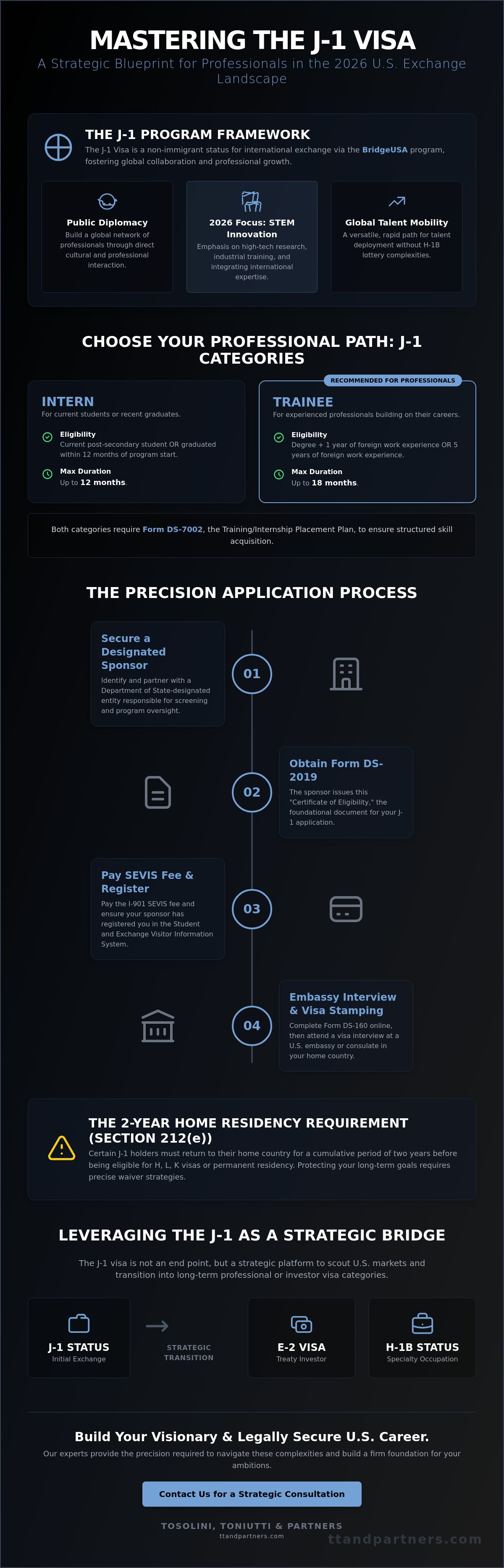
The J-1 Visa acts as a structural foundation for international exchange. It's not a permanent immigration path but a non-immigrant status designed for those participating in the BridgeUSA program. By 2026, the program's philosophy has transitioned toward a more targeted approach. There's a clear emphasis on STEM innovation and global talent mobility. This shift reflects a broader strategy to integrate international expertise into the American industrial and research fabric, ensuring that the exchange of ideas remains a two-way street of professional growth.
The Department of State plays a central role in this ecosystem. They designate specific public and private entities as sponsors. These sponsors are the gatekeepers of the program. They're responsible for screening participants, issuing the necessary DS-2019 forms, and ensuring the exchange program meets federal regulations. This J-1 Visa Program Overview provides a detailed look at how these sponsorships have historically functioned to maintain the program's integrity while expanding its reach across global markets.
Distinguishing this framework from other common visas is vital for strategic planning. The F-1 visa is strictly for full-time students at accredited academic institutions. The H-1B is a specialty occupation visa that often implies a long-term intent to stay and requires a specific employer-employee relationship. The J-1 occupies a unique space. It's flexible, professional, and focuses on the temporary transfer of knowledge. It remains the most versatile entry-level professional visa because it allows for a rapid deployment of talent without the complexities of the H-1B lottery system.
Core Objectives of the BridgeUSA Initiative
The primary goal of the initiative is public diplomacy. It's about building a global network of professionals who understand the American context through personal interaction. In 2026, the emphasis has moved toward high-tech research collaboration and industrial training. This focus ensures that the US remains a central node in the global network of innovation. The program fosters long-term partnerships that often outlast the duration of the visa itself, creating a lasting impact on both the participant and the host organization.
Identifying the Right Program Category for Your Profile
Alignment is the key to a successful application. The program offers 15 diverse categories, from Au Pairs to Research Scholars. Each has its own regulatory limits on duration and activity. For instance, a Trainee program is limited to 18 months, while an Intern program for current students or recent graduates typically lasts 12 months. Research Scholars, however, may stay for up to five years depending on the project's scope. You must match your professional background to the sponsor's specific mandate to avoid administrative delays. If you're seeking a strategic partner to navigate this complex professional landscape, contact TT and Partners to explore how we can support your vision in the 2026 exchange environment.
Strategic J-1 Categories for Professionals and Scholars
Selecting the right framework for a US engagement requires the same precision as a structural blueprint. The J-1 Visa serves as a versatile conduit for knowledge exchange, yet its effectiveness depends entirely on aligning the candidate’s profile with the specific regulatory intent of the category. For professionals, the distinction between Intern and Trainee isn't merely semantic; it's a matter of eligibility and career stage context. Each designation carries its own set of requirements that define the boundaries of the professional experience.
Intern vs. Trainee: Navigating Professional Requirements
The Intern status targets current post-secondary students or those who graduated within 12 months of their program start date. In contrast, the Trainee status demands more robust foundations: a degree plus one year of professional experience outside the US, or five years of work history in their specific field. Central to both is the Form DS-7002, a Training/Internship Placement Plan that outlines the specific objectives and phases of the program. This document ensures the experience isn't just labor, but a structured progression of skill acquisition. Understanding these Official J-1 Visa Requirements is the first step in constructing a viable exchange plan that meets federal standards while serving professional growth.
STEM Research and the Early Career Initiative
The landscape for R&D has shifted significantly since the January 2022 expansion of the STEM fields list, which added 22 new areas of study to the program. By 2026, these measures have matured, allowing J-1 Visa holders to integrate more deeply into private sector innovation hubs. Research Scholars and Professors often lead these initiatives, fostering a synergy between academic theory and industrial application for up to five years. The Specialist category serves as a 12-month maximum stay for experts to share their unique knowledge in niche fields. This specific designation allows for a focused transfer of expertise without the long-term commitment required by other academic tracks.
Short-term Scholars provide a tactical choice for high-impact, brief engagements. This category is limited to six months, making it ideal for visiting lecturers or collaborative researchers who need to finalize a specific project or deliver a series of seminars. Each category functions as a specific tool within the broader exchange program, designed to bridge the gap between global talent and US innovation environments. If you're looking to integrate these opportunities into your firm's growth strategy, we invite you to reach out for a consultation to discuss the context of your specific project and professional goals.
The Section 212(e) Requirement: Legal Architecture and Waiver Strategies
The Section 212(e) requirement functions as a legal anchor within the J-1 Visa framework. This provision, often cited as the primary hurdle for exchange visitors, mandates a 730-day residency in the home country before the participant can transition to specific U.S. statuses. It isn't a mere suggestion; it's a structural "lock" that prevents a change of status to H-1B, L-1, or permanent residency. This requirement triggers under three specific conditions: if the program received government funding, if the participant’s expertise appears on the Exchange Visitor Skills List for their nation, or if they're receiving graduate medical education. Strategic timing is the most critical element of a successful transition. You shouldn't wait until your final month to address this constraint. Most waiver applications require 6 to 10 months for full processing by the Department of State and USCIS. Initiating the waiver process too early can jeopardize your current status, while starting too late creates a gap in your professional timeline. We recommend beginning the evaluation of your waiver eligibility at least 12 months before your program’s scheduled conclusion. This foresight ensures that the legal architecture of your stay remains sound as you move toward your next career milestone.
The Five Pathways to a J-1 Waiver
Unlocking the 212(e) requirement requires selecting one of five specific legal pathways. The No Objection Statement is the most frequent choice for participants without government funding. For those in specialized research, a Request by an Interested U.S. Federal Government Agency (IGA) provides a path if your work is vital to an agency's mission. Major academic institutions often manage these complexities through
, ensuring that researchers maintain compliance while contributing to high-level innovation. Alternative pathways include Persecution or Exceptional Hardship claims. These carry a high evidentiary threshold, requiring proof that a spouse or child who is a U.S. citizen would face extreme suffering. Finally, the Conrad State 30 Program serves foreign medical graduates, allowing them to waive the requirement by committing to three years of service in underserved clinical areas. Each path requires a different set of blueprints and rigorous documentation.
Navigating the 'No Objection' Process with Professional Precision
The No Objection process is a delicate diplomatic choreography between your home country's embassy and the U.S. Department of State. It begins with your home government issuing a formal statement confirming they don't oppose your stay in the U.S. A common pitfall is a lack of synchronization; if the embassy’s data doesn't perfectly match the Department of State’s records, administrative delays of 90 days or more are common. Precision in your documentation is non-negotiable. Errors in SEVIS numbers or inconsistent program dates can lead to immediate denials. You must ensure that every filing reflects the current 2026 regulatory standards to avoid the "administrative black hole" of pending cases. If your situation involves multi-year funding or complex bilateral agreements,
The Precision of the J-1 Application Process: A Step-by-Step Guide
Obtaining a J-1 Visa requires a methodical approach similar to the execution of a complex architectural blueprint. Every document serves as a load-bearing element in your application structure. The process begins with securing a legal sponsor who issues Form DS-2019, the "Certificate of Eligibility for Exchange Visitor Status." This document defines the parameters of your program, including the start date, end date, and the specific category of exchange. Without a valid DS-2019, the visa architecture cannot stand.
Once the DS-2019 is secured, you must register with the Student and Exchange Visitor Information System (SEVIS). As of 2024, the SEVIS I-901 fee for most J-1 participants is $220; this digital registration allows the Department of Homeland Security to maintain an active record of your status. Following this, you'll complete Form DS-160, the foundational non-immigrant visa application. This digital form requires absolute data integrity, as any discrepancy between your DS-160 and your supporting documents can lead to delays or denials during the final inspection phase.
The Role of the Designated Sponsor Organization (DSO)
The DSO acts as the legal architect of your stay, holding the authority to authorize your presence in the United States. Unlike a standard employer, the DSO is responsible for ensuring your program adheres to federal regulations. They monitor your progress through mandatory reporting and site visits. A critical component they oversee is the DS-7002 Training Plan. This document outlines the phases of your professional development, proving to consular officers that your role is a structured learning experience rather than mere displacement of American labor.
Preparing for the Consular Interview in 2026
In 2026, consular officers prioritize candidates who can articulate a clear vision for their return. You must demonstrate how the skills acquired in the US will integrate into the professional fabric of your home country. Financial sufficiency is another pillar; you'll need to provide evidence of liquid assets or stipends that cover 100% of your living expenses to ensure you don't seek unauthorized employment. Successful applicants often present a portfolio of ties, such as property titles, employment offers, or specialized certifications that require their presence abroad.
The applicant's primary objective during the interview is to provide concrete evidence of social, economic, and professional commitments that necessitate their return home after the program's conclusion.
Navigating these regulatory requirements demands the same attention to detail we apply to our most complex design projects. If you require professional guidance on aligning your international career goals with legal frameworks, reach out to our team for a strategic consultation.
Integrating J-1 Status into a Long-Term US Strategy
The J-1 Visa shouldn't be viewed as a standalone event. Instead, treat it as the foundational scaffolding for a broader American professional trajectory. For many European professionals, particularly those operating within the US-Italy corridor, this status provides the necessary site survey before permanent construction begins. It offers a period of high-level immersion that can lead to more stable categories like the H-1B for specialized workers or the L-1 for intracompany transferees.
Entrepreneurs frequently utilize the J-1 Trainee or Intern programs to scout regional markets and establish local networks. This phase is a strategic bridge to an E-2 Visa. By the time the J-1 expires, the individual has often gathered the market data and partnership agreements required to justify a substantial investment. Similarly, academic and research placements under the J-1 umbrella allow innovators to accumulate the citations and peer recognition necessary for an O-1 Visa for Entrepreneurs. Success in the US requires this type of deliberate, multi-year planning.
The Transition Timeline: From Exchange to Residency
Timing is the most critical element of visa architecture. USCIS enforces a 90-day rule regarding intent; if you attempt to change status too quickly after entry, authorities may presume you misrepresented your original purpose. You must also account for the 212(e) home-country physical presence requirement. Securing a J-1 waiver is often the only way to unlock the path to a Green Card. Managing the gap between your J-1 expiration and a new approval requires a precise calendar to avoid unlawful presence.
TT and Partners: Architects of Your US Professional Future
Our firm approaches immigration with the same precision and aesthetic rigor found in high-end architectural design. We don't just process forms; we build the intellectual framework required for complex cross-border transitions between Italy and the United States. We understand that a visa is a tool for professional growth, not just a legal hurdle. By focusing on the harmony between your career goals and US regulatory requirements, we ensure your transition is seamless and sustainable. Our expertise allows us to anticipate structural challenges before they arise, providing the clarity you need to move forward. Schedule a strategic consultation for your US visa architecture to begin designing your future in the American market.
Building Your Global Professional Foundation
Navigating the 2026 J-1 Visa landscape requires more than administrative compliance; it demands a structural understanding of how Section 212(e) requirements shape long-term mobility. By aligning specific professional categories with strategic waiver applications, experts transform a temporary exchange into a permanent career pillar. Success hinges on foresight. It's about ensuring each step of the application process serves a broader architectural vision for your future.
TT and Partners brings decades of experience from New York and international jurisdictions to manage the complexities of your transition. We've established a reputation for resolving intricate US-Italy cross-border legal disputes and guiding professionals through the technical shift to E-1, E-2, or O-1 status. Our approach treats legal strategy with the same precision as a master plan, focusing on functionality and long-term sustainability. We don't just process forms; we design pathways that respect the intellectual depth of your professional goals.
The path to the United States is complex, but with a well-constructed plan, your international aspirations will find a stable and inspiring home.
Frequently Asked Questions
What is the maximum duration of a J-1 Trainee visa in 2026?
The J-1 Trainee visa allows for a maximum stay of 18 months to complete your professional development program. This timeframe is strictly regulated by the Department of State to ensure the program remains an exchange rather than permanent employment. Agriculture trainees face a shorter limit of 12 months, while those in other professional fields can utilize the full 18-month window to integrate into the American professional landscape.
Can my spouse and children join me on a J-1 visa?
Your spouse and unmarried children under the age of 21 are eligible to join you under the J-2 visa classification. This structure supports family unity while you pursue international innovation and professional growth. J-2 dependents can apply for work authorization once they've arrived in the United States, provided their earnings aren't used to support the primary J-1 Visa holder's basic living expenses.
What happens if I am subject to the two-year home-country residency requirement?
You must return to your home country for a cumulative period of 730 days before you can apply for specific work visas or permanent residency. This rule, known as Section 212(e), typically applies if your program received government funding or involves skills listed on the Exchange Visitor Skills List. You can't change your status to an H, L, or K visa until you either fulfill this biennial requirement or secure a formal waiver.
Can I work for any employer on a J-1 visa?
You're only authorized to work for the specific host organization and location listed on your DS-2019 certificate of eligibility. The J-1 Visa is tied to a designated sponsor, meaning any external employment constitutes a violation of your legal status. If your professional context requires a change in host site, you must coordinate a formal program transfer through your sponsor before starting any new duties.
How long does it take to get a J-1 waiver approved?
Processing times for a J-1 waiver generally range from 16 to 32 weeks depending on the specific basis of your application. Applications based on a No-Objection statement move faster than those involving exceptional hardship or interested government agency requests. You should initiate this process at least 8 months before your current program expires to avoid gaps in your legal authorization or professional projects.
Is it possible to change from a J-1 visa to a Green Card?
You can transition to a Green Card if you qualify for an immigrant category and aren't restricted by the two-year home-residency requirement. Many specialists use the EB-2 or EB-3 pathways to establish long-term roots in the US technical or architectural sectors. If the residency rule applies to you, the government won't approve your adjustment of status until you've obtained a waiver or completed your time abroad.
What is the SEVIS fee for a J-1 visa in 2026?
The SEVIS I-901 fee for most exchange visitors is $220 according to the current 2026 fee schedules. Participants in specific categories like summer work travel, au pairs, or camp counselors pay a reduced rate of $35. This fee funds the automated system that maintains the integrity of the exchange program, and you must pay it before your visa interview at the US embassy.
Can I travel outside the US while on a J-1 visa?
You can travel internationally and re-enter the US if you have a valid travel signature on your DS-2019 form from your Responsible Officer. These signatures are usually valid for 12 months or until the end of your program, whichever date comes first. Always ensure your visa stamp in your passport remains valid for your return date, as a travel signature alone doesn't grant entry if the visa has expired.


Comments