

E-1 Treaty Trader Visa: The Complete 2026 Strategic Guide
- Gianni Mendes Toniutti, Esq.

- 2 minutes ago
- 12 min read
While most entrepreneurs fixate on the capital-heavy requirements of investment routes, the most sophisticated path to the American market often requires no initial capital outlay at all. The E-1 Visa rewards the existing flow of goods and services rather than the size of a bank account, making it the premier strategic tool for established entities looking to formalize their presence in the United States. This approach prioritizes intellectual and commercial momentum over static assets, aligning perfectly with the needs of modern international enterprises.
You likely understand that cross-border expansion demands more than just a business plan; it requires a delicate balance between Italian heritage and American regulatory precision. It's frustrating to face the ambiguity of terms like "substantial trade" or the fear that a single documentation error could derail your global ambitions. This guide provides the clarity you need to master these complexities and leverage your international trade for a seamless US expansion. We'll examine the specific criteria for 2026, provide a roadmap for legal compliance, and show you how to transform your existing trade volume into a permanent bridge to the American market.
Table of Contents
What is the E-1 Treaty Trader Visa? A Strategic Overview
The E-1 Visa represents a sophisticated legal pathway for international commerce, designed specifically for individuals and firms that maintain a robust exchange of goods or services with the United States. Unlike other visa categories that demand a heavy upfront capital investment, this classification focuses on the tangible flow of trade. It's a non-immigrant status granted to nationals of countries that maintain a qualifying treaty of commerce and navigation with the U.S., allowing them to enter the country solely to engage in international trade on their own behalf.
This visa isn't limited to the owners of the enterprise. It extends to essential employees who possess specialized skills or executive authority, making it a versatile tool for corporate scaling. One of the most compelling advantages is its longevity; while it's a non-immigrant visa, it offers the possibility of unlimited renewals as long as the underlying trade remains substantial and continuous. There's no statutory minimum dollar amount for the trade, which provides a level of flexibility that many modern, service-based businesses find invaluable.
The Core Eligibility Framework
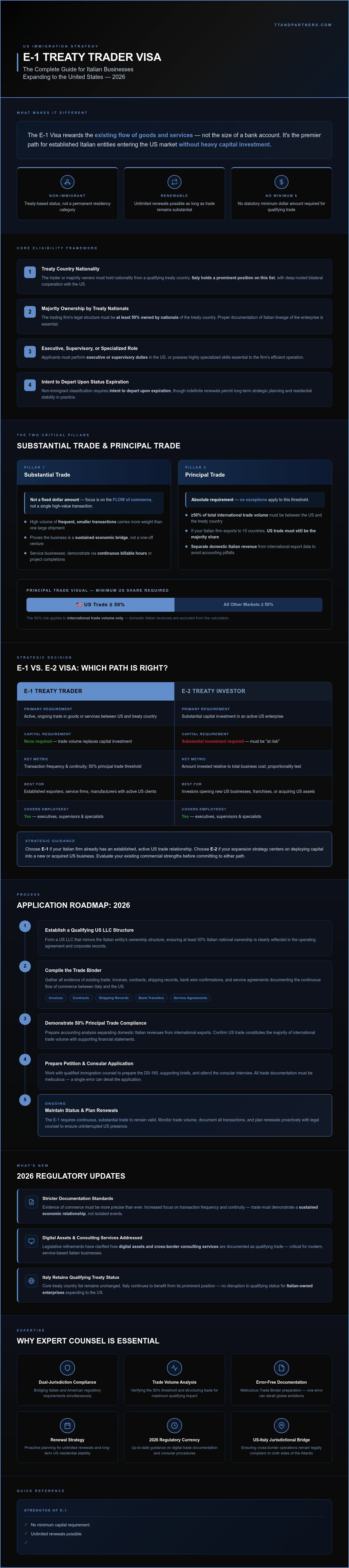
To qualify, the individual trader or the majority owners of the trading firm must possess the nationality of the treaty country. For our clients, this often involves establishing the Italian lineage of the enterprise. The legal structure must be at least 50 percent owned by nationals of the treaty country. Beyond ownership, the applicant must demonstrate they're coming to the U.S. to perform duties that are either executive or supervisory in nature, or they must possess highly specialized skills essential to the efficient operation of the firm. While the E-1 Visa requires an intent to depart the United States upon the expiration of status, the practical reality of indefinite renewals allows for long-term strategic planning and residential stability.
2026 Treaty Country Updates
As we move through 2026, the list of qualifying treaty countries remains a cornerstone of U.S. foreign commercial policy. Italy continues to hold a prominent position on this list, benefiting from a deep-rooted history of bilateral cooperation. Recent legislative shifts haven't altered the core list of nations but have refined how trade is documented, particularly concerning digital assets and cross-border consulting services. For Italian-owned entities, this means that the evidence of commerce must be more precise than ever. We've seen an increased focus on the frequency and continuity of transactions, ensuring that the trade isn't a singular event but a sustained economic relationship between the two nations.
Mastering the "Substantial Trade" and "Principal Trade" Requirements
The E-1 Visa hinges on the qualitative nature of commercial activity. It isn't merely a calculation of revenue. Success requires proving that the trade is both substantial and principal. These two pillars form the foundation of a successful petition, yet they're often the most misunderstood aspects of the application. Understanding the nuance between dollar value and transaction frequency is what separates a successful expansion from a denial.
Measuring Trade Volume and Frequency
Substantiality isn't defined by a rigid dollar threshold. Instead, the focus lies on the "flow" of commerce. A high volume of smaller, frequent transactions often carries more weight than a single, high-value shipment. This frequency proves that the business isn't just a one-off venture but a sustained economic bridge. For a service-based business, substantial trade is defined by a continuous stream of billable hours or project completions that demonstrate a dedicated commercial link between the treaty nation and the United States. The goal is to show a pulse of activity that warrants the trader's presence on American soil.
The 50% Principal Trade Threshold
The "Principal Trade" rule is an absolute requirement. At least 50 percent of the total volume of international trade conducted by the treaty trader or the firm must be between the United States and the treaty country. If your Italian firm exports to ten different countries, the trade with the U.S. must still constitute the majority share of your international dealings. Common accounting pitfalls often involve failing to separate domestic Italian revenue from international export data. If you're unsure how your current global operations align with these specific ratios, it's wise to consult with a legal strategist to audit your trade manifests before filing.
Defining the Scope of Trade
The definition of trade has expanded significantly in the modern era. It's no longer restricted to physical goods crossing borders. The following categories qualify as valid trade for E-1 purposes:
Tangible Goods: Traditional commodities and manufactured products.
Services: Including legal, engineering, and management consulting.
Financial Services: International banking, insurance, and brokerage.
Technology: Data processing, technology transfer, and software licensing.
To prove these requirements, you must present a meticulous "Trade Binder." This isn't just a collection of papers; it's a narrative of your commercial history. Essential evidence includes detailed invoices, international bills of lading, signed service agreements, and customs clearance documentation. Every document serves as a data point confirming the permanence of your commercial footprint.
E-1 vs. E-2 Visa: Choosing the Right Path for Your US Expansion
The choice between the E-1 Visa and the E-2 Visa represents a fundamental strategic decision regarding how your enterprise interacts with the American economy. While both share the same treaty-based origins, they reward different types of commercial activity. One prioritizes the movement of value across borders, while the other focuses on the placement of capital within U.S. soil. Selecting the wrong path can lead to unnecessary financial strain or administrative hurdles that a more aligned strategy would have bypassed.
Capital vs. Commerce: The Deciding Factors
If your strength lies in the existing movement of goods or services, the E-1 Visa is often the superior choice. It avoids the necessity of putting substantial capital at risk before operations begin. This route is ideal for established exporters, consulting firms, or logistics companies that already possess a robust transaction history with the United States. You're essentially leveraging your past success to secure your future presence. For startups or businesses that require significant physical infrastructure but haven't yet established a high volume of trade, the investment-based route might be more appropriate. You can find a detailed breakdown of these requirements in our E-2 Visa Guide 2026.
Approval rates often vary by industry and the maturity of the business model. Service-oriented firms with high intellectual property value frequently find the E-1 more accessible because it doesn't demand the purchase of equipment or real estate to prove commitment. However, hybrid strategies are possible. A business might initially enter on an E-1 to manage trade and later transition to E-2 status once they decide to build a domestic manufacturing facility or acquire a local competitor. This flexibility allows your legal status to evolve alongside your commercial footprint.
Transitioning to Permanent Residency
It's vital to remember that E-visas are technically non-immigrant classifications. They require you to maintain an intent to depart the United States once your status expires, though the ability to renew indefinitely makes them feel more permanent. If your long-term vision includes a Green Card, you'll need to build a bridge to an immigrant category such as the EB-1 for extraordinary ability, or the EB-2 and EB-3 for professional workers. These paths require a separate application process and a distinct legal strategy.
Successful traders often use the stability of their E-status to qualify for these immigrant categories over time. By establishing a successful U.S. entity and proving its economic impact, you create a stronger narrative for permanent residency. To understand the financial and strategic commitments involved in this transition, explore our latest analysis on How Much Is a Green Card? which outlines the 2026 landscape for international entrepreneurs.
The Application Roadmap: Navigating the 2026 Process
Securing an E-1 Visa requires more than just high-volume trade; it demands a flawlessly constructed legal vehicle. The application process is an exercise in engineering precision, where every document must align with the broader narrative of your commercial expansion. While the underlying trade might be fluid, the evidence supporting it must be static, verifiable, and beyond reproach. In 2026, the scrutiny on cross-border operations has intensified, making a structured approach more critical than ever.
Forming Your US Business Architecture
Your first step involves the creation of a robust American entity. For many of our clients, LLC incorporation stands as the preferred choice due to its flexibility and tax efficiency. Once the entity is formed, you must obtain an Employer Identification Number (EIN) and open a dedicated U.S. business bank account to house your domestic operations. Throughout this phase, you must ensure the ownership structure remains compliant; at least 50 percent of the enterprise must be owned by nationals of your treaty country. This structural integrity is the skeleton upon which the rest of your application rests.
The Critical Documentation Phase
The heart of your petition is the "Trade Binder." This isn't a mere collection of paperwork. It's a curated archive of your commercial integrity. It must include a chronological sequence of invoices, signed contracts, and international shipping manifests that prove a continuous flow of trade. You'll also need to decide on your processing path. While a Change of Status is possible if you're already in the U.S., Consular Processing at a U.S. Embassy or Consulate remains the standard for those seeking long-term international mobility. The final hurdle is the Consular Interview, where you must articulate your business's impact and your personal role with absolute clarity.
Avoiding Common Application Pitfalls
Many applicants fall into the "marginality" trap. A business is considered marginal if it doesn't have the present or future capacity to generate more than enough income to provide a minimal living for the treaty trader and their family. You must prove the enterprise will have a significant economic impact, often demonstrated through job creation or high-volume tax contributions. Documentation errors, such as inconsistent trade figures or missing logs, are the most frequent causes of a Request for Evidence (RFE). If your application meets resistance or a denial, you may need the support of international litigation specialists to protect your commercial interests. To ensure your roadmap is clear from the start, contact our legal team for a strategic consultation.
Why Expert Counsel is Essential for US-Italy Cross-Border Trade
Navigating the legal corridor between Rome and New York requires more than just a passing familiarity with immigration codes. It demands a profound understanding of how two distinct legal traditions intersect, especially when managing a complex E-1 Visa petition. The challenges of US-Italy cross-border trade aren't merely administrative; they're structural. At Tosolini, Toniutti & Partners, we act as the intellectual and strategic bridge, ensuring that your commercial vision translates perfectly into the American regulatory environment. Our approach is deeply rooted in professional precision, focusing on the quality of results rather than superficial marketing claims. We believe that a successful expansion is built on a foundation of engineering-like accuracy and a future-facing vision.
We don't view a visa application as an isolated event. Instead, we treat it as a critical component of a broader corporate strategy. This perspective allows us to anticipate the ripple effects that an E-status might have on your global tax liabilities or your long-term corporate governance. By integrating immigration law with our expertise in LLC incorporation and international litigation, we provide a seamless transition for Italian businesses entering the American market. This results-oriented mindset ensures that every piece of evidence in your trade binder serves a specific strategic purpose, reinforcing the permanence and value of your commercial footprint.
Strategic Legal Oversight
A successful expansion involves a holistic view of your assets and your lifestyle. Beyond the immediate needs of the visa, you may require professional assistance with a real estate closing or the management of high-value business assets. We ensure that your operations remain compliant with both US and Italian tax and corporate laws, preventing the friction that often arises from dual-jurisdiction exposure. There's an immense peace of mind in working with a firm that speaks both "languages" of law, allowing you to focus on your commercial growth while we handle the intricate details of your legal architecture. This synergy between immigration and corporate services is what defines a truly sophisticated expansion strategy.
Next Steps for Your US Expansion
Your journey toward a sustainable American presence begins with a clear, honest assessment of your current trade volume. We recommend starting with a preliminary trade audit to ensure your transaction frequency and volume meet the technical thresholds required for the E-1 Visa. Once we've established a viable path, we'll help you map out a relocation timeline that respects your business cycle and your family's needs. We invite you to start your E-1 Visa journey today by scheduling a strategy session with our team. Together, we can transform your international trade into a permanent bridge to the American market.
Securing Your Commercial Legacy in the United States
The path to American expansion through the E-1 Visa represents a sophisticated shift from capital-heavy investment to the recognition of existing commercial momentum. By prioritizing the frequency and continuity of trade over static assets, your business can establish a permanent presence that rewards its established international footprint. Mastering the technical nuances of the "principal trade" rule and the meticulous construction of a trade binder are not merely administrative hurdles; they're the architectural foundations of your future success. Realizing this vision requires a partner who understands the delicate legal and cultural balance between Rome and New York.
With decades of success in complex visa petitions and deep expertise in international litigation and corporate law, our firm serves as the specialized US-Italy legal bridge your enterprise deserves. We invite you to Schedule a Consultation with our E-1 Visa Experts to begin your strategic audit. We'll help you navigate the complexities of cross-border regulations while ensuring your business architecture remains robust and compliant. Your transition to the American market should be as seamless as the trade that made it possible.
Frequently Asked Questions
How long does it take to get an E-1 visa in 2026?
Current processing times for the E-1 Visa at the US Consulate in Italy typically range from two to four months. This timeline includes the initial documentation review and the scheduling of the consular interview. If you're applying for a Change of Status within the United States, USCIS processing may extend beyond six months unless you opt for premium processing. It's essential to monitor consulate-specific updates as workload fluctuations can impact these estimates throughout 2026.
Can my spouse and children join me in the US on an E-1 visa?
Your spouse and unmarried children under the age of 21 are eligible to join you under E-1 dependent status. Spouses are generally granted work authorization incident to their status, allowing them to seek employment with any American employer. Children can attend primary and secondary schools as well as universities. This family inclusivity makes the category an attractive option for entrepreneurs seeking a holistic relocation strategy for their household.
Is there a minimum dollar amount required for "substantial trade"?
There's no fixed statutory dollar amount that defines "substantial trade" for the E-1 Visa. Instead, the government evaluates the volume, frequency, and continuity of your commercial transactions. The trade must be sufficient to ensure a continuous flow of international commerce and must be large enough to justify the presence of the trader or employee in the United States. A high frequency of smaller transactions often proves more persuasive than a single large sale.
Can I work for other companies while in the US on an E-1 visa?
You're legally restricted to working only for the qualifying treaty enterprise or its approved subsidiaries while in the United States. Engaging in employment with an outside company or starting an unrelated side venture would constitute a violation of your non-immigrant status. If your business model evolves to include new entities, those structures must be analyzed and potentially added to your visa petition to ensure you remain in full legal compliance.
How many times can I renew my E-1 treaty trader status?
You can renew your status an unlimited number of times. As long as the underlying enterprise continues to meet the substantial and principal trade requirements, there's no legal cap on the total duration of your stay. Each renewal requires proof that the business remains active and that you still maintain the intent to depart the United States whenever your status eventually terminates. This longevity provides significant stability for long-term business planning.
What happens if my trade volume drops below 50% between the US and my home country?
Dropping below the 50 percent principal trade threshold immediately jeopardizes your visa eligibility. The law requires that the majority of your international trade volume occurs between the United States and your treaty country. If your global operations shift and the U.S. share becomes a minority, you'll no longer meet the core criteria for this classification. In such cases, it's vital to pivot your legal strategy toward an alternative like an investment-based visa or an intra-company transfer.
Does an E-1 visa lead directly to a Green Card?
The E-1 classification doesn't lead directly to permanent residency as it's a non-immigrant visa. However, it provides a stable platform from which you can pursue an immigrant petition, such as the EB-1 for extraordinary ability or the EB-2 for advanced professionals. Moving from a non-immigrant status to a Green Card requires a distinct legal strategy and the fulfillment of separate eligibility requirements that focus on long-term residency rather than temporary trade.
What is the difference between an E-1 visa and an L-1 visa?
The primary difference lies in the qualifying criteria. The E-1 is reserved for nationals of treaty countries and requires a specific volume of trade. Conversely, the L-1 visa is for intra-company transferees who have worked for a related foreign company for at least one year. While the L-1 doesn't require a specific trade volume between nations, it does demand a qualifying corporate relationship between the foreign office and the existing U.S. entity.


Comments