

How to Get Italian Dual Citizenship in 2026: The Strategic Post-Law 74 Guide
- Gianni Mendes Toniutti, Esq.

- 2 minutes ago
- 12 min read
The ancestral right to an Italian passport, once viewed as an immutable legacy, was fundamentally redefined on May 24, 2025. With the enactment of Law 74/2025, the landscape has shifted from an open-ended bloodline claim to a rigorous, generational legal structure. If you've been monitoring the italian citizenship processing time with concern, you've likely realized that the path forward requires more than just a family tree. The transition to a digital-first application system and the introduction of mandatory Italy-based interviews have added layers of complexity to an already demanding journey.
We recognize that reclaiming your heritage now feels like a race against shifting legislative tides. This guide provides the professional precision needed to navigate these new boundaries, from confirming your eligibility under the parent-grandparent limit to mastering the mandatory ALI portal. We'll explore the strategic steps for document procurement and successful acquisition, ensuring your connection to Italy remains a tangible reality in this new era of immigration law.
Table of Contents
Understanding the 2025 Legal Shift in Italian Citizenship
The legal architecture of Italian identity underwent its most significant transformation in decades on May 24, 2025. For over thirty years, Law No. 91/1992 provided a generous, almost limitless path for the global diaspora to reclaim their heritage. Law No. 74/2025 has replaced that expansive vision with a framework defined by proximity and active engagement. This shift isn't merely administrative; it's a fundamental revaluation of what it means to be Italian in a modern, globalized context. Applicants now find that the italian citizenship processing time is dictated not just by consulate backlogs, but by the rigorous new standards of eligibility established under Article 3-bis.
This legislative pivot seeks to strengthen the bond between the Republic and its citizens abroad. By narrowing the scope of Italian nationality law, the state now prioritizes those with direct, verifiable connections to the peninsula. For applications submitted after the March 27, 2025 cutoff, the era of tracing lineage back to the 19th century has effectively ended. The new legal climate demands a strategic approach, where eligibility is confirmed through specific cultural and linguistic markers that signify a living connection to the Italian state.
Key Changes Under Article 3-bis
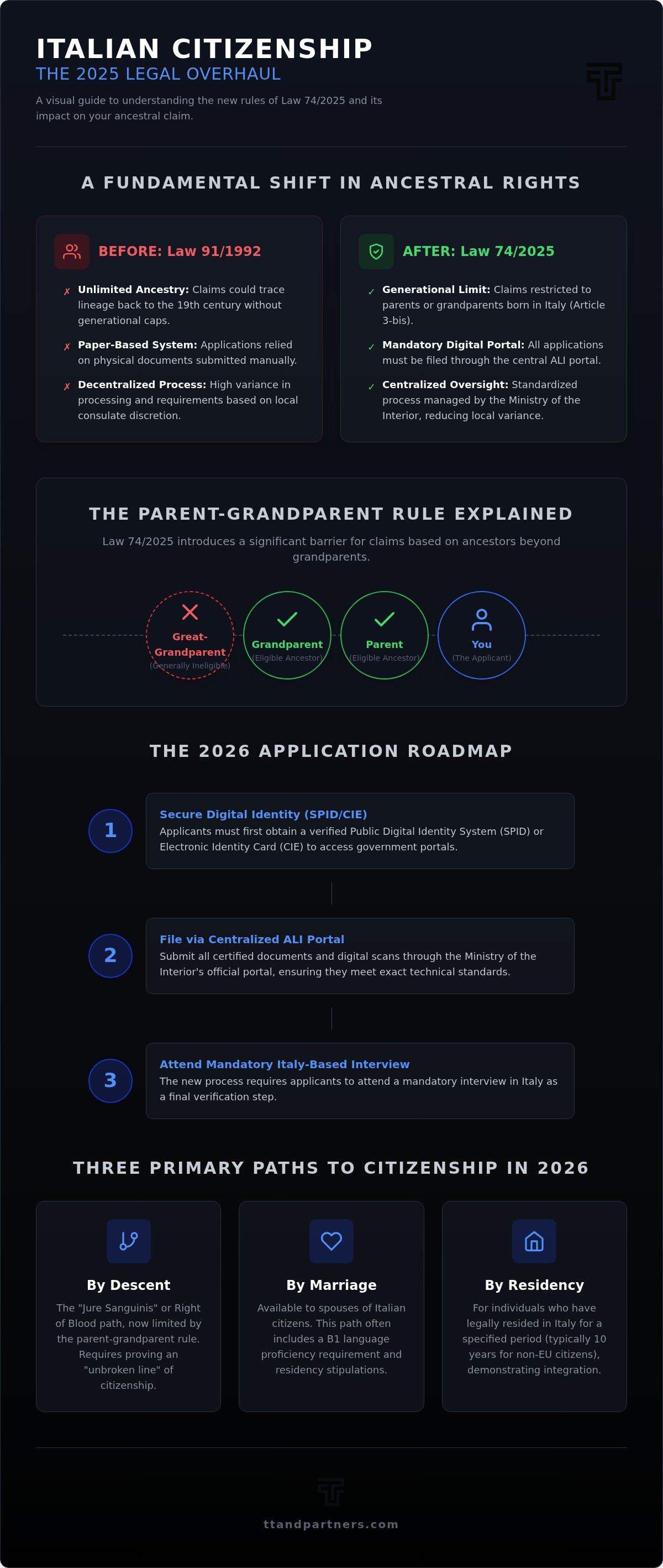
The most striking restriction is the new generational limit. Under Article 3-bis, jure sanguinis claims are generally restricted to those who can prove a parent or grandparent was born in Italy. This change creates a significant barrier for the great-grandparent lineage that was once the backbone of the US applicant pool. Beyond descent, the law creates a more complex environment regarding residency and tax implications for new dual citizens. While the B1 language requirement remains specific to marriage and residency paths for now, the strategic intent of Law 74 is clear: citizenship is a living connection, not a dormant right.
The Move to Digital Processing
Paper-based dossiers and local consulate discretion have given way to a centralized, digital ecosystem. All applications must now be routed through the Ministry of the Interior's official ALI portal. This transition requires applicants to secure a SPID (Public Digital Identity System) or CIE, moving the process into a high-precision digital environment. The Ministry of Foreign Affairs now oversees a workflow where any document discrepancy can trigger an immediate rejection.
Mandatory Digital Identity: Applicants must establish a verified SPID or CIE before filing.
Centralized Oversight: The Ministry of the Interior now controls the primary verification queue, reducing local consulate variance.
Precision Requirements: Digital scans must meet exact technical and legal standards to avoid administrative delays.
This centralized oversight aims to standardize the italian citizenship processing time, yet it demands a level of genealogical and legal accuracy that leaves no room for error. Every record must be part of an unbroken chain, verified through a lens of modern administrative scrutiny. Success in 2026 depends on bridging the gap between historical records and these new, rigid digital requirements.
The Three Primary Paths to Italian Dual Citizenship in 2026
Securing an Italian passport in 2026 requires selecting a legal route that aligns with your specific genealogy or life circumstances. While Law 74/2025 has tightened the criteria for many, three primary avenues remain available: descent, marriage, and residency. Each path carries its own distinct italian citizenship processing time, administrative fees, and evidentiary requirements. Understanding these nuances is the first step in constructing a successful application strategy.
The choice between these routes isn't always obvious. For some, a dormant bloodline claim is the most direct path. For others, a life built within the Italian borders or a union with an Italian national provides a more predictable, though linguistically demanding, journey. Regardless of the chosen direction, the current legal climate prioritizes precision and a demonstrated connection to the Italian Republic.
Italian Citizenship by Descent (Jure Sanguinis)
The most sought-after route for the US diaspora remains Jure Sanguinis, or the Right of Blood. This path relies on the principle that citizenship is transmitted through the paternal or maternal line. The "unbroken line" is the critical legal threshold. You must prove that no ancestor in your direct lineage renounced their Italian citizenship through naturalization before the birth of the next generation. For those navigating the official summary of the 2025 citizenship law changes, it's vital to note that the application fee for descent has risen to €600. Essential records include birth, marriage, and death certificates, all of which must be legalized with state-level Apostilles and translated with professional precision.
Citizenship by Marriage or Civil Union
Citizenship by marriage, or Jure Matrimonii, offers a structured timeline for spouses of Italian citizens. For those residing outside Italy, the legal italian citizenship processing time is generally 36 months, though this is reduced to 24 months for those living within the Italian territory. A significant prerequisite is the B1 level Italian language proficiency certification. It's a mandatory marker of cultural integration. If the couple has biological or adopted children, these waiting periods are halved, reflecting the state's interest in family unity. The administrative fee for this route is €250, notably lower than the descent path.
For individuals who've established their lives in Italy, residency-based naturalization is the third pillar. This path typically requires ten years of legal residency and a demonstrated tax history. While the administrative fee matches the marriage path at €250, the depth of personal and financial documentation required is extensive. Selecting the right strategy often depends on a careful analysis of your historical records and current lifestyle. If you're unsure which path fits your lineage, consulting with a cross-border legal expert can clarify your eligibility before you commit to a multi-year process.
Navigating the 'Jure Sanguinis' Requirements and the 1948 Judicial Path
The Senior Italian ancestor serves as the anchor for every Jure Sanguinis claim. Under the restrictive Article 3-bis of Law 74/2025, identifying whether this ancestor is a parent or grandparent is the primary hurdle for administrative recognition. If your lineage traces back to a great-grandparent or beyond, the consulate path is likely closed, forcing a strategic pivot toward judicial remedies or verifying specific exceptions. The single most critical data point in this search is the naturalization date. If your ancestor became a US citizen before the birth of the next person in your line, the transmission of citizenship was legally severed. This historical detail is the foundation upon which your entire case rests.
Verifying this status requires a meticulous paper trail, often starting with a Certificate of Non-Existence from USCIS or NARA records. You'll also need to manage non-renunciation certificates from every Italian consulate where your ancestors resided. This ensures the Italian state recognizes that the right was never explicitly abandoned. Because these administrative steps are sequential, they heavily influence the overall italian citizenship processing time, as a single missing record can halt the entire progression for months.
The 1948 Case: Overcoming Gender Discrimination
Historically, Italian women couldn't pass citizenship to children born before January 1, 1948. This discriminatory practice was overturned by the Supreme Court of Cassation, yet administrative consulates still lack the authority to process these specific applications. Instead, you must pursue a judicial path through the Italian court system. These cases are handled by specialized judges in the district of your ancestor's birth. Unlike the standard administrative route, a 1948 case involves a lawsuit against the Italian Ministry of the Interior. While it sounds daunting, the success rate for well-documented cases is high, and it often bypasses the legendary backlogs found at major US consulates.
Proving the Unbroken Line
The burden of proof rests entirely on the applicant to present a flawless chain of vital records. Discrepancies in names or dates are common, as "Giuseppe" often became "Joe" upon arrival at Ellis Island. These inconsistencies must be resolved through court orders or "one and the same" affidavits to satisfy the Italian authorities. Every document must be authenticated to be recognized abroad. An Apostille is a multi-national treaty certification for legal documents. This certification confirms the validity of the signature and seal on your US vital records, making them legally binding in Italy. Precise document preparation is the only way to safeguard your italian citizenship processing time from unnecessary interruptions.
The 2026 Application Roadmap: From Digital Filing to Mandatory Interviews
The transition to a digital-first administrative model has fundamentally altered the path toward an Italian passport. What was once a localized consulate interaction is now a centralized, four-phase journey that demands absolute legal precision. The efficiency of your italian citizenship processing time depends entirely on the integrity of your initial dossier. Any discrepancy in the genealogical chain can trigger a recursive loop of requests for evidence, adding years to an already deliberate process.
The roadmap begins with Phase 1: the procurement of the estratto di nascita from the Italian municipality of your ancestor's birth. Phase 2 shifts to the United States, where you must gather birth, marriage, and death records for every individual in the line. Each US document requires a state-level Apostille to be recognized under international treaty. Phase 3 involves certified translations and a comprehensive legal review to ensure the "unbroken line" satisfies Law 74/2025. Finally, Phase 4 is the digital transmission of this verified dossier through the centralized Ministry of the Interior portal.
The Digital Portal and Pre-Screening
Navigating the Prenot@mi system and the ALI portal requires more than just technical literacy. It requires a strategic understanding of how the Ministry of Foreign Affairs pre-screens digital filings. Common triggers for a Request for Evidence (RFE) include minor spelling variations between US records and the original Italian certificates. You'll also need to verify the €600 application fee for descent cases via the portal's integrated payment system. This digital gatekeeping ensures that only the most accurate files move forward to the adjudication phase.
The Mandatory Italy-Based Interview
A significant shift under the current legal framework is the emphasis on active engagement. For many applicants, particularly those establishing residency or navigating complex lineage cases, a face-to-face interview in Italy is now a mandatory final step. This recognition phase involves appearing before Italian authorities to confirm the authenticity of your intent and your documentation. It's a professional dialogue that bridges the gap between historical records and your future as a citizen. Once the interview is successfully concluded, the timeline to receiving your Italian passport typically narrows to a matter of months.
Successfully navigating these mandatory personal appearances requires local expertise and a dual-presence legal strategy. If you're preparing for the digital filing phase or need to coordinate your mandatory interview, contact our legal team to ensure your application meets the highest standards of Italian administrative law. Precision at this stage is the only way to safeguard your italian citizenship processing time from unnecessary bureaucratic delays.
Why Professional Cross-Border Counsel is Mandatory Under Law 74
The enactment of Law 74/2025 has effectively ended the era of do-it-yourself citizenship applications. The transition from a lineage-based right to a strategically managed legal process demands a level of sophistication that solo genealogical research can't provide. A dual-presence firm acts as the essential bridge between the decentralized record systems of the United States and the rigid, centralized administrative courts of Italy. This professional oversight is particularly vital when the standard italian citizenship processing time at a consulate exceeds the legal limit, allowing for "Against the Consulate" litigation to move the case directly into the Italian judicial system for a more predictable resolution.
Beyond the immediate goal of recognition, professional counsel addresses the broader implications of your new status. Italian citizenship isn't just a document; it's a legal shift that affects your global tax profile, your inheritance rights, and your ability to conduct business across borders. Ensuring compliance with the new linguistic and cultural markers introduced by Law 74 requires a nuanced understanding of both the letter and the spirit of the law. This protects your interests long after the passport is issued, ensuring that your dual status remains an asset rather than a liability.
Beyond the Passport: Cross-Border Legal Integration
Acquiring citizenship often precedes significant financial decisions. For many, this status facilitates a smoother real estate closing when investing in Italian property, ensuring that inheritance and title transfer follow both US and Italian protocols without conflict. Strategic advantages also exist for E-2 Visa holders who seek to leverage their dual status for international trade and investment. To determine how these changes impact your specific situation, you should contact our US-Italy legal team for a comprehensive eligibility audit and strategic roadmap.
Managing International Litigation and Disputes
High-net-worth individuals often face complexities when managing assets in multiple jurisdictions. Whether you're enforcing US judgments or engaging in international litigation involving Italian assets, a unified legal strategy is paramount to success. Law 74/2025 has introduced such high stakes for lineage verification that professional legal review is now mandatory to ensure every application survives the government's centralized digital scrutiny. By aligning your genealogical proofs with current judicial precedents, you protect your family legacy from being lost to administrative technicalities or shifting bureaucratic interpretations.
This level of precision doesn't just secure a passport. It builds a foundation for a life lived between two cultures, backed by the certainty of legal compliance. As the italian citizenship processing time continues to fluctuate in response to new regulations, having a dedicated legal presence in both the US and Italy remains the only way to maintain control over your application's momentum.
Securing Your Italian Legacy in a Changing Legal Era
The landscape of Italian citizenship has evolved into a sophisticated legal environment where precision is the only currency. By understanding the shift from Law 91/1992 to the rigorous standards of Law 74/2025, you've taken the first step toward reclaiming your heritage. Success in 2026 depends on your ability to navigate the digital portal and prepare for mandatory interviews with absolute document integrity. Effectively managing the italian citizenship processing time now requires a proactive judicial or administrative strategy that anticipates bureaucratic hurdles before they arise.
Tosolini, Toniutti & Partners provides the specialized cross-border expertise necessary to bridge the gap between US records and Italian courts. Our team excels in handling Law 74/2025 compliance, 1948 judicial claims, and the complex logistics of Italy-based recognition. It's time to transform your ancestral history into a tangible future. Schedule a Strategic Citizenship Consultation with Tosolini, Toniutti & Partners to ensure your application meets the highest legal standards. Your connection to Italy is a living legacy, and with professional precision, your path to an Italian passport remains clear.
Frequently Asked Questions
Do I still qualify for Italian citizenship if my great-grandparent was the last one born in Italy?
Under the restrictive Article 3-bis of Law 74/2025, administrative recognition is generally limited to those with an Italian born parent or grandparent. If your lineage relies on a great-grandparent, you don't qualify for standard consulate processing unless your application was submitted before the March 2025 deadline. However, specific judicial exceptions or 1948 cases may still offer a strategic path for those with more distant ancestry.
What is the 1948 case, and does it apply to my Italian citizenship application?
A 1948 case is a judicial challenge to the historical law that prevented Italian women from passing citizenship to children born before January 1, 1948. Because the Supreme Court of Cassation ruled this discriminatory, you can sue the Italian government for recognition. This path requires an Italian attorney and bypasses the consulate system, offering a specialized route for those whose maternal line was previously blocked by gender discrimination.
How long does the Italian dual citizenship process take in 2026?
The legal italian citizenship processing time for descent applications is capped at 24 months, though actual wait times vary by consulate. For citizenship by marriage or residency, the legal limit is 24 to 36 months for applications filed after December 20, 2020. Digital filing via the ALI portal has centralized the workflow, but the volume of global applications continues to influence the speed of final adjudication.
Do I have to speak Italian to get dual citizenship by descent?
You don't need to demonstrate Italian language proficiency for citizenship by descent. This requirement is currently reserved for those applying through marriage or residency, who must provide a B1 level certification. While descent applicants are exempt from the formal language test, the 2025 legal changes emphasize a stronger cultural connection, making basic linguistic knowledge beneficial during mandatory interviews or administrative interactions with Italian authorities.
Can I lose my US citizenship if I become an Italian citizen?
You won't lose your US citizenship by acquiring an Italian passport. The United States recognizes the right of its citizens to hold dual nationality and doesn't require you to choose between the two. You'll simply be a citizen of both nations, traveling with two passports and enjoying the rights of both the US and the European Union without jeopardizing your original status or domestic legal protections.
What are the tax implications of holding an Italian dual passport?
Holding an Italian passport doesn't automatically trigger Italian tax obligations if you reside in the US. Italy's tax system is primarily residency based, meaning you're generally only taxed on global income if you live in Italy for more than 183 days a year. However, dual citizens with Italian assets or real estate must comply with specific reporting requirements and local property taxes as outlined in international treaties.
Is there a mandatory interview in Italy for citizenship by descent?
Law 74/2025 has introduced a requirement for mandatory engagement, which often involves a face-to-face interview in Italy during the recognition phase. This is especially true for those establishing residency to accelerate their italian citizenship processing time or those navigating complex judicial claims. This interview confirms the authenticity of your records and your intent to maintain a living connection with the Italian Republic through active civic participation.
How much does it cost to get Italian dual citizenship with legal assistance?
Government fees are fixed at €600 for descent applications and €250 for marriage or residency. Beyond these state costs, total investment varies based on the complexity of your genealogy and the need for international litigation. Professional fees cover document procurement, state level Apostilles, certified translations, and legal representation in Italian courts, ensuring your dossier meets the rigid precision required by the current centralized government digital system.


Comments