

E-2 Visa Mistakes for Italians: 2026 Prevention Guide

What if the Mediterranean entrepreneurial spirit, celebrated for its intuition and agility, is the very thing that complicates your path to the American market? You likely believe that a robust vision and a healthy bank balance are sufficient to bridge the gap to the American market, yet the administrative reality is far more exacting. In 2026, common E-2 visa mistakes for Italians frequently arise from a failure to translate local business successes into the specific, evidence-based language required by U.S. authorities.
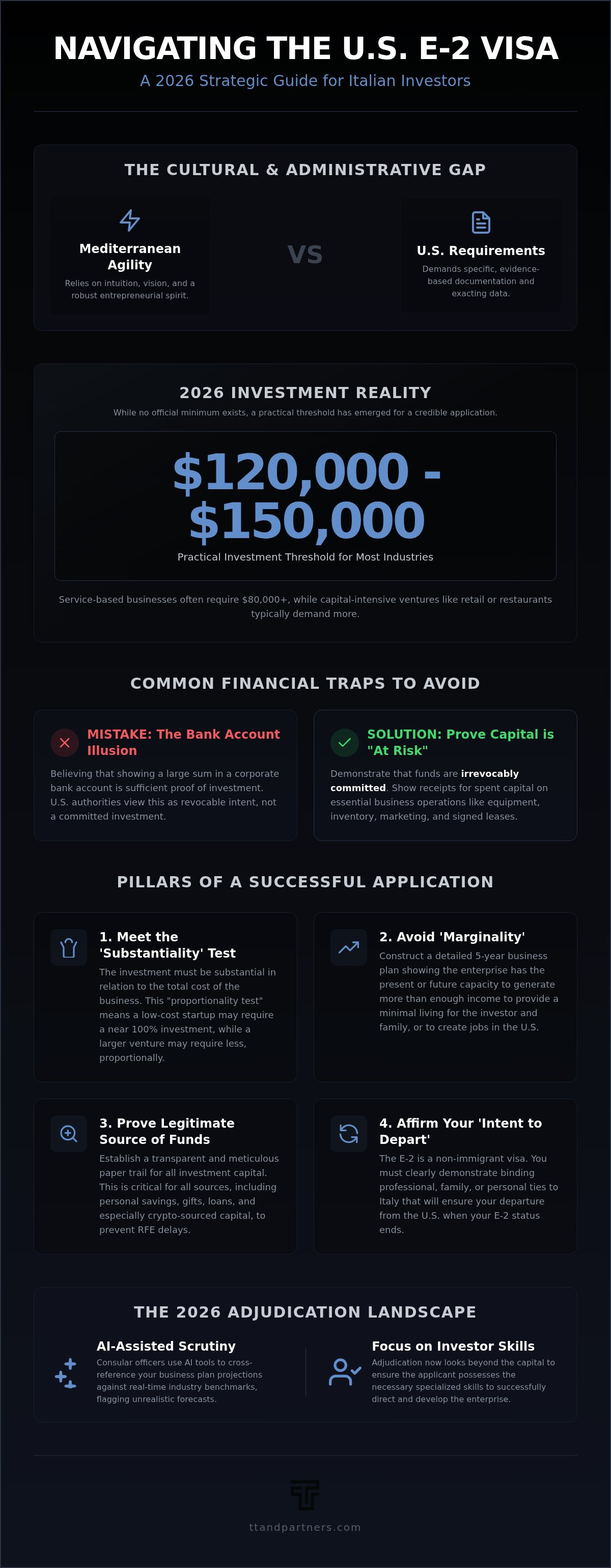
We'll bridge this gap by providing a precise legal breakdown of current requirements, including the practical $120,000 to $150,000 investment thresholds now seen in 2026. This guide offers a clear checklist of errors to avoid, from documenting crypto-sourced capital to meeting new in-person interview standards. You'll gain the clarity needed to navigate the U.S. Consulate's expectations with the same sophistication you bring to your business, avoiding the pitfalls that lead to unexpected denials.
Table of Contents
The E-2 Treaty Investor Landscape for Italians in 2026
The economic bridge between Italy and the United States is anchored by the 1871 Treaty of Commerce and Navigation. This historic agreement provides the legal foundation for Italian entrepreneurs to enter the American market through the E-2 visa. By definition, an E-2 visa allows an Italian national to reside in the US based on a substantial investment in a US enterprise. While this pathway offers unparalleled access to the world's largest economy, the stakes of an application are exceptionally high. A denial does not merely stall a business plan; it often results in the forfeiture of non-refundable capital, months of lost operational time, and potential complications for future U.S. travel. Recognizing common E-2 visa mistakes for Italians is essential for any investor who views their American expansion as a long-term strategic asset rather than a speculative venture.
Understanding the Treaty Investor Framework
Eligibility is strictly reserved for those holding Italian citizenship. While dual nationals may apply, they must enter the U.S. using their Italian passport to claim treaty benefits. The adjudication process, primarily handled by the U.S. Consulate in Italy, has shifted toward a more analytical review of the investor's role. Officers now look beyond the capital itself to ensure the applicant possesses the specialized skills necessary to direct the enterprise. It is also vital to satisfy the "intent to depart" requirement. Even though the E-2 can be renewed indefinitely, you must demonstrate that your stay is temporary and that you maintain professional or personal ties to Italy. Failing to articulate this clearly is one of the more subtle yet frequent errors in modern filings.
The 2026 Regulatory Climate for Italian Applicants
In 2026, the scrutiny applied to Italian small businesses has reached a new peak. Consular officers now utilize AI-assisted tools to cross-reference business plan projections against real-time industry benchmarks. If your growth forecasts appear unrealistic for your specific U.S. location, your application may be flagged for closer inspection. Italian investors must also navigate the five-year maximum validity period, which remains the standard reciprocity limit for Italy. This timeframe requires a disciplined approach to business growth and document retention to ensure seamless renewals. An E-2 visa serves as a non-immigrant bridge to US market entry. To cross it successfully, investors must align their Mediterranean business agility with the rigid, data-driven expectations of 2026 U.S. immigration policy. For those seeking to refine their strategy before submission, a professional consultation can help identify hidden vulnerabilities in the early stages of capital commitment.
Financial Errors: The 'Substantiality' and 'At-Risk' Trap
A frequent point of confusion for Mediterranean investors is the search for a fixed minimum investment amount. U.S. law intentionally avoids a specific dollar figure, opting instead for the "proportionality test." This metric compares the amount of capital invested against the total cost of either establishing a new enterprise or purchasing an existing one. One of the most common E-2 visa mistakes for Italians is assuming that a high net worth alone satisfies this requirement. In reality, the consulate examines the percentage of the business's value that you've already committed. For a low-cost startup, you might need to invest nearly 100% of the required capital; for a multi-million dollar venture, a lower percentage may suffice, provided the absolute figure remains significant.
Mistake #1 often manifests as the "Bank Account Illusion." Many applicants believe that showing $200,000 in a corporate bank account proves their commitment. It doesn't. To the Department of State, capital is only "at risk" when it's been spent on equipment, leases, inventory, or marketing. Keeping funds in a liquid account is seen as a revocable intent rather than a completed investment. Similarly, Mistake #2 involves relying on an "intent to invest" or uncommitted funds. If your business plan says you'll buy machinery next year, those funds don't count toward the substantiality threshold today. You must demonstrate that the capital is irrevocably committed to the business operations before you file your application.
Defining 'Substantial' for 2026 Investments
In 2026, the practical threshold for a credible application has shifted. While a solo consultancy might have succeeded with $60,000 in the past, current trends suggest a practical minimum of $120,000 to $150,000 for most industries. Service-based businesses, such as IT startups or professional firms, typically require $80,000 to $150,000 to appear viable. In contrast, capital-intensive sectors like restaurants or retail now frequently require $200,000 to $500,000+. If the investment is too low, the business risks being labeled "marginal," meaning it's only capable of supporting the investor's family rather than making a significant economic impact.
The 'At-Risk' Requirement Explained
To qualify, the enterprise must be a "real and active" commercial entity. Passive investments, such as purchasing undeveloped land or holding a portfolio of stocks, are strictly ineligible for E-2 status. The capital must be subject to partial or total loss if the business fails. To balance this risk, many sophisticated investors use escrow accounts. This allows you to commit funds to a purchase or lease that are only released upon visa approval. This strategic approach meets the "at-risk" criteria while providing a layer of financial security. If you're unsure if your current expenditures meet these rigorous standards, consulting with a legal strategist can ensure your capital is positioned correctly before the final submission.
Operational Pitfalls: Marginality and the 5-Year Business Plan
The Mediterranean approach to business often prioritizes organic growth and lean operations, yet this philosophy can trigger a "marginality" denial in a U.S. visa context. Mistake #3 involves proposing a business that exists solely to support the investor and their immediate family. To the U.S. government, an enterprise must be more than a self-employment vehicle; it must demonstrate the capacity to make a significant economic contribution within five years of its inception. This is where many common E-2 visa mistakes for Italians begin, as applicants often present conservative financial forecasts that inadvertently prove the business is too small to qualify under current standards.
Equally critical is Mistake #4: failing to establish the investor's "develop and direct" role. You aren't just an employee of your own company; you're the strategic architect. If the application suggests you'll be performing the daily technical labor rather than managing the growth of the enterprise, the visa will likely be denied. The officer must see that you possess the executive control to steer the business toward its projected success. This requires a clear organizational chart that illustrates how you'll manage future staff and oversee the company's trajectory.
Overcoming the Marginality Hurdle
Success requires proving that your venture will hire U.S. workers and generate profit beyond your personal needs. For complex applications, an economic impact study can provide the data-driven evidence needed to satisfy skeptical officers. Your hiring timeline should be specific, showing exactly when you'll bring on your first U.S. employees. In 2026, USCIS increasingly uses AI tools to cross-reference these hiring projections against industry averages, so your numbers must be grounded in verifiable reality. If your business cannot support a team within the first few years, it risks being labeled marginal.
Crafting a US-Compliant Business Plan
A U.S. business plan is a technical document, not a philosophical manifesto. It requires exhaustive market analysis and competitor breakdowns that go far beyond what's typical in Italian business circles. This document must serve as a roadmap for the next five years, detailing how your specific corporate structure supports your goals. For instance, you should learn how LLC incorporation affects your business plan to ensure your legal foundation matches your operational vision. Every projection must be backed by third-party data to survive the rigorous 2026 review process.
Documentation Errors: Proving the Legitimate Source of Funds
The transition from the Italian financial infrastructure to the American regulatory environment requires more than just a currency exchange; it demands a total transparency of wealth. Mistake #5, one of the most common E-2 visa mistakes for Italians, involves leaving gaps in the paper trail that connects the original source of wealth to the U.S. business account. Consular officers are not satisfied with seeing a final deposit. They require a meticulous, chronological narrative of the capital's journey. If you've sold a property in Milan or liquidated a family portfolio, you must provide every underlying document, from the initial notary deed to the final wire transfer confirmation. Every Euro must be accounted for from its origin, leaving no room for ambiguity in the eyes of the reviewing officer.
Mistake #6 often occurs during the financing stage. Some investors attempt to secure loans using the assets of the U.S. enterprise as collateral. Under E-2 regulations, this is strictly forbidden. The investment must be yours to lose. This means any debt must be secured by your personal assets, such as a home in Italy or a personal guarantee. If the business assets are used to secure the loan, the capital is no longer considered at risk by the investor, leading to an immediate denial of the application.
Tracing the Path of Capital
Documenting a property sale or an inheritance requires a meticulous collection of probate records, tax declarations, and bank statements. If your capital stems from a family inheritance, you must provide the legal succession documents and proof that the required inheritance taxes were paid. Currency exchange records are equally vital. The movement from Euro to USD must be transparent, showing the specific institutions involved and the exact rates applied. Any blind spot in this movement can trigger a Request for Evidence, stalling your expansion for months.
Common Document Deficiencies for Italians
Discrepancies between Italian tax declarations and the liquid capital shown in bank statements often create friction during review. U.S. officers may struggle to reconcile tax structures or specialized funds like severance indemnity payments without expert translation into U.S. legal equivalents. Unexplained cash deposits are an automatic red flag. In a 2026 landscape where anti-money laundering scrutiny is at an all-time high, even small, undocumented transfers between personal accounts can jeopardize your standing. To ensure your financial history meets these rigorous standards, contact a legal strategist who understands the nuances of cross-border banking.
Strategic Planning: Avoiding the Request for Evidence (RFE)
The final stage of the E-2 journey requires a transition from the creative energy of investment to the clinical precision of a legal audit. A "Pre-Flight" audit involves reviewing every page of your submission through the lens of a Consular Officer, searching for the inconsistencies that trigger a Request for Evidence (RFE). Mistake #7, and perhaps the most avoidable of common E-2 visa mistakes for Italians, is rushing the filing process before the investment is fully committed. It's tempting to submit once the capital is in the bank, but without receipts for spent funds, your application remains premature. In the 2026 climate, where the average consular processing time ranges from 90 to 180 days, an RFE can easily double your wait time and delay your market entry by nearly a year.
The Pre-Submission Checklist
A successful filing begins with a sequence of technical milestones that must be completed before the DS-160 is ever signed. First, ensure your LLC formation is complete and your Employer Identification Number (EIN) is active; these are the foundational pillars of your American corporate identity. Second, verify that the "At-Risk" phase is fully documented with clear, itemized receipts for all business expenditures, leaving no room for the officer to question the irrevocable nature of your capital. Finally, conduct a "Marginality" stress test on your five-year projections. This ensures your growth forecasts remain defensible under the AI-assisted scrutiny now prevalent in 2026. These steps transform a collection of disparate documents into a cohesive, strategic narrative that anticipates and answers the officer's concerns before they are even asked.
Why Professional Representation is Essential
The complexity of cross-border US-Italy cases often extends beyond immigration law into the nuances of international tax treaties and specialized banking records. An attorney doesn't just fill out forms; they anticipate the specific queries a Consular Officer in Rome or Milan might have regarding your source of funds or Mediterranean business model. If an RFE is issued, professional counsel is vital to provide a response that is both legally sound and strategically aligned with your original filing. You can contact our cross-border legal team for an E-2 consultation to ensure your strategy accounts for both the US-Italy tax treaty and the latest 2026 adjudication trends. This level of professional oversight is often the difference between an immediate approval and a prolonged administrative delay.
The final step is the interview at the US Consulate, a requirement for all applicants as of late 2025. This is not a mere formality but a critical defense of your business plan. You must be prepared to articulate your "develop and direct" role with confidence, demonstrating an intimate knowledge of your financial projections and hiring timelines. Success in 2026 depends on this final alignment of vision and technical compliance, ensuring your Mediterranean ambition finds a permanent home in the American market.
Securing Your American Legacy
Building a successful enterprise in the United States is a journey defined by strategic foresight and meticulous preparation. The path to approval requires more than just capital; it demands a transparent narrative of your financial history and a robust five-year vision that transcends the limits of a personal livelihood. Successfully navigating common E-2 visa mistakes for Italians requires a synthesis of Mediterranean entrepreneurial agility and American administrative rigor. By ensuring your investment is irrevocably committed and your source of funds is documented with surgical precision, you transform a complex legal requirement into a definitive market entry strategy.
Tosolini, Toniutti & Partners brings decades of experience in US-Italy immigration law to every application. From our strategic offices in New York, we specialize in the complex tracing of Italian financial records to meet the highest consular standards. You don't have to manage these shifting 2026 regulations alone. Secure your US investment future with a professional E-2 consultation and move forward with the confidence that your vision is protected by expert legal architecture. Your American expansion starts with a single, well-planned step.
Frequently Asked Questions
What is the minimum investment amount for an Italian E-2 visa in 2026?
There is no legally mandated minimum dollar amount for an E-2 visa, but practical standards in 2026 suggest a threshold between $120,000 and $150,000 for a successful application. While service-based startups might qualify with less, capital-intensive businesses often require significantly more to satisfy the proportionality test. The goal is to ensure the investment is substantial enough to support the enterprise's successful operation and growth.
Can I use a loan to fund my E-2 visa investment?
You can use a loan to fund your investment provided the debt is secured by your personal assets rather than the assets of the U.S. business. Loans secured by the enterprise itself are strictly forbidden because they don't meet the "at-risk" requirement. Using unsecured loans or those collateralized by property in Italy is a strategic way to satisfy the capital requirements while protecting your American venture's balance sheet.
Does buying a house in the US count as an E-2 investment?
Purchasing a residential home in the United States does not qualify as an E-2 investment because it's considered a passive asset rather than an active commercial enterprise. The law requires your capital to be irrevocably committed to a business that produces goods or services and creates jobs. While real estate holdings can demonstrate your ties to the U.S., they cannot serve as the primary basis for your treaty investor status.
What happens if my E-2 visa application is denied?
If your application is denied, you generally have the option to reapply with a strengthened filing or appeal the decision through administrative channels. Most investors choose to re-file after addressing the specific deficiencies cited by the Consular Officer, such as clarifying the source of funds. Correcting common E-2 visa mistakes for Italians before the initial submission is the most effective way to avoid the high costs of a denial.
Can my spouse work in the US on an E-2 dependent visa?
Spouses of E-2 visa holders are authorized to work in the United States incident to their status, which means they don't need to apply for a separate Employment Authorization Document. This provides significant flexibility for families, allowing the spouse to pursue professional opportunities in any field or even start their own business. This benefit remains one of the most attractive features of the treaty investor framework for Italian families relocating.
How long does it take to process an E-2 visa for an Italian citizen?
Processing times for Italian citizens at the U.S. Consulate typically range from 90 to 180 days, though this varies based on seasonal volume and specific case complexity. High-volume periods can extend the timeline to seven months, while simpler cases might see approval in as little as 60 days. It's vital to account for these windows when planning your business launch and lease commitments to ensure a seamless transition.
Do I need to have a physical office in the US for an E-2 visa?
You generally need a physical office or commercial space to demonstrate that your enterprise is a real and active commercial entity. While some digital startups may use shared workspaces, a dedicated physical location provides strong evidence that the business is operational and "at risk." Avoiding common E-2 visa mistakes for Italians often involves securing a lease that reflects the professional scale and ambitious growth of your enterprise.
Can I transition from an E-2 visa to a Green Card?
The E-2 visa is a non-immigrant category and does not offer a direct, automatic path to a Green Card. However, many Italian investors eventually transition to permanent residency through other categories like the EB-1 for extraordinary ability or the EB-5 immigrant investor program. Navigating these transitions requires a long-term legal strategy that aligns your business growth with the specific requirements of U.S. immigrant visa categories and residency rules.



Comments