

E-1 Visa Requirements for Italian Citizens: The 2026 Strategic Roadmap
- Gianni Mendes Toniutti, Esq.

- Jul 13
- 12 min read
While the total trade in goods and services between the United States and Italy reached $149.8 billion in 2025, many Italian firms overlook the most efficient path to US residency because they fear the ambiguity of immigration law. You've likely found that navigating the E-1 visa requirements for Italian citizens feels like solving a puzzle where the definitions of "substantial trade" are frustratingly fluid. It's natural to feel concerned about proving the 51% trade nexus or distinguishing between E-1 and E-2 eligibility when your goal is simply to move personnel and scale operations without a massive capital injection.
This guide will provide the clarity you need to master the treaty trader framework and facilitate seamless international commerce. We'll examine the 2026 strategic roadmap, covering everything from the $315 DS-160 fee to the specific high-frequency trade patterns that satisfy consular officers. By the end of this analysis, you'll have a technical blueprint to secure long-term US residency for your team, ensuring your Italian heritage and commercial expertise find a permanent home in the American market.
Table of Contents
Understanding the E-1 Treaty Trader Classification for Italians
The E-1 visa serves as a sophisticated instrument for Italian commerce, rooted in a bilateral history that spans nearly two centuries. This classification is built upon the 1851 Treaty of Commerce and Navigation between the United States and Italy. It isn't merely a permit; it's a recognition of a deep economic bond that allows Italian nationals to enter the US to manage substantial international trade. One primary advantage of this path is that it requires no minimum capital investment. While other categories demand significant upfront funds, the E-1 focuses on the activity of the business. As long as your trade relationship remains robust and active, you can secure unlimited two-year extensions, providing a stable foundation for long-term growth.
Meeting the E-1 visa requirements for Italian citizens involves demonstrating that your enterprise facilitates a consistent exchange of items between the two nations. This isn't about a single large transaction. It's about the rhythm of your business. The US government looks for a continuous flow of trade, rewarding high-frequency operations that strengthen the transatlantic corridor. Whether you're moving physical components or providing high-level expertise, the E-1 honors the movement of value over the simple accumulation of assets.
E-1 vs. E-2: Choosing the Best Path for Your Italian Business
Deciding between these two pathways depends on your corporate structure and how you deploy capital. The E-2 visa centers on invested funds and the assumption of financial risk. If your business model requires significant physical infrastructure or a large-scale initial purchase, you should review our E-2 Visa Guide 2026 to understand those investment thresholds. However, for many Italian service providers, the E-1 is the superior choice. It prioritizes the flow of services and goods rather than the size of your bank account. Understanding the E-1 Treaty Trader Visa is essential for firms that prefer to keep their capital fluid, focusing on operational volume rather than fixed US assets.
What Qualifies as 'Trade' in the 2026 US-Italy Corridor?
In 2026, the definition of trade has evolved to match the digital economy. While the US-Italy trade in goods and services reached $149.8 billion in 2025, the composition of that trade is shifting. Beyond traditional machinery and fashion, "trade" now encompasses digital services, banking, insurance, and even international tourism. For an Italian SaaS company, the items of trade are the software licenses and data subscriptions crossing the Atlantic. To satisfy the E-1 visa requirements for Italian citizens, this trade must be "existing." You can't qualify based on future projections; you must document a history of actual transactions. This documented flow proves that your business is a functional bridge between the two markets, not just a speculative venture.
The 'Substantial Trade' Requirement: Metrics for Success
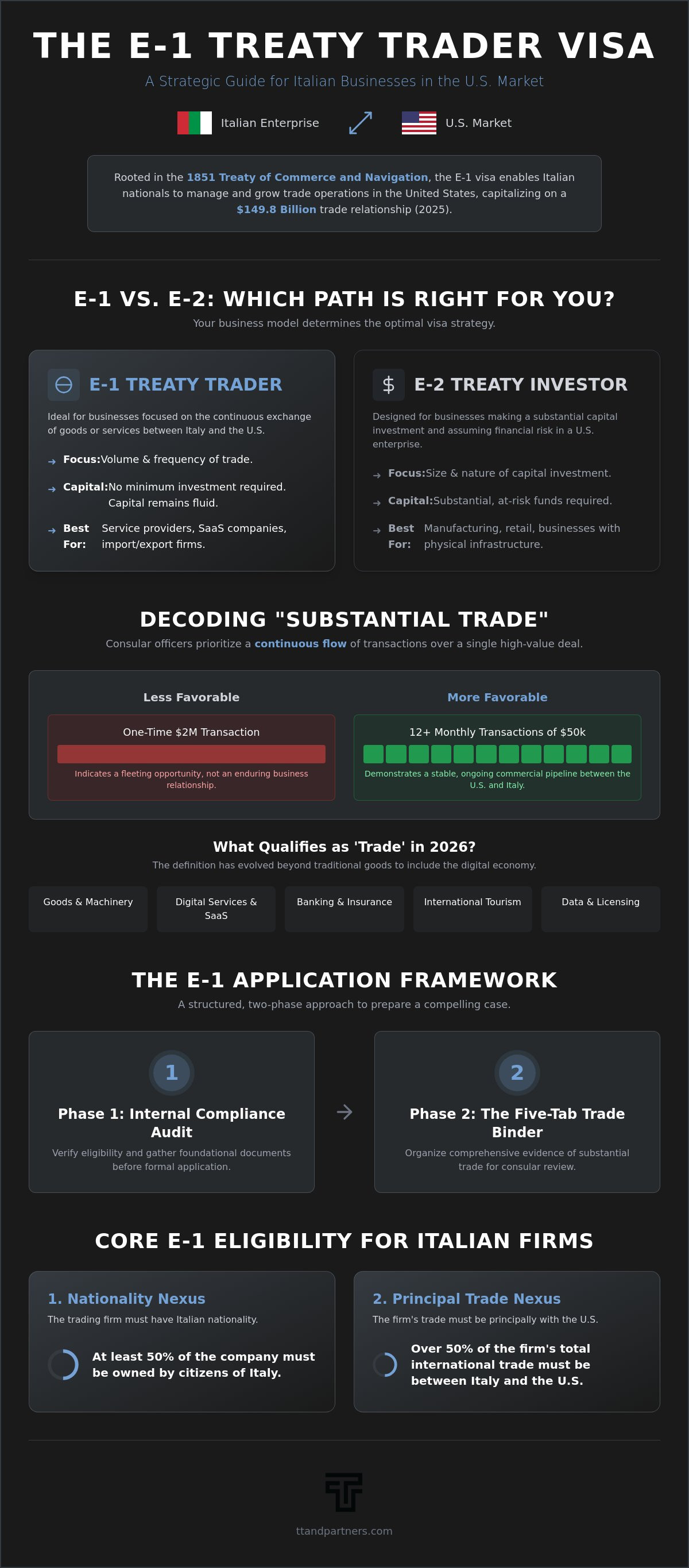
Navigating the E-1 visa requirements for Italian citizens often leads to a common misconception: that "substantial trade" is defined by a specific, high-dollar figure. It's not. Consular officers prioritize the rhythm and frequency of your transactions over the raw value of a single deal. A company moving $500,000 worth of specialized machinery through monthly shipments demonstrates a more stable commitment than a firm with a one-time $2 million transaction. This "Continuous Flow" principle is central to the official E-1 visa qualifications, as it proves that the trade relationship is an enduring one rather than a fleeting opportunity. Consistency is the metric that validates your presence in the US market.
Frequency and Volume: Building the Trade Binder
Consular officers look for a pattern of activity that suggests a permanent business operation. If you're preparing your application, 12 monthly transactions provide a much stronger narrative than a single massive contract. You must prove this flow through a "Trade Binder" that includes invoices, bills of lading, and bank statements. Every entry should be traceable; the goal is to show that your business isn't just shipping goods, but is actively managing an ongoing commercial pipeline. If you're unsure if your current volume meets these standards, it's wise to consult with a legal strategist to audit your shipping logs.
The documentation must be exhaustive. It's not enough to claim trade exists; you must demonstrate it through the actual movement of value. For service-based firms, this involves showing a history of signed service agreements and the subsequent cross-border payments. The US government rewards the "traceable" nature of trade, so ensuring your financial records align perfectly with your shipping or service delivery dates is vital for a successful outcome.
The 51% Rule: Managing Global Trade Flows
To satisfy the E-1 visa requirements for Italian citizens, your enterprise must meet the "Principal Trade" threshold. This means more than 50% of the company's total international trade volume must be between the United States and Italy. It's a calculation based on the volume of trade, not necessarily the total revenue of the global parent company. If your Italian firm trades extensively with Germany or France, you may need to strategically restructure your trade flows to ensure the US-Italy corridor remains the dominant international link.
This rule specifically counts international trade. Domestic sales within Italy don't factor into the percentage, which often helps smaller Italian exporters qualify even if they have a large domestic base. However, if your business operates as a hub for the entire European Union, you must carefully document that the specific entity applying for the visa maintains its primary commercial focus on the US market. Restructuring these flows requires precision to ensure you don't disrupt existing operations while still meeting the strict legal nexus required for the treaty trader classification.
Eligibility and the Nationality Nexus for Italian Firms
The legal framework of the treaty trader classification demands a clear, documented lineage between the applicant and their country of origin. Every individual seeking this status must hold a valid Italian passport. This isn't a mere formality; it's the baseline for establishing the "nationality nexus" that the US government requires. Beyond the individual, the US enterprise itself must demonstrate its Italian identity. To satisfy the E-1 visa requirements for Italian citizens, at least 50% of the US entity must be owned by individuals or parent companies that possess Italian nationality. This requirement ensures that the commercial benefits of the 1851 treaty remain with the stakeholders intended by the original agreement.
Ownership is calculated based on the nationality of the ultimate individual owners. If your US operation is a subsidiary of a larger group, we must trace the cap table back to the people who hold the shares. It's vital to remember that US dual citizens or Legal Permanent Residents (Green Card holders) do not qualify as Italian nationals for this specific purpose. This distinction is a frequent point of confusion for established families with complex residency statuses, yet it remains a non-negotiable pillar of the eligibility audit.
The 50% Ownership Rule for Corporate Structures
Proving nationality for a private Italian S.r.l. or S.p.A. requires a meticulous review of corporate records. We must submit share certificates and chamber of commerce filings to prove that the control remains in Italian hands. For those currently building their US architecture, our guide on LLC Incorporation provides a roadmap for structuring your entity to preserve this essential nexus. Maintaining this 50% threshold is an ongoing requirement; any shift in ownership that drops the Italian stake below the halfway mark will terminate the E-1 eligibility for all visa holders associated with that firm.
Qualifying Key Italian Personnel for E-1 Status
The E-1 visa serves as a bridge for more than just the business owner. It allows Italian firms to move their most trusted managers and specialists to the US. An executive or managerial applicant must hold primary responsibility for the company's direction or supervise a significant department. For "Essential Employees," the burden is to prove specialized knowledge. You must demonstrate that the employee possesses unique expertise in Italian manufacturing, proprietary technology, or specific market strategies that can't be easily found in the US labor market. This technical justification is what allows your US branch to maintain the same precision and aesthetic standards as your Italian headquarters.
The E-1 Application Process: A Strategic Framework
Securing a treaty trader visa is a linear progression that begins long before you reach the embassy gates. A successful application relies on a meticulous four-phase strategy designed to satisfy the rigorous E-1 visa requirements for Italian citizens. The first phase is a strategic audit. During this stage, we verify that your corporate ownership is indisputably Italian and that your trade volume meets the "substantiality" threshold. Only after confirming these pillars do we move to phase two: the creation of the Trade Binder. This document is your primary opportunity to present a narrative of commercial success to the consular officer, translating raw data into a compelling case for your US presence.
The third phase involves the formal submission of legal documents. This includes the DS-160 electronic application, which carries a $315 fee as of July 2026, and the DS-156E Supplemental Form. The final phase is the consular interview at the US Embassy in Rome. While the standard processing time for an E-1 visa is currently estimated between 3 to 6 months, the quality of your initial submission dictates the speed and smoothness of this journey. A well-prepared file reduces the likelihood of a Request for Evidence (RFE), which can stall operations for weeks or months.
The 'Rome Package': Documentation Checklist
The US Embassy in Rome maintains specific standards for how applications must be structured. Your submission, often referred to as the "Rome Package," must be compiled into a single PDF that adheres to a strict 5MB size limit. This technical constraint requires a balance of comprehensive proof and digital efficiency. The package is typically organized into five essential tabs:
Tab A: Table of Contents and a cover letter summarizing the trade relationship.
Tab B: Administrative forms, including the DS-156E and the G-28 for legal representation.
Tab C: Proof of Italian nationality for the owners and the applicant.
Tab D: Comprehensive trade evidence, such as invoices and shipping logs.
Tab E: Personnel documents proving the applicant's executive or specialist role.
Preparing for the Consular Interview in Rome
The interview is the final hurdle. Consular officers in Rome are highly sophisticated and focused on the technical nuances of the E-1 visa requirements for Italian citizens. They'll likely ask how your trade specifically benefits the American economy and why your role is essential to the US entity. You must also demonstrate "non-immigrant intent," which is a legal requirement to show that you intend to depart the US once your status expires. Upon approval, you'll pay a $308 reciprocity fee, and your visa will typically be valid for 5 years. If you're ready to begin this technical preparation, contact our cross-border legal team to initiate your strategic audit.
Maximizing the Strategic Value of the E-1 Visa
The E-1 visa isn't just an entry permit; it's a sophisticated asset for capital preservation and long-term business architecture. By focusing on the flow of trade rather than a massive initial investment, Italian firms can scale their US operations without diverting essential funds from R&D or inventory. This flexibility is vital in 2026, a year defined by the continued expansion of the US-Italy corridor. Following a year where bilateral trade reached $149.8 billion in 2025, Italian companies are increasingly leveraging the treaty trader status to anchor themselves within American supply chains. The E-1 allows you to maintain a lean financial profile while establishing a robust physical presence in the world's largest market.
Beyond the immediate commercial benefits, this classification offers a holistic solution for the professional family. Spouses of E-1 holders are eligible for work authorization, providing them the freedom to pursue their own careers in the US. Children are permitted to attend American schools, ensuring that the move supports the family's long-term stability and integration. These provisions transform the E-1 visa requirements for Italian citizens from a legal hurdle into a gateway for a sustainable life in the United States. It's a path that respects both the individual's aspirations and the company's strategic goals.
Scaling with the E-1: Adding Italian Employees
One of the most significant advantages of the E-1 is its scalability. As your US-Italy trade volume grows, you can bring additional Italian managers and specialists to the US to support that expansion. Each new hire reinforces your brand's aesthetic and technical standards. For many organizations, the E-1 serves as a reliable bridge to more permanent solutions. While it's a non-immigrant status, the operational success built under this visa often provides the necessary evidence to eventually transition toward a Green Card. The ability to obtain unlimited extensions provides the business with the continuity needed to plan for a decade of growth rather than just a few years.
Expert Legal Counsel for Cross-Border Success
While the global E-1 visa approval rate reached 89.4% in 2026, successful outcomes depend on the precision of the initial filing. "DIY" applications often fail because they lack the technical depth required to define "principal trade" for complex corporate groups. Consular officers require a narrative that connects your Italian heritage with your American commercial activity. Meeting the E-1 visa requirements for Italian citizens involves more than just filling out forms; it requires a strategic audit of your trade logs and ownership structure. Our firm acts as the essential bridge, combining a deep understanding of Italian corporate jurisdiction with US immigration expertise. To ensure your US expansion is built on a compliant and visionary foundation, contact us for a tailored E-1 Visa Consultation.
Architecting Your Transatlantic Commercial Future
Mastering the E-1 visa requirements for Italian citizens is more than a compliance exercise; it's a strategic investment in your firm's global footprint. By prioritizing a consistent rhythm of transactions and maintaining a transparent Italian ownership structure, you can unlock the full potential of the US market without the heavy capital demands of other visa categories. This framework offers a stable environment for your essential personnel and provides a holistic foundation for your family's professional growth in America. Success in this corridor depends on translating your commercial momentum into a precise legal narrative.
As a member of the American Immigration Lawyers Association (AILA), our firm brings decades of experience to the complex intersection of US and Italian corporate law. We provide the sophisticated counsel necessary to bridge the gap between Mediterranean innovation and American commerce. If you're ready to solidify your presence in the US, secure your US-Italy trade operations-contact our expert attorneys today. Your vision for international expansion deserves a roadmap built on engineering precision and legal excellence. We look forward to helping you navigate this journey with confidence and clarity.
Frequently Asked Questions
What is the minimum dollar amount of trade required for an E-1 visa for Italians?
There's no legally mandated minimum dollar amount for the E-1 visa. Instead, the US government evaluates the "substantiality" of trade based on the frequency and volume of transactions. A continuous flow of smaller shipments throughout the year is often viewed more favorably than a single high-value transaction, as it demonstrates a committed and enduring commercial relationship between Italy and the United States.
Can an Italian consulting firm qualify for an E-1 visa?
Italian consulting firms absolutely qualify as long as they provide services across the Atlantic. The modern definition of trade explicitly includes services such as architecture, engineering, and data processing. To satisfy the E-1 visa requirements for Italian citizens, the firm must document that these services are existing and represent a consistent exchange of value between the two nations.
Does the E-1 visa lead to a US Green Card for Italian citizens?
The E-1 visa is a non-immigrant classification and doesn't lead directly to permanent residency. However, it serves as a sophisticated strategic bridge for Italian entrepreneurs. Many traders utilize their time in E-1 status to build the commercial infrastructure necessary to eventually qualify for an immigrant visa, such as the EB-1 or EB-2 categories, based on their business achievements.
How long does it take to process an E-1 visa at the Rome Consulate in 2026?
Current estimates for E-1 visa processing at the U.S. Consulate in Rome range from 3 to 6 months. This timeline includes the electronic submission of your "Rome Package" and the subsequent interview. While premium processing isn't an option for initial consular applications, ensuring your documentation is meticulously organized can prevent administrative delays and expedite the final decision.
Can my spouse work in the US if I hold an E-1 treaty trader visa?
Spouses of E-1 visa holders are eligible for work authorization in the United States. Once the principal applicant’s status is granted, the spouse can apply for an Employment Authorization Document (EAD). This benefit allows the spouse to work for any US employer, providing the family with significant financial and professional flexibility during their residence in the country.
What happens if my trade volume with Italy drops below 51%?
If your US entity's international trade with Italy falls below the 51% threshold, you will lose your E-1 eligibility. The "principal trade" rule is a continuous requirement that must be maintained throughout the life of the visa. We advise Italian firms to conduct quarterly audits of their global shipping logs to ensure the US-Italy corridor remains their primary international focus.
Do I need a physical office in the US before I apply for the E-1 visa?
A physical office isn't strictly required by law, but it's highly recommended to prove the existence of a functional US enterprise. Consular officers look for evidence that the business is more than a "paper company." Establishing a physical location demonstrates a commitment to the US market and provides a tangible base for managing the E-1 visa requirements for Italian citizens.
Can I change my status from an E-2 visa to an E-1 visa?
You can transition from an E-2 to an E-1 visa if your business model shifts from investment-heavy to trade-heavy. This is a common strategy for Italian companies that initially invested significant capital to set up infrastructure and have since developed a high frequency of international transactions. The change requires a new application demonstrating that the trade now meets the substantiality and principal trade criteria.


Comments