

E-1 Visa Requirements for Italian Import Export Business: The 2026 Strategic Guide
- Gianni Mendes Toniutti, Esq.

- Jun 12
- 12 min read
Updated: Jun 16
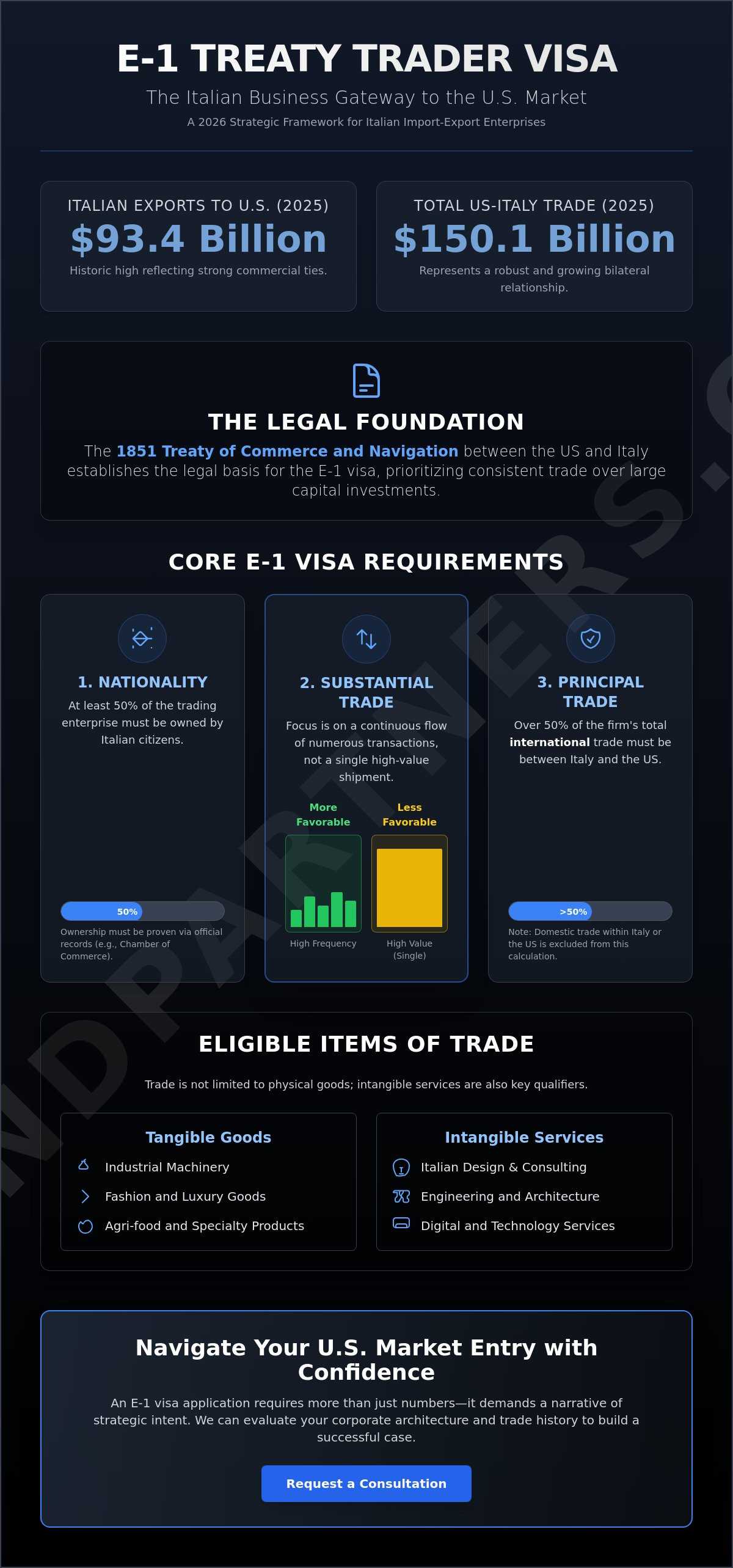
Italian exports to the United States reached a historic $93.4 billion in 2025, yet many firms still struggle to translate this commercial success into a secure legal presence. Meeting the E-1 visa requirements for Italian import export business often feels like solving a complex architectural puzzle where the pieces of substantial trade aren't clearly defined by a simple dollar amount. You've likely felt the frustration of documenting a continuous flow of goods while wondering if your specific volume satisfies the rigorous scrutiny of the U.S. Embassy in Rome.
We understand that a successful application requires more than just numbers; it demands a narrative of professional precision and strategic intent. This guide provides your roadmap for 2026. We'll examine the nuances of the 50% principal trade rule and the technical requirements of the DS-156E, providing you with the visionary framework needed to expand your reach into the American market with confidence and grace.
Key Takeaways
Understand how the 1851 Treaty of Commerce and Navigation establishes the legal foundation for Italian firms to claim Treaty Trader status.
Master the E-1 visa requirements for Italian import export business by prioritizing a consistent frequency of transactions over a single monetary threshold.
Learn the technical parameters of the 51% rule to ensure your international trade volume remains correctly aligned with US-Italy treaty mandates.
Discover how to qualify using intangible trade, including Italian design, engineering, and digital services, beyond traditional physical goods.
Explore the strategic synergy between US corporate architecture and real estate acquisitions to facilitate a seamless transition into the American market.
Table of Contents
The Legal Foundation: The US-Italy Treaty of Commerce and Navigation
The E-1 Treaty Trader Visa is a non-immigrant classification for citizens of countries with which the United States maintains a treaty of commerce. It's grounded in the 1851 Treaty of Commerce and Navigation between the US and Italy, a historical pact that remains the cornerstone for modern trade relations. For many Italian firms, this visa is the premier choice because it prioritizes the consistent movement of goods and services rather than a massive upfront capital investment. Understanding the E-1 visa requirements for Italian import export business begins with this treaty, which ensures that qualified traders can operate within the US market with high degrees of flexibility.
Determining Nationality of the Enterprise
Establishing the nationality of your business is the first mandatory step in the application process. US law requires that at least 50% of the trading enterprise be owned by Italian citizens who aren't currently residing in the US as permanent residents. In 2026, transparency is paramount. You must document this ownership through detailed Italian Chamber of Commerce records. Consular officers now look beyond surface-level shareholders to identify the Ultimate Beneficial Owner. If your corporate structure involves holding companies or complex layers, providing clear, verifiable evidence of Italian control is essential for success. You can contact our team to evaluate your current corporate architecture against these requirements.
The Italian Advantage in 2026 Trade Relations
The commercial bond between Italy and the US is stronger than ever. In 2025, trade volume reached $150.1 billion, reflecting a robust appetite for Italian excellence. Italian firms often receive prioritized consideration in specific sectors because these industries form the backbone of the bilateral trade relationship:
Industrial Machinery: A consistent leader in export volume that demonstrates long-term commitment.
Fashion and Design: High-frequency shipments that easily fulfill the requirement for substantial trade.
Agri-food: Specialized products with established US distribution networks and high consumer demand.
For Small and Medium-sized Enterprises, the E-1 visa offers a strategic bridge. It allows these agile firms to establish a physical presence in the US without the heavy financial burdens associated with other visa types. This focus on trade frequency rather than just volume makes the E-1 visa requirements for Italian import export business uniquely accessible to specialized producers and boutique exporters who maintain steady, high-frequency shipments.
Proving 'Substantial Trade' for Italian Import-Export Firms
The logic of the U.S. Embassy in Rome doesn't hinge on a single high-value shipment that might represent a one-off event. Instead, the official E-1 visa qualifications emphasize a pattern of commercial activity that is both significant and ongoing. Substantial trade in 2026 focuses on the number of individual transactions and the historical consistency of the trade relationship. For firms navigating the E-1 visa requirements for Italian import export business, the primary goal is to demonstrate that the trade isn't just a byproduct of a single contract, but the core purpose of the enterprise's existence. This requires a shift from viewing trade as a balance sheet item to presenting it as a rhythmic, documented flow of commerce.
The Frequency vs. Value Debate
Consular officers often find numerous small transactions more compelling than a single million-dollar container. This frequency proves that the business is operational rather than speculative. To satisfy 2026 standards, we typically recommend presenting a trade history covering at least the most recent calendar year. If your firm represents multiple small Italian suppliers, your application narrative should synthesize these relationships into a unified flow of 'Made in Italy' excellence. This shows how your entity serves as the vital conduit for these goods. You don't need a massive initial capital outlay, but you do need a stack of invoices that proves you're actively moving products across the Atlantic.
Documenting the 51% Requirement
The 'Principal Trade' requirement is a non-negotiable threshold. Over half of your company's total international trade volume must occur between the United States and Italy. This calculation is strictly based on international trade; domestic sales within Italy or within the US are excluded from the denominator. A common mistake is failing to separate these figures correctly in the initial application, which often triggers a Request for Evidence (RFE). In 2026, we utilize digital audit logs and automated shipping manifests to provide irrefutable proof of the trade's destination. These logs track the journey of goods from Italian ports to US warehouses, leaving no room for ambiguity regarding the trade's origin or destination. If you're unsure how your current ledger aligns with these standards, a professional review of your trade logs can identify potential gaps before your official submission. Accuracy at this stage isn't just about compliance; it's about building a foundation of professional trust with the reviewing officer.
Eligible Items of Trade: From Luxury Goods to Digital Services
The traditional image of a treaty trader often involves shipping containers filled with physical commodities, yet the modern definition of commerce is far more expansive. To meet the E-1 visa requirements for Italian import export business, you must demonstrate the exchange of "items of trade," which now includes services, technology, and intellectual property. Italy's export narrative is evolving. While the physical exchange of luxury fashion and industrial components remains a pillar of the transatlantic relationship, the 2026 regulatory environment increasingly recognizes the value of intangible assets. This shift allows Italian creative studios, software houses, and engineering firms to leverage their intellectual capital as a valid basis for US residency.
Traditional Italian Goods and Logistics
Physical goods still account for a significant portion of the $93.4 billion in Italian imports to the US recorded in 2025. For exporters of fashion, which saw a 2.4% increase in export value last year, the challenge lies in documenting the entire supply chain. You must provide a clear trail from the Italian manufacturing facility to the US distribution point. In 2026, shipping and tariff regulations require more granular data. Consular officers look for consistent bills of lading and customs clearances that prove a "continuous flow" of goods. For the food and beverage sector, this documentation must also align with FDA compliance, ensuring that the trade is not only substantial but also legally permissible under US health standards.
The Rise of Service-Based E-1 Visas
Can an Italian software firm or design boutique qualify for an E-1 visa? The answer is a definitive yes. Trade in services is a rapidly growing category where the "item" being traded is expertise rather than a pallet of goods. Proving the international transfer of services requires a different evidentiary approach, focusing on service contracts, proof of payment for deliverables, and the consistent cross-border exchange of data or consulting hours. Intellectual property, such as patented engineering designs or licensed software, now serves as a primary trade item.
In many cases, the complexity of these high-value service exchanges necessitates robust legal support. Managing the risks associated with cross-border service agreements often involves international litigation strategies to protect intellectual property rights. When these legal services are integrated into your business model, they reinforce the professional nature of your trade. Whether you're exporting pharmaceutical innovations, which surged by 54% in 2025, or providing high-end architectural consulting, your ability to document the value and frequency of these services is central to satisfying the E-1 visa requirements for Italian import export business. This holistic view of trade ensures that Italian innovation, in all its forms, finds a legitimate path to the American market.
The E-1 Application Roadmap: A Strategic Framework
The transition from identifying trade items to securing legal residency requires a disciplined procedural approach. The DS-156E form is the cornerstone of the E-1 application, requiring meticulous detail on the enterprise's financial health. It's not enough to simply list transactions; you must synthesize them into a coherent financial narrative that demonstrates the enterprise's viability and its capacity to support the trader. While the E-1 visa requirements for Italian import export business don't strictly mandate a formal business plan, a strategic 2026 Business Plan serves as a powerful instrument to prove future trade sustainability to consular officers who prioritize long-term economic engagement. This document provides the intellectual framework that connects your past trade volume to your future market expansion goals.
Essential Employees and Italian Talent
The roadmap often extends beyond the company owner to include the skilled professionals who drive the trade. While the Principal application focuses on ownership, the Essential Employee application centers on an individual's specific contributions to the trade flow. These managers or specialists must possess Italian nationality. Proving the "essential" nature of an employee's skills involves documenting their specialized knowledge of Italian manufacturing or unique market insights. In some cases, firms manage the transition from an O-1 visa for extraordinary ability to an E-1 structure to ensure long-term operational continuity. This shift requires a precise alignment of the individual's talent with the specific needs of the transatlantic trade flow.
Navigating the Consular Interview in Italy
All E-visa applications for Italian citizens are centralized at the U.S. Embassy in Rome. The process begins with an electronic submission to the dedicated Rome E-visa unit, followed by a prescreening phase that typically takes approximately three weeks from the receipt of a complete package. In 2026, we recommend initiating this process at least six months before your intended travel date. During the interview, expect pointed questions regarding the trade rules and the historical consistency of your shipments. You'll need to account for the $315 application fee and a $198 reciprocity fee upon issuance. Success depends on your ability to articulate the strategic value of your trade with professional confidence.
If you're ready to begin your submission, book a strategic consultation to ensure your documentation meets the rigorous standards of the U.S. Embassy in Rome.
Integrating Corporate Architecture with E-1 Success
Solidifying a transatlantic presence requires a corporate structure that mirrors the sophistication of your trade operations. Establishing a US-based LLC or Corporation is the most effective method to facilitate high-frequency commerce while providing a local operational hub. Tosolini, Toniutti & Partners specializes in translating the legal framework of an Italian limited liability company into a compatible American entity. We ensure your corporate architecture remains aligned with the E-1 visa requirements for Italian import export business by strictly maintaining the 50% Italian ownership threshold. This structural alignment is paramount to protecting your status during future audits or renewals.
LLC Incorporation for Italian Traders
Incorporating a US subsidiary involves more than just filing paperwork; it's about optimizing your fiscal footprint. In 2026, navigating the US-Italy double taxation treaty requires a precise understanding of how dividends and profits move between jurisdictions. For many enterprises, partnering with CiDATax SRL provides the necessary tax and regulatory oversight to manage these transatlantic financial flows with confidence. A well-designed LLC allows you to manage US logistics, from warehousing to local distribution, with the same engineering precision you apply to your Italian production lines. Integrating your E-1 trade requirements with US real estate acquisitions can further strengthen your application. Owning a physical logistics hub provides tangible evidence of your permanent commercial intent, transforming a series of shipments into a rooted American enterprise.
Long-Term Strategic Planning
The E-1 visa serves as a dynamic foundation for long-term growth. As your US operations scale from a distribution point to a multi-employee organization, your corporate strategy must evolve accordingly. Many successful traders view this classification as a precursor to permanent residency. Understanding how much a Green Card costs and the associated strategy allows you to plan your corporate trajectory with a five-year vision. This holistic approach ensures your immediate E-1 visa requirements for Italian import export business are met while preparing the entity for eventual immigrant pathways.
Expansion into the American market is a visionary endeavor that rewards professional foresight. If you're ready to design a corporate structure that facilitates your export goals, contact our team for a tailored E-1 consultation. We believe in the power of strategic dialogue to turn your commercial ambitions into a sustainable American reality.
Navigating Your Path to American Market Expansion
The 1851 Treaty of Commerce and Navigation remains a powerful gateway for Italian innovation. By focusing on the consistency of your trade flow and establishing a resilient corporate structure, you transform a complex legal process into a strategic asset. We've examined how substantiality is defined by the rhythm of your shipments and how a well-integrated US entity secures your professional standing. Mastering the E-1 visa requirements for Italian import export business is the first step toward a permanent presence in the world's most dynamic market.
Our firm provides bilingual legal support and specialized expertise in Italian SME expansion. We bridge the gap between European corporate models and American requirements with technical precision. Secure your US-Italy business future with a professional E-1 consultation. Your transition to the US market is a visionary move; we ensure the foundation is built to last.
Frequently Asked Questions
What is the minimum dollar amount of trade required for an E-1 visa?
There is no legally mandated minimum dollar amount for an E-1 visa. Instead, the focus remains on the "substantiality" of trade, which is determined by the volume and frequency of transactions. A continuous flow of numerous smaller shipments often carries more weight than a single high-value transaction, as it proves an established, ongoing commercial relationship rather than a speculative venture.
Can an Italian citizen living in the US on another visa switch to E-1 status?
Italian citizens already in the United States on a different non-immigrant visa can apply for a change of status to E-1 through USCIS. However, this only grants legal status within the country and doesn't provide a visa stamp for international travel. Most applicants find it more strategically sound to apply directly at the U.S. Embassy in Rome to secure a travel-ready visa for future entries.
How long is the E-1 visa valid for Italian citizens in 2026?
E-1 visas for Italian nationals are typically issued for a maximum period of five years. This duration is based on the long-standing reciprocity agreement between the United States and Italy. As long as the business continues to meet the E-1 visa requirements for Italian import export business, the visa can be renewed indefinitely in five-year increments, allowing for long-term market cultivation.
Does the E-1 visa allow my spouse and children to live and work in the US?
The E-1 visa allows your spouse and unmarried children under 21 to reside in the United States as dependents. Spouses are granted work authorization incident to their status, meaning they can seek employment without applying for a separate work permit document. Children are permitted to attend school and university but aren't authorized to seek employment under this specific derivative classification.
Can a service-based business, like an Italian design firm, qualify for an E-1 visa?
Italian design firms, software houses, and engineering consultancies can absolutely qualify for E-1 status. The definition of trade includes the international exchange of services and technology. In these cases, you must document the trade through service contracts, proof of cross-border payments, and the consistent delivery of intellectual property or expertise to US-based clients over a sustained period.
What happens if my trade volume drops below the 51% requirement during the visa period?
Maintaining the 51% principal trade requirement is essential for staying in legal status. This is a core component of the E-1 visa requirements for Italian import export business, and failing to meet it can lead to a denial during the renewal process. If your US-Italy trade volume falls below this threshold, the entity may no longer qualify as a valid Treaty Trader enterprise.
Do I need to have a physical office in the US before applying for the E-1 visa?
While the regulations don't explicitly demand a specific square footage, having a physical office or warehouse in the US is a practical necessity. It serves as proof that the business is a real, operating enterprise rather than a passive entity. Proving you have the infrastructure to manage the flow of goods or services is a key part of demonstrating your commercial commitment.
Is the E-1 visa a direct path to a US Green Card?
The E-1 visa is a non-immigrant classification and doesn't provide a direct, automatic path to a Green Card. However, it allows you to establish the commercial foundation and professional presence necessary to pursue immigrant pathways later. Many traders eventually transition to permanent residency through employment-based categories like EB-2 or EB-3 once their US operations have achieved sufficient scale and stability.


Comments